
Ep #43: How to Win at the Game of Entrepreneurship
By celebrating your business's success journey, you are able to employ strategy for the long term. Value-based and solution-oriented businesses are built upon your ability to transform and hold a clear vision.

Episode Summary
Jenna shares the importance of leveraging the long game as an entrepreneur, while expanding on tools for success.
Join us in the Clarity Accelerator by scheduling a call here.
Enjoy the show? Leave a review to help other like-minded entrepreneurs gain clarity in their businesses.
If you'd like to talk about working together, book a call here.
Show Notes
Every business unveils new layers of clarity as it grows and changes. This is part of the game as an entrepreneur. Our businesses are nuanced, ever changing, and have shifting needs.
By celebrating your business's success journey, you are able to employ strategy for the long term. Value-based and solution-oriented businesses are built upon your ability to transform and hold a clear vision.
This week, I break down what being an entrepreneur is all about and why creating a long game strategy is integral to building a strong business. Learn why specific support, powerful community, and playing for the long haul creates results. Discover how to create radical wins for you and your business.
What You’ll Learn From This Episode:
What the difference is between tactics and strategy.
The definition of being an entrepreneur.
Why your coach is a business expense.
How to find the right coach.
Why the right community can change everything.
Listen to the Full Episode:
Featured on the Show:
If you'd like to talk about working together, book a call here.
Click here to sign up for my newsletter and find out how the Connect The Dots Method has helped clients in all stages of their business.
Follow me on Instagram for behind-the-scenes content and daily value bombs!
Click here to learn more about the Clarity Accelerator
Episode 113. of the How I Got Hired Podcast: Jenna Harrison: From Nude Beaches to Business Coaching: Her Uncommon Career Journey
Ep #30: Creating Exponential Change in Your Business with Ale Garnica
Full Episode Transcript:
Are you focused on a specific problem or obstacle in your business and you know if you can just reach that place or master that skill or overcome that hurdle, then you'll finally be good, or at least a lot better, and you can enjoy success? Well, that might just be the very mindset that keeps you from experiencing the success that you crave and slows down your success journey. So, let's dive into that brain twister.
You're listening to The Uncommon Way Business and Life Coaching Podcast, the only podcast that helps you unlock your next level in business and life by prioritizing your clarity and your own Uncommon Way. You will learn to maximize your mindset, mission, messaging, and strategy in order to create a true legacy. Here's your host, top-ranked business coach, and reformed over-analyzer turned queen of clarity, Jenna Harrison.
Hello, and welcome back to The Uncommon Way. I'm so happy to be here with you. I have been guesting on other podcasts and I gotta say it feels different because I'm not talking to you, I'm talking to other people. Right?
But there's one that I wanted to tell you about because I just had so much fun with this host. It's called How I Got Hired, we'll link to it in the show notes. We ended up talking all about my career journey before I started this business, and so I thought it would be fun for some of you to listen to that very, very winding road and that trajectory. So, if you're interested, go check that out.
I was talking to my husband, Ben, the other day, and we get into these conversations where we really start kind of comparing and contrasting how entrepreneurship, and/or coaching, is similar or different than being a soldier, than his military career. There are a lot of interesting parallels. One that was coming up, the last time we talked, was kind of a conversation about tactics versus strategy.
And when you think about tactics, from a military point of view, it's sort of like, okay, we are going to go take that hill. How are we going to take that hill? But when you think about strategy, it's much more long term. For instance, what is our strategy with China? It's not about taking one hill, or accomplishing one small goal, it's really about kind of a very dynamic, ever-changing situation that will involve decades and decades.
I mean, look at Russia, as another example. The Soviet Union may have fallen, but our strategy with Russia continues. When you're thinking about strategy, it's not something that ever ends. There is no end state, you're always looking at the long game.
And I was thinking how much that can apply to entrepreneurship, as well. Because we often get caught thinking, “Well, if I just accomplish this next thing, or I'm just working on building this one skill, and then I'll be good.” But in reality, entrepreneurship is always morphing and changing. Markets are changing. Mores are changing. Ways of doing business are changing. You are changing.
We should delight in this. I mean, we are creating businesses for life. And how boring would it be if we just repeated the same thing over and over and over? And so, this really is how we win at the game of entrepreneurship; we take the long view. That lets us detach from so much emotion in the short term, and it helps us be so much more clearheaded and methodical about what we're building.
So, we're not resisting what is, we're not surprised by obstacles, we're not stopping and starting. Instead, it's the steady march towards mastery. Especially if you think of our souls as here on this earth in order to evolve and in order to learn more and more, then as frustrating as it might feel, the obstacles that we encounter are part of the game.
And there's a part of us, maybe our higher selves out in the ether or some part inside us in our brain, that actually delights in the hero's journey, in the ups and downs, in the fact that we don't have this straight shot, linear progression from where we are to where we want to go.
Humans have always been attracted to this. Of the myths that have survived through millennia, the Mesopotamian myths, they all had this arc of tribulation and then final catharsis and resolution. We are in the middle of this right now, and entrepreneurship is our chosen path.
And when we commit to ever increasing mastery, rather than just trying to put out brush fires, what we do is we enter into the dance of life, not to mention, on the human plane we start taking ourselves seriously. Doctors spend years on their education, and then a lifetime increasing their professional acumen.
Career soldiers do, too. So do so many other professions. Any profession, as a matter of fact, that self-evaluates as a profession rather than a job. And I don't think entrepreneurship should be any different. If you feel more comfortable thinking about your profession, in terms of a coach or a designer, that's fine.
But what goes hand in hand with that is being able to get your message out to the world to help your people find you. And to help create change for them. These are entrepreneurial skills. So, let's see what this looks like in terms of businesses that we can relate to.
I have a client that is stepping up into a new way of doing business, helping her clients on a much, much deeper level, a much broader level. But what that means, as she does that, is that she can't do it all for them anymore, because she's helping them create such a massive transformation. So, it's a whole new ballgame now.
There might have been an older part of her that thought, “Oh, if I can just start doing this, if I could just start selling this offer, then I'll be good.” But it turns out, it's now opened up so many new areas of learning for her, she is in effect learning to coach her clients. And then, needs to develop the whole body of thoughts that coaches have about their clients and their clients results. And in order to help at this level, she also has to bring on new team members, and on and on and on.
Or maybe what's happening is you start to think, “Well, if I could just reach this level,” like a financial goal. I have a client working on creating a 10K day, right now. But the energy for that will be completely different, once we've accomplished that, and then we want to move on to repeated 10K days.
How do I maintain, as my nervous system is starting to freak out and be like, wait a minute, this is actually happening? I'm actually bringing in this money? Is this right for me to be bringing in this money? Is this too much? Will I be able to sustain it? Was that just a fluke? How do I make it my new baseline? It's completely different than creating one 10K day.
Or maybe you'll say, “Well, I've built my business marketing to these types of people, this offer, but now I'm feeling my soul and it's evolving in this different area. I'm just compelled to move in that direction. But now it's like, how do I call them in?”
So, you see why I say clarity is an evolution? That there's always a next level and a next level. And right now, as I'm talking through all this, just take a read on your body. Does it feel like deflated? Will it ever end? Does it feel like a slog? If so, just take a deep breath. That's okay.
It's the natural tendency for our brains to want things to be easy, to want the problems to be over, to want things to be done. It's human biology, but it's also the way we've been trained. Because of modern society we want things fast and quick. And it's harder and harder for our brains to be available for dedication and ongoing effort in the pursuit of mastery.
I thought this was so interesting: I was listening to a parenting podcast and there was a guest, she was talking about how difficult it was to go out to dinner with her children because they would disturb the peace in the restaurant. And the coach was asking her, “Do you remember how you were when you were a child?” And she said, “Yeah, my brother and I we would just color or we’d just sit there quietly, and we'd be really grateful for our spaghetti.”
The coach brought up a really great point. She was saying that yes, now there's so much quick stimulation. Children are so accustomed to okay, now we're going to soccer practice. Now we are getting on the screen, and we have playdates and we're constantly filling our time and being entertained.
And so, to sit at a table, it's very difficult for the brain to accustom to what seems like boredom. Whereas back in the day, we didn't necessarily get all that stimulation. And so, going out to dinner was actually kind of a big deal. Right? We'd be looking around at all the different people. We'd be looking at the fun menu. We'd get crayons and something to color on. We just have to take a beat and realize we are all part of this. And so, nothing's gone wrong if we feel like we'd rather just have some quick hits.
But you don't have to associate this longer-term vision, this march towards mastery, with slog. That is just story that we pile on top. Right? It could also be super fulfilling. It could even be invigorating, in the way that it is calling you to step up to something greater.
I mean, think about all of the ‘ships’, scholarship, leadership. I looked up the meaning of that suffix, and it said, “condition, character, skill”. So, what you're doing when you step into this, is you're cultivating the identity of an entrepreneur, right? We are entrepreneurs, we don't start and stop, right?
We lean into our edge. We take this seriously, with joy and passion. We don't groan about the fact that we have to do all this stuff. We delight that we get to do these things, that we get to learn these things, that we get live this way. We wouldn't want to be anything but entrepreneurs.
So, your feeling of success, your experience of success, comes not from results but from how you show up, and how you choose to think about your experience as you're in the experience of it.
I'll tell you three of the most impactful things that I've ever learned in this game of entrepreneurship. One was, a seven-figure business owner just posing this one question to me: What if you never feel like selling is easy? And that just blew my mind. I had just always taken it for granted that someday, something would click, everything would be figured out. And it would never feel challenging to sell. It would just be this thing that was on autopilot, that I just did over and over and over.
And instead of making it feel difficult, when I realized that may never be the case, that there may always be challenge there, I felt a lot of relief. I was just like, “Oh, thank goodness. There's nothing wrong with me. This is just part of the game and part of the challenge and part of the fun.”
Another one was when I first hit some of my 10K months. I think I'd hit maybe two 10K months. The mastermind that I was in was coming to an end, and I was like, “Okay, peace. I'm done. I got where I needed to go. I'll be fine with just the small business and this quiet life.”
My son was really young, I think he was maybe two or something at the time, maybe less than one. Anyway, you don't care about the details. But anyway, I was feeling still in the new mom stage and I just didn't even envision a large business for myself at that moment.
So, I was like, “I'm good.” And I remember my coach at the time telling me, “Jen, you're just beginning. You're just beginning, not only in terms of the fact that you will want to grow beyond six figures. But also, because it's one thing to have one or two 10K months, it's another to start hitting that consistently and to make that a baseline. You really don't want to step away now, you really want to stay in it.”
I am so grateful for her, because now as a coach, I know that that's a difficult conversation to have with a client. Right? There's a natural human tendency to think that your coach just wants to get paid, wants to keep working with you. But the truth is, you just don't know what you don't know. And I had no idea. I thought the game was over. I thought I'd won. And I had not, by far.
I'm really grateful that I did, again, sign on for… It wasn't six months. It was a year when I was working with that coach. I signed on for another year. So, so grateful I did. At the time, I couldn't even envision though what I would be working on. But I built enough trust with her that I could really take that to heart when she said that.
Okay, the third thing, same coach actually, at a different time though. She was talking about how she considers her expenditures on her own coaching, not as an investment but as an operating expense. And that that is just what she does. That's just the cost of doing business for her. She won't ever stop working with her coaches, and/or a coach. She won't ever stop having business, either.
And that also blew my mind, because I think when I was starting out, I thought of a coach as someone who would help me accelerate my timeline and get me to the level that I wanted to be at, and then I would be done. Again, I've experienced this myself, which is why I can see it in others now.
It really helped me step up to a level of seriousness as a business owner. Not just… And it's so interesting now as I'm saying this, that I use the word “just” because I don't think of it this way anymore, but I definitely did then. And it was “just” a woman who has a business.
Wow, even as I'm talking this through, it really makes no sense to say it out loud. But in my mind, it wasn't a business owner, it was a woman that was happening to earn some money doing her own hustle, her own gig, having her own company. But it wasn't a business owner.
So, when I started thinking of this as part of my operating expense, I just had a completely different self-concept. One example I like to give is of Serena Williams or Michael Jordan, a pro athlete. Athletes don't say, “Okay, I'm going to hire a coach to help me win this tournament, and then I'll be good. I'm done.” Right? They continue to work. They continue to push the limits and see how far they can go.
Or executives, they don't think, “I'll hire this coach to support me through this merger and acquisition phase, and then I'm good.” No, they have a coach who knows them, with whom they’ve built trust, and has helped them create results. And will continue to help them imagine and then step into greater heights.
What we're seeing there is that these high performers, they aren't focused on the short-term problem. They're not starting and stopping. They're not waiting for the next problem to come up before they get the support. They have the ongoing support because they value themselves in that way, and they value where they're going enough. They're not questioning if they deserve a coach.
And they're not letting themselves be run by FOMO, and maybe hopscotching around from trying this to trying this. They may have something that they bring on in tandem. Maybe Serena brings on a coach just to help with her swing, or something. But that's an addition, not a switch.
We did a podcast on this with my client, Ale. It's called “Creating Exponential Results”. We're just talking there about how things start to multiply as you work longer and longer with support, and how everything starts to build upon itself, your results really start to multiply.
I had my first coach for three years, and then I only stopped working with her because she stopped taking on clients; she went to Evergreen. I have now been in the thought work community for three years. So, I'm not just saying this, I actually believe in it, have practiced it, and attribute my success to it.
So, the most important thing that you can do now for your business is to find your home base, right? You want to look for a few key things. One is trust. No ifs, ands, or buts, you have to trust the coach, trust the mentor, trust the process, whatever it is. You want to be able to speak candidly to this person. And you want to feel safe with that person, so that you can receive the guidance that you're paying for.
And next, you want it to be values aligned. You want it to be a system or a process that you can believe in. And something you actually like; you don't want to be fitting a square peg into a round hole.
Number three, this is a big one for me. But you want to look for something that's holistic. Just like when I'm talking to Ben about national strategy, long term, you're not just thinking about the military, that is one small tool. You're thinking about diplomacy. You're thinking about allied partnerships. You're thinking about the commercial sector, on and on, right? And that's the same when you are thinking about your business long term.
Personally, I have felt really hamstrung sometimes in certain communities where they have a certain way of doing things or thinking about things. Maybe it's thought work, and I have a question that comes up that's really much more about energetics. Or I'm in a container that's all mindset, but then I have something that's very tactical. Or I really want to get clear on my copy, for instance, and I just can't do that in that environment, because it's not meant for that.
But you want to put yourself somewhere where nothing is off the table. So, I often say, “I wish that people could start with coaches and then go purchase courses to kind of fill in the gaps.” That's usually not how it works, because we tend to kind of dip our toes in with our investments and start small and then build up.
But really, you can't underestimate the value of a generalist. Now, those are hard to find, right? Because in marketing speak, it's easier to be the hashtag lady or the copy guru. But really, it makes sense that you need the total picture. Someone who can say, “Yep, this is definitely a mindset problem. Okay, now you actually need to be working on this thing. You need this skill. Now it's time to introduce this new tactic.”
So few people do that. It has taken me six years to find a coach that I can really work with, in that way. I've always said that I would love to find a coach who can work with me holistically the way that I work with my clients. We can get down and dirty with copy, and then the next conversation, it's all about energetics.
I need exactly what I give my clients. I need someone who can be that outside objective coach, so that I can also see the things that I can't see when I'm in my own brain, or in my own habits, in my own way of doing things. So, I'm really grateful that I found that for myself.
And the last thing that is critical is community. Finding a community that really support you. Where everyone has each other's best interests at heart. Where people are willing to just hop on the phone call with each other and hash out some idea, or mentor each other through some situation. And being exposed to women who are also highly driven and who are normalized in success.
That is something that I started doing for myself very, very early on in my business. I got myself into those rooms, because you learn so much just by absorbing. And it's such an easy way to learn, because you don't even actively have to do anything. Just being in the room with people who are talking about this, that's one of the effective ways to use our brain’s biology to our advantage. That's one way to let it be very, very easy.
So, back to this long view versus short-term focus. Let me shed a light on what's going on here that is so, so, so powerful. What's happening is when you do that, you're orienting your brain away from the problem and towards the solution.
Instead of “When will I get over this problem of (fill in the blank), imposter syndrome, converting on my sales calls, figuring out who my people really are?” Instead of that problem, you're focused on the 180: How can I create more and more value for my clients? How do we create messaging that resonates so profoundly that when I speak with people, it's a no-brainer connection?
How can I get to know my secret sauce and my mission so unequivocally, and believe my own rightness for this work and these people so profoundly, and be willing to follow my inner calling so devotedly, that the people I'm working with become the obvious reflection of all that self-knowledge?
I can't not work with them. Seriously you all, I can't overstate the importance of this shift. It seems so simple that your brain might just sail right past it. And it might get back to its routine business of spotting problems and reactively solving for problems. That is how we're wired. And that's how we're taught.
But choose to really hear this right now: We've got to become solution oriented, rather than problem oriented. That's manifestation 101, by the way. But it's also Performance Coaching 101, we create what we focus on. And that is so much easier when you take the long-term perspective.
Now, it's a bit of a mental pretzel, because we want to have the skill of evaluating the kinks in our business, and also the kinks in our clients’ lives and businesses, right? The ones that are impeding their results. You've heard me say entrepreneurship is about solving problems. And you've got to understand what problem you're really solving. But that's because people's brains are problem focused. So, you’ve got to speak to that.
But put another way, it's about creating solutions. And for so many of the women I work with, whose work is about transformation; you either help your clients or your clients’ businesses transform in some dramatic way. You're helping create a solution that they may not even immediately be seeking, and might not fully be able to wrap their heads around. Even when they say yes to working with you. They still have no idea what's in store for them.
As you become more aware and focused, keeping your eyes on that prize, staying a step ahead, the more you'll be able to help your clients create it. And the more you'll have a beeline of clients coming to your door.
So, summing up, how are you going to win at the game of entrepreneurship? You're going to stop focusing on trying to take “the hill”. And instead, you're going to get strategic. You'll take the long view, by loving your business for life, and the mastery that you will continue to develop in that business for life.
And from that place, you will take yourself seriously. Just like any pro athlete or top executive, you'll decide that where you're going is important enough that you're done DIY-ing it. You're done with interventions that just solve short term, specific small problems. Really, in the grand scheme of things, they're small problems. And you'll get serious about creating the conditions for yourself that make your dreams inevitable.
All right, my friends. That is it for today. I hope you have a wonderful week, and I can't wait to talk to you next time.
Hey, if you're a coach who wants true clarity about your secret sauce, your people, your best way of doing business, and how you talk about your offer, then I invite you to join us in the Clarity Accelerator. I'll teach you to connect all the dots, the dots that have always been there for you so that you can show up like you were born for exactly this. Come join us and supercharge every other tool or tactic you'll ever learn, from Facebook ads to manifestation. Just go to TheUncommonWay.com/schedule and set up a time to talk. I can't wait to be your coach.
Thanks for joining us here at The Uncommon Way. If you want more tips and resources for developing clarity in your business and life, including the Clarity First Strategy for growing and scaling your business, visit TheUncommonWay.com. See you next time.
Enjoy the Show?
Don’t miss an episode, follow the podcast on Spotify, Apple Podcasts, or Stitcher.

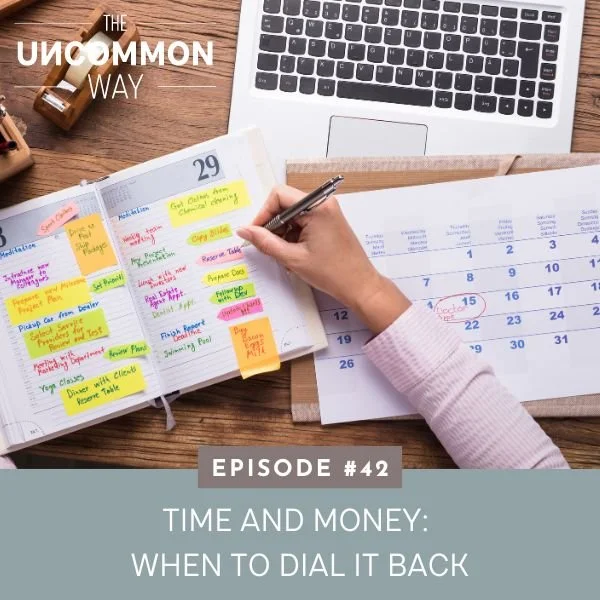
Ep #42: Time and Money: When to Dial It Back
Making money and building your business does not need to be hard. It is all about identifying your personal needs, business goals, revenue streams, and creating systems that work for you. By identifying our biases, we can ensure that our business planning comes from an authentic place.
Episode Summary
Jenna digs into the balance of time and money when deciding to reduce the earnings of your business. She offers examples of when, and when not, to dial back.
Join us in the Clarity Accelerator by scheduling a call here.
Enjoy the show? Leave a review to help other like-minded entrepreneurs gain clarity in their businesses.
If you'd like to talk about working together, book a call here.
Show Notes
Sometimes earning less can actually bring more into your life. However, our subconscious biases can prevent us from choosing business paths like this. When faced with this type of business decision, it is essential to find choice neutrality in order to act with clarity.
Making money and building your business does not need to be hard. It is all about identifying your personal needs, business goals, revenue streams, and creating systems that work for you. By identifying our biases, we can ensure that our business planning comes from an authentic place.
This week, I take a close look at the nuances of your business finances. I discuss moments in my life when I chose to make less money as a strategy to make room for something else. I remind you that your time is temporary, and your long-term value is very different from short-term value. You can have the space, time, and energy to build a company that earns any amount of income you desire with strategy, skill-building, and alignment.
What You’ll Learn From This Episode:
● What the Time vs. Money equation is and how to use it.
● How to tap into the cerebral cortex.
● How to know when to dial back your business.
● How to identify skills that allow you to work less and make more.
● What creates money.
● The benefit of working with a coach to identify time use.
Listen to the Full Episode:
Featured on the Show:
If you'd like to talk about working together, book a call here.
Click here to sign up for my newsletter and find out how the Connect The Dots Method has helped clients in all stages of their business.
Follow me on Instagram for behind-the-scenes content and daily value bombs!
Ep #32: Should I Say Yes Or Should I Say No? (Tapping Into Intuition)
Full Episode Transcript:
Are you feeling a tension between, on the one hand really wanting to dial up your business and lean in and go after those big numbers that you know deep down you have the potential of creating? And on the other, this longing that is telling you to just slow down the pace, dial it back?
Maybe because you want to create more intentionality around all the many different aspects of your life. Maybe right now you're at a decision point where you're really thinking through your next immediate goal, or you're really wanting to vision into the future of exactly what kind of business do I even want to create? If so, this episode is for you.
You're listening to The Uncommon Way Business and Life Coaching Podcast, the only podcast that helps you unlock your next level in business and life by prioritizing your clarity and your own Uncommon Way. You will learn to maximize your mindset, mission, messaging, and strategy in order to create a true legacy. Here's your host, top-ranked business coach, and reformed over-analyzer turned queen of clarity, Jenna Harrison.
Hello, everyone, welcome back to The Uncommon Way. I’m so happy to be here with you, and have you here with me. I've got to tell you, I mentioned on an earlier episode that I have been working with a pleasure and sex coach. And it has been so fun, in kind of a self-deprecating way. Because it just amazes me how you can do all the work and then you transfer something to a new area of your life, and it's like that all goes out the window.
I remember I was talking with her about a plan going forward. And afterwards I had sent her an email, and I realized everything in it was about my actions and none of it had to do with my thoughts or my feelings or how I was being in that moment. I realized it afterwards, and then that was the exact coaching she gave me.
If you are feeling that as well, in any aspect, maybe you are a coach and now you're just in your business, all up in your action line or thinking that you are kind of taking a couple steps backwards, I just want to say I'm here with you.
It's amazing to see our brains and how quickly they can kind of go back into all of the training that we've received our whole lives, that are actually counter to what we know to be true now on a more intellectual level. So, just today, we had a Clarity Collective call. And one of the clients there was talking about how we were talking about receiving; that was the workshop we were doing; being able to receive.
She was saying how sometimes someone will come up to her, or a specific person, and say, “I'm so proud of you.” And yet, depending on the state she is in, she may receive that completely differently. Right? She may think that that person’s saying that just as a pick-me-up, or it's just sort of a platitude. Whereas, when she's really dropped in, in a different state, she just receives that so fully and knows that it's coming from complete love. Same person, same exact words, totally different experience.
So, that kind of ties into what we're talking about today. We're going to be talking about how to make decisions about your financial goals that actually serve you. And when I say you, I mean the total person; you and your business, and not just financial goals. But how you want to be in your business. And sometimes that is going to mean choosing to earn less than you could on purpose. How to really dial back your business on purpose.
That might mean working less, it might mean setting a lower goal, it could mean a lot of things. But it's really the opposite of what we are also programmed to do, which is go-go-go, bigger, bigger, higher, higher, faster, faster. Which, of course, I love on so many levels. But sometimes it's just not serving us in that moment. So, we will be talking about the time versus money equation.
We'll be reframing several of the most pervasive and unhelpful stories that cloud decision making around this topic. And I'm also going to share how I, and my clients too, really best move through grounded decisions in this realm and in every realm. We'll be talking about when to dial back your business, when you don't want to set a goal of dialing back your business, and then what ends up happening afterwards.
Now, this is a topic that I am very, very comfortable discussing with my clients. So, it makes me different, I know, than some business coaches. Because this business game is not all about the money. I know for so many of us, if it were just about the money, we would have stayed in corporate. And starting a business, it was really about something else.
Yes, yes, we know that there's the potential to earn even more than in corporate. But really, we knew that we would be creating something, our expression in the world, and achieving a lifestyle that we could really only dream about in corporate.
Throughout the course of my business, I have personally chosen to earn less, before, on purpose so I've definitely walked that talk. I'll tell you more about that later. I've counseled certain clients to earn less. I've really seen how that has played out for them, and when it works, and doesn't work.
So, before we go into it, just to clarify, I love money. I think it is a great for goal setting. It's a great reflection of your business acumen, your beliefs, your ability to receive. And it's really, really important for women to have more of it, and to feel comfortable earning more of it.
But it's not everything. It's a part of the whole. And I think it's also important, before we really move into the meat of this episode, is can we just reduce the charge around these topics a little bit? Let's take a deep breath here, and strategic pauses like these are critical. We've got to recognize how charged these topics are, money and time. Ooph, right?
They trigger all of our scarcity, which feels like panic in the body. And remember, a part of your brain believes that your survival is in jeopardy when you think about not having enough money or not having enough time. That is not truth. Right? But that's what it can feel like.
So, when you're thinking about your business and not earning enough, or will I earn enough? And how exhausting will it be to get there? And also, is that really the life I want to live? What does that mean about me? Would I be a better person if I did it another way? Am I self-sabotaging through this decision? And how will this affect my loved ones, now and down the road?
When you're thinking all of that, and you start to feel that nervous system activation, just remind yourself that you're reacting to deeply patterned stories, not reality. Most of us are not in the dire circumstances that our brain and body think in that moment. So, deep breath, right?
We want to think through these things with the part of our brains that have access to our highest reasoning and creativity. That's our cerebral cortex, of course. And our cerebral cortex gets accessed through calm, calculating, sufficient, grounded energy, right? We want to be there as we clean out all the gunk and stories that are getting in the way of our best decisions.
You've got to weed out your unconscious biases in order to make clean decisions. And you'll want to stay there, in order to get to a place of choice neutrality. So, I've talked about that on the podcast episode called, “Should I Say Yes or Should I Say No?” That is an episode on intuition, it talks more about this process. So, you're getting to choice neutrality. And then from there, you're diving deeper into your intuitive knowing or your guidance from your higher self, whatever you prefer to call it.
I think it's also really helpful to remember that these do not have to be lifelong decisions. You are the CEO of your life. Your decisions, therefore, span the time that you desire. We're always evolving, so you can build safety by saying, “I will reconsider this on such-and-such a date.” And just grounding into whatever you do or don't do, you'll be okay. Right? You're either winning or learning, so your past will always serve you if you let it.
Yeah, you know, the truth is, you might earn a little less money when you didn't need to earn less money, or it may take a little longer when it didn't need to have taken longer, but you'll live. We're okay.
Okay, let's talk about when to choose on purpose to dial back your business, maybe not to earn more. That might be if you're pivoting your business. Not always, but it is possible that as you change your niche or you change your offer or you change something, there will be a lag in momentum before you catch up to where you were. Or you'll plateau rather than grow.
Now again, I've had clients that have shifted their niches or completely changed their business, and because it has been so aligned for them, they have actually earned more rather than less. But as I talked about, in the is your business outgrown podcast, you always, if you are pivoting, you want to pivot from a place of, ‘I'm willing to do this, even though this is so right for me. That I'll do it, even if…’ as opposed to, ‘I'm pivoting so that I can make more.’
You might want to dial back when you know that that is your growth edge. Right? Maybe you are so conditioned with the hustle, and your own worthiness is so tied to how much you're earning or how hard you're working, that you realize this is becoming a problem for you.
And that was my story. At one point, I specifically decided to go off of social and just stop earning for a while, so I thought. That's not exactly what happened. But to kind of just continue with the clients that I had, maybe some referral business, and really focus on other parts of my life at the moment. And I figured out for myself, at least, that I didn't just want to theorize about detaching my sense of worthiness from this, I actually wanted to experience it.
I had experienced not earning money in the past, when I first got married and we were living overseas. And because, of course, my husband is a soldier and could work overseas, but I couldn't. And that felt wildly uncomfortable. But the whole time I was there, I really had just so much negative self-talk about what that meant about me to not be contributing my share or carrying my own weight or to be dependent on my spouse.
And so, even though I was experiencing that in my head, it wasn't the outcome of detachment that I wanted. I got to a point later, where I realized that I wanted to experience that again, and really dive in to unpacking all of that in the moment. So, not something that I would recommend to everyone necessarily, but something that you need to be okay with, decisions like these, as you're walking your own uncommon way.
If this is resonating, like you're feeling a little prick of, ‘maybe that's me,’ you might want to listen to the uncommon goals podcast that I did. Sometimes it talks about how what you know you really need to do to get to your next level does not look like a typical, logical business goal or a smart goal, in any way, shape, or form.
Again, you may choose not to grow when you're prioritizing a new thing in your business. Like, you are preparing to scale or you are really building out your team. I have a client right now, thinking through all of this.
We're just taking some time to really think into how beneficial it can actually be for her to give herself that mental space to build these new skills. And to create a business that can support her. A business that can support not just her but so many more clients, and set her up for the lifestyle that she wants in the future.
Usually when you're here, it looks more like keep doing what works, as you're building in these new things. But even though that's what we see from the outside, so often, to us it feels like we're dialing back; that is how we talk about it. If you look at all of your language, it's because you're not going after that next bigger goal, that means you're not doing anything at all. Which is not the case usually. It really means you're maintaining this foundation of stability, of what works, as you're layering on something new.
Another moment when this might be the right choice for you, is when you have something outside of business that you're prioritizing. Like, I choose to end my workday at three o'clock to be with my son. I have clients who have another business that they own, and that, combined with their lifestyle, just means that they're very comfortable having a pace that isn't there full out, let-me-just-knock-this-out-of-the-park pace. Right? And they're doing that on purpose, for the long game.
I have another client who doesn't want to work above a certain number of hours, and others who, I mean, life just gets in the way. I have a client right now who is expecting and just had a really, really terrible case of morning sickness. And when life happens, you want to get really clear on what are you making it mean about you?
What are you making it mean about business? Are you loving yourself into the decision? Or are you believing that you're a person who can't have personal events and a business; it has to be either/or? Are you making it mean that your business only happens and revenue only comes in when you are doing it and when you are making it happen?
That has certainly not been the case for me. Usually, when I'm on vacation is when I get the biggest influx of clients. But the really critical thing to understand when you're making this kind of decision, is that it is temporary. Right? So, the amount of time that you work does not determine the amount you can earn over time. Because time is not what creates money.
I know that's a brain teaser. Time does not create money. Effort does not create money. Your brain creates money through the value it creates the creativity you can access, the savvy that you can wield. Through its openness to receiving and receiving with ease, through your energetic alignment.
It may be that you're dialing back to, for instance, a fewer number of hours worked per week. But do not make the mistake of making that mean that that decision has anything to do with your long-term earning potential. That decision may have an effect on your short-term earning potential. Because you have the current brain that you have at this moment, that only knows how to create money in this way.
And so, when you're curtailing those efforts, or that routine that you've established, you may see different results. But over time, what you're learning to do is you're learning to create the value, even with the time constraint.
So, this is one of the biggest conversations I have with my clients, right? They perceive that they're making big lifestyle choices for the rest of their lives. They'll say, “I don't want to earn more than a six-figure business because I don't want to work that much. And that's just reflecting their deep belief that anything over six figures requires an inordinate amount of work. And then that skews all of their decisions.
They decide not to shoot for seven figures because they don't want to exhaust themselves. But that's like saying, “I don't want a latte because I don't like dairy.” Okay, so get a dairy-free latte. That's the problem. The only reason that curtailing your hours might equal less income right now, or curtailing your effort or whatever you're deciding to curtail, the reason that it might mean that right now, is because you haven't yet figured out or built the skills to support you earning more, while doing less.
And so, in entrepreneurship there usually is a time - money trade off, especially in the first years when you're figuring that out. And there are pros and cons with working more during that period, and working less during that period.
So, working more can be really amazing, right? It builds your capacity, and really helps you see what you're capable of. It helps you develop the discipline so that you can actually start focusing in and directing your brain.
It helps you build skills in a shorter period of time because you are doing more, and through repetition you're able to condense the time it takes you to do those things. It helps you manage your mind around the thoughts that, “This is hard. I can't do this. This is overwhelming. This is interfering with my life.” Because there's always the circumstance of what exactly is going on in your life, as if we were newspaper reporters taking an account, or maybe police officers taking an account of the facts.
But then, there are all the thoughts that your mind piles on top of that, that actually makes your experience so much worse. And when we can learn to write when we are experiencing it and we're really feeling it, that's when we can gain awareness and expose what was there and start doing the work to untangle all of those little ties that will only hold us back in the future.
But working less can be amazing, also. That can help you develop presence and prioritizing. It can create beautiful memories, obviously, with your family or with your travels, or it can help you celebrate on a new level. I think that's also an overlooked reason why some of us may choose to dial back our business temporarily. So often, we can do it unconsciously after we've reached a new level, we can plateau there, and we haven't quite adjusted to this new person.
So, why not do it intentionally? Why not celebrate periods of rest in our business, a seasonality in our business? And really thinking through like what are the effects of grounding into this new level? How will it serve me in the future?
If you've read Gay Hendricks book The Big Leap, he's a huge proponent of religious grounding. Taking that moment, or even longer than a moment, to really ground in to the pleasure and the expansiveness so that we can increase our muscle for receiving more.
So now, let's talk about when we wouldn't want to dial back. And everything I'm about to talk about is why I really recommend talking your decisions through, and your goals, until you become very adept at tuning into your own intuition with a very clean mind. You really want to talk it over with someone who is familiar with the ways that you tend to hold yourself back. Or that maybe entrepreneurs hold themselves back.
So, that could be a coach, a friend, mentor, a partner. Someone who can keep their personal biases out of it as much as possible, and really help you see your brain in a really objective light.
Because we're all living as if we're in the ocean of possibilities. And we can look around and we can see all of these potentials for ourselves. But what's really happening is that we are in a fishbowl, inside the ocean. So, it seems like we have all of these different choices we could make, but because of the way our beliefs are constructed, those things actually frame our decisions and our ideas.
If you believe that earning twice as much means working twice as hard, and you're already feeling at your limit, it might sound logical, and it might feel really right to you. Your ears might be really perking up right now, with the podcast, with everything I just said in the last section. You might have been like, “Yeah, that's a great reason to dial it back. That's a great reason to dial it back.”
But that little perk of excitement, it doesn't mean that it's the optimal path for you. Maybe doubling your rates would be the simplest solution, right? And that would help counteract this bias that you have that says that the only way you earn more is to work more. That's just one example, there are many ways.
But if someone has this core belief that you've got to work double as hard to earn double as much money, then you're not even going to consider the simple solution of doubling your rates. And when you're already feeling like you're at your limit, that just seems impossible. And so, your brain looks for any out that it can find. Any great logical reason not to go forward and lean into your business.
What I also see people doing is really reacting to an emotion of some sort, and they don't recognize it in the moment. I can only recognize this in others because I've done it myself. So, this happens to me all the time. I remember once I was really anxious to build out my group program, and so I wanted to move straight into that.
But that decision was based on me reacting to the feeling that I didn't like that my business was taking so long to build out and to scale. It wasn't because that was actually the right decision at the time. The right decision at the time was, which thankfully I got coached on, was actually to start building out my ideas about how this group program would go, and to practice group coaching, and to practice building this process before.
Again, not the right decision for everyone. You don't just want to plug-and-play someone else's. But for me, at that moment, that was the right thing. And when I was able to really get quiet and grounded into myself and listen to my higher self or my future self talking to me about this, I could see that so clearly.
I remember I had a client also, that had had a history of burnout in the past. And so, everything that we ever talked through was always couched in this idea that she might burn out again. The fear of that created so many decisions for her that were unconscious. And even with a smaller amount of work time, she would start to feel these feelings of overwhelm and of it being too much and believing that she didn't have the capacity to handle that.
When really, when you're in flow, the fact that you're doing something, it's not a problem. Those are the times where you could just work for 12 hours. Maybe not everyone works for 12 hours, but we've all experienced periods of flow, where you don't even realize the time has passed. And usually that's because you're doing something that you believe is not taxing to you.
I often like to think, “Okay, I have these 10 hours in a day. How do I want to fill them? Is it really more exhausting for me to sit at my desk than it is to sit in front of the TV watching Netflix,” for instance? No, if I weren't doing this right now, I'd be doing something else. And so, I'm choosing to do this. And I'm choosing not to focus on the fact that I've previously, in this day, already done six hours or eight hours of this. It doesn't matter.
I still can be in this moment thinking, “Oh, well, I might as well be here as anywhere else. Right? This is a great thing to do with my time.” And that's not just about slapping the happy sticker on it and ignoring your real feelings. It's about creating that emotional maturity and detachment, to not buy into the stories of yours, and to just look at and say, “Is that really true?”
Because so much of what we're doing or not doing comes from avoidance, avoiding the work of managing your brain, right? Avoiding maybe being visible; you don't want to be visible. Or you don't really want clients. Or maybe even not wanting to earn that much. Maybe there's stories there about what it means to be someone who earns that much. Maybe that makes you a bad mom. Or maybe you're just avoiding your capacity and greatness.
Thinking of yourself in that way, in the way that your inner visionary wants to see you, is actually threatening to a part of you. So naturally, a lot of time my clients are exactly the opposite. They default into doing, doing, doing, rather than into not doing; but not always. And sometimes we go back and forth. I know I do.
So okay, you've made the decision, you're actually dialing back your business, let's talk about what happens then. There are really two possibilities: One is that you earn less than you could have, but you gain in wisdom, in memories, in life satisfaction, if you're doing the work. If you're doing the work to really be mindful and really enjoy it. If you're doing the work to, for instance, if you were doing this because of a growth edge of yours, if you're really mining that experience for everything.
Just imagine how differently I am in my business now, versus a time when every little fluctuation in income, I took it as a direct report of my worth. And all the drama and ups and downs of that, and how that affected my ability to go forward. I can so clearly remember. Yeah, it was spring, and I was walking along the stream near my house on a beautiful spring day, which already feels like too good, in a sense.
And I remember I hadn't brought in any money, and I wasn't doing anything about it. I wasn't going on to social, I wasn't hustling up the clients. I'm being supported by a man. And I remember slowly walking along that stream in the sun, and thinking, “Even though, I am still such a worthy and valuable human.” I can be worthy and valuable, even as all of these things are happening that a certain part of my brain tells me I should feel guilty about.
As I was able to detach and detangle, now I get to just show up from a completely different place. My business has gone back to being the expression, the plaything, the give, the game, that I want it to be. Rather than the reflection of my worth, as a woman, or as a person.
These are the priceless changes in your life that you take a few months to work through. And again, it doesn't always have to be when you've stepped outside your business. But it can be you are the CEO and get to make these decisions. And these are the gifts that just keep giving. This is why, for all of you coaches out there, really putting a value on your work is very, very difficult and intangible.
And whatever number you have in your head, that's just your number, it doesn't really mean anything. Because even a 1% shift, over the course of your client’s lifetime, could mean a world of difference, and could ripple into so many areas of their life.
But let's talk about something else that can happen. You can end up earning more. Now, sometimes that's because some people can't stick to their goal of working less, it brings up too much stuff. I've been there, too. Are you noticing a common theme here? It's that I have been through every single one of these scenarios. And so, I can talk about them.
So, this is sort of a negative result. Because you decide to dial your business back, you feel so much overwhelming shame because of it, that then you double-down and you create even bigger results. But they're really driven from a place that is not sustainable for you, and not the way you want to be living.
And those are the things that lead to so much burnout and dissatisfaction and detachment from the Self. You are not in a place where you're picking up on signs and really stepping into your alignment, when you're in that headspace.
But sometimes, when we're working less, and you continue to dial it back, or again, whatever that means to you, you end up earning more. You end up releasing your attachment, and that so often can just amplify our receiving. You're releasing all the pressure, and so you just show up differently.
You have the space to really access creativity, and downloads. The kinds of things where people say, “Oh my gosh, that is so brilliant! How did you think of that?” You have the space to think strategically. I can't stress what a moneymaker that is. You're thinking about the levers that really will drive your business forward. You're developing the practice, over time, of working smarter, not harder.
When you're giving yourself that constraint and you start seeing what you can let go of, a lot of times those are tasks in your business. But a lot of times, they are thoughts that don't serve you. For instance, that this needs to be perfect, that this needs to be A+ work rather than B- work. And you start to follow your intuitive guidance, really getting into flow. And those are where the synergies come along that make no logical sense whatsoever.
And then, your problem is that you'll have to do the work of how can this be happening? This is too good. But the big takeaway is that working less does not mean earning less. Definitely true in the long run, sometimes true in the short run.
So, to sum this all up, this is always the umbrella process where your cleanest, most ideal, maybe even divinely guided solution, it's you clear out the interference from your biases, so that you have that true self-knowledge. And you move into choice neutrality, right? How could this be great? How could the other thing also be great?
And then you employ your practice for accessing your intuition, or your highest wisdom, the guidance. And then once you have your decision, you do the beautiful dance between unattachment and desire, while at the same time opening to receiving. Because aligned decisions create your best results, period, always. Even if they don't at first look the way you expect it. Alignment is the assignment.
And that is how you develop the habit of having your own back, or you start trusting yourself. You start trusting your decisions, other people start trusting your decisions. Also, your intuition speaks louder to you because it knows you're listening. And finally, you move forward in true power without mental gunk, right?
You become this badass, unstoppable force, walking your own uncommon path and making some unexpected or uncommon decisions that others can't always understand right away. And that's okay. They don't need to, it's your decision.
The world changes when we have more women stepping into this, stepping into power, into confidence, into self-trust. Which is why it is just such a gift to me, right? It's such a gift to help women transition into that and support you all. Not just with business strategies, you know I love that. Or life coaching, and you know I love breaking down limiting beliefs. But also helping you tune into your energetic alignment, where your soul is wanting to go.
Business strategies plus the mental game plus the energetics, in my experience, you need all three for the business that supports your best life. So many times, when that wasn't available to me, I'd be in a program that was either all about strategy and tactics, or all about mindset, or all about woo.
And I felt like, but what about this other thing? I would want to bring that up in coaching. Oh, but what about this? And I knew that it would make no sense to talk about that in that context. I'd always be like, “Oh, I feel like there's this other thing, though. I feel like there's something else.” And if you're tuning into this podcast, it's probably because you feel drawn to that total picture, and the whole selves too.
And I love having you here. I'm also really delighted with the delicious thought of where we'll be able to go, with how far we can take this, when we work together even more closely. And you have full access to the entire Clarity Accelerator process. The same one which each of the clients that I've interviewed on this podcast has used to transform their own business, and reach their new heights professionally and personally. And we'd love to welcome you in there, too.
I always get excited when I think about the very next person that's going to be joining us. I do believe I have a superpower of attracting the best people. And I know a lot of you have told me, after listening to people on the podcast, they just sound so fun. Or this person sounds amazing. And I agree. It is great to be in a room like that. With those women where anything goes, no subject is off the table. And we can talk about it and support each other on all of those topics.
All right, my friends, that is it for today. Such a pleasure, as always.
And remember, deep down, you know who you are. And, each day, you're stepping further into what you are here to create.
Hey, if you're a coach who wants true clarity about your secret sauce, your people, your best way of doing business, and how you talk about your offer, then I invite you to join us in the Clarity Accelerator. I'll teach you to connect all the dots, the dots that have always been there for you so that you can show up like you were born for exactly this. Come join us and supercharge every other tool or tactic you'll ever learn, from Facebook ads to manifestation. Just go to TheUncommonWay.com/schedule and set up a time to talk. I can't wait to be your coach.
Thanks for joining us here at The Uncommon Way. If you want more tips and resources for developing clarity in your business and life, including the Clarity First Strategy for growing and scaling your business, visit TheUncommonWay.com. See you next time.
Enjoy the Show?
Don’t miss an episode, follow the podcast on Spotify, Apple Podcasts, or Stitcher.

Ep #41: Really Loving Your Offer with Dr. Georgeanne Freeman
We dive deep into the topics of vibrance, beauty, hormones, and thriving beyond our thirties. Dr. Freeman shares her passion for helping women rediscover their vitality and live their best lives.

Episode Summary
This week Jenna and Dr. Georgeanne Freeman break down Dr. Georgeanne’s offer of using mindset and medicine to transform life for women over 40 who feel old, tired or over the hill … but don’t need to.
Join us in the Clarity Accelerator by scheduling a call here.
Enjoy the show? Leave a review to help other like-minded entrepreneurs gain clarity in their businesses.
If you'd like to talk about working together, book a call here.
Show Notes
We explore the exciting and transformative process of aging with Dr. Georgeanne Freeman, an experienced family medicine practitioner and coach specializing in women's health. A self-identified Latina, Texan, and free-spirited hippie, Dr. Freeman is a trailblazer who left the corporate medical world to help women reconnect with their vibrant selves using a holistic approach that combines mindset and medicine.
In this episode, we dive deep into the topics of vibrance, beauty, hormones, and thriving beyond our thirties. Dr. Freeman shares her passion for helping women rediscover their vitality and live their best lives. We also discuss how Dr. Freeman discovered her perfect offer for her clients through a journey of self-reflection, patience, and coaching.
Don't miss this opportunity to learn from Dr. Freeman's expertise and experience. Join us as we explore the possibilities and potential of aging with excitement and joy.
What You’ll Learn From This Episode:
The key difference between attracting people who want what you have versus need it.
Strategies for overcoming doubt and confidently owning your offer.
Understanding the concept of red ocean versus blue ocean strategy for business success.
The importance of patience and time in developing a successful offer.
Essential conditions and factors for achieving clarity in your offer.
How to evaluate your offer to determine its true value.
The potential role of hormone therapy in supporting your journey.
Listen to the Full Episode:
Featured on the Show:
If you'd like to talk about working together, book a call here.
Click here to sign up for my newsletter and find out how the Connect The Dots Method has helped clients in all stages of their business.
Follow me on Instagram for behind-the-scenes content and daily value bombs!
The Paul F. Glenn Center for Biology of Aging
Full Episode Transcript:
Today I’ve got two really important topics for you blended into one episode. So on the one hand we’re going to be talking about loving your offer. Like really believing in your bones that what you are offering the world is what you want to be offering, what you should be offering, is exactly the right offer for your people, it’s a steal for them. That it’s perfectly fit to them and you’re bringing in the people that you want to bring in. And that you or your company is the right service provider with the best solution for them.
And even though sometimes we look at other people and think, “Well obviously they have a great offer or obviously they were qualified to do this thing, we can have a lot of doubts about our own offer. And so today we will be talking with my guest about what goes into actually building those kinds of thoughts around your own offer.
And we’re also going to be talking about the process of aging for women and how all of us, even over 40, should be feeling like we’re 35. And my client, Dr. Georgeanne Freeman, believes that this is true for everyone.
Now, Georgeanne helps her clients do this through a multi-pronged approach that includes both medical and mindset interventions. So, that being said, we’ve got a lot of information in this episode today and I hope that it serves you well.
You’re listening to The Uncommon Way Business and Life Coaching Podcast, the only podcast that helps you unlock your next level in business and life by prioritizing your clarity and your own Uncommon Way. You will learn to maximize your mindset, mission, messaging, and strategy in order to create a true legacy. Here’s your host, top-ranked business coach, and reformed over-analyzer turned queen of clarity, Jenna Harrison.
Jenna: Hey, everyone, welcome back to the uncommon way. I am really excited today to bring to you my friend and client, Dr. Georgeanne Freeman. If you’re a woman, you need to listen to this episode. And if you’re a man, you’ll probably want to listen to this episode because it’s going to affect women you know in your life, either your family or your partner if you’re hetero, and you’ll probably want to pass this information on.
So without further ado, I am going to bring on my guest who is not only going to talk about how things have changed in her business since working together, but also give you so much information about women’s health and aging and longevity. You are going to love it. So, Georgeanne, thank you for coming on.
Georgeanne: Oh, you’re welcome. It’s my supreme pleasure.
Jenna: So I really want to start kind of like I did with Lindy, where I let people get to know you a little first before we jump into all the business part. So I would love for you to just tell us a little bit about where you grew up, what you liked doing, some of your interests. And then a little bit about your career progression up until you started incorporating coaching into your business.
Georgeanne: Yeah, thanks. I identify with three cultures. My mother was raised in Peru, so I have a little bit of Latina. I grew up in Houston, Texas, so I’m a United States citizen, but in Texas we just consider ourselves Texans. And then I would say because I was born in 1965, I definitely got caught up in the hippie movement.
Jenna: Nice.
Georgeanne: So I’m a Latina, Texas hippie.
Jenna: Hippie. So good, so good. And so growing up, what did you like to do? Who are you?
Georgeanne: Yeah, I always liked to move my body. I like to ride my bicycle. I grew up surfing here on the coast of Texas and swimming. Being outside, being in the sunshine always brought me so much joy. My father was a surgeon and I didn’t think that I would be a doctor because it looked like really bad hours and he was grumpy a lot.
But somehow I found my way to family medicine. So I did end up going to medical school. I didn’t make that decision though, until after I graduated from undergrad.
Jenna: Oh, okay, interesting. And weren’t you, I think, up in Oregon for a while and you were moving around into the great American heartland? I remember you were a local doctor. Tell us all things.
Georgeanne: Yeah, you have a really good memory. I left Texas as soon as I could, moved up to Oregon. Really good decision making out there, by the way. I had seen a picture book in the library of these waterfalls and very green plants and trees, which is a great reason to move halfway across the United States, right?
Jenna: Yeah.
Georgeanne: So I moved up to Oregon. Love, love, love it. Still have a love affair with the Pacific Northwest. I went to a small private college up there, Lewis And Clark, and I got really into nature up there. We had a college outdoors program and we used to sea kayak around the islands off the coast of Washington and Canada and camp on these remote islands. And I had never done anything like that growing up in Texas, so that really spoke to my hippie heart. That was super fun.
And then I did end up going to medical school in Des Moines, Iowa. I don’t have anything negative to say about Iowa. It’s not a place I’ll probably ever go back and visit. I think I got a really good education, but I’m not a Midwest girl. That’s one thing I’m not.
And then after that I did my residency up in Seattle, because I had to go back to the Pacific Northwest, and that was super fun. And then I was a National Health Service Corps scholar. And for those of y’all who may not know what that is, it’s kind of like the Peace Corps. It’s a program we have in the United States where the federal government pays for some of the medical tuition, which is very, very expensive, to go to med school if you will serve in an underserved area.
And the Ozark Mountains are certainly underserved. Most doctors don’t want to go there, so that’s how I ended up in the Ozarks. And my husband and I lived there for eight years. I was a country doctor, literally made house calls on horseback.
Jenna: Oh my gosh.
Georgeanne: Yes, I did trade chickens for health care.
Jenna: Medical services. Oh my gosh, I love it. See, I knew I couldn’t remember exactly what the details were, but I knew we had to fit this in to really paint the full picture. So, so, so fun because nowadays you are living a super glam lifestyle in Austin, Texas, right?
Georgeanne: It’s true.
Jenna: And so you kind of look the part of the established doctor who has her own practice, by the way. You know what? Speaking of the uncommon way, I never know where these podcasts are going to go, but now I’m seeing a theme here. And it’s really how you were able, you did decide to make these unconventional choices early on.
And when I met you, I remember that I was working with some other doctors and they really strongly felt these golden handcuffs to stay within the system that they were in. And when you came to work with me, you had already left that.
And not only did you have your own practice, but you came to me saying, “Hey, I’ve decided I’m no longer taking insurance.” And I remember there were so many women that were really inspired by that.
Georgeanne: Yeah, thanks to coaching. Thanks to getting in my brain and tapping into my natural essence, which is someone who’s courageous and not afraid to make a change. I can definitely see, I see it in my colleagues all the time. But it’s just a thought that they have to stay anywhere, right?
It’s just a thought that you have to stay in a marriage that maybe isn’t serving you anymore. Just a thought that because you’re a doctor, you have to stay in that job. But I had done that thought work and let go of those ideas.
That said, the first several months of working with you got me to the next level of that, which is I can quit taking insurance. And I can also start to consider letting go of the doctor being 80 plus percent of my identity.
Jenna: Yeah. Yeah.
Georgeanne: So I think it’s really a continue on this whole golden handcuffs thing that doctors have.
Jenna: Yeah. So I really wanted to bring you on because you said something the other day on a call about loving your offer. And I knew that we had to double click on that and let everyone know what that feels like and what you went through to get there. But before we go there, let’s just talk about what was going on with you when you first came to work with me.
Georgeanne: I think when I first came to work with you I hadn’t really quit insurance yet, right? That was like right before?
Jenna: You had already planned to, you were going to be transitioning, I remember.
Georgeanne: Okay. Yeah, so I had planned to let go of insurance, but I hadn’t done it yet. And you talk about jumping off the high dive, I had a lot of fear. I had a lot of trepidation. But I also was willing to fail.
Jenna: Yeah, and I remember you were already bringing coaching into your practice significantly, right? You found that so much of your time was spent coaching clients or that you couldn’t get people the kind of results that you wanted without incorporating coaching. Tell us about that.
Georgeanne: Yeah, it’s true. Jenna, I’m not exaggerating when I say that coaching is the most powerful medicine that I have encountered in my career. And for those of y’all listening, I know I’m not wearing any makeup today, and that was intentional.
I like to tell my medical students that I was born in 1883. I’m not actually that old, but I am 57. I’ve been a doctor literally since the last century. And this is the most powerful medicine that I’ve come across. And yeah, I just noticed just this desire to turn people on to learning about their brain so they could have a freer life.
And when you do that, your health, it falls like dominoes. Like health improves, people need less medication. I mean, I’m all in for that, right?
Jenna: Yes, yes. And I think one of the things going on, I remember now when you came to me, was that you really wanted to build your practice in a way and call in the right people, right? But you weren’t 100% clear on who those right people were because that’s kind of what happens when you’re a very skilled family practice doctor and a skilled coach that can kind of help anyone with anything. It’s like, okay, the whole world is out there, who do I help, right?
Georgeanne: Yeah, and you gave me some clarity. When I say some clarity, I felt like I had no clarity. You’re reminding me, I remember feeling just so scattered and all over the place. And I remember you telling me, well, that you realized at some point that you could make soap. And you thought about being a soap maker, but you didn’t end up being a soap maker.
And you said just because you can do something and you might be really good at it, doesn’t mean you need to do that. And yes, I was calling in patients, I was attracting people who needed me. And you said, “What would it feel like to attract people who want what you have to give them?” And I still just, like it feels so warm and gooey and good when I remember attract people who want what I have to offer. Not the needy energy.
Jenna: Yes, yes, yes. And I remember you were thinking about working with high powered executive men. You did really well, you had a client, I think fairly early on in our time. And you really enjoyed coaching him, right? And there were all different types of people that you could coach. Do you remember that as well?
Georgeanne: Absolutely.
Jenna: It’s funny to look back on, because now you are so obviously doing what you need to be doing, and we’ll segue into that. But isn’t that interesting to think back on how that did not seem clear when we first started working together?
Georgeanne: No, I had no clarity when we started.
Jenna: Yes. Yes, yes. So you came into the Clarity Accelerator and you started asking these questions of yourself and really going back through your mission. And I think let’s talk about that because I don’t, on this podcast, I haven’t been having my guests speak to their mission specifically. And we all take it for granted now that we’ve done this work, how it really leads to so many of our other decisions.
But if you haven’t done that for yourself, you may not see the connection or even see how it’s important or how it’s a priority right now in your business to get this all aligned and tightened up.
So thinking back when we were doing that original work there was a story you had about being in a medical office or something and getting chastised. You remember what I’m talking about?
Georgeanne: I sure do it.
Jenna: You had been doing exercises or swimming or something?
Georgeanne: Yeah, when I was a rural doctor in the Ozarks, the hospital that employed me periodically, I had to leave my rural bucolic Hamlet and go to the town, Springfield, Missouri, and have a meeting with the manager types. You know, the administrators. And I had driven a good three hours and it was an all-day thing, it started at 8am.
So I was already kind of tired from the drive and then you’re expected to sit in this conference room around a table for eight hours. And about an hour in I was getting groggy and tired and my body felt kind of stiff. And so I stood up. I wasn’t in front of people, there was no stage, it was a round table.
I thought I was being quiet and discreet, and I just stepped to a corner of the room and gently started doing some stretching exercises. And I saw one of my colleagues who’s an older doctor, practiced with me in the little town where I was. And I saw him looking at me and kind of motioning for me to sit down, which I did.
And then later, when we broke for lunch he just chastised me. And then when we got back to our little town he was the medical director of our clinic. And he made a disciplinary action against me.
Jenna: Was that because of the bathing suit or because of that event?
Georgeanne: Okay, that was a different day, sorry.
Jenna: Okay.
Georgeanne: And then I was already on a disciplinary warning for being disruptive in a meeting, for doing the stretching. And then, I mean, it was less than a month later I had done - Not unusual for me, as you all now know I grew up swimming and I’m kinetic and I do like to move my body. So I had gone out for a swim at lunch.
My colleagues are sitting around drinking their sodas and eating their processed foods and I went out for a swim and came back and had my bathing suit hanging up on a hanger to dry in my little cubicle. And the same guy, this older doctor said, “So what the hell are you doing with that bathing suit there?”
And it wasn’t like a racy bikini, trust me. This was like a lap swimming, matronly, bathing suit. I said, “Well, I’m hanging it up to dry.” He said, “Well, what’s that doing? It can’t be in your cubicle.” And I said, “Gosh, I don’t know why you’re all worked up. It’s not like patients come back here.”
And anyway, his feathers were just super ruffled about that. And he put me on a disciplinary action for that too. And I just started seeing that corporate medicine might not be a good fit for me anymore.
Jenna: It might not be a good fit, yeah. And when we really dug down into the why of that and connected the dots to other memories that were sort of similar in your life, I remember what we got to was that you really wanted to be free to be who you are. And that later on, it was really about remembering that, right?
You’d always been the athlete. You wanted to be the role model, the athletic person who goes for a swim or moves her body rather than grabbing a soda, right? And those tied into so many other memories that you had also, were the times that you felt the most alive and the most activated were when you were remembering who you are and just absolutely being yourself.
So let’s talk about how that ties into your current clients. What’s going on with them? Who do you help?
Georgeanne: So I help women over 40 who feel like they’re tired. They feel like they’re old and they don’t need to because we have these modern tools of medicine and mindset now, and I just help women remember how they felt in their 30s.
Jenna: Yeah.
Georgeanne: It’s really easy. And I wish more women knew how easy and how accessible this is.
Jenna: Wow. Yeah, I don’t know of any woman over 40 that’s thinking, “I should feel like I’m 35.” That’s just not what we’re taught to think, right?
Georgeanne: Right.
Jenna: Yeah, and so you’re 57.
Georgeanne: 57.
Jenna: You’re 57 and you feel great.
Georgeanne: I feel like I’m 35.
Jenna: Yeah.
Georgeanne: And in some ways, I feel better than I did when I was 35. I would say physically I feel about the same. But with coaching, so I’ve had a life coach for four years, I’ve had you for over a year, my brain keeps getting more clear.
Jenna: Yes.
Georgeanne: And I keep feeling better mentally and emotionally, which then expresses itself. My experience physically is about age 35, but people who’ve known me for years, just keep telling me how much younger I keep getting. And that’s the brain work.
Jenna: Amazing. Yeah, because I know several times where you’ve, as we’ve been building your offer and your messaging, you’ll talk about how people stop you and they’ll just say, “You are so radiant. What do you do?”
Georgeanne: Yeah.
Jenna: And then you need to explain to them that, yeah, there’s medical, right, some medical interventions that we can do, but so much of it also is the mind.
Georgeanne: Yeah, it’s more mind than it is medical. And I’m learning that more and more. We have these aging institutes now who are doing these really exciting studies. The Paul Glynn Institute at Harvard has a really exciting database where they collate studies from all over the world, mostly Scandinavia, because they have a socialized health care system.
They get to collate data, they don’t need the permission of their patients. So we get a lot of information from them. And they’re aging so well in general in Scandinavia. So now we’re learning that it is more mindset than just genetics.
Jenna: Wow. Wow.
Georgeanne: Yeah.
Jenna: And then you also do help some women with hormone therapy as well, right?
Georgeanne: Yes, absolutely.
Jenna: I think we need to talk about that because there’s a lot of stigma around using hormone therapy. So can you just give us like a three minutes or so, five minute opinion?
Georgeanne: Yeah, absolutely. So when I was going through medical school it was verboten to prescribe hormones because the Women’s Health Initiative study was just coming out churning data on thousands of nurses who were now turning over 40. And there was a higher incidence of heart attack and stroke.
But as the data kept churning, what scientists figured out is that it was the synthetic estrogen and synthetic progesterone that could lead to an increased risk of heart attacks and strokes in some women. Now, years later, decades later, we have more data on risk stratifying who those women are, and now we have bioidentical estrogen, bioidentical progesterone.
Bioidentical means plant derived. So the old synthetic hormones that could be harmful were from synthetic sources, not plant based natural sources. So the estrogen and progesterone that we have today, totally different than what we had before.
Testosterone has always been an option, but wasn’t really looked at very much in women, now it has. So now we get to treat women safely with all the hormones that might be needed. And most women do feel a whole lot better on one, two or three of these hormones. So yeah, that’s the medical part that’s very powerful.
Jenna: Yeah. So there’s the feeling better. There’s the, obviously, like alleviating hot flashes and the “reasons” that we normally hear people talk about going on hormones. But then isn’t there a whole – This is what I’ve learned from you now, so it’s like we need to share this. Isn’t there a whole branch of medicine that is actually talking about how hormones are beneficial to us? So it’s not just about alleviating symptoms, it has to do with longevity, right? Tell us.
Georgeanne: Yes, it absolutely has to do with longevity. So the average lifespan of women worldwide right now is 76.
Jenna: Yeah.
Georgeanne: In 1950 it was 49. So if we graph that out, you and I, I know you’re younger than I am, but people in their 40s and 50s who have access to good, clean water and food, we’re actually tracking to live well into our one hundreds. I’m talking about 120s, 130s. So if we’re going to live longer, most people, if not all people, don’t want to live a longer life just to live a longer life. As long as we feel good, it’s okay to live longer, right?
So more and more we’re learning that hormones do help with that longevity, not just to increase the amount of time that we’re on the planet. In fact, I don’t know that that’s a correlation at all, but to feel better as we age. And we know that hormones are very good for our skin, for balancing cholesterol. There is some evidence of cardio protective, so decreasing the risk in some people of having a heart attack or a stroke. Improving cognition, especially testosterone.
Just clearing the brain fog that women get when we’re perimenopausal or menopausal. And also for men going through andropause, which is male menopause when they get that low testosterone.
Jenna: Oh, so fascinating. And what happens when women do start the hormones but they don’t do the coaching? They don’t have the mindset.
Georgeanne: Then they’re probably going to look younger. They’re physically probably going to feel better. They’re going to feel a little bit better mentally and emotionally, but on a scale of one to 10, I think medicine can get you to about a four. But I think if you add coaching, you’re going to get to a nine or a 10.
Jenna: Oh my gosh, that’s so good because let’s just talk about it. I mean, we’ve all been conditioned to believe that at a certain age we’re over the hill. We’re no longer relevant. I mean, tell me some of the things that you hear from your clients.
Georgeanne: For sure. So in my three cultures Latina, Texan, and hippie.
Jenna: And hippie, I love that.
Georgeanne: The thinking, the zeitgeist in general, is that women over 40 are over the hill. So, of course, women come to me and they feel tired and they feel old. And I get to say, “Well, that is reversible. We can reverse that.”
Jenna: Yeah.
Georgeanne: Starting with there is no hill.
Jenna: Yeah. So what are some of the other things? I mean, obviously, I know that it’s so mind breaking for your clients when they do hear your thoughts about longevity and how long we’ll be around, right? Because I too, I hear a lot of people saying things like, “Well, I don’t know if it’s worthwhile to pivot my business at this point, or start another business at this point.” And I’m like, you’re going to be alive for another 80 years probably, come on.
Georgeanne: Right. Yeah.
Jenna: But people are thinking, we have it in our minds that retirement age is 65 and after that nothing really counts for the next 10 or 15 years until we croak, basically, right? It’s crazy.
Georgeanne: Yeah.
Jenna: Rather than, oh no, honey, strap in, it’s going to be a while. So what else? So I know that’s a big mental shift. Knowing that hormones maybe are not evil is a big mental shift. Knowing that coaching is actually so important, and is so much more of the game than even the physical aspect. What are some of the other things that surprise your clients?
Georgeanne: It surprises them to learn that genetics doesn’t determine the outcome. And a lot of the people I coach are female doctors, and they’re still teaching in a lot of medical schools that how your mother and how your grandmother went through menopause is how you’re going to go through menopause.
That’s what scientists thought 20 years ago. But we now know that that’s not true. And I love your thought, and I agree with you completely, that at some point these coaching concepts have just got to be taught in school. Because we’re born with these superconductor brains, and then we don’t get a manual on how to use it.
Jenna: Yeah. Right.
Georgeanne: But coaching teaches you how your brain works. And then you can use that superconductor.
Jenna: Right, you can be the leader of your brain, instead of just getting whipped about by this brain that’s having thoughts based on evolution from hundreds of thousands of years ago. Yeah.
Georgeanne: Yeah.
Jenna: So what about the topic of beauty and sexuality? Because I know, right, if I were hearing someone, before all the time that I’d spent working with you, who said, “Yes, you can live longer and yes, you can feel better, but don’t worry, honey, you’re not over the hill.” I’d be like, “Yeah, maybe I’m feeling okay and I’m going to live longer. But come on, I’m not 30 anymore.” Right? But that’s a mindset.
So talk to us about beauty and attractiveness and zhuzh really. Because that is what, like if people could see you visually right now, right? That is something that it’s just like you just come into the room, you command the presence, people are stopping you talking about how radiant you are. You just have a sashay, right? You own the place. And yeah, tell us about that. Tell us about being 35 when you’re 57.
Georgeanne: Yeah, so I am grateful that I feel beautiful every day. I feel so juicy. I feel desirable. I feel sexy. Not every minute of every day, but in general I do. And that even more so than my experience of being in my mid 30s.
So it also is probably not going to be a surprise that I date a man much younger than myself, and that’s because energetically I feel so much younger and I look younger. So that’s where my alignment is. And people do stop us on the street sometimes and ask about that, which is really funny. I think he gets a big kick out of that.
Jenna: Okay, so I just have to stop you again. This is another of my memories coming up now. And people learn through storytelling, the things that people will remember are the stories. So I just want to share, obviously, this has stuck with me, maybe it’ll stick with someone else.
But you were telling me about a conversation you were having with a very well-known coach, who now is actually kind of known or famous for dating younger men. But back then she wasn’t. And she was just in awe of you dating someone younger. And didn’t she say something like but don’t you feel uncomfortable around him or getting naked in front of him or something, right? And what was your response?
Georgeanne: Yeah, I can take full credit for her turnaround because she just got – At first she was just, “What?” And then you could see she got super fascinated and then she got curious and she kept just poking me and pushing me like, yeah, but when you get naked in front of him, don’t you think, “Oh my God,” because he’s probably been naked with women in their 20s and maybe at most 30 years old?
And I just thought, gosh, no, I don’t have that thought at all, but I’m so comfortable in my own skin.
Jenna: Because he was always ripping your clothes off anyway, that’s what you told me.
Georgeanne: I know, yeah.
Jenna: You were like, “He’s always ripping my clothes off anyway, so he must like it.”
Georgeanne: I’m like, “Dude, I wear all this sexy lingerie.” He’s like, “It’s just in the way. Don’t even bother.”
Jenna: So fun. So fun. Good. Okay, so this is what I wanted to get across, right? I really wanted people to feel this energy, rather than kind of the sterile aspect of, “Take these medicines and then your whatever levels will increase and blah, blah, blah,” right? I wanted them to feel this, which is so fun, right, and so important. It just makes you feel like I’ve got so much longer, right? Let me go have fun with it and conquer the world.
But what we haven’t talked about yet is the reason I wanted you on this podcast for anyone that is thinking about their own clarity journey. And I’m just going to read the thing you said. We were on a group call and you said this, and I’m like, “Oh my gosh, you have to come on to the podcast, because this is so important.” So I’m going to read it, okay?
You said, okay, so you were talking about a client that you’d had a call with. And you didn’t know if this person was going to say yes or no. And yet you felt totally confident about not being tied to the outcome, right? And that is juicy enough, because a lot of people are not there. So we can talk about that in a sec.
But then you said, “You know what? When I listen and look back to our first calls and my journals, one of the growths that feels the best is that I know the value of what I have to offer, and it is so good. And there are more women over 40 who want what I have to offer than I could ever help.”
Georgeanne: That’s right.
Jenna: Now let’s break that down, Georgeanne, because I remember when you and I were looking at Geraldine once, and I’ve had Geraldine on the podcast. And she helps people move into digital mindfulness and really break the addictive habits that they have with their phones and digital devices.
And when she was talking about this niche and how much that aligned with her and her mission, she was feeling hesitant because this is what the brain does, right? Would anyone actually want that? And you and I were like, “Hello, the entire planet could use that help.” It was so obvious to us.
And so I have a feeling that some people now listening to this will be like, “Well, Georgeanne just tapped into this great niche. Of course, all women over 40 want this.” But let’s just rewind and talk about kind of some of your doubts in the beginning and then how you’ve moved through it.
Georgeanne: Yeah, so I started getting online and I saw that I wasn’t the only doctor counseling women for hormones. I wasn’t the only doctor coaching women over 40. And I felt like it was a red sea, but you explained to me the blue sea. I didn’t know those terms yet. For your listeners, if you don’t know about that, you can ask Jenna about the red sea and the blue sea. It’s a super fascinating concept.
Jenna: Red ocean and blue ocean.
Georgeanne: Sorry, red ocean and blue ocean.
Jenna: Yeah, and it’s a term coined by Russell Brunson to talk about markets that are really crowded and over saturated versus ones that have a lot of room and so you can pretty much name your price and have a waitlist or out the door. Which, of course, are the offers that we want to create, right? We want to create really unique, one of a kind offers so that people are like, obviously, I need to work with you. Rather than let me compare and contrast between these 50 people because they all sound the same.
Georgeanne: Yeah, yeah. And I think once someone does the work, like you’re so good about getting us to just back and then back and then back like, and who were you in your childhood? Like figuring out what your secret sauce is.
When you do that work and you build that foundation, when you get to the universe revealing to you, as she revealed to me what my gift is, then you stand in confidence with your offer. Because you’re not just trying to pick something out of thin air and then trying to hustle it or trying to sell it. You just have this confidence.
I have this confidence, oh yeah. What I have to offer is something probably every woman over 40 wants, certainly the majority of women over 40. More women than I could ever have the time and resources to help.
Jenna: Yeah, yeah.
Georgeanne: This is so good.
Jenna: And that work of really tying it in and seeing the trajectory of our lives and the things that we do that we take for granted and that people just absolutely love and want to hear. That work itself, it’s really only a couple of weeks or so, right? In the Clarity Accelerator it’s only a few weeks. But then our brain encounters reality and it comes up with all of these other, but if, but maybe not, but what about, right? And that is really what we coach through.
It’s helping you come back and realign to it. And I think that is what you’ve done so well. Because when you talk about this offer, it sounds like you’ve never had doubts about it. But you and I know that that wasn’t true, right?
Georgeanne: Oh yeah, so many doubts along the way. Well, who am I to tell other women, right? Well, all this information is accessible, why would someone pay me to give them this information? Anyone could figure this out.
Jenna: Yes.
Georgeanne: I had so many doubts along the way.
Jenna: Yeah, and would people even want it? I remember that was a big one, too.
Georgeanne: Yeah.
Jenna: Which is hard to imagine now. But really, would people really want this? Would they even want coaching?
Georgeanne: Yeah.
Jenna: Now compare that, contrast that, fast forward to you showing up on a group call and being like, “I did it. I got my whole process down. I wrote out my whole group program. I have the worksheets. I have everything.” Do you remember that?
Georgeanne: I do. It felt like it was overnight. It felt like it was immediate, but what you and I both know is that it takes time for that to come. Just like I think I likened it at the time to being a doctor, it takes years of study, years of practice, and then you have this product. So you do have to put in the time and the work.
Jenna: Yeah. And for us it wasn’t years, but it was you really doing the work to build your beliefs and question all of your thoughts and your inner critic, and build that body of thoughts that allowed you to then create this product, right?
Georgeanne: Mm-hmm.
Jenna: Because I think that’s what people don’t understand, like if you are really doubting yourself and doubting if people want it and doubting if you’re the one to deliver it, and if you’re ready yet to create it, and all the things that can come in, right? You don’t just sit down and create this thing and say, “This is it, this is exactly what they need. I’m so excited to share this.”
Georgeanne: Yeah.
Jenna: And I remember on that call then I was asking you what were the conditions that allowed you to create it, right? Not just so that you can replicate it, but so that everyone in the group can also learn from it and hear you say it, because there are thoughts, there is what kind of state were you in? Who were you being on that day to create that creative flow? And what we were really thinking about, right?
Because our brain can go and concentrate on whatever it wants to, right? But when we’re directing it to just we’ve been spending a lot of time in these kinds of thoughts, that’s when it finally allows that creativity to come through, I believe.
Georgeanne: Absolutely.
Jenna: Yeah. So now just tell us why you think this offer is so great. And I just want all of you listening to just kind of compare yourself. Do you feel as strongly about your offer as Georgeanne feels about hers? And just kind of watch and listen to the texture of her energy as she talks about it.
Georgeanne: So this has been my journey, and I’m well over 40. I’m 57. So I’m just tickled at what I know and what I can impart to other women. And I feel like I’m the one. I’m the one to lead or guide women into how to age, how to have this longevity. And then you have it, how to feel juicy, sparkly good about it. How to feel beautiful going through it and less of a drag. I just like to take the drag out of it for women.
Jenna: For sure, for sure. And then I love that it’s not just because you’re a doctor. Because there are how many doctors that may have access to this information? But that doesn’t mean that they’re the right ones to be leading this group of women through this because it’s about you having really, really experienced it and really understanding on a deep, deep emotional level what it means to really remember who you are.
Georgeanne: That’s right. And I asked that question, well, how come every doctor doesn’t do this, doesn’t quit taking insurance? Because it’s obviously so much better not doing that. You have all this time with your patients and I have more time for myself. And you said, and you’re so right, that doctors are walking around with human brains also.
Jenna: Yes.
Georgeanne: But I just decided I wanted a different way, I wanted a better way. And so I was willing to step out of that paradigm and learn some new things.
Jenna: And do the thought work and hire the coach and make it happen.
Georgeanne: That’s right.
Jenna: Yeah, Georgeanne, keep going because I know this will be interesting for people. So just tell us about, you know, maybe it’s a great offer that you like giving, but why do you really deep down believe that it’s the best thing for your people, right? And why is the value, I know that’s a big sticking point for a lot of people, like why is the value the right price for them?
Georgeanne: Because I can’t even put a monetary value on how much better women feel when they do my program.
Jenna: Yeah, and it’ll last for life.
Georgeanne: And it lasts for life. I tell them, “I’m giving you these worksheets. I’m giving you these handouts. I’m showing you these ways to think. And if I get hit by a truck tomorrow, you’re still going to know how you can feel better as you age.”
Jenna: Right. Right. If I teach you these key concepts that you need to understand about the brain and about your body and about how a lot of things we’ve been taught to think just aren’t true.
Georgeanne: Yeah.
Jenna: Oh my gosh, that’s so good. That’s so good. And why is the way that you’ve laid it out, the actual program and process so good for your people?
Georgeanne: Because it has been my journey as well. And with you, we have scoured the top 10 roadblocks for women feeling younger and rediscovering that. Whether it’s their perfectionism, their thoughts about their body, we go through all those and there’s a worksheet for anything that could be an obstacle for someone. And I teach them how to figure that out. I mean, that’s what coaching is.
Jenna: And right now they have access to you too, right, as a coach?
Georgeanne: Yes.
Jenna: So they get to apply all of this stuff in the abstract. They get to say, but what about my specific circumstance? How does that apply to me? And then you are right there to coach them.
Georgeanne: And then as you know, things always come up.
Jenna: Yes.
Georgeanne: Like my dad unexpectedly died when I very first started with you. And you were so beautiful and showed up so well for me during that time. I was coaching a woman not too long ago, she mostly came to me for this perimenopause, menopausal weight, which is often the thing that is so uncomfortable for women that they won’t seek help for. Came to me for weight, and two or three weeks in realized that she was losing her mind over becoming an empty nester.
Well, when you have a coach in place, it doesn’t matter what comes at you in life, your coach is going to hold your hand and guide you through that with the same concepts, regardless of what the “thing” is in life that’s happening. These concepts work for anything. And so you just get to show them how, for their individual situation, “Look I’m going to help you feel better through this”.
Not feel better toxic positivity, but how to get through it in a way that is healthier than you would without a coach.
Jenna: Yeah. So do you think, I mean, tell us about what you’ve seen with your clients so far in terms of their transformation.
Georgeanne: I love to use this example of someone who is currently my client, who came to me for weight. She started losing the weight, we added some hormones in. And then when it was time for her to consider continuing her coaching with me I asked, “Is there anything else you would like help on?”
And she looked at the floor, I had already been coaching her for probably seven or eight months. I always knew her to wear a ball cap. She was a woman who you could tell could be beautiful, and probably was beautiful at one time, but was definitely hiding from the world. And she looked at the ground and she said, “Well, you’ve shown me things that are possible that I wasn’t sure were possible before. So I’m just going to ask this. Is it possible for me to feel beautiful again?”
And we both got a little teary. And I said, “Yes.” And of course because I could see the diamond in the rough, she wanted to feel it, but she couldn’t see it. So I get to hold space for her. And I still get chills thinking about her.
And then there was this time where I was preparing for her visit. And I was going to ask her to remove her ballcap. This was going to be a very, very dramatic thing, right?
Jenna: Yes, yes.
Georgeanne: So I’m sitting there, she comes into the office, no ballcap. This beautiful head of hair was just thick and luscious and shiny and she had combed it. And I just laughed. We got into the room and I said, “Well, talk about earning bonus points, you’re ahead of your teacher. You’re already onto me, I was going to ask you to move the ballcap.”
And she said, “Yeah, it’s funny. I just quit wearing the ballcap one day. I just got up and I was like, okay, well, we’ll let’s go on to the next then.”
Jenna: Oh, I love it.
Georgeanne: And now she feels beautiful. I’ll ask her, “Do you feel beautiful?” She says, “I feel beautiful. Not all the time, but sometimes. More often as time passes.” So, whoa.
Jenna: Yeah, and that’s about retraining your brain to believe that more and more often.
Georgeanne: Absolutely.
Jenna: Oh my gosh, I just love the symbolism of the ball cap because I think all of us, as women, there are so many times in our life where we do want to hide for whatever reason. Where it is comfortable to just be small and not be seen and blend in. And we all know that. It’s that quintessential scene in the movie where the woman has the bun, you know, the librarian or something. And she just shakes her hair free, and where she just opens herself up to being seen by the world.
Georgeanne: Yeah.
Jenna: And here’s your client, just taking off her ballcap. That’s so symbolic. And so beautiful. I love it. And I know exactly what you mean, obviously, when my clients come in and they’re like, “Do you think maybe I could...” And I’m like, “Yes, absolutely. I see that for you.” Right?
And that’s the beauty of being a coach, is that you can hold space for that transformation long before your clients really believe in it themselves. And then help accelerate the journey for them, of course. So good.
Georgeanne: And it’s really fun when men recommend their wives, or their sisters, or their mothers to me, because they tell me, like they’re kind of like, “I see this woman, she’s so beautiful. But I can see that she doesn’t feel it anymore.”
Jenna: Oh, that’s so sad.
Georgeanne: And I’m like, “Yeah, bring her in, let’s have a call.”
Jenna: Yes, yes, yes. When everyone around you sees it in you, but you just can’t see it in yourself. Oh my gosh, I have not even really thought about the parallels in our work, but they’re so glaringly apparent, right? Because I’m helping people with their secret sauce.
And it’s so apparent, I’ve told stories about how I’d have this client and she was saying, “Well, I don’t know if I should just teach this course about LinkedIn, or if I should do like high-end art collection with private clients.” And she was like lounging on this divan with beautiful art surrounding her just looking like a queen. It was so easily obvious, you could just see that this is not normal. This is her, this is so distinctly just how she is.
And another client I remember that wasn’t sure about is she the one or does she really want to help people lose their inhibitions? And why would they come to her? And she would come to calls, I swear in her underwear. And she would just be dancing around on lives and everything, like very uninhibited.
And these are the things we don’t see in ourselves, but everyone around us can see it. And when we can start to correlate – I think on Kerry’s podcast she mentioned this. Like if I can just start to see, if I can start to close that gap between what others see in me and what I see in myself, right? And we can really own that, right, women will change the world.
Georgeanne: Yes.
Jenna: I mean, things would be so different. I love it. I love this vision of all of these very confident, very sexy women over 40 walking around the world with your help.
Georgeanne: Yes.
Jenna: So good. All right. And on that we will close.
Georgeanne: Thank you, it’s always so fun to interact with you in any way, Jenna. Thank you for having me on today.
Jenna: That’s so great, thank you for coming on. This is going to be really helpful for a lot of people to see how you have done this for yourself. And anyone that thinks, “I want to feel this way about my offer,” you can.
Georgeanne: Yeah.
Jenna: All right. Bye, my friend.
Georgeanne: Bye, everybody. I hope you have a great and juicy day.
Jenna: And something that I did not mention when we were in the interview and it just hit me like a light bulb later, I never mentioned that I too am on hormone therapy. And I think that is really important. How did I not mention that when we were talking?
I think it’s really important to let you know that, so that regardless of the decisions you make for yourself, we can at least normalize all the different decisions available to us.
And so I’ve worked with people that have said that none of us should be experiencing perimenopausal symptoms if we were living right and eating right. And I’ve worked with other people that would think that actually, even if you’re not experiencing dire symptoms of any kind, it still might be the right decision for you to get some hormonal support for a lot of the reasons that we talked about in this episode.
And so women don’t really talk about this. And I think it would be really great if we did, and if it were completely normalized and we were making our decisions purely based on what was right for us, rather than a lot of fear or stories or shoulds and shouldn’ts and what does this mean about me that can come up with a lot of our healthcare decisions.
Hey, if you’re a coach who wants true clarity about your secret sauce, your people, your best way of doing business, and how you talk about your offer, then I invite you to join us in the Clarity Accelerator. I’ll teach you to connect all the dots, the dots that have always been there for you so that you can show up like you were born for exactly this. Come join us and supercharge every other tool or tactic you’ll ever learn, from Facebook ads to manifestation. Just go to TheUncommonWay.com/schedule and set up a time to talk. I can’t wait to be your coach.
Thanks for joining us here at The Uncommon Way. If you want more tips and resources for developing clarity in your business and life, including the Clarity First Strategy for growing and scaling your business, visit TheUncommonWay.com. See you next time.
Enjoy the Show?
Don’t miss an episode, follow the podcast on Spotify, Apple Podcasts, or Stitcher.

Ep #40: Uncommon Perspective: Business Investments
Investing in education and mentorship is essential to grow, expand, and thrive in business. But women are often told that we should be careful with money, or that we can’t be trusted with money.

Episode Summary
In this episode, Jenna shares the investment opportunities that have made the most impactful changes to her business.
Join us in the Clarity Accelerator by scheduling a call here.
Enjoy the show? Leave a review to help other likeminded entrepreneurs gain clarity in their businesses.
If you'd like to talk about working together, book a call here.
Show Notes
Investing in education and mentorship is essential to grow, expand, and thrive in business. But women are often told that we should be careful with money, or that we can’t be trusted with money.
This pervasive scarcity mentality can trigger an agitated nervous system response. We delay, we say no, we experience shame and fear that holds us back. We have a belief that we won’t actually accomplish our goals, pay off debt, or build our business fast enough, so we wait for an existential crisis before investing in ourselves.
This week I share my uncommon investment experiences. I share how I relate to my body, use my tools, leverage desire, and how to learn from past experiences. Where there is a will there's a way. Hear how to make the decision to invest in your business for yourself and lean into where your soul seeks to grow.
What You’ll Learn From This Episode:
Why investing in a business is not the same as consumer purchases.
Why an agitated nervous system doesn't mean it’s a bad business plan.
What the opportunity cost of time is.
The power of consistently accomplishing goals.
The difference between what I want and what I need while investing.
The power of tuning into where my soul wants to go.
Listen to the Full Episode:
Featured on the Show:
If you'd like to talk about working together, book a call here.
Click here to sign up for my newsletter and find out how the Connect The Dots Method has helped clients in all stages of their business.
Follow me on Instagram for behind-the-scenes content and daily value bombs!
Full Episode Transcript:
What if you never again based your business investment decisions on whether or not you had to do that thing in order for your business to be successful? What if you never made the decisions based on money or whether you deserved it or not? And what if you never again bounced back and forth between ‘should I’ and ‘shouldn’t I’? Today, we're talking about an uncommon way of investing.
You're listening to The Uncommon Way Business and Life Coaching Podcast, the only podcast that helps you unlock your next level in business and life by prioritizing your clarity and your own Uncommon Way. You will learn to maximize your mindset, mission, messaging, and strategy in order to create a true legacy. Here's your host, top-ranked business coach, and reformed over-analyzer turned queen of clarity, Jenna Harrison.
Hey, everyone, welcome back to The Uncommon Way. We are in full cherry blossom season here in Pennsylvania, right now. And it's something that I really, really came to appreciate when we lived in Japan, because there it’s a very deep ritual viewing the cherry blossoms.
It's all about the fleetingness of life and the cyclical nature of the environment and really honoring beauty and just kind of the “is” of it all in that moment. Like, it just “is”. It's, I guess, a mindfulness practice. And people, they go out and celebrate with picnics and walks and viewings, it's an event.
So, ever since I've been completely enamored with cherry blossoms. I even have this coin purse that I carry, and it has a little cherry blossom that dangles from it. And it's just a reminder to me to be in the moment. I love it. So, that is the surrounding as I sit down now to record this.
I teased this episode a while back. I had just invested with a new coach and I said I'd be creating an episode about investing, since I noticed myself doing it differently than most people around me. And since then, something else has happened. My coach just announced that for her next round of this mastermind, and I assume I'll be working with her again, because I do like to work with people for a long time.
But she said that it's now going to be a year long and a $50,000 investment pay in advance. Which means, I now have an extra $25,000 in business expenses that I need to pay this year that I was not anticipating, which is perfect timing for this episode. Because it puts me right back with a lot of my listeners. I'm noticing a bunch of thoughts coming up, and I've been observing how I talk to myself about them, so that now I can present it all to you in real time. And then hopefully serve you in some way.
I know for me, it's always been so helpful to have others talking openly about these topics. Because that's a big part of me then being able to reshape my own thoughts and beliefs. And there's a part of me that says, “Every business coach on the planet has done an episode on investing, do we need another episode on investing?”
I just know that for me, it was really helpful to hear it from different people in different ways, and maybe even hear it over and over again even if I'd heard it before. I'd want to tune in to someone else's just to really shore up my beliefs or help that really land more in my body. So, here I am doing my part.
I think it is such an important topic for women to think about; any entrepreneur to think about, but especially women. I just think that I've taken it a little further than many other people are talking about. So, I want to share this radical view of investing with you in case it serves. And, by the way, throughout the episode, if I say something like, “In the beginning or earlier in your journey,” I mean newer to investing with coaches. I don't mean new to business.
Because you might remember from… For instance, I had a podcast episode with Lindy, and she talked about how she's at seven figures, but had never invested in coaching before. So, there are a lot of people out there like that. That are doing really well in their business, but the thought of investing in this way, with coaching, feels very, I don't know, dangerous.
It's really because of what's considered normal and acceptable in our society. You know, many of us have invested hundreds of thousands in a house. Maybe hundreds of thousands in an education. Maybe even close to $100,000 in a car, who knows. But there's a big warning signal that rises up in our minds when we're making a decision about education or mentorship for ourselves.
And especially for women, it can feel like we're doing something very selfish or foolhardy. So first, let's just neutralize that shame a little bit. Let's just bring that down a notch. Because investing in a business is not the same as consumer purchases. Right?
When you invest in your brain, it's not the same as investing in a car that depreciates as soon as you drive it off the lot, or a fountain for your front yard. I’ve got to laugh because I heard someone say that a long time ago, I don't remember who it was, and it just stuck with me. It just makes me laugh, even though I don't know anyone that has a fountain in their front yard.
But I just imagine some big white monstrosity, like in the movie, My Big Fat Greek Wedding. Have you guys seen that? It just makes me smile to myself. So, I keep reminding myself, “I'm not buying a fountain for my front yard.” No offense to anyone that has a fountain in their front yard, of course.
So, back to the story. Almost all companies do this, they all invest in the beginning. Why? Because it's a smart business move. You are leveraging current capital in exchange for a little less capital in the future having to pay back the interest or whatever. Or maybe you're paying a percentage of your business, if you bring on an investor and you give them a percentage of your business.
But you make so, so, so much more than if you hadn't borrowed the money in the first place and if you hadn't made the investment. But we don't think that way for our own businesses. For some reason, we treat it like some indulgent luxury, or some guilty secret that proves that we weren't smart enough to do it on our own.
And to think that you'd hold back on getting support and knowledge until you can do the thing that you don't know how to do yet, is really ludicrous, right? In my opinion, it comes from a combination of three very strong conditionings that we have been brought up with. We were brought up in scarcity. We're brought up in patriarchy. And we are brought up being told that debt specifically is bad.
So, we're being brought up with debt shame. I grew up with a dad who was a lot older than my mom, and he had grown up right after the depression, so he lived in a lot of fear about financial cataclysm, I guess, and a lot of distrust of institutions. And was just really always counting pennies, and being very, very careful with money.
And of course, then we learned, and I know that a lot of you can relate, then we learned that that is the responsible way to be or that is the best way to be. And we just start modeling that behavior. And really all of us grew up in a very different time when business usually required a large capital investment, and tons of sweat equity. Right?
And it wasn't always impossible; the quintessential immigrant story about coming with nothing and then living out the American dream. There are always these spots of possibility. But really, it wasn't something that a lot of people were doing. And it definitely wasn't something that people felt comfortable doing. It hasn't been that long since we lived in a society where you would just work 30 years, then get your pension and just rely on someone else to take care of you.
And even now, most of us in this world still think the safest way to be is to be receiving a paycheck from somebody else, which I strongly disagree with. Of course, we're all brought up being told that there's not enough money to go around, that money doesn't grow on trees. And especially in this country, that you have to be really careful with your money, or really terrible things could happen to you. You could really end up in a bad situation.
And then you layer on to that the patriarchy, which tells us that women are bad with money. Even though women are shown to actually be better with money in many studies. From an early age in math class, when little girls are not called upon as often as little boys to answer math questions. And when we're receiving all of the input about what women are and are not good at all the way up to later in life, we internalize a belief that we can't be trusted to make sound business decisions.
And then with debt shame, we all know about the very vocal and well-respected financial planners that have very large platforms talking about how bad debt is, and that the only acceptable debt is a mortgage. And so many people could dispute that, even that a mortgage is even something that you would necessarily want.
But basically, the message is, “Look, you either save in advance for that thing, or you don't buy the thing.” And that's where that belief comes from, with so many people who are thinking, “Well, I need to earn the money before I can make this business investment.” Even though, again, how are you supposed to save the money when you don't know how to earn the money?
But even when we understand this at a logical level, we understand, “Yeah, that's true, women are brought up to think this. And we all do operate in this scarcity mentality. And yeah, of course, people are talking about how debt is bad. And we have to remember that business debt is not like consumer debt.”
Even when you have that level of cognitive awareness, it doesn't change the fact that your body may have a really strong reaction to risk and discomfort, and that your mind is being triggered by all sorts of things going on all the time.
So, that is one important thing, I think, that separates me from others. Which is, I'm not surprised by that. I don't wait and expect myself to feel settled before taking action. I don't make an agitated nervous system mean that this is a bad business investment. I just make it mean that my nervous system is activated.
Now, I used to make it mean something terrible. I've told the story before on the podcast, about the first time I interviewed with a coach and I said yes to her on the phone, but then just felt so, so sick to my stomach. I actually wrote her back and said, “You know what? I think I'm just getting this feeling; I can't understand it, I can't describe it. But something is just telling me, I really shouldn't do this right now.” And she was like, “Whoa, whoa, okay. That's fine, whatever.”
But now, in hindsight, it's so clear to me that that feeling was really about my own personal shame about making this investment for myself. And I didn't, wasn't able to separate that out at the time. And even before that, I waited for four years on Marie Forleo's list before I ever invested in her business program.
And so, I think that just can really show you where I was at mentally, and how anything that I'm saying in this episode, it does not come from a place of judgment. I've been there, and perhaps in a more exaggerated way than you. But those experiences they really served me, right? Because I felt the pain of those six or so years. And the four years of waiting to even start the business. And then the couple years of kind of dilly dallying around with “Is this a real business?”
Pain can be a great teacher. Right? I felt the pain of no progress or snail like progress. I felt the pain of the ‘what ifs’. I felt the pain of not believing in myself. I felt the pain of watching others succeed more quickly. You know how rich I'd be right now if I'd started my business six years sooner? It would make my business twice as old as it is now.
But we don't think about that when we're making those decisions. Right? It has been demonstrated in countless economic studies, and my degree is in economics, so I knew this, but my brain helped me forget that I knew this when it was applicable to me.
The brain’s short sightedness with financial decisions is very well documented. It has been proven again and again, that when you add in the factor of time, we tend to not have the capacity to effectively employ logic. And that goes for men and women, too. So, we delay our decisions, because we think, “Okay, well, maybe I won't make any money from this investment. Maybe I'll just make, I don't know, $15,000 from this investment this year.”
And that spread, somewhere between maybe $0 and let's say $10,000, or whatever, it's just not enough to incentivize you to push past the fear, to move you into action.
So, we end up thinking, “Well, okay, now's not the right time. I'll just make that next year instead. It's not that big a deal. It's just this year versus next year, a few thousand dollars. It's okay. And especially, because maybe I won't even need to make the investment then, maybe I'll get there on my own. And then yeay, for me, because I've saved $2,000 or $5,000, or $25,000, or whatever.”
But what we don't realize is the opportunity cost of that time, right? So, we think we're saving $2,000, but we're actually costing ourselves a lot of money by waiting a year; business growth tends to accelerate over time. So, five years from now, you may, in that year jump from $500,000 in revenue to seven figures in revenue. Meaning that if you're a year behind, you just lost out on that difference, which is $500,000.
When people are evaluating an investment in the Clarity Accelerator, for instance, and they're like, “Well, I'll just wait six months or a year or something, to invest that money because I really don't like debt. I'm just totally anti-debt. I'm just totally anti-debt. I just want to work and pay off my credit cards for a bit so I can feel better when I invest again. I want to save the money up first.” That is very short-term thinking.
If I went to any financial advisor on Wall Street and said, “I know of an opportunity to invest a few thousand today and make $500,000 in five years. Do you want in?” People would be lining up around the block. None of them would be like, “Nah, I don't want to borrow that money and have to pay back interest. Yuck. I'd rather save the hundreds that I'll spend on interest now, and I'll give up that hundred thousands I'll gain in five years.”
People just don't like the feeling of carrying debt. Maybe their daddy told them that they were a better person if they didn't have debt. So, rather than feel worse in the short term, but then, really fucking amazing a few years from now, they're like, “Nah, I just want to feel really good right now.” Even though we don't feel really good, right? Because our brain’s doing the ‘what ifs’ and feeling frustrated in the business and all the things.
And so, here's where we draw out the true belief that is keeping us from taking action. And the true belief usually is, we don't fully believe in our capacity to get that return on investment. Right? Our brains go to, “We're the financial advisor evaluating this decision,” saying, “Yeah, show me the proof. Show me the proof that you're going to have$ 500,000 in five years.”
And that's natural. It is very hard for our brains to believe in something that we haven't personally experienced. Which is why, if you don't know how to build belief for yourself and set goals that you will stick with and always accomplish, no matter what, then you should, first thing’s first, work with someone who can teach you those essential life skills. Which will transform the trajectory of your life because we don't learn this in school. Which completely blows my mind.
You do need to work with someone who can teach you those things. Because the crazy thing about our fears is that if we follow them to their logical conclusion, keep asking yourself, “And then what? And then what?” they usually just lead you right back to where you are.
So, maybe you will say, “I'm terrified of quitting corporate and starting a business because I might fail.” Now, you all may not be thinking that, but I bet you remember yourself at a certain time when you were thinking something like that, right?
And just ask yourself, and then what? And then I'd have no money, and I'd have to go and get a job. Okay, so you'd be right back where you are now, right? So, you'd rather fail in advance and not try, because you might end up returning to having a job, which is exactly where you are.
And then people might say, “Yeah, but then I'd feel ashamed.” So, I get it. Shame isn't a feeling most of us enjoy feeling. But what is a feeling really? Come on. It's a slush of neurochemicals in your bloodstream. That's it, it doesn't make your skin peel off in hideous boils. It's just a sensation of discomfort.
So, are you really going to let a sensation… Actually, it's not even a sensation, it's the thought of the possibility of a future sensation. Are you going to let that determine the course of your life? For most humans, unfortunately, the answer is yes. But I hope that's not the case for you.
There are some of you listening I know, who are in this space right now, because you and I have been talking for maybe a year or two, and you keep telling me you definitely for sure want to work with me, just not quite yet. And that's fine. My friend, you are an adult woman who is allowed to make your own choices.
I just want you to have eyes wide open and know that there is a cost to that choice. I have a client, a very, very new client, who was in that situation. We talked to each other a couple years ago for the first time and her fear and doubt at the time outweighed her belief. Again, no judgment. I have absolutely been there myself.
But it's interesting when you can see someone outside and see them in a way that they don't see themselves; and she is a rock star. Right? I knew it from the first time we talked. She reminds me so much of another client I worked with who, two years in, had a multiple six-figure business. They’re even the same age, they have the same type of business.
But meanwhile my current client, these last two years, she went back to corporate and got a job. She didn't pursue her business and her soul has been dying inside because it knows she doesn't belong there. It took the pain getting strong enough to finally hop back on the phone with me and get this party started.
Y'all, when do we get to start being kind to ourselves, and move from love for ourselves and not force ourselves to get into an existential crisis before we're allowed to make investments in our future and in our desires? You know what finally got me to invest big in my business for the first time, when I joined a mastermind that cost, I think, like $25,000 a year, after so much time of me just blogging in the background and “giving value” in Facebook groups and watching every webinar available in the online space?
It was me having my son and thinking, “Oh, my God, how did I get in this situation where I have a child, and I'm not earning enough to support us if something happened to my husband?” It was like all my demons reared up and said, “I will not be like my mother.”
I can laugh in hindsight because my mom had a super happy life. And she and my dad were perfectly happy with their arrangement. The only thing going on was my fear and judgment about their situation. But still, it was that kind of come-to-Jesus moment that got me to get over myself and start taking this seriously.
I just wish that it didn't have to be that way for so many women. I wish we allowed this of ourselves. And looking back, I just imagine that point in time, and I imagine the universe and my higher self and probably my audience, and definitely my mom and husband, who were my biggest supporters, I imagine them all being like, “Finally, she's taking herself seriously.” And that's when things really started to take off for me.
Which is another way that I invest differently than other people, I don't get surprised when a large part of my brain is in doubt about my own abilities. For so many early years in my business, I secretly feared that coaching or online entrepreneurship in general was just a huge pyramid scheme. I feared that the only way to make money was by selling to people that hadn't yet made as much money. And that at some point, it would all dry up, because there'd be nobody else to sell to.
It set me up for fearful investments and fearful selling. Because how could I sell with integrity when I didn't really know if my clients would be able to scratch their way up to the top of that crab pile and become one of the chosen people? So, I didn't start making money, surprise, surprise, until I convinced my brain otherwise. And it took a lot of active evidence building on my part, because at first, of course, my brain kept bringing me more and more evidence of the old belief.
It keeps showing me statistics of how many small businesses fail, in articles where journalists questioned the validity or usefulness of coaches, and on and on and on and on. And then over time, I started to see new evidence and new evidence and new evidence. And it helped me shore up the beliefs that I wanted, that I was hoping for, but I could never quite access. It was like, “Oh, if only I could believe that.”
And as I did that, I was able to see dramatic differences. And of course, now I think about it completely, completely differently. I am 100% assured that anyone can have a business if they're willing to put in the work to have a business.
So, just to rehash, I don't expect my body to feel comfortable in an investment. I just use my tools to resettle my mind and my nervous system to the best of my ability. And then, I sit and watch my tolerance grow over time. Because that happens, too. The sums that once freaked me out, don't freak me out anymore. But that took building into it and stretching myself even when it felt uncomfortable, or I was in doubt.
Now I choose to believe that even though I don't know the how, or even the exact timeline. Where there's a will, there's a way. And if I remain resourceful and I just don't give up. That's really what all of this comes down to. People who are ahead of you in business and making more, they, more likely, just started earlier and didn't give up. Of course, some people are unicorns, hurray for them. They have different life lessons to learn from you.
Or maybe they did a lot of visibility work or whatever, before they even started a business. But for most of us, we have to stick with things a little longer than we would have preferred. If we'd scripted out exactly how this journey would go down, it would have happened faster. But luckily, with each new iteration of entrepreneurs, it actually is happening faster and faster.
Marie Forleo took much longer than me to get to my level of income. I took much longer than my clients are taking. But all of us are learning the lessons we need to learn, and the sooner we can embody those, the better. And it does work out in the end. Right now, Marie Forleo, she's doing fine, right? I don't think she's crying into her soup about the time it took her to get started. I think she's loving her life and living pretty well.
Another thing I do is I think about what I want instead of what I need. And this, I think, is probably the biggest difference that I see when I look around and see how other people, including my peers, are investing. Because I think that decisions that are based on need usually come from scarcity. Like, I need to fill in this current lack that I have. I need to know how to do this, otherwise I won't be able to get ahead.
Versus decisions that are based on desire, those come from sufficiency. I'm good where I am and as I am, and I'm expanding from there. So, if I ever notice that sense of need within myself, I take a pause. I question that. Like, right now I could have done something on scaling out and hiring team members; probably, that is a need in my business, and it's definitely a hole in my knowledge. I will do that.
But right now, that is not where my desire lies. My desire lies in dramatically increasing the amount of pleasure in my life, and in my business, and increasing my capacity to receive and to allow which I'm already okay at. I'm a little inconsistent sometimes, but I'm dialing it in.
And most of my clients have moments of clarity and groundedness in their own power, they don't come to me with nothing, right? But they want to dial it in, they want to go deeper. So, I trust that whenever I spend money from a clean place, it comes back to me amplified. I expect to 5x my investments, minimum. And I expect every client of mine, too.
When I sign a private coaching client, for instance, I expect that they're going to receive 5x ROI, like $125,000 in value back, over the course of their lifetime; no ifs, ands, or buts. And that even if they never made a single cent, it would still be $125,000 worth of value. Because what I teach is that life changing. So, it's easy for me to sell because I know it's such a no-brainer. If you don't fully believe your offer is a no-brainer for your clients, you need to get in the Clarity Accelerator.
Something I watch out for is, I tune in to see if this desire that I'm talking about, if it's kind of an impulse candy bar from the checkout line, or a bad boy in high school kind of impulse. Those wants aren't true desires for expansion of your soul, right? That's just some weird amygdala shit, where I'm on autopilot and there's some primal need or something, or some wound that I'm healing or something, right?
If you're a person who has been buy-buy-buying based on every sales page that comes your way, you could probably benefit from some awareness work; as could we all. But we want to move forward from desire, not from lust. We want to tune into the expansive impulse of our soul that is seeking to grow and to amplify its strengths.
A lot of times that'll look like not doing the thing that's the shiny, shiny object, the quick high, that your primitive brain craves. Instead, we specifically do the thing that we know will be harder work internally and will challenge us. So, tune into where your soul seeks to grow and unravel any parts that feel like quick-fixes, or the desperate need of ‘I'll never get there on my own, I need to do this.’
When I invest, I never think, “If I don't do this, I won't get there.” I think, “Obviously, I'll get there because I have the desire and I'm working on it to the best of my ability.” But I can accelerate my journey if I work with someone who can share their proven process, their thoughts that I don't yet embody, and their energy with me.
It's like I won the lottery when I invest, because what took them, I don't know how many years, to trial and error their way through, I get in condensed form. Distilled and curated, and then applied to me specifically by my coach. Who can see my situation, in my mind, objectively. In a way that I can't. And that is money beyond valuable, because time is still our single most scarce and precious resource.
I also choose to trust heavily in my intuition, even if I don't know the why. When I signed up with this coach, I didn't have the way that I've been reflecting about that investment now. I didn't have that at the time. I just knew that something was calling to me. I couldn't quite explain it. My intuition was on fire that I needed to do that thing.
And when you can move from that place, it means you don't get into FOMO. Will I be missing out on something else if I do this? Or I don't start interviewing a bunch of coaches because maybe there's some better offer out there? That really just tends to keep you in research mode and out of taking action.
I feel like if the timing is right, this is something I've been interested in growing into or expanding into and I've kind of started playing with it, and then I cross paths with someone that can help with that, then it's all good. And that comes from a few things. Believing the universe is conspiring with me to bring these people into my conscious vision. I met my current coach in another mastermind. She was a coach of mine in there working for somebody else.
So, it was not love at first sight. I was not like, “Oh, I need to work with her immediately.” But there were some things that happened over time that made my radar kind of tune in and pay attention. And then there was a day where it was just absolutely obvious to me that I needed to go that direction.
And then, I've had clients, I think I've mentioned this before. I had a client who opened up her drawer and took out a shirt that said, An Uncommon Way of Life, and thought, “Oh, that would be cool,” and googled it. I thought the name was cool, decided to google it, and then found me. So, I do believe that the universe is conspiring in the same way we are conspiring, to bring us the people we need for the next step we need to take.
And I know that I'm the one that makes my investments back. So, I will make anything work. Even the things that aren't what I expected end up serving me. I had a coach that, at the time, seemed like a huge investment to me, I think it was like $3,000 or $3,500. And then it seemed like a failure because this coach had a nervous breakdown in the middle of the program, and was just like, “I'm out, peace out. I just can't do it. I'm in the hospital.”
So, we were all just kind of left floundering. This actually happened, I can't make this stuff up. And then also, in that program, she had really been encouraging me to, the way to build credibility for myself was to really play off my past with the military and kind of sell myself as this drill sergeant that would whip people into shape, which is so not me. And it's kind of the antithesis of everything I believe about motivation.
And so, I could say that kind of knocked me off course for a limited amount of time, but I can see so clearly now that that is what made me question that and dive deeper into my beliefs about what my gifts actually are and what I do believe in. I wouldn't have had that opportunity if not for that.
And also, I do have a tendency, and even back then had more of a tendency, to overwork and push myself too hard. I think that seeing somebody, who was kind of a role model, do that to herself, really taught me from very early on in my business, that I need to be cognizant of what can happen, and really just give myself some time to not work.
So, I choose not to question my decisions in hindsight, or beat myself up for anything that happens, because I know I made the best decision at the time with the information and the experience that I had. And I'm always winning or learning anyway so the experience ends up giving me more wisdom to make even better investment decisions going forward. And those lead me to exactly where I need to go.
When I'm making investment decisions, I try to quiet my fears, relax my nervous system, and really find choice neutrality. I talked about this in the episode on intuition, which was called, “Should I Say YES or Should I Say NO?” So, if you want to know more about choice neutrality, but you're basically seeing that either way you'll be fine. This kind of ties into my other episode on “Business Sufficiency”, which is you’re good, you've got this.
And then from there, when I'm in that place of neutrality and sufficiency, then I have an honest conversation with my future self, who has already accomplished the results. And I ask for guidance about my greatest growth opportunity in this moment. I ask for guidance and clarity on whether this offer is an aligned one for me.
Now, at this point, you might be thinking, “Oh, I wish I could invest like that.” Once, someone told me, “I wish I could just take your brain and implant it into my head and feel that confident. Because I really, really wish I did.” And you also might be thinking, because I used to think this way too, “If I were making money like you, then I would be investing that way. But right now, I can't kind of afford to play in that way. I need to be really serious.”
I used to think that, like I said, and when I was listening to podcasts, just like this one, I would have the belief that those people were somehow different than me, right? They somehow had it easier than me when it came to the circumstances and my mindset surrounding these decisions.
But if you take any one thing away from this episode, take this: Where I am now in my business is not what created my ability to invest like this. What created my ability to invest like this was practicing investing like this and practicing the thoughts of investing like this. I constructed this mindset piece by piece. Being the kind of person who would bet on myself and allow myself such high-level support.
I've worked with some of the best minds in the industry, I'm convinced, and people that have in turn, themselves, invested with some of the best minds in the industry. So, I know I'm getting the benefit of all of that wisdom and knowledge.
There was a coach that I wanted to work with, and I got turned down for her program. So, what did I do? Within a week, I signed up to work with one of her protegees, because I knew I'd still benefit from her teaching. Not in the same way, but I'd still get a lot.
So, I invest with these people, and I often choose to work with them in kind of a high tier offer of theirs, so that I get maximum interaction and support. I tend to outspend my colleagues who are at my current level of income. That was certainly the case when I put the $25,000 onto the credit card to invest in that first mastermind for myself.
And therefore, in those rooms, I was almost always the lowest earner in the room, until recently. That let me be around people who were further ahead. And it could really normalize everything for me and help me start to see myself as one of them, and just the same as them.
Because of these investments, I didn't make as much profit from my business. I reinvested everything back into my mind, because I knew that was the one thing no one could ever take away from me. Right? And that was the one thing that would generate me income for the rest of my life.
So, it took me years until I was able to pay off my business debt and get to the point where my business would cover my investments. But I did that in one year, which is super fun. Meaning, I carried the net negative on my books for several years. And then in my first six-figure year, I earned more in that year than the sum of my entire investments up until that point.
And I created that through thinking about it long before it ever manifested. I started thinking to myself, “Yeah, okay, body, it feels scary to have invested $25,000 in my business,” or later, it was $50,000 in my business, and then $100,000 in my business. “But you know what? Someday I'll have a six-figure year or a six-figure month. And then, I'll continue to do that for the rest of my life. So, it's all good. I can tolerate this discomfort.”
That is what entrepreneurs do. They think long term, and they assume risk. And therefore, they reap larger financial rewards than their ex-colleagues in corporate who stick with the safety of earning a salary. And they also reap larger lifestyle rewards. Which we all know, really is at the heart of why we're even doing all this in the first place. Right?
So yeah, I mean, to be honest, this is the first year that I'll be taking a six-figure salary out of my business for myself. Now, obviously, I'm in a huge place of privilege and married to someone in the military, so we have a lot of expenses covered.
But those decisions haven't totally come without cost to us, right? There are things that I would have liked to have invested in or bought. I knew that I could be living more lavishly if I wanted, rather than investing back into the business. I could quell some shame around not contributing as much to the family income if I reinvested less in my business. I might not have carried kind of a low-grade stress, but that is the choice I made; not the right choice for everyone.
But this episode is really just about me sharing how I think whenever I do these uncommon perspective episodes. It's just like, hey, this is a different way that I've noticed, compared to other people. Maybe it'll serve you.
So, to be clear, I wasn't carrying $100,000 on a credit card until the year I paid it off. I was making some money and paying it down along the way, and then making money or investing again, making money, and paying it down. But cumulatively, I've spent well over $100,000 on investments.
And if you're wondering, “Well, why aren't you carrying $100,000 on a credit card right now, if you believe so much in investments generating future income?” It's because last year and this year, I wanted to practice sitting on larger sums of money, and specifically self-earned money; $50,000, $60,000.
Because my personal money history, as a working girl, was to always spend what I earned. And I wanted to build that tolerance and comfort for myself. So, that money is the nest egg for my business as I move forward. When I have employees, when I'm making and spend anything that is already there, and it will help me not move into scarcity around needing to sell in order to cover bills. Right?
So, that is, in fact, an investment in my future. But it's also an investment in my future because it was an investment in my mindset to be comfortable holding that money without spending it. If all of that is a little like, “What? Why would you sacrifice long-term revenue just for some mindset thing that you want to learn?”
You might want to go back and listen to my episode on Uncommon Goals. Because I talk about how to evaluate where your true growth edge is at the moment, even if it goes against maximizing revenue and why you might want to do that. Again, these are just my own thoughts.
But yes, being someone who is willing to not just invest in premium support to accelerate my timeline, but to consistently do the work to increase my beliefs and increase my nervous systems tolerance for all of this. That is what created my ability to invest like this. And it helped me create a really lovely business.
The interesting thing is that when I listen to billionaires and multimillionaires talking about business investments, they sound a lot like mine. They do talk about the gut, right? Following their gut or even intuition. And they do talk about leveraging current cash for future potential. So, this has all been working out really well for me, so I think I'm onto something.
And now it's for you to make your own decisions. I think some questions for you to consider this week are: Just what are your deepest fears about investing in yourself? What is the worst case that your brain is holding onto? And is that sensation of discomfort enough to keep you from moving forward?
Maybe you're in a place where your credit is so shot, and you have absolutely no items of yours that you could sell, and no people that would loan you money, and you absolutely can't get the money; everything is accounted for. Then, you are probably focused on making very smart plans to remove yourself from that situation.
But so many of the people that are holding back from making decisions are holding back because of beliefs that don't serve them, and their preference for feeling a little better, and their preference for avoiding discomfort.
All right, my friends, that's it for today. Always remember, on a certain level you know who you are. And, each day, you're stepping further into what you are here to create.
Hey, if you're a coach who wants true clarity about your secret sauce, your people, your best way of doing business, and how you talk about your offer, then I invite you to join us in the Clarity Accelerator. I'll teach you to connect all the dots, the dots that have always been there for you so that you can show up like you were born for exactly this. Come join us and supercharge every other tool or tactic you'll ever learn, from Facebook ads to manifestation. Just go to TheUncommonWay.com/schedule and set up a time to talk. I can't wait to be your coach.
Thanks for joining us here at The Uncommon Way. If you want more tips and resources for developing clarity in your business and life, including the Clarity First Strategy for growing and scaling your business, visit TheUncommonWay.com. See you next time.
Enjoy the Show?
Don’t miss an episode, follow the podcast on Spotify, Apple Podcasts, or Stitcher.

Ep #39: Signs That You've Outgrown Your Business
It can be hard to identify if you have outgrown your business. Are you eager to embrace change or are you avoiding a challenging shift within your current format? Knowing how to listen and work with your truth is essential in building intentional, grounded, aligned, and successful businesses.

Episode Summary
In this episode Jenna gets to the root of outgrowing your business, how to identify if you have outgrown your business, and the beauty of committing to change.
Join us in the Clarity Accelerator by scheduling a call here.
Enjoy the show? Leave a review to help other likeminded entrepreneurs gain clarity in their businesses.
If you'd like to talk about working together, book a call here.
Show Notes
It can be hard to identify if you have outgrown your business. Are you eager to embrace change or are you avoiding a challenging shift within your current format? Knowing how to listen and work with your truth is essential in building intentional, grounded, aligned, and successful businesses.
What if you embraced that idea that keeps resurfacing, rather than stifling it? When you are ready to build the business you want, despite the challenges, you are working with your soul’s alignment and desire. These are the business changes that are rewarded time and time again.
This week I share my experiences working with folks that have outgrown their businesses. I explore how you can build a profitable business around anything you want as long as you understand the pillars of your business’ foundation. Let’s blossom in business, listen in to find out how.
What You’ll Learn From This Episode:
Some of the ways uncertainty affects the way you show up in business.
Two common themes of a struggling business.
How to identify if it is time to pivot your business.
What the cornerstone pieces of my business are, and why it is essential to build my business around them.
Some common phrases of internalized patriarchy.
Why a pivot or restart is an opportunity, not something to shy away from.
How a coach helps in identifying and building upon an outgrown business.
Listen to the Full Episode:
Featured on the Show:
If you'd like to talk about working together, book a call here.
Click here to sign up for my newsletter and find out how the Connect The Dots Method has helped clients in all stages of their business.
Follow me on Instagram for behind-the-scenes content and daily value bombs!
Ep #32: Should I Say Yes or Should I Say No (Tapping into Intuition)
A House for Hermit Crab by Eric Carle
Frozen 2- Into the Unknown - movie
George Carlin's American Dream by Judd Apatow and Michael Bonfiglio - HBO Special
Full Episode Transcript:
Is something off about your business? Do you feel like you've fallen out of love with it? Maybe there are a lot of parts of it you do love, but there's this voice inside that's telling you to do something different. Like, you're becoming more distant from the past and evolving in some new direction. You might have outgrown your business, my friend. Just like a potted plant that now needs a bigger pot in order to flourish. Let's find out if this is you, or if it might be something else, or let's get you prepared in case this happens in the future.
You're listening to The Uncommon Way Business and Life Coaching Podcast, the only podcast that helps you unlock your next level in business and life by prioritizing your clarity and your own Uncommon Way. You will learn to maximize your mindset, mission, messaging, and strategy in order to create a true legacy. Here's your host, top-ranked business coach, and reformed over-analyzer turned queen of clarity, Jenna Harrison.
Welcome back to The Uncommon Way, everyone. I've got to tell you; I've picked up on this pattern that I never noticed before. I get inspired for a podcast idea, I record the episode, and then a week or a week and a half later, when it gets released, I write my email newsletter to my list.
I've noticed that once my brain has had a week to digest the episode, I tend to come up with some new angle to express what I was talking about. Or there's some extension of what I said that I believe will be really valuable for you.
So, the other week, I did this episode on harnessing the spring energy for your business. I included a seated meditation practice in there, and afterwards, I was walking my dog and I realized that there's a powerful walking meditation that I, myself, do frequently when I'm walking my dog. And I thought, “Oh, that would have been perfect to have included. Let me share it with everyone so that they can use this too, if they want to.”
If you are a regular listener to this podcast, you should get on my email list because you'll get even more of the kinds of things we talk about here in digestible bits. Just go to TheUncommonWay.com homepage, scroll to the bottom, and choose one of three free gifts, or all of them if you want.
At the time of this recording, one is a training on how we set our businesses up for clients on autopilot. It's called the Clarity First training. Another is a checklist to see if you really are as clear as you could be in your business. And the third, is a clarity practice with seven daily prompts that you can repeat over and over for increasing clarity.
Those can be used for journaling or for social media, so that your audience is getting clearer and clearer along with you. And you never have to struggle thinking about what to write that day.
All right, last week, I introduced you to the concept of an ungrounded business. And I told you that this week, I'd be telling you about an outgrown business. This all spurred from a conversation that I had with a friend of mine. She was asking what kind of people came to me. And without thinking I just said, “Well, their businesses are either ungrounded or they've outgrown them.” And she said, “What does that mean?”
Right away, I realized what was perfectly clear to me wouldn't necessarily be clear, at first glance, to others. And so, they deserved an episode. Because to me, these two are endemic in the entrepreneur space. And yet, no one's really talking about them.
So, if you listen to the symptoms of them, they'll sound a lot like what a lot of entrepreneurs are talking about. Maybe they're not seeing the sales they want, or they're working too hard, or on and on and on. But the point of these two episodes is, hey, let's get to the root of what's really going on. Because there are two common themes that spur all of this, all of these symptoms. And I'm going to break it down for you and tell you what those two things are, and what to do.
If you've been thinking that maybe it's time to pivot, or even dramatically change your business, this episode is for you. And if not, that might be you in the future, so you might want to listen to it and that way you're prepared if these things start to happen.
I'll tell you about the conditions in which I would encourage my clients to go ahead and pivot or change businesses even. And when I would not. Basically, when is it the next right move for you? And when is it all brain trickery, and you probably are best served doing some other work first?
So, let me start this off with a couple of visuals. When we talk about an outgrown business, I think it's really helpful to think about this in terms of a plant that has really outgrown its pot. You can have a plant that is thriving, it's doing so well, but it will get to a point when the roots just grow large enough that it will start to, unfortunately, wither and die just because it needs space to breathe. It needs a bigger pot. It has simply outgrown its pot.
There was nothing structurally wrong with the pot, right? There's nothing wrong with the soil. There's nothing going on like that, it just needs a bigger pot. And then, so often when you transfer these plants into the pots they need, all of a sudden, you finally start getting the blooms and the flowers that just weren't happening as the plant was wilting in the old pot.
Another way that I think about this is my son has a book by Eric Carle called A House for Hermit Crab. Hermit crabs, they live in shells. But the shells don't grow when they grow. They're always growing bigger, so whenever they get to the point that that shell gets too tight, they have to go out into the ocean again, and they have to find another shell.
As they're preparing for that transition, they're probably not too psyched about leaving their shells, right? Imagine you're out in the ocean, you're being bandied about by the currents, you're vulnerable to predators, and so maybe you won't leave your shell. But eventually the discomfort of that smaller shell grows uncomfortable enough that it becomes worth it for you to venture out and find your new place.
An outgrown business is just like that. It serves you at the time, it's what has allowed for so much of your growth, and you're grateful for all that it brought you. But now there's a disconnect. It's no longer a fit. And in fact, it's starting to feel constricting. Or maybe it's been feeling constricting for some time, and you've been trying to ignore that sensation.
Now, the change that your business needs, that could be a tweak, or it could be a broadening or narrowing, or it could be a massive overhaul, or you could just blow up your whole business. But at this point in time, it is an outgrown business. And an outgrown business is actually a form of an ungrounded business, which I talked about last week, because it's not in alignment.
So, if you're getting a hint that this might be you, then definitely go back and listen to that episode too. Because I kind of go into more specifics about ways that it might be showing up in that way, and exactly what you need to have to have a grounded business.
But here are some ways that I've seen an outgrown business show up for friends of mine, for clients of mine, for people I've just been like stalking and spying on. Sometimes it's just that you're being moved to share new things with your audience or a new side of yourself, and you're consumed with doubt.
You're wondering what people will think. If it'll affect your sales. And you're wondering if this is just a phase that you'll get over, so you really shouldn't mess up a good thing. So funny, I'm just realizing, I said that I see it with friends, and I see it with clients, and out and about, but I didn't turn that camera on myself, because this has definitely been me at several points.
I've outgrown my business several times. And it was me for about a year before I released the podcast episode that's called “How Entrepreneurship Made Me Woo”. I held on to that for probably a year. Eventually, I was just sharing it with my clients. And then I started sharing it with my newsletter.
But it was no place where it was written in public, or spoken about in public, kind of for posterity. At a certain point, I just couldn't contain it any longer and keep it inside in integrity. And then, that was really a kind of pivotal moment for my business.
Okay, so another thing is, you could find yourself thinking, “This is so not me.” When you write copy and when you coach your clients, you're going through the motions. Or you're taking so long to write copy because you have to keep checking, does this even relate to them? Or how can I say this in a way that's more palatable for them?
Or it might be even more exaggerated for you. One of my clients said it made her want to poke her eyes out. Hopefully, that is not you. But I've been with six- and seven-figure business owners who right out admit that they've lost the love for their business, and they are only doing this for the money. They could really care less what they're teaching or what they're selling.
So, you're probably spending a lot of time with mental somersaults, right? You're making pros and cons lists. You're talking to your partner friends about it. You are spending time in increasing complexity, which is the opposite of clarity and simplicity. And so, you’re tentative, and you, in tentative energy, holding back, doesn't serve you or the world.
Like I mentioned last week, in that episode on ungrounded businesses. An outgrown business, it's actually a type of ungrounded business, like I said before. It just tends to happen later in your entrepreneurial journey. But you no longer either believe in, or are even clear on anymore, those cornerstone pieces of a service business. Like, what you're doing and why, who you're doing it for and why, how you're doing it for them and why.
And those are the absolutely critical, no ifs, ands, or buts, things that you need in a service business, if you want to be operating at full potential. Otherwise, you're hamstrung. You're on that wobbly barstool that I was talking about last week.
Okay, what else do I see? Maybe you're seeing a wave of strange clients coming in, right? You can tell that your energy is off. It's like your uncertainty is messing with your field. Or the same clients are coming in, but you just feel very disconnected or even bored with the topics that your clients are interested in. Or you might be seeing stagnant or declining revenue, you're not creating as many sales as you want.
That can be from you no longer feeling motivated to work in your business, or the fact that your copy is off. Or you could keep everything the same and yet sales still drop, because there's an energetic disconnect that your clients can feel.
Or maybe you're just playing small, right? You don't sign up for the partnerships. You don't launch the new promotion. Maybe you aren't applying for, I don't know, an award or something, because maybe you feel like you're on the edge of a decision and so, you don't want to put extra work into something that you're going to shut down. Or you don't want to seem inconsistent later if you do end up changing your business or changing something about your business.
It can also show up as you being completely overworked physically or feeling overworked and exhausted mentally, because you're resisting what is, you're trying to action your way back into the way things used to be, and you're beating yourself up mentally. So, you're spinning into action in order to avoid thinking about what's really going on for you.
Maybe you're starting to voice your thoughts to people around you and they're telling you to just keep your head down. Keep your head down, focus on what you're good at, come on. Or maybe they're telling you that your mind is just tricking you, and you just need to think yourself into loving your offer.
One of my clients said people kept telling her, “Just stay in your lane. Why do you distract yourself like this? It's almost self-sabotaging. Because if you just focused on this business in front of you, you could grow this into a huge business and be wildly successful. So, don't get distracted.”
Now, I hate to always harp on the patriarchy, because some people can take that as ‘us against men’, when really, it's all of us against outdated, toxic norms. That's really what's going on. But when we squelch our desires, or someone else thinks that you should squelch your desires, that can have a lot to do with internalized patriarchy.
Historically, women's desires have been feared. They've been suppressed. They've been made wrong at every turn. So, can you hear the subtext when someone's saying, “Just stick to what you're good at”? Because here's what I hear:
Women need to stay in their lane. They're not very good with business. They get themselves into a lot of trouble following their “intuition” and desires. They need help being logical. A good woman doesn't just do whatever she wants, she puts others first. She is satisfied with just what she has. And besides, your clients right now need you. Maybe your own family needs you. You don't want to risk a drop in income or extra time away as you pursue this harebrained idea of yours. What kind of a mom would you be? What kind of a partner would you be? I mean, your wants aren't really important compared to those really important things.
Does any of that sound familiar? Because that's what you've been told, directly or indirectly, over and over again throughout your life. And so has your mom, your grandma, and your great- great- great- great grandma as well. Your soul, meanwhile, is like, “I am boundless and infinitely resourceful. And me stepping into my potential and power will rock this world. In fact, that’s why I'm here, to live my fullest expression. So, you know why I'm being called to step into this? Because it is inevitable. And you know why I'm going to do it? Because I'm a grown-ass woman and I want to. I don't need to justify anything. I desire it, and that's okay.”
Look, as you move into higher frequencies, you're called to do work that more closely matches where you are. And to work with people that more closely match that, too. Nothing has gone wrong, and there's nothing unusual about us procrastinating on taking action on this.
Or maybe you'll keep trying to fit into that box that doesn't fit, or that shell that doesn't fit. Like the hermit crab, you'll keep trying to convince yourself that it's okay to stay here, or that it's best to stay here, or that you're just not ready yet to do the other thing. Maybe you need more experience or credibility first.
I remember a client of mine, Karima, she was in that loop. She was doing digital marketing, but deep down, she dreamed of being a branding expert and web designer. But her brain kept telling her she couldn't do that, so she was trying to squash it. But there was this little whisper inside that wouldn't shut up.
And I don't know if this is you, but I've talked to clients who really worry about suppressing what they truly want, because they think it could lead to adverse health issues. Maybe they had health setbacks in the past, and they believe there's a correlation. I'm bringing this up, again, I don't know if it's you, but I have talked to enough people that have this thought, so I just I want to bring it out there. You're not alone, if it's you, but I know that it can weigh on you.
So, the question for Karima, the one whose soul was dreaming of something that seemed too big for her to wrap her mind around, the question for her became, but what if I could? But what if that desire were there for a reason?
Four months after she started marketing herself in that way, she was making more than at her day job. And a year after she started marketing herself that way, she was consistently on track for a six-figure business. And now, she has a multiple six-figure business. And that's been, what, four years now.
So, when you try to ignore that voice inside, and you tell yourself that it's not really there, that's not only gaslighting yourself, it's stifling your inner calling and your highest potential and your revenue. It's delaying the direction that your soul wants to take you.
Maybe you're starting to be like, “Okay, Jenna, tell me more. I don't know, I still have some doubts.” That makes sense. Otherwise, you'd already be building the new business, or you'd be putting out the new offer or incorporating the new content, whatever it is.
So, I want to give you a way to evaluate whether taking action on this will be a good move for you or not. I want to let you in on how I teach my clients to think about pivots or restarts. It really comes down to you figuring out the source of your current experience, right? Going back to those roots and asking yourself, why do I want to make this change? And then, just pay attention to the answer.
Do you think it'll be easier? Maybe then you'll be able to sell more? Or are you avoiding feelings, right? Something about my next business steps feel kind of scary, and so my brain is tantalizing me with, “Maybe we could start doing something else instead?”
Or maybe something feels hard, right? So, you're avoiding the feeling of discomfort, because whatever; I don't know how to get beyond this financial plateau. I don't like how it feels when I haven't figured out how to deliver this better. Or how to attract better clients.
I might have mentioned this story before, but I had a client who came to me for clarity. She wanted exactly this, she wanted to pivot. She wanted to start a new business. She was a health coach. I asked her why she wanted to do that, because when she started telling me about her life and her interests, it seemed like she was really dialed in and that this was her thing.
She told me that she was just sick of dragging people along to get the results that they said they wanted. So, that wasn't her soul calling her to evolve into something different, that was just that. There was a problem in her business that she hadn't figured out yet, and her brain, to make that situation easier for her, was telling her that everyone in the world that wants health coaching doesn't really want to do the work.
Well, that's impossible, because there are all sorts of different people in the world. And obviously, some of them are willing to do the work in order to get the results, especially if they're hiring a health coach. I don't mean to laugh; I just laugh because these are the kinds of things that brains do. And my brain has certainly done it to me, as well. But thank goodness, we were able to make some quick adjustments to her messaging in order to get her back on track with a business that she loves.
So, if you can tell that there's something that you're avoiding in your business, or you think that the grass will be greener… Because I see this a lot as well, “Oh, I think it'll be easier if I do that business over there,” then don't make any moves from that energy. Work with a coach to get all of that cleaned up.
I have another client right now, as a matter of fact, she was doing the Clarity Accelerator work, and all of a sudden realized that actually, she didn't want to continue working with larger brands, she wanted to become a coach and work with individuals. And the next week, I just had a gut hit and I wanted to check in. It turns out, another Clarity Collective member had also had this, and had checked in. This is how people take care of each other in this group. I love it so much. It also checked in about the motives for that change.
And it was interesting, because on the first week, when she kind of announced this, I said, “Is this something that you really want to do?” I asked some initial questions. And she was like, “Yes, yes. I can tell, it makes so much sense with my mission, my theme.” But I just wanted to make sure, and I told her, “You know, sometimes this can happen if it felt easier.”
And by then, she'd already had a couple conversations with people. And she's like, “Yeah, that's actually what I wanted to talk to you about. I realized that I was thinking it would be easier to work with individuals and to have a business coaching individuals, rather than going after those brands.”
Coincidentally, on that other call, I had really challenged her to go big, and really go after some big, big accounts in way that she hadn't before. I think that might have just freaked her out a little bit. But that's okay, that's what the coaching relationship is for. And it only took a week to get her back on track. So, all is good.
But I just want you to know that this really happens to all of us. And it's just something to watch out for in yourself. If you're not quite sure about the roots of your experience, and you're like, “I can't quite tell. I can't quite tell if I'm just in avoidance or if this is really a calling. I feel it really strongly, but I don't know.” Then, go back and listen to my episode called “Should I Say Yes or Should I Say No?” It's all on intuition.
Or work with a coach who can provide that objectivity and help you get clear. I mean, that's why I work with coaches. It's not so that the coach will tell me what to do, there are lots of times I don't do what my coach is telling me to do. But when my coach says, “Could this be what's going on? I think this might be coming up for you,” then I get an opportunity to tune into myself and to discover yes or no.
Lots of times, it's like, oh snap, that is what's going on and I just couldn't see it. You just can't see inside your own brain sometimes, because it's so good at explaining things to you so perfectly logically that it's just irrefutable logic. It's so brilliant, our brains are so brilliant.
So, I want to be clear that there are times when your experience can feel like you've outgrown your business, but that might not be the whole story. And if you do decide to pivot or switch niches, do it with eyes wide open. Knowing that on the other side, you're still going to have the same brain with the same thoughts.
And therefore, you'll be seeing parallel results for a while. The new niche or the new offer or the new messaging, none of that will solve the problem of your way of thinking, if you don't clean up the way you're thinking.
But if you are longing for this change, despite the fact that it might be hard, or despite the fact that you might lose some money in the short term, when you're willing to do it because of a different type of reason, because of this calling, then we might be onto something, my friend.
Maybe you were totally aligned with your business earlier on, and now you've evolved, right? Or maybe you never really gave yourself a chance to step into what you wanted to create because you were so focused on what you should create. You might have entered into this business because it seemed like a good way to make money. Right? It was just what you knew.
And people said, “Don't overthink it. If you already know how to do X, then help people with X.”
You were so focused on getting out of the rat race, creating financial autonomy, or learning to build a business, which are all great things. Right? And so, at the time, that was totally a fit for you and you're proud of everything you've built.
But now, it's like two things are happening. One, your rational brain is like, “Okay, now I've proven I can make money. So, what next? What do I want to do?” This is the perfectly natural progression on Maslow's Hierarchy of Needs, right? Once you have the survival covered, you move into obtaining recognition status. Once you have that covered, you're moving towards self-actualization. And so, this is just a very natural progression.
On a deeper soul level, your soul is dying to move into alignment and desire, and you creating the exact life you want. So, there's two things going on. One, your brain is just doing the human brain thing. And then, there's also the soul that has, I believe, kind of known the direction you were going and keeps trying to give you the nudges and navigate you in that direction.
One of my favorite fictional stories is the story of Queen Elsa, in the Frozen Disney series, and the second one, specifically, Into the Unknown. It is so great because… By the way, spoiler alert! Spoiler alert! If you have not seen this, you've got to see it. It's so good. It's so funny. I wrote a note to my friend, she'd been telling me to see it. I wrote a note, she's also a coach, after I saw that movie.
And I said, “Well, I can just give up coaching now. I can just tell everyone, ‘Go watch that movie because it has everything in it,’” it's so good. But if you haven't seen it, go watch it. And fast forward this 15 seconds, or 30 seconds, because I'm going to totally do a spoiler.
So, there's an opening scene where the queen is kind of inundated with, I don't know, like accounting, administrative type tasks, and she's hearing this voice calling her in the distance, but she continues to push it away. There's even a beautiful song she sings, where she's like, “I can't hear you, I can't hear you.” Because she's surrounded by love; she loves her family, she loves her kingdom, everything's good. Why in the world would she give that up? Why would she give it up?
She's just like, “Quiet voice, I don't want to hear it.” And yet, it continues to call to her, and she eventually goes off and seeks the source of this voice. She ends up transmuting herself into half spirit, half human. I'm telling you the story, for those of you that want a reminder and want the perspective and are wondering how this even ties into what I'm talking about. The seed of that was already within her when she was hearing that voice.
The voice that was calling, the part of her that was resonating with that, that was moving her forward, that already was her. Those seeds were already there. So, I believe that you just can't suppress this calling inside of you, because the components are already there, and the desire would not be there for nothing. There's a reason that it's there.
I don't know if I should clap. What should I do for the people that want to come back? Come back! We're done talking about Elsa. It's all good. Because this is important, and I don't want you to miss it. So, the way I think of pivoting your business is, if this move is getting you closer to your mission, then yes, do it. If you've discovered a way of even more fully expressing who you are and stepping into your genius, then yes, yes, a thousand times, yes.
Whether you have an ungrounded business or an outgrown business, get in touch with your truth and align everything to it, every fucking thing. Give yourself permission to go there. Remember that Marianne Williamson quote that I brought up last time? “Our deepest fear is not that we are inadequate. Our deepest fear is that we are powerful beyond measure.”
It's our light, not our darkness that most frightens us. And so, our brain finds delay tactics. It would much rather stay in the safety of what it knows. And yet, we can still put on our big girl pants and do what we know we need to do, right? But that's only possible if you're clear on what this new version of yourself or your new business would look like.
Otherwise, you can't take action. And this is where I meet a lot of my clients. Some of them, they know what they want, but they're looking for support to get there. But others aren't. Right? They want to take that nudge that they're feeling inside, or all the little ideas that they have on Post-Its scattered around the house, and they want to turn it into an actual concrete thing.
The way you do that is exactly the same as for an ungrounded business. You've got to give yourself some focused space and time, with a real commitment to knowing yourself, possibly more deeply than you ever have before. Or the more accurate term, I guess, would be revealing yourself to yourself. Because that truth and clarity is always within, it just hasn't surfaced.
But when you get serious about figuring it out, your brain will start to reveal what it knows. I have seen this over and over and over again in the Clarity Accelerator. We tease these truths out through a variety of tools. Tools that I used myself to get clear, and tools that my clients have now taken to new heights since then.
So, we ask deep questions about our why, we connect the dots through our memories to find the themes that have been showing up for us over and over again. We identify our secret sauce; we do this in a few different ways. And then, we also use our Human Design charts to give us more nuance and understanding about everything that we've discovered.
And together, it paints an undeniable picture of what we really care about, right? What we are primed to dedicate ourselves to, and where our gifts truly lie. And usually, what happens is that when that evidence is presented to you, it unlocks so many things. And what was once mysterious becomes obvious.
My clients have told me that, then, even though owning all of that can seem intimidating, going back to that Marianne Williamson thing, it is disconcerting to see our greatness like that, on paper, in front of us or in our journal. Right? Even though something has changed, they just can't unsee it, they can no longer deny it.
This is what creates a grounded business. Because everything in your business becomes very intentional. Understanding your why and who you are, naturally informs which clients it makes most sense for you to work with, and then what your offer will be, and then how you'll position yourself and create messaging that calls in your people.
But you've got to create the time and space for this. Because when you're all distracted with the day-to-day, putting out brush fires, most of us don't have the space for intentional thinking or for daydreaming. And so, the days slip, by the months, or the years, in my case, the decades. It's when you take it seriously, when you constrain yourself to this and prioritize this, that's when you see results. Like everything in life, right?
It sends a message to your brain and the universe that you're serious. And then the dots can connect, and the pieces can align. You'll want to put yourself around people who also care about this. That don't think you're being ridiculous. That don't tell you, “This isn't really important. Aren't you getting a little full of yourself?”
Put yourself in a room with women like you, who are highly driven, but also highly committed to alignment in their business. Bounce your ideas off of them, right? Let them reflect back what they see and support you as you make decisions and move into action.
Groups are amazing because we live our lives thinking we're swimming in an ocean of possibilities. But really, we're in a fishbowl, in the ocean; that fishbowl is your mind. It keeps you trapped in a very limited set of possibilities. And as long as you're perceiving the world and yourself and your possibilities in that fixed way, you won't even consider the opportunities that are out there. You won't even see yourself as stepping into that.
But when you have a coach and a full support group of women who are thinking about these things, and they're watching you and seeing you in that light, they can show you where your fishbowl is, they can help open you up to your potential.
I remember, once I had a client and she was telling me that she really couldn't decide whether or not she wanted to launch some course on some sort of, I don't know, how to do something on LinkedIn; I don't even remember what it was. Or if she wanted to do high-end art consulting. You all, we were on Zoom.
As she was telling me this, she was laying back on this chaise lounge. She was just surrounded by this gorgeous art, in this really cool, eclectic apartment. I said, “I want you to just look at the screen and tell me what you see.” It was so apparent and yet, well obviously, what she really wanted to be doing.
But she didn't think that it was that obvious because she's so used to living in it. She's so used to seeing it in her mind, she probably thinks everyone lives like that, and everyone could put that kind of a room together, and everyone thinks the way she does. But that's not true. It was very, very obvious what her soul wanted to do.
This is where I'm different than most business coaches, right? That would be heresy for some business coaches. I'm sure they'd be listening to this going la-la-la-la, not even wanting to hear. Why would you tell someone to pursue something, I don't know, that doesn't fit, that doesn't conform to the typical business model? Even though it does, that's a bad example. But doesn't conform to “the top three moneymakers” of health coaching, or weight loss coaching, or financial coaching, or whatever, whatever, right?
I believe that we can build a profitable business around whatever we want, as long as we're smart about it. As long as we don't skip any of the pillars of our business foundation. Again, listen to last week's episode. As long as we really understand our people and the problem as they see it, and can then create a compelling offer for them, that's it, that's business.
So many of my clients have told me that working through it piece by piece in this way is something they never got to do when they were starting out. And they wish they had because it would have made everything so much easier and more straightforward. Giving themselves the time and space to gather their thoughts and shore up their beliefs is the best thing they ever could have done for themselves.
Because it's like a pro athlete prepping themselves or psyching themselves up before the big game. And that goes for you creating a new business, or a new offer, or just a new angle of your messaging. You want to get that all dialed in. You want to believe it so that your clients, your audience, can believe you.
And when you get into alignment and you get those pieces dialed in, what happens? Well, first off, I mean, right off the bat, a part of you feels really damn great. Hey, you know what you deserve to feel. Feeling dialed in and aligned is our natural state. It's just that we get pulled away from that by our fears and all the shoulds that we internalize, right?
And those are often, really just based on the opinions of a few people. People that we wouldn't even want to have at our party if we were sending out invites. We are wired for freedom, for thrill, for expansion. That is a core human need. There's also a strong desire to hide away and stay in the cave, right? And that tension makes life so interesting. But your body wants this on a visceral level. And you've felt it before, you know why it's so intoxicating.
I mean, think back to when you were younger, and you were in a relationship that didn't really serve you, but you kept hanging on. And then one day, maybe it was just your realization, or maybe the person did something really insensitive for the last time, but there was that final line in the sand where you were like, “No, I deserve better.” Afterwards, do you remember that feeling of liberation? Maybe you were crammed in the middle seat of a commuter plane.
We're heading to Houston this week to see my husband's family's, thinking about uncomfortable travel experiences. I think I do that whenever I travel with my son. It's like, “Okay, get my mind together. What's going to happen?”
But imagine, now this has happened to me, I know it's happened to you, but when you're crammed in a middle seat of a commuter plane, and you're in between two really big dudes whose shoulders and arms are clearly encroaching into your seat, and you're just right in the middle. Maybe there's no overhead space either and your carry-on is under the seat in front of you.
And you're just waiting and waiting for those people to deplane. You're like, “Can they move any faster?” And then finally, it's your turn to stand up and your body is just like, “Yes. Oh, my God, the freedom, it feels so good. Right?
That is the feeling when you finally make the change in your business. Moving into that feeling of or that simplicity of, ‘I know exactly who I am. I know what I'm doing.’ You are moving from that confusion into that clarity. You're not the only one who deserves to feel great, right? Your business and your clients deserve that, too.
Okay, let's break those down really quickly. Your business, sometimes it's helpful to think of it as something outside of yourself that kind of has a will of its own. And if that's not helpful, you can think of it as an expression of you that has the ability to bring into focus the deeper parts of you that you're not fully acknowledging.
But either way, your business doesn't want to be hampered by your ideas of what it must or must not be, it just wants to be. There's a water component to our type of business, service businesses. They thrive with fluidity. They're not meant to be blocks of ice. Even if you see people that have large businesses with the same types of offers, you will hear change and transformation in their messaging, or different types of offers that they're launching. There is evolution happening.
And then breaking down that second part, your clients. Especially when you're a solopreneur, they deserve to know who you are too. They don't have to know all the details of your private life, but the fewer masks that you are wearing, the better. Let them make an informed decision. Give yourself the gift of being seen and appreciated for who you really are.
If you're trying to be what everyone else needs you to be, you're not getting to experience true connection, either of you; you or your client. And if you're hiding behind the mask of, ‘I really enjoy this still,’ is it really right to bring them on as a client? Do you want to let them find someone who's overjoyed to help them? This is Relationships 101.
What ends up happening when you take off the mask, is that the ones who are your people become more your people. Which starts to show that this is not just a move to feel good, although that's wildly important in my opinion, it's actually a really smart business move.
Listen, I get how scary and vulnerable it can feel to remove the mask. Like I said, that was happening to me before the woo episode I put out. And then afterwards, it was no big deal. People were like, “Yeah, obviously, woo.” And the people in my audience who weren't very woo, they were still like, “Yeah, I don't know. I don't know if that is really me. But I'm willing to listen, and I'm here for other things. So, it's all good.” My business grew, not shrank. My clients and I started having more fun, not less.
It's like when Madonna changed her image. Everyone was all, “Oh my god, it's career suicide. She was known as a blonde, and what now? She's a brunette and she's dancing around in a church with crosses? And wait, what is going on?” But through her metamorphosis, people became more interested, not less.
I've mentioned this before, but I love the documentary on comedian George Carlin. Judd Apatow did it just last year on HBO. George Carlin made these radical turns in his career, sometimes totally alienating his current audience. And his following just grew bigger and bigger each time he grew more into alignment.
That has been my personal experience, as well. When the pandemic hit, I totally blew up my business. It was scary, and it was also one of the most thrilling things I've ever done. There was such rightness, such freedom. It was a truly kind of untethered, unbound, soul move on my part. And my business and life were much better for it. I am so thankful that I'm doing what I do now, rather than what I was doing then.
So, you do make money. Right? Not always, at first. There can be a lag, full transparency. And that's okay. Because for most of the people listening to this podcast, you love money, sure, but not at the expense of your deep satisfaction and living your truth.
That is why you left corporate, because you didn't want to sell your soul just to make money. Staying with a business you've outgrown just for the money is the same golden handcuffs as when we were in corporate, or when you watched your dad staying in a corporate job he hated because of the money. This is not the life you want to lead. Right?
A dip in income is fine if it nets me so much more in terms of life satisfaction. But in the long run, you will make more cash too. All the brainpower that is being used for mental somersaults, and back and forth-ing, and resisting what is, and trying to talk yourself into whatever is no longer working, you can direct all of that brainpower to leaning in and growing your business. Right?
You move away from anxiety and forcing it or faking it, into productivity and creativity and problem solving. Which is how you make money, right? You use your brain to product events, solving problems, and communicating effectively with your people. When you are dialed in, your clients feel that conviction, and conviction sells. I say that over and over again.
When you serve them, you're doing it at a different level, and they feel that too. So, people are sending you referrals, they're telling friends about you, people want to be part of your audience, they want to experience that energy. Plus, the money you do make, you actually get to enjoy more because you're loving your life.
I personally am convinced because I've seen it over and over. The universe rewards you for stepping into who you're meant to be. It rewards your trust fall. I mentioned my client Kat last week, she has transformed herself from being a visual artist to a highly respected strategist for social good organizations. I didn't know what that meant either before I started working with her, but we talked about it a little bit, if you go back and listen to her podcast episode.
In that episode, you'll hear about the synchronicities that were happening for her right as she was making these decisions in her mind. And as she was moving closer and closer into her alignment, as witnessed by the clarity work she was doing, and evidenced by her Human Design chart, it just made so much sense that she had been holding back, as we all do, a bit on the action or on the moving into that decision. And then, as soon as she was clarifying that and speaking that into being, it was just like, boom! It was amazing, you should listen to it.
I remember when I blew up my business during the pandemic. Right after that is when I started ranking on Google for coveted search terms that made my head spin in disbelief. There was, it seemed, like no rhyme or reason.
Now, a quick note for any of you that have disappointment or past trauma from a time when you felt like you were tapping into expression and you wanted to take this trust fall, and then the effort “failed”, failed in some way. You might want to disentangle your thoughts about the rightness of pursuing your truth, from your thoughts about how quickly and easily your desires should manifest or come into fruition.
We are not entitled to immediate rainbows and lollipops as soon as we take a leap of faith. Sometimes it does work out that way, and that is wonderful. But if it didn't for you, it might just be that you had some really important lessons to learn first. It doesn't mean that the direction you chose was wrong, just because the experience was more challenging than you anticipated, given that you had never actually done it before, and you didn't know how it was going to go.
Maybe the lesson you were learning is that your conviction wasn't quite strong enough yet, and you needed another year or two to more fully understand for yourself why you want to do this.
Okay, here's something else that tends to happen when you listen to the call inside, you bring in awesome clients. It's funny, because when we aren't dialed in to energetics, we have this idea that everything rests on our shoulders. That the exact words we use and the platforms we choose are solely responsible for the clients we bring in. And all that stuff certainly plays its part, right? I love me some messaging.
I built a great business based on the strength of the conscious and subconscious messaging that I've put out there, that I've deployed to help attract my ideal clients. But I know the truth is that my messaging is just reflecting my own clarity and beliefs. And it's the clarity and beliefs that attract the clients, even more than the words in black and white.
Because let's not discount the reciprocal forces at play here. It's not just you wanting the clients, it's the clients wanting you. They are looking for the answer to their prayers. Your clarity facilitates that process energetically. You become the lighthouse that they're able to see.
I’ve spoken before about how the messaging on my website doesn't change. And yet, the types of people coming through there do change, based on my mindset. That seems like hocus-pocus until you start experiencing these things for yourself. And like I said, I certainly wasn't woo when I first started my business journey. But now, I'm not alone.
I know I'm not alone. I’ve talked to so many entrepreneurs who experience similar, seemingly unexplainable things. We just can't chart the cause and effect. It seems like, how could this lead to that? How do you explain that? So, your clients are looking for you and they need you to burn brightly enough, unashamedly enough, to not be dimming your light and energetically blocking them from finding you.
And then there's a third force, which is the universe. It behooves the universe to connect you with your people, once you're both ready, of course. Because you get to help each other rise to your next level. You help your clients; your clients help you.
Most of us understand that we help our clients, but do you know how much your clients help you? If you're a coach, you get to integrate your knowledge even more deeply through teaching, and through being nonreactive and non-judgmental towards the parts of yourself that you see reflected in your clients.
If you're a designer, you get to stretch your creativity. You get to step in the flow through the challenges and vision of your clients. Right? And that goes on, it's true for any service business.
So, my friend, if you know that a part of you is kind of turned on, perked up, right now during this episode, it's listening very intently, it's nudging you to pay attention, and that there is some further evolution in store for you, you can feel it bubbling up, why wait a second longer in that small pot of yours, which is too small, right? It's stifling you.
I spent two decades waiting to get clear. And in my experience, clarity doesn't come from waiting. Clarity comes through your commitment to getting cleared now rather than later. So, maybe you're waiting because of some kind of fear.
Two really common objections I hear are: I don't want to start all over or start from scratch, or whatever. I've already put in all this work. And another one is, what if this doesn't work?
To respond to the first I say, your future self will never be like, “Oh, why did I take that extra couple months, or six months, or however long it took to realign my business and create this amazing thing that I now have today?” Said no future self ever. And the future selves are like, “Thank God, thank God, she did this, so that we could have what we have today.”
And also, just clarification, it isn't actually from scratch, that is black-and-white thinking, kind of catastrophic thinking, that our brain brings to us. But actually, you have all of these transferable skills from what you've already built-up learning in your business. And now, you're just changing your offer, it goes so much more quickly.
All right, that second one, what if it doesn't work? A lifespan avoiding failure is not a life lived, right? I mentioned this last week to my client. Lindy was saying that she realized she had been playing not to lose rather than playing to win. And if you live your life trying not to fail, you don't grow because you're staying right where you are. And you don't accomplish anything new. So, you fail in advance.
Usually what we're most afraid of when we say we're failing, if you ask someone, “Well, what would happen then?” All that happens is that you go back to exactly where you are. If someone's in corporate and they say, “Oh, what if I try and become an entrepreneur and that fails? Okay, well, what would happen? Well, I guess I'd have to find a job.” Yeah. And you already have a job right now, so you'll be no worse off basically, than you are right now.
And yet, our brain tells us that failure is so terrible. That this feeling in your body, that this little wash of neurochemicals going through your body is so terrible, that you can allow it to dictate your life. That you can hold back on your wildest dreams because you don't want a little flush of feelings. Come on.
What awaits you on the other side of playing to win is not just the fact that you're now living to your max potential and earning to your max potential, as is only possible when you're all-in rather than holding back in that tentative energy. It's not just that, there's more to it. Because now you've radically increased your self-trust muscles, right? You bet on yourself. And you've had the lived experience of seeing what you're made of. Right?
Maybe you've had some cuts and bruises along the way; you've increased your mental toughness. You have increased your tolerance. So, a couple of years from now, who knows how, you'll be stretching yourself. Then, if this feels like a stretch now, once you go through this, who knows what you're capable of?
Maybe you'll be going through a whole new evolution. Who knows? If so, I hope you'll rejoin us in the Clarity Accelerator; come back again. With each iteration, you'll be getting bigger, you'll be glowing brighter, you'll be feeling even more tapped in.
Maybe this moment you're in, it's not the make-or-break decision and experience that it feels like. Maybe it's just the training ground for a life of transformation and growth. It is just the tip of the iceberg for what's to come. But a very, very necessary next step for you.
How fully can you live into your uncommon way? How much of your light and your greatness will you allow yourself to experience? Allow the world to experience? Allow your children and other young girls to witness? Really, how good can you allow things to get?
The answer to all of those questions come on the other side of you answering this very honestly, as if your life depended on it: What is the next evolution that's calling to you? And what would it take for you to cultivate the courage to step into that?
Okay, my friends, that is it for this week. Remember, deep down, you know who you are. And, each day, you're stepping further into what you are here to create.
Hey, if you're a coach who wants true clarity about your secret sauce, your people, your best way of doing business, and how you talk about your offer, then I invite you to join us in the Clarity Accelerator. I'll teach you to connect all the dots, the dots that have always been there for you so that you can show up like you were born for exactly this. Come join us and supercharge every other tool or tactic you'll ever learn, from Facebook ads to manifestation. Just go to TheUncommonWay.com/schedule and set up a time to talk. I can't wait to be your coach.
Thanks for joining us here at The Uncommon Way. If you want more tips and resources for developing clarity in your business and life, including the Clarity First Strategy for growing and scaling your business, visit TheUncommonWay.com. See you next time.
Enjoy the Show?
Don’t miss an episode, follow the podcast on Spotify, Apple Podcasts, or Stitcher.

Ep #38: Getting to the Root Issue in Your Business
Every single client that comes to me falls into the category of an ungrounded business, or an outgrown business, so over the next two weeks, I’m diving deeper into what these look like, the differences between the two, and what you can do about it if you have either of them showing up for you.

Episode Summary
Jenna explains what an ungrounded business is, why it is a problem, and how to establish if this is something that is showing up for you.
Join us in the Clarity Accelerator by scheduling a call here.
Enjoy the show? Leave a review to help other likeminded entrepreneurs gain clarity in their businesses.
If you'd like to talk about working together, book a call here.
Show Notes
If your sales aren’t what you want, or something feels off or uncertain in your business, your business may be ungrounded or outgrown. And as long as that root issue isn’t addressed, it is unlikely that your business will grow as quickly, or flourish as magnificently as it could. But what exactly is an ungrounded or outgrown business and how do you know if it applies to you?
Every single client that comes to me falls into the category of an ungrounded business, or an outgrown business, so over the next two weeks, I’m diving deeper into what these look like, the differences between the two, and what you can do about it if you have either of them showing up for you.
Tune in this week to discover why things may feel a little shaky or wobbly in your business, and what is really going on at the root level to create this experience for you. Discover the problem with having an ungrounded business, how this can prevent you from achieving the success you desire, and what it really takes to create the change you want.
What You’ll Learn From This Episode:
Some of the ways uncertainty affects the way you show up in business.
The cornerstone of any successful service-based business.
Why it is impossible to sell with conviction if you don’t have clarity.
How clarity is at the center of everything in your business.
What it means to play small and what to do about it if it is showing up for you.
The difference between a grounded and ungrounded business.
Why so many people avoid this clarity work.
Listen to the Full Episode:
Featured on the Show:
If you'd like to talk about working together, book a call here.
Click here to sign up for my newsletter and find out how the Connect The Dots Method has helped clients in all stages of their business.
Follow me on Instagram for behind-the-scenes content and daily value bombs!
Ep #31: Uncommon Sales Advice: How to Sell More by Trying Less
Full Episode Transcript:
If your sales aren't what you want them to be, or there's something that feels off or uncertain, then it's possible that your business is either ungrounded or outgrown. As long as that root issue isn't addressed, it's unlikely that your business will be able to grow as quickly or flourish as magnificently as it could. And the effects you're feeling now might continue to amplify over time. So, let's clean up the source of what's really going on and set you up for success.
You're listening to The Uncommon Way Business and Life Coaching Podcast, the only podcast that helps you unlock your next level in business and life by prioritizing your clarity and your own Uncommon Way. You will learn to maximize your mindset, mission, messaging, and strategy in order to create a true legacy. Here's your host, top-ranked business coach, and reformed over-analyzer turned queen of clarity, Jenna Harrison.
Welcome back to The Uncommon Way. I have got a lot to cover today, so I'm going to just dive in. In this episode and then next, I'll be talking about two different types of businesses, the ungrounded business, and the outgrown business.
I want to highlight these two because I see them frequently. But they aren't industry-wide terms where you'd be able to say, “Oh, yes, that's exactly my problem. That's what I need to work on.” So, I'm going to show you what these look like and what to do about it if you have a little of this showing up for you. Because, for sure, every client that comes to me falls into one of these two categories. And like I said, I see this over and over just moving around in the entrepreneur space.
There are some of you that wouldn't really describe your business as having a problem. You might think, “Oh, I'm just getting better at…” fill in the blank; my copy, my selling, my Instagram strategy, whatever. For me, it was creating an ads funnel with a tiny offer, tripwire, and all that stuff. “If I could just learn that one piece, I'll have all this money rushing in, I'll have all this ease in my life, and I'll ride off into the sunset.”
So, if you're in the camp of thinking your business doesn't really have that big of a problem that you need to address now and clean up now, I just want to say, maybe it doesn't. Maybe you're just here listening to this, because you want a little weekly dose of inspiration, or some tips and tricks, or some good coaching questions to self-coach on.
Maybe everything's on track for you. And if so, I'm super happy for you, and I am totally here for you. Keep tuning in, you are a very, very welcome part of this community. You know, we're all women who care about doing things in our own way, expanding ourselves and what we think is possible, and creating really unique lives of our own choosing. Right? You are still my people.
But if your sales aren't what you want them to be, or there's something that feels kind of shaky about your business. Maybe there's an uncertain gray area where you can tell that your belief or your clarity is a little wobbly, then I encourage you to really tune in to what I'm about to say. Because today we're talking about what's going on at the root level. What is likely, really, creating this experience for you.
The experience might show up as not creating as many sales as you want. Or it could be showing up as you being completely overworked. Or just feeling like you've lost motivation for working in your business. Or you feel yourself playing small. But the root of all of these is the same. And we'll get to the root by describing these two different types of businesses.
Today, we'll talk about the ungrounded business. And next week, I'll describe the outgrown business. We'll identify the clarity gaps that happen within them so that you can decide if this is or is not you. And then, we'll talk about what it takes to create change. So, let's get those roots nice and healthy and firmly planted so you can grow something gorgeous and abundant.
I was talking to a friend and colleague of mine the other day about how I've been bringing in more six- and seven-figure clients to the Clarity Accelerator, and how I've been actively tweaking aspects of my messaging because I'm finding that those people are a great fit. And since she actually fits the profile for that type of entrepreneur, she offered to let me bounce some things off of her and use her as market research.
Which, little interjection here, this is why I only join group programs. Having other business-minded women who are happy to help you strategize your business or give you a hand up is so priceless. So, I don't work with one-to-one coaches that don't also offer some sort of group interaction.
And I still keep in touch with mastermind sisters from programs I did years ago. They're still helping me grow. So, it's like I get to benefit from the support and the coaching while I'm in the program, but I get the lifelong earning potential from all that knowledge I pick up, those skills I refine when I'm there, and I have this lifelong network too. The value of a group always goes way beyond that value that you get in that moment.
So anyway, in the past, I had heard her say, “I feel like I'm not 100% clear on X.” I think it was who her people are exactly, but it might have been the results her client gets. Anyway, I asked her, “If you know you're not clear, why aren't you looking for help to get clear?”
I know that she has several coaches, but they're all for different things like making money or becoming more visible or processing your feelings and cleaning up your mind. All of those are great and super important, we work on all of them in the Clarity Accelerator.
But to me, it was quite obvious that she won't be able to capitalize fully on other investments if she doesn't resolve this. Because when you're uncertain, you're tentative. The way you talk about your business is tentative. The actions you take are tentative. The way you move through the world is tentative.
Or some people overcompensate, they go the other way. But that's just a reaction to the feeling of tentative. So, go back and listen to my episode on overselling if you're getting a little nudge that this might be you. It's called the “Uncommon Sales Advice: How to Sell More by Trying Less”.
But when you're in this energy, with this feeling of tentative, it's like you're running a race, but you're not clear on the route. So yeah, you might be running, you might be burning calories, but you're logging lots of extra miles running around in circles. Maybe you slow down your pace while you're trying to decide the best route to take, and you lose ground that way.
Back to my story, my friend was like, “I never really thought about getting help with clarity. I think it's because I wouldn't identify as being unclear, you know? Maybe a little wishy-washy around this particular topic, but I think of myself as a very decisive person in general. I know what I want. I know what my preferences are, like when it comes to politics or where we live.”
Little interjection here, we're almost always the least decisive and assured when it comes to our business or something like our romantic life, because those areas are so highly vulnerable to us, so tied up with our self-worth. I mean, it was definitely that way with me. I considered myself very confident and bold, until I started my own business.
So, my friend was trying to wrap her head around all of this, and she asked, “Well, what's going on in the businesses of the people that tend to come to you?” And I said, “It basically comes down to two things. Their business is either ungrounded or outgrown.” She was like, “Well, what does that look like? How does that feel?”
Which is about when I realized that I needed to do an episode on this topic, of course. So, here is a grounded business in a nutshell: You're clear on what you're doing and why, who you're doing it for, and why you actually believe those things deep down. And you know exactly what you're working on growing at that moment. And why, when those pieces are dialed in, you feel a sense of groundedness, like this resilience is confidence.
I call it “knowingness”, that's my capsule word for everything. And just to clarify quickly, because my friend asked this, she said, “So, is it about calmer energy? Do you transmit excitement when you're talking about your programs, and then you switch to calm, grounded, energy when you go into the sales call?”
But your emotions are separate from your energy, right? I can feel the emotion of excitement when I'm creating these podcasts or when I'm on a sales call, but that doesn't take away from the energy of my groundedness. And remember that energy of groundedness comes from knowing what you're doing and why, and actually believing in it.
No, no, no, no. I can hear some of you saying, “Okay, I’m there. I believe that what I'm doing is meaningful work, that's why I'm doing it. So, I'm good.” But not necessarily. Let's break this down piece-by-piece just to make sure. Okay?
The cornerstone of any successful service business is that you offer some sort of solution to people. So, you need to be really clear on what problem you're solving and what solution you're bringing and for whom, with some degree of specificity.
If you're telling me your people are small or medium businesses, I'm going to be thinking there's lots of room for you to grow into a clearer understanding of what you really do for your clients. And once you're clear and can speak to that, your ideal clients will feel so at home, so seen and so safe, that it will make sense to move forward with you.
Beyond having made a decision about our work, our people, or our offer, for most of us at least, probably everyone listening to this podcast, we actually have to believe in what we're selling in order to sell, right?. We have to believe that those people exist and want our solution. And that our solution is a great, great fit for those people.
For many of us when we're starting out, we basically are our solution. So, you're really needing to believe that you are a great fit for your people. Remember, if you're not clear on that, you can't expect them to be clear on that. But once you are, you're much more likely to be able to communicate that in a way which helps your clients believe it too, so that they want to pay you, they feel that truth and connection.
And that's it, really just a few things: You knowing what problem and why, who your people are and are not, with specificity. And why you or your solutions are right for them.
I mean, are we living in the greatest age ever or what? Your ability to do work that's deeply meaningful, and to create wealth that upsets generational paradigms just comes down to that, pretty much. And when those are dialed in, you don't have all the ambiguity or shakiness, right? You feel grounded.
It's a difference between when you're all wound up, versus how you feel after a good yoga class or a good workout session. Have you ever gone to a restaurant, sat at a high-top table, and one of the chair legs is shorter, so you're unstable and rocking back and forth? Or worse. Okay, this is the worst. When you can feel that one of them is loose and you're not sure, but you might just fall flat on your butt at any minute. It's very disconcerting, right? Not good. It's hard to concentrate on the conversation.
Definitely not a good thing to try and build a business upon. You're telling your client, “Hey, come sit on my lap, I got you.” And they're like, “Um, I'll pass.” My friend, you deserve a chair that's rock solid, handmade, beautiful wood, one-of-a-kind, unlike any other chair out there. Right? You need to be like, “This is my throne. This is where I reside. I was born for this, groomed for this. This is what I do.”
You want to be the woman who knows what she's about. Still feels secure when people don't text that day, or maybe even break up and decide to go their own way. She still knows her value and the kinds of people who appreciate that value. That creates such resilience for you and your business.
When you can commit to and hold those powerful decisions that are made from your greatest power and vision, rather than from scarcity or reactivity, then synchronicity start materializing. Because when you're unsure, the universe is giving you opportunities to become sure. And often, those opportunities are not fun to live through.
You'll make a decision to sell to X kind of person, and then maybe you get flooded with discovery call bookings from the old kind of person, for instance. Go back and listen to my episode with Ale Garnica about “The Power of Decisions”. You'll hear about the synchronicities that started happening in her business when she dropped into belief and alignment.
She had been resisting a decision about an offer for a specific type of person. And as soon as she made the offer, a client dropped in to receive it, and more. Her stories are always really fun. I actually have two episodes with her.
So, back to my friend. As I started talking through all of this with her, she really opened up to me. She was saying, “I do wish that I were booked out. And honestly, I keep going back and forth on the result my clients truly want. Like, what am I really selling them? And then that sends me into a bit of disbelief that I'm the expert and I know what my people need. Because if I knew, then they, in turn, could really nail exactly what they need.”
All of these clarity gaps finally started coming up, the ones that were obviously affecting her business, because how can you sell with conviction, when in the back of your mind, you're thinking, “Can I really do this? Am I really the expert? Am I the right one for this job?”
She went on to tell me how it had been affecting her, the pressure she'd been feeling, because it seemed like she was doing things all wrong even when she had been trying so hard. Why didn't she have a waitlist by now? And how all of that drove her to hustle even harder and then feel even worse.
So, I asked her, “All right, so before we talked, if you weren't thinking it was clarity, what was your interpretation of what was going on with you? What was your interpretation of why I'm able to bring in cold traffic off of Google, and enroll $25K clients into my VIP mindset coaching?” And she said, “Oh, I just thought I wasn't good at overcoming objections yet, whereas you had more confidence with selling.”
See how the mind works? It zeroes in on ‘I just need to learn to overcome price objections.’ But since I, Jenna, spend so much time thinking about clarity, I see it totally differently. I see someone having problems with price objections. And I think that's kind of natural, if you're unclear, because then how can your people be clear? They'll naturally have reservations as they should, right? There's a disconnect, and they pick up on that.
So y'all, if there are any of you out there who have been thinking, “I need someone to help me with selling confidence. The whole problem in my business is that I don't know how to overcome objections,” then we should definitely talk.
Because it's true, I sell with confidence, as do a lot of my clients. I absolutely believe that my $25K offer is a no-brainer for my clients, and not just as a one-off, but to continue paying me $25K for the long haul. I think that we co-create beautiful things together that just wouldn't be the same if she found a different coach, or I found a different client.
But all of that's the very end result of everything I've been talking about. I didn't come out of college talking that way. I built that belief, piece by piece. All the clarity and belief work and worthiness work, allowing myself to receive, scary decision making and even scarier sticking to my decisions, I built all of that.
That's important, because in my experience, very few of us heart-centered women are born with a strong, let's call it a strong sales gene. Where we can just go sell anything to anyone and feel no qualms about it, not question the integrity or the product, or will this really help the person.
Most of us are very heavily grounded, there's that word again, or grounded by our sense of integrity, and we don't want to do anything unethical. But this is the work that lets us create the safety to ask for and claim something, that on some level, we feel wrong for or not entitled to. And we sell it to the right people so that it's an energetic match.
This is how clarity is at the heart of everything. I mentioned overworked, earlier in the show. Well, I was talking to someone the other day who was really exhausted and burnt out in her business. She was working weekends and evenings, but she absolutely didn't believe in the value she was offering her clients. And so, she was way undercharging, and then taking on tons of clients.
But if you don't get to the root of what's going on, if you focus on time management, for instance, you won't be making meaningful change. And you see the showing up all over the place. I have a coach who is brilliant and amazing, but during her latest launch, she abruptly dropped her price by a third. She probably had some thought that the action would bring her a better outcome.
But you know what would really bring a better outcome? Building up her beliefs so she can charge what she wants to charge and attract the clients that want to pay for her support. This goes for any way that you might be playing small. Playing small just means that your fears carry more weight for you than the possible positive outcome.
So, however that’s showing up for you look for the deeper reason. Don't go to the doctor asking for aspirin for your headaches when the true issue is that your teeth are out of alignment, and so what you really need is an orthodontist.
It reminds me of another client of mine, Carrie. I have a podcast with her, too. When we met, she was helping people clean out their closets, charging $65/hour, and was frustrated because she wasn't making ends meet. She thought she just needed someone to help her drum up more business.
But she didn't need that. She needed me to help her get clear on her true value so she could create this one-of-a-kind offer that really landed with her and brought her so much more joy than cleaning out closets, and it's something no one else offers. And then she could start selling it to her exact ideal clients for $6,000, who were overjoyed. One even asked if she could pay her more.
I'm remembering my client, Carly, whose clients were coming in sporadically. She wanted to improve her messaging to bring in more clients. She was targeting a group of people that deep down felt pretty tiring to work with. But she told herself those people still needed her, and they were the most likely to pay. That's not a grounded place from which to build your business.
You don't have the super strong roots from which your tree can just spring towards the heavens, right? Because instead of having knowingness and conviction, you're tentative. A sales call books in and in the back of your mind, you're like, “Ugh, I hope they postpone. Ugh, another one of these clients, here we go.”
But when we got down to the people she really wanted to work with, and she shifted her messaging to call them in, because that group was in such perfect alignment for her she sold out her first group program.
Or, like my client Kat. When we first started working together, she was signing clients for $10K projects, and doing visual notetaking for social-good organizations. That was comfortable work, she had a multiple six-figure business, and she really enjoyed it. She was really good at it. But she had started doing far more complex work with some of her clients, and that work absolutely thrilled her. So, she wanted to reposition herself as a strategist, not a visual artist.
We went back through her “why”, we shored up her beliefs, and now she's not really taking on clients for less than $100K. She has already enrolled a couple of them, and we're still getting her website together. But she told me last time we talked, “This transformation feels totally within reach. It's like I'm at mile 16 of the marathon and I've hit a great stride. I'm calmer at work, and there's less ego. I just want to help these people and use my gifts and talents.”
Kat, Carrie, and Carly, they have great stories, right? More clients, scaling, premium offers, and all the glittery things. But I'm convinced that those are just byproducts. Whereas the biggest benefits, the truly priceless benefits, are the ways you get to experience yourself.
It's hard to describe just how empowering groundedness can be, especially when you don't quite realize how off things are actually feeling. But just think about a time in your life when you were truly tapped in. Maybe it was a big decision to change majors, or right when you became a mom, or you'd made it through a health crisis.
But it's like the world stills, priorities reorient, and you're doing what needs to be done in complete trust of yourself and the universe to have your back. Right? The noise just silences.
Now, for some of you getting to this place of alignment will be like a chiropractic adjustment, you just need a couple little tweaks. For others, the foundation work is a bit more extensive. Either is fine, because you're building a business for life, and this is so worth it.
This friend I've been talking about, she falls into the camp of the chiropractic adjustment. I'll show you what I mean. Remember before, when I laid out the components of a grounded business, I kept saying “and why”. So, you know what you're doing and why. I said that for a reason.
The reason is that in my experience, knowing your “why” drives so many decisions that you'll need to make in your business. And it enables so many of the other beliefs and clarity pieces to just fall into place, just click into place.
Your “why” guide you to the work you do and to your ideal people, and then they guide you to your offer. And then your messaging ties everything up with a pretty bow. You're just connecting the dots. The same way you can look at something in hindsight and see how all those dots connected so perfectly, that's what your grounded business should be like.
And your “why” is really that key strategic piece that gets the ball rolling. Like when you're building a Zen tower of rocks, this is the stone that all the other stones of your business will rest upon. For some people, their “why” comes from their vision for the future, or values, or it's about the personal development work they themselves did or that they are still doing, or your Human Design sun gate or vocation gate. There are so many ways to think about this.
I also teach my clients to connect to their purpose by looking back over the course of your life and really teasing out the themes that have been showing up for you again and again. Because I think we spend our lives paying attention to and then invariably becoming experts on certain things, and then we're compelled to dedicate our lives to that in some way. But what matters here is that you are grounded in your “why”, in the deeper meaning of your business or your work in the world.
I have a client who has a service business that she thought was a pretty basic service. There was really no “why”, other than doing work she liked and contributing to household expenses. That was her “why”. It was challenging for her to see how going deeper would actually serve her.
The part of what was happening was ,she was, again, undercharging, and therefore overworking because of the thought, “This is just a basic service.” So, in her mind, she was always competing on price with other providers. We were several weeks in before she went, “Oh, I get it now. I hadn't seen how this would all connect through the people I chose to work with and bring in, and then my sales and my offer to them. And then, all the way into my social media messaging. But it all connects.”
Because truthfully, she longed to be a renowned designer, and create designs for her clients that were really above and beyond. So, that showed us that her aligned clients, they don't want basic either, they want magnificent. And once you start speaking to those people and creating offers for those people, everyone's on the same page and super psyched to be working together.
She's working with clients who appreciate her, and she has the space to create the kinds of design she wants and give the kind of service she wants. And of course, to create raving fans.
When I asked my friend about her “why”, she said she dreams of helping more women of color get into top leadership positions in their companies, because that will change the world. But the person that she had been describing, talking to, the one who had the price objection, that person was a young woman fairly new in her career.
Now, think about the logic flow here. If you're focused on women getting into top leadership positions, knowing that then they'll turn around and offer mentorship and better opportunities for the junior women of color in their organizations. Then it makes sense to focus on the women who are within reach of those positions. The ones who can actually carry out that vision. At least when you're working one-to-one and you have limited availability, right?
You want to make the biggest impact possible with each client. And those women, and this is the beauty of alignment with your clients once you get clear on this stuff, they are just as interested as you in that vision. And it's accessible enough to them and attractive enough to them to make it happen, that they're happy to pay someone to help them.
Versus when you're kind of thinking your mission is to help create this new paradigm, but you're not really sure. And so, you're attracting women who are also unsure about investing, and also about whether they have what it takes to get an ROI on the coaching and to step into these places of power. Then, your business is unaligned. There's no grounding, and you feel like you're on a wobbly barstool.
So, I could work with you on sales techniques all day, but if you don't have the underlying belief, you won't show up as an energetic match for your right clients. And you sure as hell won't be able to sell to those clients because you'll kind of crumble under the weight of your own disbelief. Maybe you'll get all tongue-tied or brain foggy or self-sabotaging right in the middle of the call.
But you see how, with a simple chiropractic adjustment, then the energy can flow. It just all makes sense and things can click into place. If you keep following that logic, if you're intent on really stepping into your power here and creating those big changes, then you're looking for clients that have the best chance of creating that vision with you, like we've said.
So, instead of thinking about, “How can I convince them through this price objection, these women that probably aren't even my people?” You're like, “Hmm, how do I vet this woman in front of me to make sure she's as committed to this vision as I am? Knowing that I can't work with everyone, who are the 10 or 20, or however many women, that will make the most of this?”
Only after they've demonstrated that to you, then you make an invitation to work with them. And by then they've likely worked through a lot of objections in their own mind. Because they've talked themselves through how much they want this and why and what they are willing to do to make it happen.
And if you're thinking, “But I wouldn't know how to call in those people.” The clients that want magnificent rather than basic, or the women executives. There are ways, my friends. This is why you want to spend some focus on getting to know your chosen people and then creating the conscious and unconscious resonance in your messaging that calls them in. That is what we do in the Clarity Accelerator.
So, this work, it changes everything. And yet, it's amazing how little attention people give to these core basics, these core pillars of their businesses. And to me, it's amazing just how willing they are to tolerate ambiguity, uncertainty, low self-worth, and just kind of keep winging it. Because you can wing it and still grow a large business, but you're spending longer getting where you need to go, with more drama and less pleasure.
I see a lot of circular thinking where we tell ourselves, “Well, I can't feel confident and clear and secure until I'm seeing X revenue, or a waitlist in my business.” When the truth is, those thoughts stick around. They probably aren't going to go away until you work through them. And as I've said before, results follow revelations.
You probably won't create the waitlist until you've realized that “Oh duh, of course, I should have a wait-list. This is a no-brainer for my people.” Most of the time, we don't even realize we're trying to shortcut around this stuff or postpone figuring it out. Your brain is just trying to avoid some emotion like frustration, disappointment, or embarrassment.
So, maybe, if deep down you aren't sure that you can help your people get results, then instead of doing that work, your brain will tell you, “You just need a new certification. And then you'll have what you need to help people. I'll just water down my messaging, so I won't feel guilty selling something I can't deliver.” You basically, then, are putting the burden on your clients to decide how you can really help them.
Or it just feels easier to hide out learning some new tactic. Maybe it's Facebook ads, sales scripts, or your sales page copy. And then later, you tell yourself those things don't really work for you, when actually they work fine. It's just that you're tripping over that part of the sales script because you don't really believe it. Or in the Facebook ads copy or the sales page copy when it says, “Here's where you insert your clients pain points. Here's where you insert the result they really want,” you don't really know what to put there.
And I get it, nobody wants to bring their insecurities into the light of day. It feels much better to occupy ourselves with busy work and then get the dopamine hit of feeling productive. Or maybe, you just don't want the discomfort of seeking out ideal clients and having a conversation so that you can understand them on a deep level.
It's much more comfortable to take a course on Instagram hashtag strategy and then hide behind your computer pumping out content, hoping that maybe someone will fall into your lap saying, “I need to work with you. Here's my credit card.”
I've had a couple of people say to me lately, “I'm so ready to take action Jenna. I've done this kind of value stuff and getting to know myself stuff, and this feels like a step back. I want to get out there and let things be messy.” And I am all about your action, woman.
Yes, as an entrepreneur, you’ve got to be a little scrappy. Things will be messy at times, yeah. But be scrappy with your tactics. Be a little sloppy with your copy. But do not be sloppy with the core pillars of your business. Because that shit leads to a lot of wasted time and energy and a lot of sleepless nights.
I've spoken to many women who come back to me later and said, “Okay, now I need help. Because I've been posting for a year and it's not really working. It's driving me crazy. I should be further along by now. I think maybe I should change my niche.” So, I am all about your action if you're running the race with a trail map. Otherwise, I think it's worth it for you to pump the brakes and get yourself oriented.
Listen, your future self, who has this aligned, grounded business that she totally loves and believes in, she will never say, “Ugh, why did I take a couple of months to get this all dialed in?” A thing she never said.
Which brings us to, maybe, a deeper reason, my friend, why a lot of us avoid this clarity work. And it's that on a certain level, it feels safer not to have this all dialed in. We resist how powerful we really are. We resist that potential. Like Marianne Williamson wrote, “Our deepest fear is not that we are inadequate. Our deepest fear is that we're powerful beyond measure. It's our light, and not our darkness that most frightens us.”
It makes sense, right, that any smart brain that was terrified of that would do its best to subtly dissuade you from uncovering your gifts and bringing them to light. Yes, confusion, busyness, etc. Those can all be brilliant tools for playing it safe. But once you're onto your brain, helpful though it's trying to be, you can redirect.
It's like a mentor of mine, Brooke Castillo, says, “Your brain can try everything it wants to get you to pick up that cookie, but you're the only one who can decide to lift up your hand and grab the cookie.” So, your brain can tell you anything it wants about why not to do this work for yourself right now. But only you can make the decision about whether to fall in line with that opinion.
So, if you've been thinking, “Working with Jenna sounds nice. But doing a bunch of flowery get-to-know-yourself work in the Clarity Accelerator, it's just not a priority right now in my business.” Know that, this is not that. This is the brutally hard work of actually claiming your genius. And the hard work of building all the thoughts and beliefs to support scary decisions, and your ability to commit to them.
And then, from that grounded place, actually taking action on and manifesting the biggest vision you have for yourself. Without that clarity and conviction, you won't take the same level of action and lean in. Like my client, Lindy, said on her podcast episode, she had been playing not to lose, rather than playing to win.
And this world wins. This world becomes an amazing, exhilarating place when women start owning their genius and playing to win. You ready to step into that? What you should be asking yourself is:
Am I committed? Not just interested, not just thinking about, but really committed to creating an experience for myself where I feel deeply grounded in my business? I'm bringing on aligned clients who really jive with the meaningful work I'm doing. And I know exactly what I'm really working on improving in my business and why. Not from scarcity, but from pure desire and potential. So, that I can know what it feels like to lean in and gain traction in mastering this area. So, that I can start getting the ROI from all my other investments. So, that I can blow my own mind.
If your answer is yes, “I am committed to this for myself and my business,” you need to be in the Clarity Accelerator, there is no better place for you. Because that's where I can help you make the powerful decision that your business needs, and the sooner the better.
Over eight weeks, we work through the three necessary parts of an aligned and grounded service business. Which is: Know yourself. Know your people. And then, speak to how those both connect with each other. Then we'll continue on for another month, or as many months as you'd like after that, as you integrate and implement all of your new insights and decisions.
Okay, my sisters, that is it for today. I was spitting some fire; I hope it landed where it needed to and you're feeling kind of pumped. I am so excited to see what you do and what you grow into. And remember, deep down, you know who you are. And each day, you're stepping further into what you are here to create.
Hey, if you're a coach who wants true clarity about your secret sauce, your people, your best way of doing business, and how you talk about your offer, then I invite you to join us in the Clarity Accelerator. I'll teach you to connect all the dots, the dots that have always been there for you so that you can show up like you were born for exactly this.
Come join us and supercharge every other tool or tactic you'll ever learn, from Facebook ads to manifestation. Just go to TheUncommonWay.com/schedule and set up a time to talk. I can't wait to be your coach.
Thanks for joining us here at The Uncommon Way. If you want more tips and resources for developing clarity in your business and life, including the Clarity First strategy for growing and scaling your business, visit TheUncommonWay.com. See you next time.
Enjoy the Show?
Don’t miss an episode, follow the podcast on Spotify, Apple Podcasts, or Stitcher.

Ep #37: Price Accessibility for Your Clients
So many of my clients come to me with reservations about charging what they believe to be high quantities of money. They know that their work is much needed in the world, but due to how it is priced, it is not accessible to everybody, and this causes them to experience some shame and guilt around their offerings. But is it really wrong to charge for something good? Even though you are righting the wrongs of society and creating a better future, does that really mean you should do it for free?

Episode Summary
Jenna dives deeper into a common question faced by purpose-driven entrepreneurs: is it really right to provide services that aren’t financially accessible to everyone?
Join us in the Clarity Accelerator by scheduling a call here.
Enjoy the show? Leave a review to help other likeminded entrepreneurs gain clarity in their businesses.
If you'd like to talk about working together, book a call here.
Show Notes
What are the ethics of an offer that is only accessible to a select few? How do you want to move through life as a responsible business owner in a society that has some severe equity inversions? The truth is, there will always be more people in the world that need what you offer than you can give, and I’m diving deeper into the topic of price accessibility in this week’s episode.
So many of my clients come to me with reservations about charging what they believe to be high quantities of money. They know that their work is much needed in the world, but due to how it is priced, it is not accessible to everybody, and this causes them to experience some shame and guilt around their offerings. But is it really wrong to charge for something good? Even though you are righting the wrongs of society and creating a better future, does that really mean you should do it for free?
In this episode, I share how I talk this through with my clients as well as my perspective on the topic of price accessibility as someone who offers packages that are inaccessible to many people. I give you some things to think through as you implement new ideas in your business around pricing and accessibility and show you how to get clear on what you want to create.
What You’ll Learn From This Episode:
How this internal conflict can be expressed in unintentional, unbeneficial ways.
The problem with black-and-white thinking.
How you may have internalized patriarchal conditioning and how it could be affecting the way you operate in your life and business.
Some examples of ways you can make your packages more accessible.
What you have to do to have the impact you want to have.
Listen to the Full Episode:
Featured on the Show:
If you'd like to talk about working together, book a call here.
Click here to sign up for my newsletter and find out how the Connect The Dots Method has helped clients in all stages of their business.
Follow me on Instagram for behind-the-scenes content and daily value bombs!
We Should All Be Millionaires: A Woman's Guide to Earning More, Building Wealth, and Gaining Economic Power by Rachel Rodgers
Full Episode Transcript:
What are the ethics of an offer that is only accessible to a select few? How do you want to move through life as a responsible business owner in a society that has some severe equity inversions? And what exactly is your role in creating change? If we do want to make change, what would that even look like? What do we need to think through to make sure we're making sound decisions? We've got some thinking to do. So, let's get into it.
You're listening to The Uncommon Way Business and Life Coaching Podcast, the only podcast that helps you unlock your next level in business and life by prioritizing your clarity and your own Uncommon Way. You will learn to maximize your mindset, mission, messaging, and strategy in order to create a true legacy. Here's your host, top-ranked business coach, and reformed over-analyzer turned queen of clarity, Jenna Harrison.
Welcome back to The Uncommon Way, I am so glad to have you here. I'm just back from my Charleston trip with my husband, where we were seeing whether or not this might be the next place for us to move to. And it turns out, it is not our place. That's okay. Now we know.
It's so similar to what happens with entrepreneurship, right? Like, well, that didn't work. Now, I know. I only had the information I had at the time. I formed this hypothesis that was unsuccessful. But hey, failure is the path to my dreams, right? We're either winning or learning.
As a quick example, one of the things that we became aware of while we were there, is that there's a long list for people that want to get in, for instance, to see pediatricians or health care. It's all backed up because so many people are moving there. So, this is a question that just never would have occurred to me to ask. You don't know what you don't know. But now, I do.
Is the population explosion here having enough of an impact that it's affecting basic services, like health care, education, and infrastructure? And to what extent? It's such a great question, right? We will definitely ask people about that when we go to Charlotte, in June.
But you can't fault yourself for never having thought to ask the question. And so, I just wanted to share that as a little metaphor for any of you that are like, “Ah, I wasted this time. I should have known better,” or any of the things. Of course, you shouldn't have, right? We're all building businesses from scratch. We're all figuring out how to do this as we go along.
So, right before we went to Charleston, we got word that my son was not thriving in his school. And in hindsight, this was not the right school for Dylan. But because it was kind of this free-range model where there's not much communication between teachers and parents, we really didn't know what was going on.
We were supposed to be asking our child about the day-to-day. The same child who tells me he's already been to outer space is supposed to also give me an accurate account of his trials and tribulations at school. He was obviously in over his head. They just had very high expectations for what children can do.
It was a mixed-age schoolhouse. He was the youngest, he was in the youngest group. So, everything came to a head, and within a week, we had to withdraw him. Frankly, he was picking up a lot of bad habits from older kids that he just doesn't yet have the discretion to manage. When are we joking? When are we not? When is it appropriate to say this? When is it not?
And even though it was free range, they had really strong ideas about safety. So, when my son's all activated, because he's been wrestling with eight- and nine-year-olds in the rough play area, and then says something like, “If you do it again, I'm going to poop on your head,” he thinks it's all a big joke, or it's him standing up for his boundaries, or who knows what goes on in that little head?
Maybe he's even heard it from a bigger kid who was smart enough not to say it right in front of a teacher. But when it is said it's considered a threat. Yeah. Right. It's an unkind phrase. Now, Ben was talking to a friend of his and he heard that the saying, that has really kind of sunk in with us, which is, in schools we’re treating boys like failed girls.
Because of the fact that they can't sit quietly, and they are so agitated, and they are rough and are playing at things, that can be considered a failure. And they internalize a lot of shame because of it. In this instance for him, what I saw there, I kind of I agree.
I was the mom, who made sure to dress my son in a variety of colors. I wanted to give him little dolls to play with; everything I could to not condition him with socially expected masculine choices. So, I'm not the one to say ‘boys are different than girls’ as a blanket statement. But this kid has just been pure boy from day one. I had a client who referred to her sons as a “little Vikings”. And I'm like, yeah, yeah, that lands, he is my little ball of yang energy.
So, the last week has been… We've had several sleepless nights. We've had a lot of time not working, where we've been running around trying to find childcare at a moment's notice. And really talking things over every evening and making decisions and plans. How are we going to respond to this letter from the school? Is this really the red flag that we've maybe been thinking about, and it is time to withdraw him? And then, where are we going to put him, and all the things?
So, I know that Ben, right now, would be like, “Why are you talking about this to people we don't know.” And first of all, I feel like I know you, right? Because I know enough of you that I assume the rest of you are just the same. And we're all just a bunch of women hanging out and being real, right? Except that I get to do all the talking, of course.
But seriously, I'm sharing this for a reason. Number one is because we sometimes think that at some point in our business, we just won't have problems anymore. And, that's not true. I think it's really helpful to be very transparent about that. It was always helpful for me when I heard people talking about that.
And, you know, we have human brains. We interact with other humans with brains, and we have a bunch of circumstances we can't control. And so, life will always have challenges, and grounding into that has helped me more fully enjoy the stage that I'm in right now.
There's not so much of this, I need to get there kind of desperate energy. And when you're not in that desperate energy, when you really are enjoying more of where you're at, of course, that always serves you. That always ends up serving you, in your business and life anyway.
So, if I can do that for any of you, and any of you are like, “You know what? I'm just going to kind of sink into where I am right now. Jenna’s right, there's always going to be issues. And you know, right now is pretty good. There's some good stuff going on with my business. And this is kind of fun,” then I would love for you to take that away from this.
I'm also bringing it up because I see a lot of you really get sidelined by events in your life. And I just want to show up as a model of someone who still gets her podcast out, still talks to clients, still hops on sales calls. I acknowledge all of the privilege that allows me to do that. My mom lives nearby. And we do have the means to hire sitters to get us through a challenging phase like this; we are very lucky.
And also, I have spent years building a business that lets clients come to me on autopilot and that gives me free time during my week. I've also spent years building a brain that can compartmentalize and talk myself down off the ledge, and a nervous system that can tolerate an upset in my life.
This all would have been a really, really big deal to a prior version of myself. I probably would have made a whole bunch of stories and meaning about the whole circumstance and my choice to send him there in the first place, and all the things.
But I have so much trust in me, trust in the universe, and trust in the ability of humans in general, to be super resilient, even after going through hardship, that I know my family and my son will be fine. Right? And we tend to think that mental toughness is all about this “Hooah”, brute force, willpower, squelch those feelings, just push through, and make it happen. But it's not.
It's really about equanimity. Which Google defines as “mental calmness, composure, and evenness of temper, especially in a difficult situation.” We don't need to suppress what's going on because we can tolerate and handle whatever's coming up for us in our body and in our environment. It's about seeing the human side of you have real fears and freak outs, but not attaching to them. Allowing it to blow through the house of your mind, like when moving through screen doors.
Some of us can get really hung up on what we're not able to do when there's an upset in our life, when life happens. I found it very helpful to just shift and focus on what I can do. There's so much less friction there. So no, I am not releasing the episode this week that I had planned to release this week. And, that's okay.
But I can still show up and drop a little nugget that might still be super helpful for someone. It might still be what they needed to hear this week, rather than what my agenda was to put out to y'all this week. So, you'll be the judge, right? Let me know in the DMS or wherever if this episode was helpful for you.
But today, what I want to talk about is kind of that icky feeling a lot of us have about selling services that we believe are really needed in the world. But then, because of how they're priced, they aren't accessible to everyone. I've had many clients come to me with reservations about charging money, specifically, what they perceive to be high quantities of money.
Because they really want to be able to help people of all sorts of financial situations, and they really see that as necessary for righting so many of the wrongs in our society and creating a better future. And, I respect that. It's something that I've thought a lot about, as well.
I want to share how I talk this through with my clients. And also, my perspective, being a person who does offer some $25K packages that are obviously inaccessible to many people on this planet. But the thing is, I can see sometimes this internal conflict in women. I can see that expressed sometimes in ways that are unintentional or not beneficial.
So, they'll maybe make a choice that because of that, “Because I don't want to feel that way, I'll just start with a lower priced program, like a little course or something.” And that may not be the best business decision for them, for their personality, even for their market at that time, right?
Or “I will change my niche because I'll be a better person if I choose this niche.” Or they just carry around a lot of guilty feelings and it really interferes with how they're selling and how they're speaking and what they're doing.
When we make business decisions, we want to try to move towards something rather than reacting from something that we think we should probably do or something we're trying to avoid. We just want to get really clean in our thoughts, to get clear about what we do want to create, and then get really creative about how to make that happen.
The first thing that I would recommend that you think about, is just to avoid black-and-white thinking. We sometimes have this belief that either ‘I'm a full-on capitalist serving only the wealthy,’ or ‘I'm a do-gooder selflessly helping all the people.’ There is so much room to be, in between those two extremes. And to move in between those two extremes, at different times.
Just because you make one decision now doesn't mean that that's how you're going to run the rest of the business for the rest of your life. Right? So, I do encourage people to just think through: What do they want to move towards in the world? And really, reverse engineer that. Get very strategic about how they want to really make their big goals happen in the world, rather than focusing just on the next six months, or just on the next year.
That will allow you to make a plan, and hopefully, really like your reasons. Do you feel that you want to offer a scholarship spot right now, or a pro bono spot? Do you want to do that now or do you want to do that later? At what point in your business will you start doing that or will you implement whatever thing you're thinking about implementing?
Does it have to be right now? What are the pros and cons of doing it later versus doing it now? What are the reasons? And can you really like your reasons? Are they really clean reasons, like I said before?
Some people may choose to build a really large business. It's almost like a Robin Hood thing, right? They are maybe working with wealthier clients and then they're generating wealth and they're funneling that back into charity. Those are decisions that they get to make as business owners and as humans on the face of this earth, and that may be perfect for them.
Other people like to offer some sort of tiered access. You may want to be volunteering your time outside of your business. You may be building a business, and this is kind of the route that I went…
It was very important for me, in my thinking, to break generational paradigms, and to create a level of wealth for myself before I started offering scholarship spots. I just had a very clear focus that this was something that needed to happen, really in my family lineage, and that I needed to get very clear about. Still doing everything within integrity, of course.
And really, then what I was going to be doing was, I was going to be giving away so much for free to the people that would never even work with me. Right now, this last year, that is what this podcast has been about. The money that I've earned in my business allows me to have a team that can edit my podcasts for me and social media people that can get it out and make it accessible to people that can hopefully benefit from it.
I do give, I believe, a lot of value in these episodes. And I often give you just a lot of straight-up how tos. Like, this is exactly how I think about it, this is exactly how I do it. That was a decision that I made long before I ever created this podcast. It was, I really want to build to this level of income and safety and security for myself and my son, heaven forbid, we are on our own.
And then, I want to be able to just fully give back, first by way of podcast. Or if there had been some other technology that I preferred by that point, I would be using it. But I knew that I would transition from a place of really keeping my head down building my business, to a place of sharing without even an expectation of seeing a return on that investment, so to speak.
This may not make a lot of business sense, but when I moved forward with my podcast, I thought of it as, “Of course, there will be people that find a fit and come to me through this.” But I really did think of it as, “This is an expenditure I'm making for me, for the world. This is my giving back. And even if it's not generating income for me, it's my choice to still go forward with this and to make this investment every month, to get this out there to y'all.
Okay, so as you are making your plan, and as you are avoiding black-and-white thinking, you also want to bring in a healthy dose of realism. Because the truth is that you cannot help everyone. There will always be more people in the world that need what you offer, than you can actually help.
So, what is the best way to help? Is it by filling up your coaching slots with scholarship clients right now? Or is it to spend a few years building a very well-funded business or even a marginally… I guess that's all relative, right? What is well-funded? Building what you consider to be a well-funded business, and then having the resources to reach more people and affect greater change.
If you haven't read, We Should All Be Millionaires by Rachael Rodgers, I recommend that book for every woman on earth, basically. She goes into business building at the end, and I have some differences of opinion there. But the first chapters, where she's talking about the ways women have been conditioned to keep them from generating wealth, she paints the vision of a world where more wealth is in the hands of women. You've got to read this.
She backs up everything she's saying with data. She's linking to different research reports. I found it really eye-opening, and I have been studying these topics for years. So, I haven't met anyone that didn't find some nuggets in there that were just like, whoa.
You definitely want to make sure that you are being realistic, as you're making your plan, without being a cynical pessimist, of course. You want to allow room for you to get to your highest level of creativity while being grounded in reality.
Because another harsh reality is that we are in business to make money. My friends who have done a lot of work in the nonprofit sector or are in traditionally female service roles, like teachers and social workers, y'all can sometimes have some friction with this concept. You learning to receive wealth and abundance is a big part of your journey.
So, this is another thing that I would say, the answer to these questions is not the same for every person, right? There's no blanket statement. And you really need to know what some of your work is, and also what change you want to effect in the world.
Again, for those of you that have come from a background where there is a moral prize for earning less and giving more, you understanding that a lot of your thoughts are actually internalized patriarchy is also a big part of your journey. You understanding that just because you've grown up witnessing a world that is temporarily wounded from a toxic masculine energy paradigm; that same paradigm that has told us that the only way to accumulate wealth is through selfish and cutthroat practices.
Just because you've been conditioned with that, does not mean it's the way the world needs to be, or the way you will operate in the world. And it's your job to get creative about what the new paradigm actually looks like, and how you want to be, really, a trailblazer in this area, while living within the current economic system that we have.
Something else to think through: Our clients are humans. As you implement your new ideas, you just want to pay attention to how that is serving them or not serving them. We tend to think that people will be very, very happy with lower prices, and that they will have more favorable outcomes because of our lower prices.
But because humans have brains, sometimes actually, higher prices, are what encourages them to really, really commit and dive in, in a way. And obviously, again, that is very relative; what's a high price for one person is not a high price for another. All I'm saying, is use this as your laboratory to test, because what you assume will happen is not always exactly what will happen.
And you just want to be open to the fact that you're learning, you're evaluating, you're taking the pulse of this, and you're really looking to see what truly does get your people. And your people are going to be different from someone else's people, so there are no blanket statements here. But what really does get your people the best results for them.
And at the same time, you are human. So, you have got to be real. If you're bringing on a lot of low-price clients, but then your nervous system is all activated with scarcity, and maybe you even start falling into resentment, then you won't really be helping anyone.
If you're noticing that that could be something that would actually happen for you, then I encourage you to listen to my podcast with Ale Garnica, my client; the first one, where we were talking about powerful decision making. Because she was working through a lot of these exact questions. And making powerful decisions around them had a direct effect on her business.
The act of just not making the decision and kind of feeling the cognitive dissonance or the inner turmoil around these questions, she didn't realize it was having a pretty dramatic effect on her business. And so, just becoming clear on this, making these decisions for herself and how it was going to play out in her business, removing the shame and the guilt from the decisions that she did make, turned out to be very, very effective in a very short amount of time.
My therapist always says, “Put on your own gas mask before you turn to help someone else.” And that's not what we are taught to do as women in this culture, right? But that's what we have to do to have the impact that we want to have.
And I think there's room for us, even as we're putting on our gas mask, to still lend a hand to some extent. But we want to make sure that we're doing it from a place of our own safety in doing so. It's not going to keep us from getting the oxygen that we need, and it's not going to, in any way, interfere with or misdirect or keep us away from the grand vision that we have.
We are learning to really keep our eyes on the prize. To really hold the vision of something that does not even exist yet. And then, like I said, reverse engineer. Get very smart and methodical about how we're going to build into it and manage the thoughts and the feelings that are coming up as we do so. Because there are so many external influences at play, that grounding into what really is right for us in this moment, tuning in to where we want to go, and giving ourselves the latitude to create that.
It doesn't all have to happen today, has been something that has been very helpful for me and for my clients. I absolutely wish that it sparks something for you, that helps get you to resolution. Because I want all of us doing our best work in the world. And yes, increasing our capacity to give our sisters and our brothers a hand up that are not in a position to hop into that without some assistance.
Okay, my friends. Thank you for joining me here today. And just remember, deep down, you know who you are. And, each day, you're stepping further into what you are here to create.
Hey, if you're a coach who wants true clarity about your secret sauce, your people, your best way of doing business, and how you talk about your offer, then I invite you to join us in the Clarity Accelerator. I'll teach you to connect all the dots, the dots that have always been there for you so that you can show up like you were born for exactly this.
Come join us and supercharge every other tool or tactic you'll ever learn, from Facebook ads to manifestation. Just go to TheUncommonWay.com/schedule and set up a time to talk. I can't wait to be your coach.
Thanks for joining us here at The Uncommon Way. If you want more tips and resources for developing clarity in your business and life, including the Clarity First Strategy for growing and scaling your business, visit TheUncommonWay.com. See you next time.
Enjoy the Show?
Don’t miss an episode, follow the podcast on Spotify, Apple Podcasts, or Stitcher.

Ep #36: How to Harness Spring Energy for Your Business
In the depth of February, when everything seems still and stagnant, it can be easy to see nothing but evidence of death, decay, and deceleration. But in that exact same moment, with a simple shift, you can tap into something completely different that is always there. You can see that every tree and bush around you are gestating little buds that will turn into berries, flowers, leaves, and thriving revitalization.
Episode Summary
Jenna shows you how to ride the wave of revitalizing spring energy and harness it to create an abundant harvest in your business and life.
Join us in the Clarity Accelerator by scheduling a call here.
Enjoy the show? Leave a review to help other likeminded entrepreneurs gain clarity in their businesses.
If you'd like to talk about working together, book a call here.
Show Notes
Behind the scenes, all the trees and bushes have been orchestrating the arrival of leaves, flowers, and berries that are about to burst forth into your vision. That has been going on for a while, regardless of whether you can see it or not. But what would you say if I told you the exact same thing is happening in your life and business?
In the depth of February, when everything seems still and stagnant, it can be easy to see nothing but evidence of death, decay, and deceleration. But in that exact same moment, with a simple shift, you can tap into something completely different that is always there. You can see that every tree and bush around you is gestating little buds that will turn into berries, flowers, leaves, and thriving revitalization.
In this episode, I share what spring energy is, what it might look and feel like for you, and a simple exercise to help you tap into it and connect to its existence. Discover how to drop into knowingness so you can harness, amplify and play with this spring energy. I share the specific steps you can take right now to ride the wave of spring energy and reap an abundant harvest in your business and life later.
What You’ll Learn From This Episode:
The specific steps you need to take right now to take advantage of the spring energy so you can reap an abundant harvest later.
One of the most powerful things you can do when reaching for a new level.
What exactly will enable you to handle and ride this powerful spring energy.
A powerful realization I had about spring energy.
Why these transition points are beautiful opportunities to reflect and set new intentions.
The importance of trusting in something that you can’t see with the human eye.
How to move into the simplicity of remembering who you are.
Listen to the Full Episode:
Featured on the Show:
If you'd like to talk about working together, book a call here.
Click here to sign up for my newsletter and find out how the Connect The Dots Method has helped clients in all stages of their business.
Follow me on Instagram for behind-the-scenes content and daily value bombs!
Ep #32: Should I Say Yes or Should I Say No? (Tapping Into Intuition)
Ep #30: Creating Exponential Change in Your Business with Ale Garnica
Full Episode Transcript:
Behind the scenes, all the trees and bushes have been orchestrating the onslaught of leaves, flowers, and berries that are about to burst forth into your vision. That has all been going on for a while now, regardless of whether you can see it or not. The exact same thing is happening in your life and business, and I want to help you harness and amplify, and also, just play with that spring energy. So, stick around, we're going to ride that wave. I'll show you how.
You're listening to The Uncommon Way Business and Life Coaching Podcast, the only podcast that helps you unlock your next level in business and life by prioritizing your clarity and your own Uncommon Way. You will learn to maximize your mindset, mission, messaging, and strategy in order to create a true legacy. Here's your host, top-ranked business coach, and reformed over-analyzer turned queen of clarity, Jenna Harrison.
Hey, welcome back to The Uncommon Way. How are you? We are in March now, wow. Here in Pennsylvania, our daffodils are up and the ducks in my backyard stream are pairing up. And even though we're still at freezing most mornings, spring is definitely tantalizing us with anticipation. I don't know about you, but for me, these transition points are just beautiful times to reflect and set new intentions.
I hope that you have had a wildly successful first quarter. Maybe it feels like you're already in full harvest. Or maybe you've been experiencing more and more signs of inevitability towards whatever goal you are working on bringing forth. Personally, I have been in a planting and preparing phase. Aligning so many pieces so that my future self can thrive at an entirely new level.
I'm going to run through them for a minute, because one of the most powerful things you can do when you're reaching for a new level, and this is what I've always done working with coaches, being in rooms where people are excelling and are probably stages ahead of me.
And the most powerful things you can do is start to imagine what kinds of things you'll be thinking about and what problems you will be solving at that new level. And then, when your brain wants to spend time ruminating on things you can't control in your current life, you can direct it to think about things that you will be thinking about later. Right?
Doing so gives you access to new thoughts that you haven't thought before. So, right now, I'm thinking a lot about where I want to live. Because when you have a business that gives you location independence and money to choose your location, there are no have-tos, you just get to choose.
Ben and I are leaving tomorrow for Charleston, South Carolina. And we'll be investigating, you know whether or not we're moving there. We've got three US locations in mind, and this is the second that we visited. So, we are very close to an exciting decision.
And since there is absolutely nothing I love more than a powerful decision, it's an actual thrill in my body. And I'm very conscious of the power that gets unleashed through that. It's like I can feel those wheels in motion starting to line things up for me as soon as I say go.
For instance, the wheels are lining up for Majorca already, which I'm pretty sure will be our European home. I've been putting that out more and more to the Universe, and just with all of my actions and the way I talk and the way I think, that this will be my place.
We'll be there in July. And so, like I said, the wheels are already in motion, there are all sorts of synchronicities. Like, I have had this thing on my vision board for years, and it's a picture of a long wooden table underneath trees. And there are people there that are breaking bread, sharing a meal, and they're laughing and talking. I'm just imagining really kind of deep, but fun conversations. I've always imagined this with a group of my closest friends. And I’ve imagined it somewhere in the Mediterranean.
And lately, so many people right now, all these old friends are saying they want to come to Majorca, right when I'm there. And so, I randomly reconnected with an old client. I met a new business bestie at my mastermind retreat, and she said she wants to bring her daughters.
Y’all, I have been going to Europe for years, but this has never happened before. Usually, it's just a small family thing. And I believe it's because I have locked into my fully aligned place. Right? Which is a lot like business alignment. So, just saying, right?
I'm planning an entire rebrand with the photographer that I just found, she's just perfect. I've even hired a stylist. And speaking of hiring support and hiring on people in my business, I've been hiring on support. My very trusted VA, Angad, is stepping up to take on more responsibility. I've hired a new business coach. I've hired a pleasure and sex coach, so things are going to get a little spicy.
I've hired more support to help with my son Dylan and his mental health. Mental and physical health is something that our family dedicates serious focus to. And we want him to be able to participate in that, as well. And, yeah, there's a lot of movement that you wouldn't necessarily see from the outside. But all of these things are happening.
I'm watching myself, and really recognizing that I have some growth room here to really lean on support. And perhaps embrace kind of the B+ or B- in my life, when you're bringing new people on and they're contributing, and their ideas aren't your ideas. But it will all be so worth it.
And all of this really helped set me up to create more powerfully for you, because I'm leaning into that pulse and alignment, right? I'm allowing myself to rest and be supported more and more. And that's when you get to tap into the best, most creative, most strategic parts of yourself. So, I have been quietly revamping the trainings and delivery methods within the Clarity Accelerator.
I want to simplify it. I want to make it even easier for you to implement. And also, to create more like inclusivity and relatability for the influx of six- and seven-figure business owners that have been coming in. Because it turns out, all sorts of women want to get clear on the next evolution of their business.
Everyone wants a space to call forth that new, audacious idea. Or that little nudge that they've been getting that's been bumping around inside them, and really hatch through these ideas. And then, finally commit and step into that really powerful decision or decisions that need to be made, in order to propel a scary but necessary transformation. Right?
This is still the place for you if you're figuring this all out for the first time. But it's also the place for you if you're figuring this out for your next time. Or if you know that there are a few pieces that aren't quite dialed in, in your business. You know that’s showing up in kind of wishy-washy messaging, and maybe I'm talking to you one day, I'm talking to you the next day, a different person.
I want to help you move from tentative and uncertain, and from, maybe “I'm doing this wrong” to the conviction and simplicity of “This is so right. I know who I am. I know where I'm going.” And that is, that no turning back, forward momentum energy that I want to help you tap into today, very similar to that spring energy.
But before we go into it, I want to give a shout out to Sherry. Sherry was kind enough to comment on a post of mine in a Facebook group and say, “Hey, I've really been enjoying your podcast.” Now, I had no idea Sherry was listening, and it was so nice of her to just take that extra little minute and make a personal connection.
And as I'm creating this episode, I'm thinking of you, Sherry. I don't know if this will be helpful, or if it's even your jam at all, but I hope that it serves you. And to the rest of you that I either don't personally know or I just don't know that you're one of my listeners, I just wanted to say, “Hi, and to thank you for your support.”
Okay, here is spring energy, in a nutshell: The inevitability of revitalization. There's also an inevitability of decay, death, and deceleration. That is good and necessary. But a lot of us spend way too much of our consciousness in that inevitability and its shadow side, rather than in this other inevitability, right?
We stay in the heaviness of ‘it's not working’, the reactivity to the cold, the cold response of an email list, maybe. The closing in your body to protect your vital organs. And by the way, asked me how I know. I've spent ample time in that shadow, and I still visit it sometimes.
But here's the thing, in that same exact moment, in the depth of February, when everything seems still and stagnant, the birds have flown away, in that same moment when you might be looking around and saying, “Ah-ha, this is evidence of the death and deceleration. Here it is. No leaves, cold toes. What went wrong?”
At that same moment, every tree and bush around you is gestating little buds that will turn into berries, flowers, and leaves. So, right now, same exact moment, which is a simple shift of the dial on your energy attunement, you tap into something completely different that's always there.
This realization came to my life very powerfully one day. This was years ago, and I was hiking in the hills behind my parents’ house near Seattle. I want you to imagine the Twilight movies if you've seen them, or maybe the movie Arrival. When it's winter in Seattle, it is a gray, foggy, drizzly, cold place, right?
So, imagine hiking in the rain forest with these towering trees and big oversized ferns. I was in a very dark place. I had been trying to conceive for years. My husband was deployed, and I was taking weekly or bi-weekly visits to the fertility clinic. It was just failure after failure after failure.
Actually, you know what? It wasn't. It was like, failure, and then hopeful expectation. And then failure, and then some new method or technology we were going to try. And hope and maybe, and then failure. I cried a lot; lots of hormones coursing through my bloodstream.
I clearly remember wanting to get away and clear my head and taking that hike on that cold day. The exact moment that I slowed down to look at some raindrops that were hanging from the spindly branches of this tall bush, in that very second, my focus shifted away from the rain drop, and oh my god, a bud was forming. It felt so early in winter to see this bud, right?
But it honestly felt like a moment of pure grace. Like a direct message targeted specifically to me by something showing me this: That even when I couldn't see evidence of the life that was coming, that didn't mean it wasn't in the works.
And right now, two inches underneath your cold toes, is a bulb that's been buried there in the ground all winter, invisible to you. They're there regardless of whether they've materialized into your human plain vision or not.
We tend to be very egocentric, right? It's like if I don't see it, it doesn't exist. I got called in principal's office at my son's school the other day, because there were these certain behavior issues that had stopped taking place out in the open, but apparently had gone underground.
Apparently, my son is thinking that if the teacher can't see him, she can't hear him, either. Even though he's right around the corner in the hallway. It's like ‘if I can't see the teacher, she's not there.’ Right? And that's how we get, too.
And with that shadow, winter energy… And by the way, energies have gift sides and shadow sides. Winter brings beautiful gifts that we can also harness. But right now, I'm talking about the shadow side. And when that is the dominant energy within us, we're doing one of two things. We’re either, keeping our foot pressed right there on the soil so that the poor daffodil sprout can't come up. It won't get the space and the sunlight it needs.
Or you're like, where's my daffodil? Where's my daffodil? Maybe it needs more water? Until you’ve drowned the poor thing. Or maybe, we're pouring orchid food onto the spot. Now, we're setting up a heat lamp. We're doing all the things to create an orchid because we think we should have an orchid.
Either that's what was successful before or somebody said that's what you should have or it seems like the safest bet. So, of course, nothing's happening, orchid or daffodil, because the bulb needs daffodil conditions to flourish.
Okay, let me move away from the abstract metaphor and say that the first condition your bulb needs, is your belief that it has already been planted and will flourish. Very soon the trees will have these, whether or not you can see the buds, the buds are forming. Right?
And before we dive into the steps that I'm recommending for you and the practice or meditation that I want to invite you into, I just want to mention that everything I'm saying here will be easily accessible in the season of spring.
But if you're on the other side of the equator, or you're listening to this at a later date, or you listen to this when it came out, but several months later you realize you've been in that heavier shadow winter energy and you just want some revitalized spring, you can just decide it is springtime in your life for business.
Yeah, you can do that. Nobody can tell you, you can't, right? Just call on this energy at any time, and this mindset at any time. Because consciousness and energy are so entwined, and that spring energy is always present in our universe.
And believe me, I know it feels uncomfortable when we're kind of in this space of not knowing what is next. We know that we've kind of maybe outgrown where we've been, or that something is no longer fully us and there's something else, but we can't put our finger on it.
So, definitely not wanting to minimize, not wanting to say, “Hey, the buds are coming, be happy!” But also, this energy is here for you. It is here for you.
First thing really, is in order to harness that spring energy, you first need to connect to its existence. To that inevitability of revitalization. You need to trust in something you can't see with your human eyes. You need to drop into knowingness and openness instead, which is very vulnerable, not going to lie.
All sorts of disappointments and unmet expectations might come flooding back to you as I say these words, that's okay. They don't stop spring from coming. It's your job to ground into where you do believe and start looking for the signs and evidence of spring’s inevitable coming, and then feel into it. If you get still and you consciously call it up, you will be able to feel the pulse of that energy, because it is everywhere, especially this time of year.
We'll do this together in a second, but you might start by going outside watching the ducks. But truthfully, you can feel it. You can feel it from your office chair, you don't really have to do or go or have anything special happen. You can just tune into it. I've been hanging out in some Facebook groups, and this might be a projection, but I don't think so, I can feel it there. Step one, lean into belief.
But now step two, consciously call up that energy and feel into it. Get curious about how it feels qualitatively. Now, some of you are very sensitive. And as you do this, you might tap into a whoosh of energy. It feels like next level excitement and inspiration. You just want to pay attention to where is that manageable and where is it in excess? Because as we've said, every energy has its shadow and gift.
And so, if you feel it going into this very spun up frenetic almost, energy, then I recommend some conscious grounding so you don't spin out here, Especially if you're like me, and you secretly have this kind of love-hate thing with adrenaline.
Even when I was young, I grew conscious of this pattern of mine of loving an all-nighter; procrastinating and then riding that adrenaline rush as I typed away furiously throughout the evening. I liked that level of activation. And we live in a hyper stimulated world where it's very easy for us to fall into the trap of seeking the next big rush and the next big rush, which we know is unsustainable and usually counterproductive.
When you find that energy imagine grounding it. We'll do an exercise for that in a minute, but yes, go sit under a tree, do some floor yoga, drink a cup of herbal tea, eat some warm, nutrient dense foods, right? This is what will allow you to handle and really manage and ride this particular energy.
And then, amidst all of these energies, I want you to now feel into, what is your energy? Like, what is the ocean floor beneath all the waves? What is you? What is coming to you from the material world or from some other person versus what is generated from your field? And once you're there, watching the interplay and the kissing of these energies, allow your inspired knowing and wisdom to come from your energy.
This is the same one that we spend so much time running and hiding from, it's that very powerful knowingness within ourselves. Which seeds do you want to plant right now? What is the timing of that? Which tree, of all the trees, is about to burst forth? This is a metaphor for your business, right? But you could also, actually practice it with real trees.
Let your knowingness guide you and let your Higher Self advise you, too. You have a board of advisors, most likely underutilized. Call on those resources, right? And once you've opened up that channel, or just made space within you, however you think of it, listen.
Maybe you're being told that your audience, which is made up of humans who are also feeling this spring energy, maybe you're being told to lighten up a bit in your messaging to more powerfully connect with where they are right now. Maybe that wave is carrying you straight into concrete actions like really showing your clients or your audience the vision of their future. Or creating content that can't help but get them inspired and excited.
Maybe you're called to put on a certain color today. Who knows? Don't judge. Don't be like, “Ick, this daffodil sprout isn't what I expected. I wanted an orchid, so I must not be getting this.” No. Sometimes you'll get really illogical sounding guidance. Just play, it's springtime after all.
Okay, last thing. This is really, really important. If you listen to my episode on intuition, you know this. But the last thing is, you've got to take action. Timing is not something to be trifled with. And you've been given a gift through this information download. So, trust it and move on it. I can't tell you how many times I've gotten a hit and moved on something, and later that timing has been key for connecting with a new client or something.
And you’ve got to listen to my episode with Ale Garnica on creating exponential change. You will see that it is not only me; this happens everywhere.
So, let me run through those again, for you. First, lean into belief. Even if you've only got a shred of it, that's what you're working on. Second, consciously call up that energy, that spring energy, and feel into it. But make sure to ground yourself, if needed. Third, now feel into your energy as something separate. Fourth, allow your inspired wisdom or knowing. And fifth, take action, not tomorrow, unless that was part of your guidance, but right now.
Okay, you want to practice all this. I recommend going outside or listen now but then revisit this later when you can go outside. Bring a journal or you can take notes on your phone or into a voice recorder. But don't actually take the notes during the practice, do so afterwards. You can write down whatever you noticed or anything that was revealed to you.
Okay, my friend, sit down on the ground. Maybe find a spot under a tree somewhere in front of a beautiful view, something that feels comfy. Now, if sitting is uncomfortable for you just lay down on the ground. What we want is for your body to be in contact with the earth. And now, just take a few deep breaths and longer exhales. Feel your body sinking into the earth. I'm being supported by the earth.
Now, tune into the energy of the earth itself. There is a vibration there that is very grounded, steady, and also nurturing, and feel that moving up through your body. And now, imagine that within you, you had a little seed or bulb or bud, however you want to imagine it, right in the center of your chest.
Imagine a little sprout coming from there, a little tendril, and it was moving down through your body and into the earth, forming roots. Feel those roots going deeper and deeper, grounding you into the earth. Then just scan your body.
Notice if there are any qualities that are maybe anxious or heavy. And with each exhale, release all of this anxious energy into the Earth. Imagine yourself as just a tiny speck on this great, green and blue ball, in this moment in time. And when your nervous energy is delivered, it's just so inconsequential compared to the Earth, relative to the Earth, that it's just absorbed. It dissipates and disappears into this really rich, fertile soil or rock.
And as you're inhaling, especially if you feel a heavier or a lethargic energy, imagine inhaling that nourishment of that vitality that is our planet. Just notice this for a few rounds, of your inhales and exhales, and feel yourself stabilize. And then, I want you to attune to this springtime energy that we've talked about.
What is actually happening in the trees and the bushes underneath our feet, between the bunnies and the ducks? That momentum, tune in to the quality of that energy. What does that feel like? Maybe it feels like a wave, or a tingling on the outside of your limbs. Maybe it feels like momentum swelling underneath you and carrying you forward. Just get curious about how you perceive that.
And next, I want you to ask your energy to turn on, so that you can feel it. You felt the earth energy, you felt the spring energy, what is yours? What does your energy feel like, your Highest Self? How are you feeling that in your body in this moment? Is there a place for it? A color for it? A movement, a sensation? What does that feel like when it is turned on, when the volume is increased?
Now, from the interplay of these very powerful energies, you can kind of imagine them maybe swirling around and playing with each other. These three powerful energies of the earth, the spring, and you, my friend. From there, I want you to ask for guidance, from maybe your Higher Self, your inner visionary, God, the Universe, your board of directors. However you think of it, wherever you glean your wisdom from, just ask. What do you need to plant, to nourish, to wait for, or to envision, at this moment?
Right now, with this spring energy, that will facilitate the most potent use of this time, of this energy, to deliver your future harvest. There is no right or wrong here. And there's no linear time here. This guidance may come to you now, it may come to you later; just opening. This is one of the few moments in our modern world where we can let our energy and our intuition lead instead of our mind. Just to help balance out all of our powers.
All right, my friends. If this has been helpful for you, to tap into this energy, to receive guidance, or even just ground yourself and give your nervous system a reset, you have just experienced a small part of what happens inside the Clarity Collective that accelerates the process of you becoming your future you.
To experience that acceleration yourself, you can join us in the Clarity Accelerator, or you can join me for private coaching. Either avenue brings you into the larger Clarity Collective. Consider this your invite.
Okay, I am cheering you on as you ride this wave of spring energy into tremendous revitalization and the resulting abundant harvest in your business and life. Remember, deep down, you know who you are. And each day, you're stepping further into what you're here to create.
Hey, if you're a coach who wants true clarity about your secret sauce, your people, your best way of doing business, and how you talk about your offer, then I invite you to join us in the Clarity Accelerator. I'll teach you to connect all the dots, the dots that have always been there for you so that you can show up like you were born for exactly this.
Come join us and supercharge every other tool or tactic you'll ever learn, from Facebook ads to manifestation. Just go to TheUncommonWay.com/schedule and set up a time to talk. I can't wait to be your coach.
Thanks for joining us here at The Uncommon Way. If you want more tips and resources for developing clarity in your business and life, including the Clarity First Strategy for growing and scaling your business, visit TheUncommonWay.com. See you next time.
Enjoy the Show?
Don’t miss an episode, follow the podcast on Spotify, Apple Podcasts, or Stitcher.

Ep #35: Reinventing Who You Are with Lindy Schmidt
I’m welcoming another one of my seven-figure clients, Lindy Schmidt, to the show. After 20 years working in corporate, she was presented with the opportunity to try something different in her life and purchased her hometown grocery store. She is now the owner of two independent community grocery stores and joins me this week to share how she reinvented herself and why every woman can be the CEO of a deeply meaningful, impactful seven-figure business if they do the mental work required.
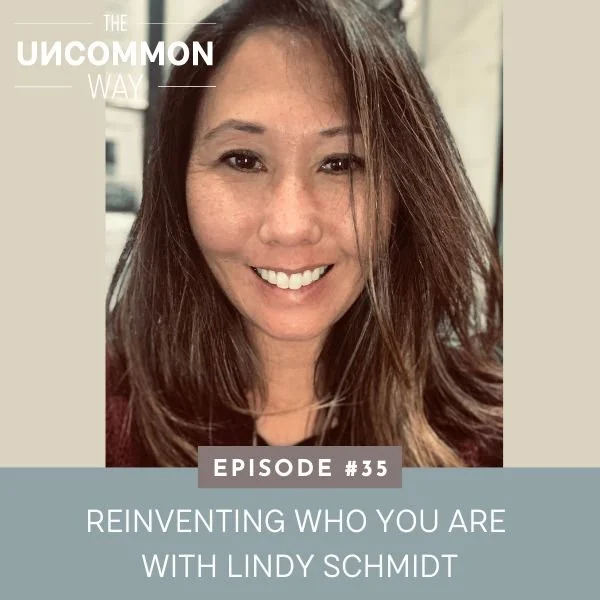
Episode Summary
Lindy Schmidt joins Jenna to share why every woman can be the CEO of a deeply meaningful, impactful seven-figure business if they do the mindset work required.
Join us in the Clarity Accelerator by scheduling a call here.
Enjoy the show? Leave a review to help other likeminded entrepreneurs gain clarity in their businesses.
If you'd like to talk about working together, book a call here.
Show Notes
There is a future version of you that is accomplished and has what you want right now. She thinks, acts, and shows up in ways that are different from how you do currently, and the sooner you can transform into those ways of thinking and being, the sooner you can see the results that she creates. But how do you get outside your current brain to recognize those differences as they’re happening in real-time so that you can start to shift them? That’s exactly what we’re discussing this week.
This week I’m welcoming another one of my seven-figure clients, Lindy Schmidt, to the show. After 20 years working in corporate, she was presented with the opportunity to try something different in her life and purchased her hometown grocery store. She is now the owner of two independent community grocery stores and joins me this week to share how she reinvented herself and why every woman can be the CEO of a deeply meaningful, impactful seven-figure business if they do the mental work required.
Tune in this week to learn more about reinventing yourself and how to disrupt current patterns and ways of being that are keeping you stuck where you are. Lindy talks about the turning points in her life that led her to coaching, the shift that happens once you start embodying a different identity, and how to take the first steps towards a new identity and a purpose-driven life.
What You’ll Learn From This Episode:
One of the reasons Lindy was struggling in her business prior to coaching.
How Lindy thinks about coaching and what she does to be a power client.
Why Lindy’s business is uncommon and meaningful to her.
The benefits of working with a coach.
How Lindy made such a huge shift in such a short space of time.
One shift to make you 5x or 10x your investments.
What it really takes to reinvent yourself.
Listen to the Full Episode:
Featured on the Show:
If you'd like to talk about working together, book a call here.
Click here to sign up for my newsletter and find out how the Connect The Dots Method has helped clients in all stages of their business.
Follow me on Instagram for behind-the-scenes content and daily value bombs!
Full Episode Transcript:
Somehow, there's a future version of you who will accomplish what you want to accomplish. And now, thinks, acts, and shows up in ways that are either, subtly or dramatically, different than the ways you do currently. The sooner that you can transform into those ways of thinking and being, the sooner you'll start seeing the results that that woman naturally creates. But how do you get outside of your current brain to recognize all of those differences as they're happening in real time, so that you can start to shift them? That is what we're diving into today.
You're listening to The Uncommon Way Business and Life Coaching Podcast, the only podcast that helps you unlock your next level in business and life by prioritizing your clarity and your own Uncommon Way. You will learn to maximize your mindset, mission, messaging, and strategy in order to create a true legacy. Here's your host, top-ranked business coach, and reformed over-analyzer turned queen of clarity, Jenna Harrison.
Jenna: Hey, friends, welcome back to The Uncommon Way. Today, I'm bringing on another of my seven-figure clients to talk about a few themes that I know each and every one of you will benefit from, no matter where you are in your business.
I'm so excited to introduce you to Lindy Schmidt. First of all, she has an amazing mission that I know you'll love. It's one that you don't hear too often, so it's distinctly her uncommon way. And we're talking about my favorite subject, maybe it's yours, too.
But we're talking about how to reinvent ourselves in order to disrupt the current patterns and ways of being that are keeping us stuck, rather than skyrocketing into the future that we think might be possible for us, if we could just figure out exactly how to get there. There's also a big added bonus in this episode. One that really, if you just make this shift, you are going to start 5x or 10x your investments. And you'll no longer worry about, “Will I get what I want out of this?”
Lindy shares how she thinks about receiving coaching, and exactly what she does to be such a “power client”. I hadn't come up with that term when we recorded this, unfortunately, but I really like it. And, I invite you to take this on for yourself once you hear about how she does it.
Every woman can be a power client. Just like every woman can be the CEO of a deeply meaningful and impactful seven-figure business, if they do the work. And by the way, I mean mental work. Sometimes, the physical doing of stuff is exactly what we're doing to avoid the uncomfortable changes that will actually get us where we need to go. Lindy can tell you a lot about that.
Okay, friends, it's my deep gift and pleasure to bring you this conversation. Enjoy.
Jenna Harrison: Hi, Lindy, thank you so much for coming on.
Lindy Schmidt: Good morning, Jenna. I'm so happy to be here.
Jenna: I've noticed, as I've been playing back some of the podcast episodes with other clients, I maybe haven't given people a chance to get to know the person before we actually dive in to the learning and the teaching. So, I thought I'd do it a little differently now, and especially because your story is so interesting. I'd just love for you to tell people just a little bit about you, and your business of course; why it's uncommon, why it’s so meaningful to you.
Lindy: Sure. Well, my name is Lindy Schmidt. I live in a small town, south of Omaha, Nebraska, in Louisville, Nebraska. My husband and I own two small, independently run grocery stores. So, my background is, I had worked in a corporate environment for just shy of 20 years. And we had the opportunity to do something different, try something new, and purchase our little hometown grocery store. That was back in 2019.
It was December 19, right before COVID, where I had made the decision to quit my corporate job and purchase our little grocery store that was closing or had closed, and kind of devastated our small community that we live in. Because I wanted to try something different. I wanted to try something new, and I wanted an opportunity to do something helpful. Something that I could give back to the community. So, that opportunity came before us and I jumped on it. The rest is history.
Jenna: I love it. And you've since opened another location?
Lindy: We did, we opened a second location in September of last year, so September of 2022. We opened a second store, in another small community about an hour away from where we live, and where our original store is. That was a really fun learning there, as well. And yeah, so as of right now, we are the owners of two independent, small grocery stores.
Jenna: Why do you think it's important for towns to have an independent grocery store?
Lindy: It is. Well, I know it personally, because we lived in a community that had one, and then we lost it. We really think, or I really think, that it's important to have for everyone; for everyone to have access to fresh food. There are places across the country that the closest supercenter, or the closest grocery store, is 20, 30, 40 miles away.
Even in some of these smaller communities where there's chain Dollar Generals or chain stores that may pop up in some of these smaller communities, you don't have a lot of fresh food. They don't have fresh produce or fresh meats. And I think it's important for everyone, regardless of where they live, or the size of the community that they live in, to at least have options. At least have access to that, and at least have options.
Jenna: I love that. From what you've told me, there can also be kind of a community aspect too around this. Can you talk about that?
Lindy: We quickly realized that a grocery store is sort of the heart of Main Street in some of these smaller communities. And without that sense of community, without a place for people to come and shop, and see their neighbor and see their friends, and run into the people that they literally live within this community, it's hard.
So, it really does shine a spotlight on the importance of Main Street, and having a vibrant, small community. And, that was really important to us. Because if you live in a smaller town… We've seen instances where they're not thriving.
And our hope is to kind of be a beacon, and then maybe if we can do it and open up a business in that community, someone else could be inspired to do the same thing. And then, we all win. The entire community thrives if just one person sees that opportunity, and they can inspire someone else, who maybe has a different kind of a business. Or maybe, who has a dream to open their own little shop or do something. It's good for everyone; it's all of us.
Jenna: I love that. I love the idea of that leadership within each town that you move into. It's like you really get to have your fingerprint on the development of all these communities, and all that coming together. So, talk about what's your vision. Your vision goes beyond two stores? What would you love to see happening in this country?
Lindy: I would love to see… Our store’s called The Market, The Market, Fresh, Local, Community. And we would love to see a Market in every single town across the country that doesn't have access to fresh food.
There is a need. If there are people and there is a community, there's a town… There used to be, Jenna, independent grocery stores everywhere. And sometimes, in small little communities there were multiple. You think back to the days before these giant super-centers took over everything, and closed a lot of these small independent retailers because they weren't equipped, at the time, to compete with them.
I see a real need and a shift back to bigger not being necessarily better, just because you have so many more options. It's almost overwhelming sometimes, to think about going into 200,000sf. store and thinking, “Oh geez, it's going to take me 10 minutes just to walk from my car to the front door; from the parking lot to the front door.
You lose that sense of community. We lose that sense of customer service. You lose that connection that you can build with other people. Every town, every community, every person, deserves to have access to that.
Jenna: Oh, I love that. Yeah. Let alone even finding the thing that you're trying to find in that supermarket, right? You'll spend so long… I'll give up so frequently, because I just don't have the time. It feels frustrating. Right? And, I just won't get the thing. And then, I have to make a trip to a second store where I actually know where the thing is, in order to find it. Or, I'm wandering around looking for someone to help me find something.
Lindy: Or, If you can’t find it, hey, 20ft. down here, there's a person that's more than happy to help me show me where that is. So, that’s what we’re trying to get back to. Trying to get back to smaller communities. Making sure that those small communities thrive; they're vibrant. The little Main Streets of yesterday kind of light up with business and industry again. I think there's a real need and a real place for that. And, I think the time is now. I think we're getting to the point where people recognize that bigger isn't always better. Sometimes, simpler is better.
Jenna: I love it so much. And I love that we brought this in, because everyone listening to this podcast really cares about the business they're creating. They really want to make some sort of impact, do something. And I think this really helps them tie it in, your story, right? We'll help them kind of ground into that and feel like… I have a feeling everyone listening to this now is like, “Yes!”
Lindy: I was talking to someone the other day, who said, “I'm so glad you opened the second store in our community, because my grandmother lives in town. And, you know, she has to get someone to take her 20, 30mi. a week, just to get groceries for the week. And now, she's right here in town, she can pop in. It's just so much easier.”
I just think there's so many advantages, so many. I mean, we do it, obviously, it's a business, but there's also so many other good things that can come from it, inspiring other people potentially, to do the same thing. And then together, we can build something really great in these small towns.
Jenna: Yeah, yeah. And there's also… I mean, as we've seen, my husband and I now, are looking for our next place to live. And all of the “little places” we're looking at, it seems like they've already been discovered, right? The housing prices are so high, and the traffic is so big. And so, I know that inevitably, there's going to be a greater influx of people into smaller communities, that right now are just like little gems waiting to happen. But if there's no grocery store and you have to drive 30 miles, my family would never move there.
Lindy: Right. You actually, are trying to get away from… We see that all the time, too, as kind of a shift and a migration from the city, and busyness and the impersonal nature of living in the city. We kind of decided to move out of the city after we had had our two kids, for that very reason. Because we wanted to feel that connection with other people within our community.
And sometimes, it's really hard to do that when you live in a giant state. When your children go to a school that has thousands of kids, they don't have the same opportunities. We wanted to kind of simplify and get back to a smaller community, really. Where our kids could go to a school…
They go to a school right now, that's a pre-K through 12. And so, all together you don't have a thousand kids or 500 kids in your graduating class. And, we see that as a trend. There are so many new people coming into our little community because of that reason.
They want to have that simpler life. That real connection with the people that they live in their communities with, that you kind of lose. So, I see a shift, because we live it, that's the community we live in. And, I see that shift of a lot of people really wanting to get back to that.
But in order to do that, in order for it to be a desirable community, there has to be business and commerce. There are places across the country where that can happen again. Even if even if they had it and it's kind of died. Not really died, but it's kind of gone away; it's possible. Let's bring it back.
Jenna: Yeah, I love it. I love it. Okay, so good. The reason that I really wanted to have you on the call was to talk about a conversation we had, about what the actual turning points were in your life, that led you to get to this point of coaching? And then, some of the realizations you've had.
Then, specifically for people, what exactly you have done and how you've thought, that has created such a shift for you in such a short amount of time? Because I know that if everyone could do that, there wouldn't be all these conversations about, “Oh, I invested here and didn't really get what I wanted. I'm not sure if it worked for me.” None of that would be happening, because you've just made it work. Like, it is working.
So, let's share that with everyone, just so they can kind of adopt some of the ways of thinking that you have, and then get the kind of results that you’ve been seeing. Tell us first, about what do you think sparked the journey? And what were the steps along the journey to then find me and really decide to hire a coach?
Lindy: Yes. It was a dissatisfaction with the business that we had created, or I had created with my husband. So, we had gotten to the point where it just felt heavy. You know, it's a hard business. It was overwhelming, and I was getting to the point where I wasn't having any fun anymore. I couldn't see, I lost the vision. I lost the vision of why I wanted to do it in the first place.
Jenna, you and I, in one of our first coaching calls, we kind of described it as being stuck in the muck, right? Stuck in the muck every day. And, that was the way that I was feeling. I was getting bogged down the ticky-tacky, day-to-day things that consumed me. And so, it was that deep feeling of, I would guess I would call it, I just didn't love it anymore. I was starting to fall out of love with my business that I had created.
I had been for years… I listened to podcasts, I read books, and all kinds of personal development things. But I never actually… I mean, with some of the things, you’d get a journal; you get your gratitude journal. You write things down, you do some things, right? But I didn't have a consistent practice. And I thought, “Okay, well, I need to take a big step. I need to shift because I don't want to go on in my business this way.”
And so, I had just decided, “I need to find a coach. I'm going to find a coach. I'm going to put my money where my mouth is, and I am going to work with someone to help guide me out of this place that I’m in, that I didn't want to be in anymore.”
So, that, literally led me to just google. I'm on the Google's googling, Omaha business coach, or whatever it was. And somehow… I’d click on this one, or click on that one, nothing really spoke to me. I don't exactly remember what the search was on how I found you. But I found your website. Which is kind of funny, because in hindsight, you and I have chatted about the fact that I'm probably not your target client.
But I found you and I went through your website, listened to your podcast, and I thought, “I want to work with her. I think I want to work with her.” And then we had our call, and that was what? December of last year, a few months ago.
But to answer the question on kind of what led me to making that decision, or making that leap was, I “studied” or put a lot of information in my conscious mind, but I'd never actually embodied it. I'd never actually worked with someone to help me to see my thoughts. See those things and the thoughts and the feelings that I was having, which was creating the state of my business, essentially.
Jenna: Right, right. And yeah, it is so amazing. Because the page that ranks on Google, is very much geared towards coaches figuring out their messaging, right? And so, I loved the fact, when I saw your intake form, I asked you which page had you looked at? Because I do have another page that speaks to clients like you, as well. And you said, “No, that's the one I saw. But I just decided to do it.”
Obviously, it's been great, and I'm so glad you did. Other people have managed to find me also, that are not coaches looking to nail their messaging. So, I think just really speaks to what I'm saying, about the resonance that's created is both conscious and subconscious. There was a subconscious component that clicked and allowed you to feel safe and trusting to move through.
Lindy: That was big step for me too, Jenna. That investment, having never really taken any classes or worked with anyone in the past, to just say, “I'm going to do this. If I need to have some big shifts in my identity and in my business, I need to really make the investment to do that.”
Jenna: I think that's what we identified in the first call. I went back and I looked at your initial intake form, which was so fun, and you were talking about how you guys just didn't have time. It was like a firehose of issues and problems, and how you're so busy sweeping the floors that how can you ever plan for the bigger things? And I thought, “Wow, sweeping the floors,” that’s just so emblematic of where you were.
And yet, when we got on the call, you did have this grand vision, and you saw it as so important. I knew that you were still in a different identity, right? Not in the identity that would get you there.
Lindy: That's right. And that's one of the biggest things that you and I have worked on from the beginning. Is creating that identity shift and stepping in to a different version. I know, this is going to sound kind of silly, but it's really a different version of yourself. And, it is a shift that you have to embody. I wish I could articulate exactly what that looks like; you probably can.
But it really is just a gradual change, a gradual shift, in how you see yourself and who you become. Because where I was, I knew that I couldn't stay in that place and get to where I wanted to go; it just wasn't possible. And so, it's those little thoughts that you and I have worked on, since we've been working together, since December, on how to embody and shift that paradigm, shift the thoughts that you're having.
Jenna: Right. And, they're so ingrained in you that you don't see them.
Lindy: Yeah, that’s right. Because there’ve been so many times where you and I'll have a conversation, and you'll repeat back something that I said, and say, and I'm like, “Oh, my gosh, you’re right.” It was just last week when we were on, and you said, “Well, you said this, but you also said this.” And, you're right. You're absolutely right. Because it's so hard to get inside of our own brains and to see our thoughts. It's so ingrained, it's so embodied in who we are, that we need that outside perspective.
Jenna: I think for you, the biggest thing, was that deep down, you had a belief that you weren't a big-picture, strategic thinker. The kind of person that could roll out a national, nationwide, brand. And what we found out, was that really, at the place you were in your career, you were focusing on other things, and you hadn't had the mentorship to transition into a different type of thinking. So, it wasn't actually an inherent part of yourself. That was big.
Lindy: Yeah, one of the big, big realizations that I had over the course of our discussions was, “Okay, here's a thought that I'm thinking; I'm not good at this. I'm just not a big-picture, strategic thinker. I'm not good at this.” But it came to me, at one point, that nobody ever taught me how to do that. Of course, I'm not good at it. I've never learned how to do it. I'm going to learn how to do that now. And I'm going to step into that, versus just saying, “Well, I can't do this, because I don't know how to do it.” Nobody ever showed me how.
Jenna: It was such a reinforcing belief. Because since your brain believed that, it was spending more time putting out brush fires in its comfort zone; doing what it knew it could do well. Rather than taking the time out and handing that off to someone else, and actually giving yourself the space to bring on these visionary ideas and new ways of thinking that your company desperately needed, that leadership.
Lindy: Because I could see it. I could see it, Jenna. I could see that where I was, wasn't going to get… There was no way. Where I was, the things I was doing, was not going to get me to where I was going. But I had gotten so bogged down in the, you call them brush fires, I call them a hot flaming dumpster fire. Yours sounds way more eloquent.
I had hot steaming dumpster fires every other day. And I had gotten so into managing that and thinking… My husband and I always say it's like a game of Whack-a-Mole; deal with this thing, something else pops up. But we had gotten so muddled down in that, that I couldn't even see the vision anymore, because that was my reality every day. And, I lost it, and I wanted so desperately to get it back.
Jenna: Let's talk about how you got it back. Because I always find that this is how I am with my coaches. We'll have a session, there'll be some a-ha, and then I take that and run with it. So then, in between sessions, I'm using that and I'll start looking up podcasts on that topic. Then, I'll find this book. Or, I'll journal and then I'll get another a-ha. And, I've noticed you do exactly the same thing.
And so, every time we get on a call, I sit down with you, you start to give me an update, and you're like, “Here's the a-ha I came to. This was so big this was huge.” Tell us, in your words, what you're thinking in between our sessions, and how you're doing all of that?
Lindy: We'll usually have something that sticks out in one of our sessions. And then, I'll think about it. I journal. I write things down. I do re-listen to our calls, which is helpful. And I'm always kind of searching and looking, and trying to find, I guess, something that speaks to me. And so, then I'll go out, like you mentioned, and I'll say, “I'm looking for some more inspiration on this topic.” And then I'll look for a podcast; “I don’t know if she speaks to me.” That may lead me to another person or another topic.
One of the things that you and I had really talked about in the beginning, is reinvention. I don't know if we called it reinvention, or it's just kind of recreating my identity around this business. And I realized that I really did need to step into a different role in this business a bit, if it's going to go to where I really envisioned going.
I think you had mentioned Kris Plachy in one of our calls. “You need to go listen to Kris.” I had heard of her because I'd been listening to Brooke’s podcast for years. And granted, never necessarily done anything, but I had heard her name before. And so, then I started listening to her podcast. She really spoke to me in the way that I needed to hear about some of the more tactical things in the business.
About stepping into becoming a CEO of your business. And, what that looks like at a more tactical level.
Jenna: Yeah, hiring clients and performance reviews…
Lindy: And job descriptions, and all of the tactical things that one has to do in the business. But then, I started seeing that as being very, very relevant to me and to what I needed to do, as well. So, finding her also helped me start to embody that identity of someone who is a CEO; who can make these decisions.
And then, she led me to someone else. You've given me other tips and books and podcasts. It's amazing how it kind of unfolds.
Jenna: So, maybe it is like that relentless curiosity. Or, sometimes for me, it's almost like obsessive, right? Like, I'm just looking. Yeah, I'm just calling it in.
Lindy: All the concepts are all the same, right? But certain people say the same thing in just a slightly different way that just resonates with you. Right?
Jenna: Oh, that’s so good for all the coaches out there to hear. Did you just hear Lindy say that? She needed to hear it from different people. Yeah.
Lindy: Different people; it's the same message, but in their own unique way. Yes, to all the coaches out there. It's the same stuff, but you have your own way of explaining it, of teaching it. And it will hit home with somebody, it will resonate with somebody. I guess that's me. I'm always looking for the people that can relay that message in a way that I go, “Yes, that makes perfect sense.”
Jenna: Yeah, yeah.
Lindy: I do a lot of that in between our calls every week.
Jenna: I did really want to highlight that and just honor you for that. Because it's not what everyone does.
Lindy: That the work. That's the work to….
Jenna: Talk about that.
Lindy: So, I'm really committed to making this shift. And so, what that looks like, is a lot of self-reflection, thought downloads, questioning my thoughts. Why do I feel this way? Why am I feeling this way? Where's that coming from? I think in one of our very first calls, Jenna, you said you have to be an observer of your thoughts. And it's so, not done.
Jenna: And, not taught.
Lindy: It's not taught how to do that. And then, it's not taught to take it that step further. The first step is just recognizing it. That's self-awareness and being like, “Why am I having…?” And then, questioning it and saying, “Why?”
We can talk about this later, but one of my biggest a-ha’s was came when I just listed all the thoughts that I was having about the state of the business. And then I said, “No longer.” Because I was having all these thoughts about it that I didn't even realize, or not necessarily thoughts. But I just sat at my computer one day and just emptied my brain about that specific topic. I got a page full of things, and they weren't all good, right? Most of them were not good. And, I was like, “Well, it's no wonder I feel not so great about this. Look at all the thoughts I'm having about it.”
Jenna: Yeah, yeah. So, let's go there, because I know that was a huge epiphany. And, I think there are so many people that need to hear what this revelation was for you, because it's the same for them.
Lindy: Yeah. Well, let's back up. I had realized I was having all these not so good thoughts. I just started questioning, “Why? Why do I feel that way?” And then, I just had that moment, that a-ha moment, where I realized one of the reasons why I was struggling in my business was that we weren't necessarily running the business; we were playing not to lose, versus playing to win.
There was a difference in being scared and being hesitant about decisions that needed to be made, versus just having that knowing, that, “No, we're going to win. We're going to play to win, versus not to lose.” It's a completely different shift in the energy, in the mentality, in the confidence in your own decisions that you're making.
That was a huge, huge moment for me. I felt it. It's like I could finally see it and articulate it. And, I remembered being really excited to have figured that out.
Jenna: It is a huge shift, right? It's like the defense versus the offense. You we're playing defense all the time. Like, how can I mitigate the pain that this will cause, instead of what is possible for me, if I really wanted to win at creating this thing that hasn't been done, this national brand? What would I be doing?
Lindy: Yes. What would I do? What decisions and actions would I take differently, if I knew, really knew, that I just couldn't lose?
Jenna: Because you weren't going to give up. You’re going I figure it out.
Lindy: Yeah, that was never an option for me. Let me just go back and say, of course, it's our business. And of course, if we were struggling in it, we could just say, “I don't want to do this anymore.” But that was never an option for me. So, it was kind of a go on in the way that you're going, which was not feeling great about it and kind of becoming resentful towards it, to be honest. Or, figure out a way, one day, to shift; shift your brain, shift your mind, on how to get back on track and move in the direction that you want to.
Jenna: Talk about the process that led to that realization. Because I think there'll be some people listening to this that say, “That sounds great that you had that a-ha, but I've been journaling and I haven't had my aha,” or something. What I've seen happening with you, is that as you've cleared the channels you are allowing the synchronicities into your life. And so, you did the work; you did the thought download. You made your intention known that you really wanted to, now, get to the next step, the next truth, about this download. And then, you happen to watch a movie, where they kind of said that kind of line.
Lindy: Okay. Yeah. So, let me back up. This is how that whole thing kind of unfolded. I think I went in the middle of it. So, we had a group call with some other…
Jenna: The Collective.
Lindy: And we were talking about Master Manifestors, I think it was. There were two girls on the call that were really good at that. And so, we were chatting about money and how they're good at manifesting money. I was thinking about that, and then I went and found… I was looking for, searching, like we had talked about… Again, for someone. “Let me find a podcast or someone who's specifically speaks to me about this topic.” Found someone, and on her podcast, she didn't necessarily speak specifically to me, but she had an episode where she had a guest on. And that specific guest has the podcast, too. And, she really speaks to me.
But in the process of that, I had downloaded some sort of meditation. Like a manifestation, money manifestation book or something. And part of the visualization that you're doing, is stepping into this person. You're visualizing this person who has all these things.
In my mind, in my visualization, I would see this person, right? It didn't have to be you. It could be someone else. It could be a real person, fake person, it didn't matter. But this person that I saw, was from this movie that I had seen a million times, years ago. But it kind of inspired me to rewatch that movie. “I'm going to rewatch that movie again. I liked that.”
And then, there was a scene in that movie where someone said that line. They were playing poker, and it was somebody teaching a classroom on poker mindset; something. And she said, “I beat him because he was not playing to win, he was playing not to lose.” And that's when I said, “Oh, my gosh, that's me. That's how I'm running my business. I am playing not to lose. I'm scared.” It just clicked with me.
But that whole series of events, it's very funny how it just kind of unfolds, and that's how I got to that a-ha moment.
Jenna: Yeah, but it wasn't… Again, we always go back to how did you create that? Right? Instead of, “It just unfolded.” And so, what I love to share with other people… And also, Lindy, you and I were talking about masculine and feminine energetics. And the feminine really is like the potential and the possibility and the trust. So, you had all of those components there, as you were there. But you also had the masculine energetic of this conscious focus, right?
So, you were following the breadcrumbs of these different podcasts. And when you combined the two, when you allow the trust, and you allow the play… You weren't a person that listened to one podcast, and then said, “Well, dammit, that didn't give me my answer,” and then you just stop there.
No, you were really in this place of play. This will come to this, and I'm sure I'll be learning more. And then, maybe this person does, and this person doesn't. And maybe, I'll just watch this movie. You didn't let your brain get in there and say, “What's the point? I mean, is this going to further your cause?” No, you're just like, “I will watch this movie…”
Lindy: I will watch this movie that I had seen before. And yeah, I wasn't looking for some big a-ha moment. It just inspired me to do that. And, I got it.
Jenna: Right. And that's the perfect marriage of the masculine and the feminine coming together. Where you have that focus and that trust.
Lindy: Well, and we had spoken about, Jenna, the masculine and feminine and how I was… Do you remember what you said, how I said, “Well, I think all the things that I've created up until this point, has really been just masculine energy.” When I think about that, I think about not hustle and flow, it's almost like, flow and hustle. Right?
So, the feminine energy, I've come to think of as the allowing, the visualization, the curiosity, yes, trust. And then, the masculine energy I feel is more like the doing, the actions, the doing-the doing-the doing. But I think the magic is in… You and I talked about this last week, we're so ingrained with the doing-the doing-the doing-the doing, the hustle. But what if there's an easier way?
What, if you can tap into that other piece of it, that flow, that feminine energy? You still have to do the things, right? But it doesn't feel so hard. It doesn't feel so tight. It's possible. It's possible that things could just come easier.
Jenna: And yeah, your results are amplified because you’re finally having these two forces working together, rather than one just suppressing the other.
Lindy: Right. We just do-do-do.
Jenna: I'm going to block the receiving because I need to make it happen myself. It's like, “Okay, we won't give it to you, then.”
Lindy: I mean, maybe you'll get some stuff done, but there's a much easier way to do it. I’m still working on that, too. I mean, I don't know, you and I will probably talk out that on Thursday. But getting better at the receiving, getting better at tapping into that; you call it “opening the portal.” Getting that to be more intuitive, versus being so conditioned for the hustle. And I want to turn to the flow.
Jenna: It's beautiful to see that you have been doing it now, so eloquently and effectively, with the coaching and the personal development. And so, now we'll just be turning that to the business. Now, we'll be seeing the same results. But you know how to do it. Now, it's a transferable skill.
Lindy: Yeah. What happened? You want to talk about my backpack analogy?
Jenna: Yeah, yeah, sure.
Lindy: Once I had my big a-ha, I was trying to articulate, okay, what is this? My husband's really big into metaphors, right? So, he's always thinking and describing things in metaphors. And I thought, “Okay, well, how am I going to describe this to him? And, how am I going to describe this big moment to Jenna, when I chat with her next?”
I had likened it to this. I had felt working in my business was like carrying this backpack on my back, full of rocks and sand. And so, every morning, I would get up and I would put that backpack on. I would walk down my path, and it was heavy. I wasn't very fast. I would bitch and moan the whole time, about carrying this damn backpack.
But it could still move forward, right? I was still going, I was still walking, I was still putting one foot in front of the other, every single day. But it was unpleasant. I had gotten to the point where this backpack sucks. So, I get to a point where I say, “You know what? I don't want to carry this backpack, because it's these straps are hurting my shoulder. I'm going to modify it. So at least, on my journey every day when I put it on, it doesn't hurt as bad on my shoulders.”
You get a little foam pad and you put it around the shoulder straps. You get up the next day, you strap that thing on your back, and you walk. But it's still heavy; full of rocks and sand. And, you're still putting one foot in front of the other. But at the end of the day, when you take it off, it's a little bit better, your shoulders don't hurt as bad, it didn't chafe as much when you were carrying it during the day. So, it's a little bit better.
And when you and I started working together, and you get these a-ha moments, that is when I realized that I don't actually have to carry this dang backpack on my back anymore. There's a better, easier, faster way. And that's when you trade the dang thing in for a frickin’ jetpack with rocket launcher on the back.
And you're like, “Guess what? I don't have to carry this backpack. I can put it down and I can get something completely different, and a thousand times better. And, I can get there 10 times faster than I am right now. That's what I likened it to. That's what I saw in my mind. That is progress.
Jenna: I love it. It's a great metaphor. It's so good; so good. One last thing I wanted to touch on, was you were talking about how you work between our sessions. And you said, “That is the work.” And so, I think it's an interesting shift; it's the way I think about it. But I'd love for you to say it, so that people can hear it differently through you. Again, when you sign on with a coach, tell me how you think about your involvement between sessions.
Lindy: It's my work. That's my journey. I can pay you, Jenna, and tell you every day, “Jenna, what do you want me to do? What do I need to do? What am I supposed to be doing?” And you can tell me, but if I don't do the work, and if I don't take the time to gather some knowledge, take the time to do the steps that are necessary, at the end of the day it's on me, it's my results. I own it you; can't do it for me. You cannot create my life for me.
I found you to guide me. To be able to see things in my brain and in my thoughts, and reflect them back to me, that I didn't even know I was having. But really, the work is on us, you, me, to do it. Because you can't just sit back and say, “Oh, well, Jenna told me to journal and nothing's happening.” You have to take the time to put in the self-awareness, the thought download.
I mean, if nothing else, just writing down your thoughts, that literally was kind of a catalyst for me to get to, from having bad thoughts about my business and how hard it was, to literally having that a-ha moment. Where I said, “I get it! I've been operating in this way: I'm not playing to win; I'm playing not to lose.” And all the stuff in between those two things, was self-awareness, was looking at my thoughts.
It was a process of getting from dissatisfaction to, “I get it now.” Doing the work in between that. And the simplest step, I would say, is just understanding your own thoughts that you're having. Just write them down. That's all I did. I just wrote them down one day, and then I could see. That was the next step, is to be able to see. “Well, it was no wonder. Look at all these terrible thoughts that I'm having.” I could see it, in black and white, on a piece of paper.
Jenna: Such good advice. Yeah, for sure. And as I'm hearing you talk, I'm thinking that there's kind of a next step. Because, yeah, some clients, you'll tell them what to do, and they just won't do it. And other clients, you'll tell them what to do, and they'll do that. And, that's great. But then, what you do, is that I'll tell you what to do and you'll do 10 times more. You'll do that and all these other things.
Lindy: Yeah, it's almost like having that excited curiosity. I'm always looking for that other person, that other teacher, who says something in just a different way, in just that special a way that resonates with Lindy. And then, I can get to those a-ha moments that way. Oh, yeah. And it may just be something that I've heard before, 10 times, that for whatever reason it didn't stick with me, but this time it does.
Jenna: Yes. And this is what makes for a truly productive, co-creative, coaching relationship. Because it's as if you and I entered into an agreement to be partners at the very beginning. And we're like, “Okay, that's the end result we wanted to get to.” And then, between sessions, we're thinking how to further get to that result. And so, you're working your angle, and I'm working my angle. And together, we'll get there.
That's completely different than someone almost coming in with an employee mentality to the coach, and saying, “Okay, what do I do next? What do I do next?” You're taking ownership of, ‘I'm half the team.’
Lindy: Right. I mean, I could hire you to tell me what to do. But again, I could do it, or I could really do it. Like, really understand it, really embody the work that needs to be done. Because you see the path, too, and your job is to guide me. But together, it's so much more impactful if you, like you said, you're doing yours from your standpoint, and I'm doing all the things in between that I can come to you with.
It’s like, “Oh, Jenna. It's been really, really powerful.” I could have never have gotten to this place by myself, or on my own. Because I couldn't even recognize some of these things in myself. You just need to have a coach and an objective third party, who can help you navigate and decipher the thoughts and the things that you're telling yourself that you don't even realize.
Jenna: Absolutely. I feel the same way about my coaches. I just never would have even seen it.
Lindy: No. Not even in my awareness. So, I'm so thankful that I found you. Well, no, I created our relationship. Right? I attracted you to me because that’s what I needed.
Jenna: Right. You absolutely found what you needed. You're just moving forward, creating this vision that you will manifest.
Lindy: It's really been fun. The whole idea of stepping into a new identity has been kind of scary. But you know what? Exciting. Getting to that place where you feel, and again, I wish I could articulate it better. There's just a shift. There's just a shift that happens, once you start embodying that different identity.
And I think the getting of it was kind of little steps, baby step. So, you almost feel like you're faking it till you're making it, right? It’s little things like, I don't want to do these certain things anymore, like sweeping the floors or putting product on the shelves. So, I'm not going to dress as if I'm going to do that job anymore.
You don't necessarily believe it, but you're kind of telling yourself, “I'm going to shift.” But then, one day, you just kind of feel different, [crosstalk] that new person. You just don't need those things anymore.
Jenna: I love it. So good. Lindy, thank you so much for coming on.
Lindy: Thank you for having me.
Jenna: Yeah. And, we will link to your website in the show notes, but just give it to everyone quickly, if they want to feel the vibe.
Lindy: The Market, Fresh, Local, Community; TheMarketFLC.com. You can see a little bit about our stores. You can see pictures of my family, who run the stores with me as well. So, thank you for having me. And I look forward to having another a-ha that we can chat about on our next coaching call.
Jenna: Love it. So good. Thank you.
Lindy: All right. Thanks, Jenna.
Hey, if you're a coach who wants true clarity about your secret sauce, your people, your best way of doing business, and how you talk about your offer, then I invite you to join us in the Clarity Accelerator. I'll teach you to connect all the dots, the dots that have always been there for you so that you can show up like you were born for exactly this. Come join us and supercharge every other tool or tactic you'll ever learn, from Facebook ads to manifestation. Just go to TheUncommonWay.com/schedule and set up a time to talk. I can't wait to be your coach.
Thanks for joining us here at The Uncommon Way. If you want more tips and resources for developing clarity in your business and life, including the Clarity First Strategy for growing and scaling your business, visit TheUncommonWay.com. See you next time.
Enjoy the Show?
Don’t miss an episode, follow the podcast on Spotify, Apple Podcasts, or Stitcher.

Ep #34: The 'Too Braggy' Fear and What I'm Doing About It
Where are you feeling braggy in your life? What are the things in your life that in theory you should be proud of or want to share, yet you don’t? Whether it’s how educated you are, how well you did in corporate, or any of the privileges that you hold back from expressing, I want you to ask yourself: what would be possible for you if you were fully, audaciously, uninhibitedly showing up as yourself?

Episode Summary
Jenna shows you why it’s time to stop hiding away out of fear of appearing ‘too braggy’ and start showing up authentically and expressing your true self.
Join us in the Clarity Accelerator by scheduling a call here.
Enjoy the show? Leave a review to help other likeminded entrepreneurs gain clarity in their businesses.
If you'd like to talk about working together, book a call here.
Show Notes
As women, we have been taught for millennia that we shouldn’t stand out. We should stay small, stay quiet, be humble, and cater to everyone else before ourselves. As a result, there is a tendency for us to hold ourselves back and play ourselves down for fear of coming across as too full of ourselves or braggy. While we recognize that so much of this is patriarchal conditioning that we have internalized, we still don’t always take action to heal from and move beyond it.
Where are you feeling braggy in your life? What are the things in your life that in theory you should be proud of or want to share, yet you don’t? Whether it’s how educated you are, how well you did in corporate, or any of the privileges that you hold back from expressing, I want you to ask yourself: what would be possible for you if you were fully, audaciously, uninhibitedly showing up as yourself?
In this episode, I shatter one of my own glass ceilings and share what will be going on with me and my business in terms of new territory I’m wandering into, specifically around being perceived as being braggy. I encourage you to hold space for yourself and others, to support women when we see them trying, and I show you how to start showing up authentically without being afraid of being perceived as being braggy.
What You’ll Learn From This Episode:
What’s going on with my own personal transformation right now.
The antithesis to us fully showing up as ourselves and expressing in the way we need to.
Why community is so important.
Some examples of where you might be hiding away from showing up authentically in your life.
Why even though it can feel scary and vulnerable to show up as your true self, doing so can bring something greater than hiding away from it.
Listen to the Full Episode:
Featured on the Show:
If you'd like to talk about working together, book a call here.
Click here to sign up for my newsletter and find out how the Connect The Dots Method has helped clients in all stages of their business.
Follow me on Instagram for behind-the-scenes content and daily value bombs!
Full Episode Transcript:
I'm about to shatter one of my own glass ceilings. Do you want to come along for the ride? In this episode, I'm going to be sharing what will be going on with me in my business. Some new territory that I'm wandering into, specifically around the area of being perceived as braggy. I've been through it before. This is a new level now that I'm going through. And I want to invite you all in on this ride, because I know that it's something that touches each of us in different ways, and is probably affecting you in some way, right now. Let's talk about it.
You're listening to The Uncommon Way Business and Life Coaching Podcast, the only podcast that helps you unlock your next level in business and life by prioritizing your clarity and your own Uncommon Way. You will learn to maximize your mindset, mission, messaging, and strategy in order to create a true legacy. Here's your host, top-ranked business coach, and reformed over-analyzer turned queen of clarity, Jenna Harrison.
Hey, my friends. Welcome back to The Uncommon Way. I am so happy you're here. Really, you have no idea how happy I am that you're here. I'm going to get a little personal on this episode, more so than usual, maybe. And it feels a little vulnerable right now, sitting here in my closet, totally protected with four walls all around me. But that is the point.
I don't mean the point is for us to bare all of our secrets and all of our fears with our audience, necessarily. Although if you want to, great. But what I mean, is that when there is something moving, when there is a transformation moving through us, it longs to be expressed. It longs to be made manifest.
It looks like evidence that people can see. It looks like something or it sounds like something, it becomes a tangible thing in the world. And so, I think it longs to be made manifest. And it also longs to be received within the universe.
When you are able to share with other humans, that sets wheels in motion, is what I'm trying to say. And so, the vulnerability is that first initiated impulse that drives you forward. And then, the beauty is that, especially in the kind of women-led networks that are popping up everywhere around the world, like this one, which I honor and love and respect so deeply, there's a feeling of safety for me, at least, within the vulnerability.
So, just knowing that I'm talking to you, and that the kind of person you are allows this expansion… It not only allows that expansion, right? It's almost like a magnet calling to the expansion. So, there's one sense of energy where it's coming out through you and pushing outwards.
And I know you all feel that. I know you all feel the nudge for something, in some direction, at this moment, right? There's something in you, there's some little voice that won't shut up, and is just kind of gently knocking at your door. Or, if it's been a while, maybe it's screaming loudly in your ear.
There is that, and there's that energy, that push from the inside out. But what I'm noticing, more and more, and I'm tapping into, is this other energetic, which is coming from the outside, and it's magnetizing more and more of us to speak our truth.
For instance, I have that energetic very strongly, for all of you. I am teasing that, I'm seducing that, out of you, so that the world becomes a much brighter and much more conscious and evolved place. I believe that so fully. That's absolutely my mission. That's why I'm in this, is so that the expression within us is no longer stifled.
What's going on with my personal transformation in the moment, is I have signed on with a new coach, entered a new mastermind. And this is something that I would love to do, just a complete episode on that, about how I make decisions of this sort.
Because I've been doing this so long in my thoughts, in my mind. It's actually not really my thoughts, but my feelings, right? And my beliefs about this are very precise at this point. But it is reflecting the impulse that was within me, the part of me that needed to be expressed, and then I basically found my home there. I attracted it to me; I attracted it into my sphere.
I know enough to move very, very quickly when I received that matched energy to the thing that I've been calling in. So, I moved very quickly. Made a powerful decision in my life, and it's taking me in a direction that feels a little scary.
Because here's what's going on, and this is really what I want to talk about today. I have felt very passionately for a very long time, about this tendency for women to hold themselves back, to tamp themselves down, specifically around this idea of feeling braggy.
We've been taught for centuries, for millennia really, that we shouldn't stand out. That we should cater to everybody else. That we should be humble. And that it was actually dangerous for us to stand out. That doing so, would be like that woman wouldn't be proper marriage material, right? She'd be a problem to handle. Right? It was dangerous for us. Literally, we were burned at the stake. Like I’ve said, we wouldn't get married, we wouldn't procreate; it was very dangerous for us to stand out.
And I think that goes with, this is something that we see throughout both the masculine and feminine. Men also, to a lesser degree but to some extent, there is a huge virtue placed on humility. And the way that translates, is that we're always checking ourselves, right? We're always checking ourselves to see, am I going too far? Is this inappropriate? Is this going to offend anybody else's sensibilities? Will this be perceived in a negative way?
I've done a lot of work on this. And it was very vulnerable for me to start, for instance, sharing the fact that my family and I do go to Europe for a month; that felt very braggy. It felt like, oh, la-di-da. Look at us. We have money and we have this freedom and we go live in these glamorous places once a year. It felt scary; it felt like I'd be judged.
I continued to do that, but my next level is through the visual sphere. So, while I'm talking, in certain contained areas, about things that before I never would have shared. For instance, being educated. Or, having done well in my career, before I came into this line of work. About, I don't know, things that come easily to me.
All of the things that I might have tried to control or manipulate, I'm getting better and better about speaking about and owning. Of course, this is so much of the work that I do with my clients, is helping them own their superpowers. And, there's room for more.
Because what I really don't do is, I don't show myself. You've seen my writing; you hear my voice. And there were very concrete reasons that I went off social media, that had nothing to do with visibility. And as I come back onto the visual sphere, as I start being seen, I'm noticing which pictures I select and which pictures I don't.
For instance, I don't give my social media manager pictures of myself in a bathing suit; there's one coming out soon. But there are things that I don't send her, right? And a lot of the ones that I do send her are like, how can I look the most approachable? I get that… I get that so often. I often ask people on a sales call, when they first find me, what led you to think that I might be the right coach for you? And many people say that I just seem approachable.
And so, I noticed myself filtering the information in this way. And that is really the antithesis of us fully showing up as ourselves, being fully uninhibited, and expressing in the way that we need to express. If we're all carbon copies of each other, then the universe halts, right?
As we are expressing this pulse of consciousness, that comes through each of us uniquely, our world is infinitely more beautiful and interesting and inspiring. And it creates opportunities for us to bump into things that we are either drawn towards or repelled by, that helps us clarify our desires and our positioning, and then inspires new ideas for us. And so, all of this is very necessary for a world that is in continual evolution, right?
If we all look the same, if we all think the same, we all dress the same, then the world progresses more slowly. And we've seen this throughout history. We saw long stretches, hundreds of years at a time, thousands of years at a time, where humanity stayed pretty much the same.
And then, we've seen this explosion that happens, and is happening, and is accelerating, as we all benefit from the work that others are doing in this realm, and then start to step our way into it ourselves. What I wanted to share is that for all of us, we have things in our background that would keep us from feeling safe to really show up absolutely, authentically as we are.
And for me, that could look like… Especially with relation to my body and my success. When I was younger, I think I've mentioned this before, my dad was older than other dads. And so, in the military, he was by default a higher rank and earning more money; because it is a meritocracy in some way. But basically, if you stay in long enough, you move up the ranks and you earn more money. So, by default, he was.
That set me apart; a few other things set me apart. And I spent so much of my energy as a child proving that I was just one of the gang. Proving that I was just like everyone else. That I wasn't going to be judging anybody. That I didn't look down on anyone because they had less money than me. I spent so much energy, and that has carried through in a lot of ways.
I honor it, of course. It's a beautiful, beautiful thing, to have had those conversations with myself about the fact that all humans are created equal, and I have nothing to do with my dad’s success. That I'm not any better or worse, based on these circumstances. And, I love that and I honor that part of me that does believe that is approachable.
Also, I don't love the part of me that tells me that I need to change who I am in order to be loved. Right? That's just bullshit. People will love me; people will hate me. And I might as well be who I am, in the middle. It's probably not going to change the percentage either way, no matter what I do. So, just be me.
I also think, that with women there's another layer. Which is the threat of sexual predators. Of feeling unsafe because of the dynamic that we've been brought up with. With fearing for our safety based on how we look or what attention we might attract.
And that was certainly my case. I grew up in Hawaii, among Polynesian and Asian ethnicities. I was a white girl who developed very early, was much taller, was wearing a bra, had curves long before anyone else did. I drew a lot of attention that I did not want and could not handle when I was that age.
Throughout life, I've, unfortunately, continued to have sexual assault and date rape, and I have a stalker. I was with a person; it was an abusive relationship. He has continued to seek me out and find me; I do have a restraining order. And so, it feels very scary even to talk about this right now. Because I have a fear that he'll hear it. And he'll know that I still think about him.
As I was thinking through this, I knew that what I want to share with all of you, and what I want to open up for all of you, is so much more important. So much greater than whatever thoughts I want him to think or not think; which I can't control anyway.
So, I do want to talk about this and how there are definite reasons for many of us, for not wanting to be fully visible, right? And definitely for not wanting to be braggy. It's one thing to be seen and to be visible within the kind of confines of what's appropriate in our culture, right? Like, oh, I'm the mom. It's safe for you to see me being an everyday mom in my yoga pants, with my son.
But it's not safe for you to see me lounging in this gorgeous, expensive bathing suit, in a villa in Santorini. Right? Laying there like some, I hear all the judgment coming out, but fill in the blank. Laying there like some privileged, I don't know, pampered person, and then being so full of herself that she's putting it on social media. Those are just all my thoughts right there. There you go. There you go; on a platter, all my thoughts. By the way, that's the image that I plan to use for this podcast. So, there you go.
For many, many of us women, there are very tangible things that we can point to in our lives about why we don't want to be seen or perceived as braggy, in any way that seems outside of what's acceptable. But I really, deeply, believe that even if we don't have that, all of it is there for us.
I personally believe that anything that is triggering from this life is really just a reflection of either past life events or our ancestral legacy, our genetic trauma that we have inherited. And so, I have had clients that have felt ashamed because they had extreme worries in a certain area. It wasn't necessarily visibility, although sometimes it is, but it was about speaking up, or whatever their thing was.
And they felt ashamed because the trauma, with a little t, that they could trace it back to felt so inconsequential compared to the big trauma, the big stories, that they hear out there. I believe so strongly that their sensation, the feeling, the nervous system reaction that they have in their body, is 100% real.
And it isn't necessarily from that trauma. I think that that trauma, what it does, is it opens up our mind to the sensation that's already there in our body. And so, it helps us bring awareness to it so that we can heal it. So, that we can see that it's there, and then we can work through it. And we have, at least, something tangible to process.
I don't want to go as far as to say these are gifts, because shitty things happen to really wonderful people; for I believe, sometimes pure chaos; no rhyme or reason. And also, anything that happens to us, we can transmute into a gift. That is the grace and the beauty of our humanity, is that anything can become our gold, no matter how much muck it came from in the first place.
Any little ehh that we feel, any little bit of ourselves that feels sticky in that way, is really just pointing us, I believe, to something much, much deeper, that could benefit from healing, right? That will help us be unbound. That will help us be lighter.
And I know so many entrepreneurs… because of the fact that entrepreneurship is the biggest personal development, spiritual journey that you could undergo. Especially for women, because it brings up every issue. Every issue that you thought you'd never have to deal with comes straight in front of you, into your face. And then, you have to work through it. Any one of those little things is the gold for you. It is the roadmap. It is the trail map.
What you will see in the next months is, well, a lot of it will be behind-the-scenes. So, you'll be seeing some social media pictures, but it's going to be happening behind-the-scenes. There is a big rebrand coming. And there is there is change. There is change happening. It will look very visual, but the visual is just the tip of the iceberg.
And I know that in doing this work, it will ripple down into much, much deeper work. More of my messaging. More of my philosophy. More of the direction that my business takes, because it always does.
And so, what I was saying, so many of my entrepreneur friends and I have this conversation, that even though entrepreneurship does have you bringing up all of these things, and it can feel like such an emotional roller coaster of the up-down, up-down, we would do it even if we weren't making any money, because of who it has made us.
I am so different than the woman of a year ago, or even God, how long was it now? Three years ago, I think, the first time I decided to take Dylan overseas. It felt so challenging for me to share that information with my audience at the time. And then, let alone talk about it while I was there.
I challenged myself to actually talk about it when I was there. And, that feels like a long time ago. I have come a long way since then. And, that's just one example of the many realms.
Where are you feeling braggy? What are the things in your life that, in theory, you should be proud of? Or, you should be wanting to share, and yet you don't? For some of us, we don't want to share how educated we are. We don't want to share how well we did in corporate. We don't want to share how we look, how sensual, how feminine we look, how sexy. Oh, that word, right? How sexy we look.
We don't want to share the things that come easily to us, because it's not fair for them to come easily. We don't want to share any of our privilege. We don't want to share any of the darker things either, that we've overcome. And we don't want to share how good we are at what we do, because it might be perceived as sounding full of ourselves.
And while we recognize that so much of this is just patriarchal bullshit that we have internalized, we still aren't always taking action on healing that and moving beyond it. I'd love for us all to hold space for one another. To really support women when we see them trying.
When we see them testing boundaries. When we see anything that kind of triggers us to just have that conversation with ourselves about why. To practice softening, and ask ourselves where in our own lives we're holding back because of the fear that we don't want to be like that.
And I'm not saying we have to become like that. What I'm saying, is that part of us that is being so productive is probably dialed up to ten. And we just need to dial it back down to two.
So, where are you feeling a little braggy about certain things in your life? And just what is the one area that you're also feeling a reciprocal pull to heal? And to start expressing what would be possible for you, if you were fully, audaciously, uninhibitedly, showing up as yourself? What would be possible for your business? What would be possible for your children to see? What lessons would they take from it?
What would be possible for your friends to see? What would be possible for your audience to see? What would be possible if the whole damn world, if all of us women just laid down the fucking armor and stepped out into the sunshine?
That is a lot of the work that I will personally be doing. First, within myself, with my coaching, and with the support of my mastermind sisters. And you will start seeing the seeds of that slowly made manifest and expressed.
And it's also the work that I encourage you to dip your toe into, dip your leg into, and fucking throw off the robes and just dive naked under. And, I am here to cheer you on. Collectively, there are so many women that are cheering you on.
This is why I know community to be so important. Every single one of my programs, it has to be community. If you are not tapping into the community, you are missing out. Because we need to flood our brains with evidence of the people that are there supporting us, that are cheering us on. Rather than, usually the one or two people or five people or a specific category of people, that our brain is spending so much time worrying about and focusing on.
Before we wrap up, I just want to make sure that we aren’t leaving this with a very heavy energy. Like this dire, we must do this very difficult thing. No. Let's just shift into, this is who we are. These things are going to come out because it is the natural progression of our expression. This is what is happening in our entrepreneurial journey.
We're showing up more and more. We're doing the work. And we're just kind of lightly flittering along on the breeze. Let's let this be. Yeah, there's going to be some ehh moments, but let's look at the overall trajectory for ourselves as kind of this light movement; it's a very natural movement, and almost like playful joie de vie. That's the overall carrying energy that is supporting our transformation.
Every once in a while, we run into a little bit of our conditioning, a little bit of a past trauma, a little bit of… I don't mean to laugh at past trauma, but I do, right? What if we bring in this playful energy, where it's like, “And that happened. But really, we've also had the last 30 years on top of that, of thinking about it and making meaning about it, and resisting and reacting.”
And while there are very serious problems in our world, and very serious inequities, that we can definitely have front and center in our vision, we can also carry, at the same time, this forward energy that's moving towards lightness.
I'll just give you an example of what I'm thinking right here. I'm thinking about how shocked I am, when I go back and watch movies or comedy skits from the 80s. Have you all ever done this? They are horrible. They're just so, so bad. The things that they're saying about different groups of people, and how the callous it can feel. You can watch that and feel so much judgment and heaviness.
But as time passes, it kind of also becomes like, “That shit was just crazy.” You almost have to bring in humor, because it's just so ridiculous, compared to where we are now. And that energy is available to us, even if we're not 40 years removed from the event.
It's a choice. And what this requires, is us becoming very comfortable with paradox, and being able to hold two beliefs and two perspectives at once. Yes, we are spiritual beings. And we are very, very grounded in the material world.
We are very much here with bodies that get aches and pains and have bills to pay and need to make sure we let the dog out to poo. Yes, there is a very serious work for us to do in the world. And there is a very serious work for us to do on ourselves and for our people. On the other hand, sometimes it's just not that big a deal. We need to laugh at the folly of humanity.
So, as you do the work uncovering where you feel braggy, where it's worthwhile for you to show up differently, and express differently. As you do that work, I just recommend that within it you also take time for humor and lightness. And that you ride those two energies, like a wave leading you to your destination. Because those impulses, those urges, are there for you. They're guiding you, and you can trust them.
This is the beauty of being able to wield your brain like a tool that serves the you, that works for you. On the one hand, yes, we can see it going towards a heavier energy, and we can love that, we can support it, we can boldly feel those feelings, and process them through and transmute them into something magical, like bold social change, or radical self-transformation.
And on the other hand, we can hold it lightly, so that we can ease the pressure, right? So, that we can make our steps easier. And I'll give you a personal example. Yes, there's a part of my brain that really wants to focus on the danger of this, on the negative thoughts about, what if the stalker sees this? And what will they think? And what will my peers think? What will my audience think?
Also, there's a side where, you know what? It's not that fucking big of a deal. Every time that I've moved into this energy, it's just been so helpful for me, and I've just seen it come true, over and over again. I remember when it felt so heavy and difficult to press ‘send’ on that post, or whatever the button was at the time on Facebook. To actually announce to the world that I was a coach and I was calling myself a coach and opening a coaching business. That felt so difficult.
And you know what? People were busy in their days and they didn't really care. Maybe if they did, they didn't really say anything. It didn't turn out to be that big of a deal.
When I started sharing about the lifestyle that I was leading, that also felt big. It didn't end up being that big. Here, on this very podcast, when I started sharing my woo, felt like a big deal. And, it really wasn't. Everyone was like, “Yes, of course. Of course, we all think that there's universal energy.” It felt like such a big thing at the time.
And so, being able to stretch your brain in one direction and the other, and give it what it needs, but also challenge it in different ways, is, I believe, the most powerful and potent of our human faculties. I'm not afraid of the darker emotions and the deeper triggering that's happening within my body. I can go there; I can sit with it; and I have.
I can process, up to a point, when it's time to shift into another side. To just say, “Okay, I see you there, and I'm driving the bus. We really want to focus on this.” And then I can get into, why do I want to do this? What difference will it make for me, when I can do this?
There's definitely the practical side, right? I will be living in the Mediterranean. I am at the water a lot. I will be in my bathing suit. It would be nice to not have to rearrange shots, and just to be able to take a shot right there, if I want to.
And the fact that I do love beautiful things and beautiful landscapes, and I do I stay at really amazing places when we travel. I love luxury hotels; I love that part of life. And I love nice clothes and buying pretty things. And I enjoy a lifestyle that not many people get to experience.
For a lot of the world's population, that's because they can't right now. But for a lot of other people, it's because they won't right now; they won't let themselves go there. Not saying that everybody wants to live in the Mediterranean. But everybody, I believe, especially you listening to this, everybody wants their thing. Everybody has that dream, that for some reason they're not living into fully.
And so, I also think about what it will be for me to be attracting more attention and why that's important. I want to attract attention. I want to get the message out there. I want more and more people to find this work and to benefit from this work and this perspective.
Also, I want to challenge myself to not be afraid of it. To welcome it in. To be able to hold it, and have the capacity to hold it. To have the capacity to shine, and to be okay with calling that in. I want to see more women in the world shining rather than dimming. I want more young women to grow up seeing that as normal and okay.
I want to completely flip this paradigm where a man and a woman will look at the same job posting, and a far greater percentage of men will apply to that, even if they don't meet all of the qualification. But the woman won't, unless she meets all of the qualifications. Because even then she feels like ‘who is she to go after that? To call that, claim that space.
I am claiming this space, this space right here. This clarity, this unusual way of doing business, this stepping into power in this way with this kind of alignment. This is my space. This is my world and my universe, and I am welcoming anybody in.
But I can't expect people who aren't there yet, to do all of the heavy lifting. I need to be willing to go out, to put myself in those rooms, to shine in those faces, to speak up and to be heard and recognized. It's scary, yes. And, we've done it before. We've all done it before.
We've all walked into the classroom as a new student. Or, we've challenged ourselves to take on the new job opportunity. Or, we've started businesses. We can do hard things. We can expand our capacity more and more and more. And so, wherever you are on your journey right now, I honor you. I honor everything that you have done up until this point, and everywhere you're going to go in the future. It's already there inside you.
As you keep doing this work, the expression will come out and it will seem like the time to do the next thing. And then you'll just do it. And then it will be done. You'll be holding out a hand, or being the example for the next person, just as you turn your eyes in a different direction and start thinking about your next step.
I am so grateful to be connected to each and every one of you. And to be in this together. Thank you so much for having my back.
If you want to tag me, or show me anytime that you are stretching your boundary, I'm at The Uncommon Way, everywhere. So, just tag me, DM me, and I will support you so fully. In that work you're doing, you are always safe with me to shine.
Hey, if you're a coach who wants true clarity about your secret sauce, your people, your best way of doing business, and how you talk about your offer, then I invite you to join us in the Clarity Accelerator. I'll teach you to connect all the dots, the dots that have always been there for you so that you can show up like you were born for exactly this.
Come join us and supercharge every other tool or tactic you'll ever learn, from Facebook ads to manifestation. Just go to TheUncommonWay.com/schedule and set up a time to talk. I can't wait to be your coach.
Thanks for joining us here at The Uncommon Way. If you want more tips and resources for developing clarity in your business and life, including the Clarity First Strategy for growing and scaling your business, visit TheUncommonWay.com. See you next time.
Enjoy the Show?
Don’t miss an episode, follow the podcast on Spotify, Apple Podcasts, or Stitcher.

Ep #33: Turn Your Insecurities into Great Positioning
In order to buy from you, people need to believe that you or your service is the best fit for them. They need to know what makes you stand out. Sharing your true self is a gift you can give to the world, and when you understand this, you can stop overlooking things you should be highlighting, and start creating the aligned success you want in your business.
Episode Summary
Jenna shares why the very things you are trying to cover up or hold back on in your business could be exactly what your ideal client is looking for.
Join us in the Clarity Accelerator by scheduling a call here.
Enjoy the show? Leave a review to help other likeminded entrepreneurs gain clarity in their businesses.
If you'd like to talk about working together, book a call here.
Show Notes
As women, we are taught to be unidimensional and fit into boxes of how we should look, act, and think. We are taught to fit into what successful and professional looks like, and we tend to hide whatever parts of ourselves don’t fit into these boxes. But your clients are human, and they are looking for someone they can either relate to or aspire to, and you could be hiding the very thing that makes you their number one choice.
In order to buy from you, people need to believe that you or your service is the best fit for them. They need to know what makes you stand out. Sharing your true self is a gift you can give to the world, and when you understand this, you can stop overlooking things you should be highlighting, and start creating the aligned success you want in your business.
In this episode, discover why the very things you are trying to cover up could be the things that are most magnetic to your most aligned clients and how to best position yourself and your services moving forward. Learn how to show your right-fit clients that you are the only obvious choice for them, and how to expose the best parts of yourself to create the business of your dreams. If you’ve been holding back or hiding some aspect of yourself, you don’t want to miss this episode.
What You’ll Learn From This Episode:
What a USP is and why it will help people see how you are different.
Some examples of where myself and others have tried to hide things about ourselves that could be attractive to aligned clients.
What I mean by positioning and why it is so important.
How to establish your unique differentiators.
Why entrepreneurship is the greatest personal development journey around.
How to establish the parts of your offer you don’t want to reveal.
Listen to the Full Episode:
Featured on the Show:
If you'd like to talk about working together, book a call here.
Click here to sign up for my newsletter and find out how the Connect The Dots Method has helped clients in all stages of their business.
Follow me on Instagram for behind-the-scenes content and daily value bombs!
Ep #31: Uncommon Sales Advice: How to Sell More by Trying Less
Full Episode Transcript:
In order to buy from you, people need to believe that you or your service is the best fit for them. So, they need to know what makes you stand out. And guess what? You might be completely overlooking something about you that you should be highlighting. Something that will have people knocking down your door to work with you, and only you. And the crazy thing, is it might actually be the very thing you've been trying to keep them from seeing.
You're listening to The Uncommon Way Business and Life Coaching Podcast, the only podcast that helps you unlock your next level in business and life by prioritizing your clarity and your own Uncommon Way. You will learn to maximize your mindset, mission, messaging, and strategy in order to create a true legacy. Here's your host, top-ranked business coach, and reformed over-analyzer turned queen of clarity, Jenna Harrison.
Hey, welcome back to The Uncommon Way. I love this time of the week when we get to talk, it’s so fun. So, we are having some good vibes around here. We are finalizing another trip to Charleston. We are still on our adventure to find our next place to move. We've been to Raleigh-Durham.
So, it's an exciting, very fun time for us. Because, for those of you who are new here, Ben is in the military and this is the time where we are actually choosing where we're going to live. So fun.
So hey, I got some really good feedback on the sales podcast I did recently, and specifically the embodiment exercise at the end of it. Some people told me that they really felt a shift after doing that, which gives me shivers. If sales is a sticky point for you go back and listen to that episode; we'll link to it in the show notes.
Now, today's episode is inspired by a conversation I had with a client just this morning, on how to best position yourself and your service. As I mentioned in the intro, in order to buy from you people need to believe that your service is the best fit for them. And your USP, which is your unique service proposition, or your secret sauce, is what will help them see how you're actually different.
There's a part of you that welcomes this and wants to shine, right? That wants to be like, “Here's who I am. Here's what my offer is.” And then, this flood of clients is like, “That's exactly what I've been looking for!” And there's another part that feels a little less than, about certain parts of yourself or your offer. And it's trying to make sure that nobody knows about them.
Maybe it's telling you that in order to be perceived as trustworthy, or professional or cool or relatable, then you need to look or act a certain way. But what I've seen, over and over, with my clients is that the very things you're trying to cover up could be magnetic to your clients. And without a full and complete understanding of your secret sauce. Without you recognizing how valuable it truly is.
And owning it without shame, and actually making it part of your positioning, you are missing a huge opportunity not only to create more success in your business, like more revenue or more of that kismet type of feel with your clients, but to feel as free as you could when you get to show up as your true self.
Now, before we dive into it, let's just talk about what I mean by positioning. So, positioning is a strategic decision about how to frame the way in which you or your offer is understood. We've talked a lot about self-concept on this podcast, the way we think about ourselves. Well, positioning is the concept that you help your audience create about you or your offer.
We do this in order to differentiate our business and really stand apart from whatever else is out there. So that our right-fit clients can find us more easily and recognize that we are their obvious choice.
When you hear people talk about positioning, they often talk about pricing. Will you be perceived as a luxury brand or is something more accessible? And why? In a world where coffee was sold at a very cheap price, as a loss leader, Starbucks said, “You know what? Let's charge four or five times the going rate.” And from there, you make more decisions to create an aligned, unified brand.
So, for Starbucks, they needed to make decisions about how to offer a premium product in exchange for those premium prices. They were like, “I know. Let's start highlighting where the coffee comes from and our particular roasting method. And instead of coffee, let's create coffee beverages, different types of coffee beverages. Let's make our locations a destination and an experience in and of themselves. From that starting point, we want to create a new coffee experience as a luxury coffee brand.”
They were able to think in ways that they hadn't previously; really, that no one had previously. But positioning goes way beyond what you charge. Here, at The Uncommon Way we think more about what are the relatable and/or aspirational aspects of who we are or what our service is, that not only create a strong, almost insurmountable competitive advantage for you, but that are a true expression of who you are. So, that we're calling in the people that we're most aligned to work with. Because remember, it's not a coincidence that we're working with the people we're working with.
What we want to move away from is any masks in our branding and positioning. Trying to conform to what everyone else seems to be doing will block the connection you're wanting to create. Not only does it make you blend into the background, like into the social media scroll, but it creates an energetic cloaking because you are, in essence, hiding.
And even if you're standing out, but you're standing out via a product or a look, that isn't really you. Maybe it's what you think people would most want from your type of business or what you wish you could be. It's not the true aligned expression of what's moving through you.
So, you're doing the opposite of creating resonance. Being something we're not blocks the resonance that our true people would feel. It's quite literally, discordance. I knew someone once who was a mild mannered, new coach from the Midwest, who had a branding issue; where she was rocking a leather biker jacket and an outfit to match, and she just looked uncomfortable, like it didn't really fit.
Now, I love reinvention. And I love us all moving fearlessly toward the expression that's moving us in whatever direction it's moving us. But the external should be a reflection of the internal. Meaning you need to have done the internal work of becoming that person and shedding the old identity and stepping into the new, before we try to project a completely new vibration through our clothing.
You can't just put on the clothing and be the biker chick because your audience is picking up on everything, conscious and subconscious. And coherence creates a sense of safety for them that allows them to move forward.
Now normally, this is all much more subtle than a biker jacket, right? It's in the subtle ways we talk and act, and the things that we say and the things that we don't say. And what I want to offer to you today, is that the very things that we might want to hide might be the things that would create the strongest, most aligned positioning and branding for us.
That's not to say that we should air all our dirty laundry and make everything about us. All it means is have a frank conversation with yourself about the parts of you or your offer that you don't want to reveal or the way you think you should be showing up, and question all of it.
I have a client who's in a space that's occupied by “professional” consulting firms. And her tendency, when she's interacting with clients, is to recreate that professionalism, or rather, it had been in the past. That can show up as wanting to have all the answers. But you know what? Her clients resonate with her when she's being funny and quirky and completely straight-up about moments when she's unsure, or moments when she has been unsure in the past.
And then, there's this very strong bond that's formed and a deep trust that allows people to perhaps share more than they normally would, right? Ultimately creating a phenomenal product going deeper and further than they might have. And that in turn, turns them into raving fans and creates great word of mouth for her.
Again, the things that we feel most vulnerable or insecure about can actually be catnip for our audience and our clients. Now, it might be something as simple as you worry that your program isn't complete and thorough enough. But actually, your people are really busy, and they're thankful that you've curated only exactly what they need.
But for a lot of us, it's not just our offer; it's us. We are the face of our brand and offer. Our clients will either be working with us directly or they're looking to us as the creator of the product they're consuming, and their purchasing decision is driven in part by how they resonate with our message and ourselves. And, that can feel terrifying.
Our brains perceive exposure as very dangerous. But what are you willing to do? Not just what are you willing to do, but what are you willing to expose, to create the business of your dreams?
I once had a client who was a business coach, and I gave her an assignment of going and looking at some of the websites of other business coaches and really thinking about in what way she was different. But when we spoke the next time, it turns out that this had triggered a lot for her.
She realized that what she was seeing on all of their sites was reflecting her insecurities. She was seeing that these people all had some sort of background, maybe as an executive in a PR company or something; they all had something that felt very credentialed to her, very legit.
Meanwhile, she was a massage therapist and didn't feel that she had anything like that to offer. But guess what? Her clients also were feeling like they didn't have the kind of credentials that they wish they had for whatever they were doing. They also were coming from a slightly different background than most of the people in their sphere.
And when she started highlighting that, when she started talking about doing it anyway, and how your own perspective is actually what shines. Your own perspective is actually what brings the most value to your clients. She created such relatability, that when they were looking at business coaches, they didn't want someone that had never experienced what they were experiencing.
It's sort of like, do you want to learn weight loss from someone that has never struggled with their weight? No, they wanted to learn how to do it from her. That became such a strong differentiator for her, that for her people there was no other choice but her.
I'll give you some personal examples. I had some stories from childhood that I would get rejected whenever certain things would come up. Such as, if I was getting higher grades. If my family was making more money. Which was kind of comical because we were in the military. My mom was a stay-at-home mom, but my dad was older, and so, he was making more money than many of the parents of kids my age.
And there was also, for instance, if I had a different background, if I'd traveled more, which I had a lot as a child because of the military background. When we moved to a small community, when I was 15, I remember once there was a girl who was kind of making fun of me. Well, she was actually making fun of me, there was no kind of about it. And she was sort of saying, “Oh, well, when I was in Greece, blah, blah, blah,” and she literally did the hair toss thing.
I remember feeling deep shame about this and just keeping my mouth shut from then on about anything that I thought seemed different. And then, going off to a college far, far, far away, so that I could hopefully be with people where I didn't have to hide everything. Because the truth is, that memory I was sharing did occur in Greece, or wherever I happened to be talking about if that moment.
So, those thoughts lingered when I was first getting into business. But I've worked through them, right? And my people now think that it's kind of okay that I use big words or that I have released a lot of shame around money or that I do talk about travel, and how it's such an important value to me and something that I want to let my son experience too.
Those are the kinds of things I was talking about this morning with my client. We were turning everything on its head that she thought would be impediments to people buying from her or taking her seriously. And we just wanted to flip that all around and see how actually it could be all of them. Each and every one of them, could actually be really strong differentiators for her.
I knew I just had to hop on here and share that same message with you because I want you to own and love all of you. As pollyanna as that might sound, I feel that it is a radical act. As women we are taught to be so unidimensional and to fit in these boxes of how we should look, how we should act, and how we should think.
And as a society, we're taught to fit into what successful and professional looks like. But the truth, is that your clients are human, and they're looking for somebody that they can either relate to or aspire to. Entrepreneurship is the greatest personal development journey around. I've said that a million times and I know so many of you agree with me on that.
And this, right here, this is part of your personal development. Really owning who you are, and seeing these parts of you as things to be celebrated and yes, even capitalized upon. This is part of the work of recognizing that we are worthy of receiving, not just despite what we are, but precisely because of the unique being that we are.
When we start understanding that sharing our true self is actually a gift we give the world, we are able to receive more and more back from that world. So, if you're realizing that you've been holding back or hiding some aspect of yourself, here is something I challenge you to do.
List your brain's objections to why someone would want to work with you, or work with you in a group format, or pay higher prices, or whatever current belief you're working on. And then, counter each of those with why the opposite might be true. That your people would best be served working with someone like that because X. Or, that they'd be attracted to someone with those characteristics, because why?
I want to know what comes up for you. Seriously, hit me up in the DMs on Instagram or wherever you want to, I'm kind of everywhere. And let me know what this revealed for you. I would love to know. And if you hit any blocks, or stuck points where you're just like, “I don't know how this will sell,” hit me up about that, too.
Okay, my friends, I hope that that served whomever among you that needed to serve today.
And remember, deep down, you know who you are. And, each day, you're stepping further into what you are here to create. I’ll talk to you next week.
Hey, if you're a coach who wants true clarity about your secret sauce, your people, your best way of doing business, and how you talk about your offer, then I invite you to join us in the Clarity Accelerator. I'll teach you to connect all the dots, the dots that have always been there for you so that you can show up like you were born for exactly this. Come join us and supercharge every other tool or tactic you'll ever learn, from Facebook ads to manifestation. Just go to TheUncommonWay.com/schedule and set up a time to talk. I can't wait to be your coach.
Thanks for joining us here at The Uncommon Way. If you want more tips and resources for developing clarity in your business and life, including the Clarity First Strategy for growing and scaling your business, visit TheUncommonWay.com. See you next time.
Enjoy the Show?
Don’t miss an episode, follow the podcast on Spotify, Apple Podcasts, or Stitcher.

Ep #32: Should I Say Yes or Should I Say No? (Tapping Into Intuition)
Do you ever wish you could just figure out what to say yes to and what to say no to? Are you trying to make a decision but finding yourself getting hung up on all the different options? You have an inner guidance system that understands where you need to go, you’re just not hearing it. So this week, I’m helping you start to tap into your intuition.
Episode Summary
Jenna shows you how to differentiate between conditioned thoughts and feelings and following your intuition.
Join us in the Clarity Accelerator by scheduling a call here.
Enjoy the show? Leave a review to help other likeminded entrepreneurs gain clarity in their businesses.
If you'd like to talk about working together, book a call here.
Show Notes
Do you ever wish you could just figure out what to say yes to and what to say no to? Are you trying to make a decision but finding yourself getting hung up on all the different options? You have an inner guidance system that understands where you need to go, you’re just not hearing it. So this week, I’m helping you start to tap into your intuition.
I used to get angry hearing people talk about intuition because I just didn’t have it. But once I learned to discern the difference between the sensations that occurred when being driven by the conditioned part of my brain versus the ones that came from being tapped into my most grounded knowing, everything changed. And I want the same for you.
Join me this week as I show you how to stop misunderstanding your intuition and share some examples of where doing this has shown up in my own life. Find out how a lack of alignment leads to uncertainty, poor decisions, and missed opportunities, and some steps you can take to improve your ability to tap into your intuition so you can step into being a powerful, confident decision-maker and start trusting yourself completely.
What You’ll Learn From This Episode:
The benefits of taking quick, decisive action.
What’s really going on when you don’t hear or trust your intuition.
Why it is OK if you don’t understand your intuition right away.
What has been getting in the way of your most aligned, inspired decisions … and what to do about it.
Some questions for you to consider about your alignment.
Why it can be difficult to know the greater wisdom you are meant to have.
How to decipher if what you’re hearing is intuition or something else so you can trust it more.
Listen to the Full Episode:
Featured on the Show:
If you'd like to talk about working together, book a call here.
Click here to sign up for my newsletter and find out how the Connect The Dots Method has helped clients in all stages of their business.
Follow me on Instagram for behind-the-scenes content and daily value bombs!
Full Episode Transcript:
Do you wish you could figure out what to say yes to and what to say no to? Are you trying to make some kind of decision, but you're hung up on all the different options? Or maybe you just say screw it, and you make haphazard choices because you can't stand how uncomfortable your uncertainty feels. I've been there.
But I’ve got to tell you something, even though it used to make me want to roll my eyes whenever I heard it. You have an inner guidance system, let's call it intuition, that understands where you need to go. It's just that you're not hearing it. So, let's talk about how to tap into that resource, and how to decipher if what you're feeling is really intuition or something else, so that you can trust it more.
You're listening to The Uncommon Way Business and Life Coaching Podcast, the only podcast that helps you unlock your next level in business and life by prioritizing your clarity and your own Uncommon Way. You will learn to maximize your mindset, mission, messaging, and strategy in order to create a true legacy. Here's your host, top-ranked business coach, and reformed over-analyzer turned queen of clarity, Jenna Harrison.
Hey, friends, so glad you're here once again, putting in that focus and time to get clear on your uncommon way. And really dial in that exact business that's moving through you and out into the world. Today's episode is going to help you speed up that discovery process. Actually, it's more like jumping the queue because intuition helps you skip steps.
But first, I just want to give a shout out to Malsharpie, who was kind enough to take a second and leave a review. They say they just found this podcast, and it's so helpful. And they're going to go back and listen to all the episodes. It is so fun. Because in my mind, whenever I talk, I feel like I'm talking to people who've been with me over the last six months. But I can see by how the downloads are growing, that new people, they are coming on board all the time. And I guess Malsharpie’s proof.
Which means, Yeay, more women living out the unique uncommon lives of their choosing. And more of us willing to go deep and do the vulnerable work of creating or realigning businesses into something that's a true expression of who we are, and what we're here to bring to the world. Not just some mask we put on or some formula we follow that's a reflection of rigid business and marketing have-tos from the past.
We’re following the call. The call that's always been there for women like us, but was never possible to realize as it is now. And I believe that because it's possible, and because now's the time, the call is really loud. It's like that voice inside won't shut up until you do the damn thing. So, we're doing it even if it's scary to play big.
And I get shivers, literally, I don't know about you. But when I think about how many of us are doing this now, compared to a decade ago or two decades ago, and what the world will be like as more and more women are living and serving this way. We are here to be game changers. And I am so grateful to be in communication with women like you.
And to those of you who are in the Clarity Collective, of course, I am so grateful to be your coach and to witness you amplify right in front of me. And also, witness the universe playing itself out through you. I'm kind of tearing up. I'm just so proud of you for being audacious enough to believe that the feeling you had when you were a little girl, that you were here to do something big and something different was actually spot on.
If it's your first time here, I want to give you a special welcome and forewarn you that it's probably not a coincidence you're being invited to go deeper with your business, and the thrill you experience in your business and from your business than you ever have before. Because it's a thrilling ride once you give yourself full permission to break all the rules and create your own.
I say the more the merrier. The world desperately needs more ‘for purpose’ businesses and the impact we bring. So, if you've got someone you know who you believe is just a powerhouse waiting to happen, maybe has just scratched the surface really. It doesn't even matter what income level she's at because that can be all of us; that can be us at 50,000, at six figures, at seven figures; then share this podcast with her.
Okay. In an ideal world, I think we can all agree we would all be in full recognition of our gifts and our power to create, and in full belief that there are an abundance of people who want what we have to give, and in full trust that our own intuition is leading us exactly where we need to go.
But we live in this world. We live in this world inhabiting bodies with human brains that have picked up all sorts of conditioning and societal patterning. And we're taught to be up in our heads and to be realistic and compare and contrast the pros and cons of each possibility, even though we're almost never looking at two clear-cut options. And actually, our brains easily go into complete gridlock when considering complex real life scenarios.
So, we're left with a situation where there's some direction we're considering. But instead of moving forward and creating momentum, you're either sitting in complete uncertainty, or you're taking hesitant, halfhearted action, or you're barreling ahead overdoing it, but there's no real punch behind it.
You're wondering, do I pursue that group of people or another? Is this really a strategy I should pursue or is it shiny object syndrome? Should I drop that client? Should I make that investment? So many questions. And you wish, you can just say, “Here's what my intuition says, and I always trust it.”
But the truth is, you don't trust your intuition fully. Or, you may not even feel like you have intuition, or it's really intermittent. You're like, “I got nothing. If I knew, I'd already be doing it.” Because taking action isn't really your problem, right?
You're great at achieving all the goals and mile markers when you know exactly what to do. But when there's infinite possibility, and you're also yearning to give up that fast and furious pace, and move into a calmer, more grounded and more inspired way of doing your work in the world, that's when you're like, “Okay, how do I drop into this greater wisdom that I'm supposedly meant to have?”
Because you don't want to just throw caution to the wind, there's a thing or two at stake here. “I might lose money. I might lose clients. I might lose time. Both in the opportunity cost of what I could be doing instead, but also in what it takes to build back or back out of some problem I create. I don't want to expend all that energy for nothing. I could end up looking like an idiot.
Everyone will be like, ‘What was she thinking? She got a little fool of herself, didn't she?’ I could be reinforcing a pattern of self-sabotage. I spend too much. I get shiny object syndrome. I take on more than I can handle and end up overdoing it. And worst of all, I could feel like an idiot. Incompetent, maybe even delusional, but definitely not cut out for business.”
Phew, right? Take a breath. I want to share something with you. And hear me, that this is coming from a woman who used to get angry when hearing people talk about intuition. Because it was just so unfair that I didn't have it. And instead, just had this brain that was always thinking and analyzing and considering and reflecting and filling up mountains of journals and talking my partner's ear off.
I want to share with you how you too can step into being a powerful and confident decision maker as a CEO and as a woman. Someone who knows she can trust herself. Rather than worrying she's fooling herself. Who knows what to say ‘yes’ to and what to say ‘no’ to.
I have a client who I started working with, and it was just a couple of months ago. She was used to making really quick and kind of haphazard decisions, because there's so much going on in her business. And she felt that need to really act quickly. But then, afterwards, she beats herself up because she second guesses her decision.
And so, every day she was waking up with anxiety and feeling like she was stuck in the muck. That sense of being was reinforcing her story that she really wasn't a strategic big-picture thinker, and would never be able to grow her company to the nationwide household name that she wants to.
What she most wanted to focus on, she said, was if she could improve her decision making. If she could make really thoughtful decisions and know why she made them, and have her back about it, then this would all be worth it.
The other day, she came on her call and was like, “I feel a shift.” She was stepping away and breathing and centering herself. She was connecting with her clarity. And then, the ‘why’ behind her decision comes to her. and she feels confident in her ‘why’. So, she has her back with every decision she's making. And she is making some big ones.
But she's just like, yes to this. No to this. She feels deliberate. She said, “Everything seems a little slower, more clear, less rushed. And I just didn't know how terrible I felt until I was no longer feeling it.” She even gave a name to it, “dread.”
She'd been trying to grow a business from the place of dread. But now that she's so clear, she can recognize it. And when it starts to happen again, she can shift herself out of it. The way she had been living is not uncommon; it's tragically common.
So, if you resonate with that, and I know I've been there before, I hope this helps you see how possible it is for you to shift too. Because really, it's quite simple. All that has to happen is you need to learn how to discern the difference between the sensation that happens when you're being driven by a primitive and or conditioned part of your brain, and the sensations that come from you being tapped into your most grounded knowing.
This is a felt sense. You can logic it away as best you can with your brain. But brain awareness comes after knowingness. That's why I always say that true clarity is the simplest, least complicated thing in the world. You just know.
All of the ‘shoulds’ and ‘should nots’ dissolve, or all the reacting and rebelling against the way things are. Sometimes we're doing what the world wants. And sometimes we're making sure not to do what the world wants, right? But either way, we're letting ourselves be driven by an outside influence.
But when we turn inwards, you just start to flow in that interplay between desire and creation, and what is and what can be. And to get there, believe me, I wish I can just say your intuition is just a muscle that you need to strengthen, start relying on it, and it'll start speaking to you more clearly. That would be a lot easier to teach.
And actually, it's true, in a sense, but it's not the whole story. Because what gets left out is that, unfortunately, the sensations that are generated by your primitive brain, especially if they're unmanaged and dialed up to 10, feel more intense than your intuition.
I remember the first time I interviewed a coach. I said yes, but then was sick to my stomach. It was like every cell in my body was screaming, “Don't do it!” So, I wrote her back and told her my experience, and I said I had changed my mind. Instantly, I felt a flood of very delicious, feel good chemicals in my bloodstream. I interpreted that as having been saved by an intuitive hit.
But I can see so clearly now, in hindsight, that that was not an intuitive hit. That was pure shame, driven by the fact that I had just agreed to pay more money than I thought I deserved to spend on myself and could realistically recoup. And the great feeling afterwards, that was relief.
My inner visionary was screaming for me to get support, but I was in such an activated state that I bulldozed right over it. And spent two more years trying to prove myself worthy by doing it all on my own, before I finally went and hired my first coach. I don't blame myself for that. I just didn't know what I didn't know. And I didn't have an objective viewpoint because I didn't have a coach, right? Oh, the irony.
But seriously, it's of zero use for us to blame past versions of ourselves for not having the tools and wisdom that we have today. But our brains, they can so cleverly pull the wool over our eyes.
So, here's another personal example. Okay, I really believed, for decades, that I had no clue about what I wanted to dedicate myself to. When in reality, it had been showing up for me over and over throughout my life. But the feeling of stuckness and confusion was so real in my body.
And every time I'd start down one path, my body would start to build up discomfort as shit got more real. Until my brain would latch on to a new idea. And then, I'd get a flood of relief because oh, thank God, I'd come across a really good idea this time. Until once again, that would lose its luster. Thanks to my body, I'd start to feel less excited about it, or have misgivings that may or may not have been intuitive hits, until I dropped that idea and feel a flood of relief again.
So, my well-meaning brain, which was trying to help me avoid failure and being cast out from the tribe and the obvious crippling self-recrimination that I’d feel, my well-meaning brain just kept me right where it wanted me by using all the tools available to it.
When you're in the throes of those strong sensations, you wind up playing small, at best. Or with some really unfortunate self-sabotage, at worst. That deep down there's always a tug-of-war going on inside of you. Because the part of you that's longing to evolve and fulfill your potential, it doesn't just go away. It keeps making its presence known in subtle and not so subtle ways.
So simply put, if you want to tap into your intuition, you've got to neutralize or relax the part of your brain that's keen on managing you like a marionette. Which requires, and we're going into step one now, doing your best to gain visibility on that part of you so that it doesn't surprise you, right? So that you can watch for it and get ahead of it.
If you're in the Clarity Accelerator, you can do this by heading to Module 3 for that first Mindset Training there. And that accompanying worksheet called, “Get to the Bottom of What's Really Going On.” That section is really the compilation of what I learned from the years of working with mindset coaches, and years of learning from the minds of my clients. So, don't underestimate it just because it's been compiled like this for you.
That is what the Clarity Accelerator is all about; packing a huge punch in a short time with just a handful of modules. And once you have visibility and understanding, you'll be able to observe it and really feel the energy of it. “Oh, okay. This is my fear response. Got it.”
Like that client I mentioned before with the dread, remember? “Oh, okay. There's that dread feeling happening again. Hmm, what's being triggered? What's going on?” There's a detachment, and you become the watcher rather than the subject. And then, you can dial that shit back down. You can relax your nervous system. You can recenter yourself. So, that's step one, you gain visibility, and then dial down all that activation.
And that paves the way for step two, moving towards choice neutrality. Choice neutrality is when you create equanimity about all the possible choices you're considering. Where you believe that you're going to be okay, no matter what, and that things are going to work out for you. It's linked to sufficiency.
So, if you haven't listened to my podcast episode on business sufficiency, then definitely do that. It really explains why, and I've seen this over and over having walked hundreds of women through this. It explains why when you elevate a woman’s self-concept, the way she thinks about herself and sees herself, suddenly, she finds it much easier to connect with her intuition. Because choice neutrality is more available to her.
When you're thinking that you're a person who may or may not succeed, it's challenging to find choice neutrality. If you're a person who doesn't trust herself, then no decision will ever seem trustworthy. I'll say that again: If you're a person who doesn't trust yourself, then no decision will ever seem trustworthy.
But when you're thinking that you're a person who always figures things out, and always turns things to your advantage, and quickly pivots and ends up better than before, then choice neutrality becomes your normal operating frequency. And of course, all those great thoughts likely lead to great results and a reinforced belief that they're all true.
Don't worry, you don't need to have created this mega-self-concept in order to tap into your intuition. You just need to, step one, get into a less activated state. And step two, see your options a little more neutrally.
And then this is a big one. step three, open yourself to and expect to hear from your intuition. So, to dial down into that, once you've gotten into a less activated state and created more neutrality, then you need to open yourself to and expect to hear from your intuition. And you trust that you will hear from it if you just keep listening.
Now, that alone might send some of you back into a more activated state. “But what if my intuition isn't there? What if I’m misreading it?” etc. Just go back to step one, get into a less activated state. Because this is where the work begins, that we first mentioned in the beginning.
Which we could call step four, exercising and growing your intuition muscle, or attuning your receiver. That's why if I had told you to begin there, you wouldn't be set up for success. You need to create the conditions that let you hear it, and then listen for it and actually take action on what it says. You’ve got to actually do the scary thing and take action. Because if you never actually follow your intuition, it'll get quieter and quieter.
That's what was going on with me when I was younger and thought I didn't have intuition. It's just that I so often dismissed its words and advice. I poo-pooed it and talked myself out of it every time. So, it stopped bothering as much. Or, she stopped bothering, because I think of my intuition as guidance from my higher self.
It's amazing, because I look back on my life and I see exactly when I stopped listening to it, and then when I started again. And taking quick, decisive action like this, you might fail sometimes. Especially when you're first starting out, you might misread your intuition. It's okay. It's okay not to get this 100% right from day one.
Why? Because you're a person who always figures things out and turns things to your advantage, and quickly pivots and ends up better than before, of course. And don't worry, the universe will keep giving you opportunities to dial into your self-trust and intuition; for good or bad.
It's like the woman who keeps attracting unavailable partner until she finally decides, “No more.” So, if you misunderstand your intuition this time, you'll get more chances to figure it out.
Now, exactly what intuition will feel like for you in the body, the exact imprint of intuition, it shows up differently for different people. I used to think everyone experienced it the way I do, but no. You might feel it as an instant gut hit.
Or, more like the settling of falling leaves, with one that emerges as right and sort of feels like a magnet. Or, something has a charge or there's a tingling energy. But it always feels expansive, grounded and supportive. Never diminishing, never reacting from fear, never resigned and dialing it in.
I remember a coach saying that she taped a picture of herself as a sweet little girl up onto her computer monitor, just as a reminder of how she'd like to talk to herself.
You would never say something to a little girl like, “Do you really think you're capable of that? Don't you think you should just set your sights on something more realistic? Yeah, that was okay, but you definitely could have done better. And that, alone, doesn't mean you'll be successful with the next thing; they're two different animals.” That was so good, right? Instant perspective.
Sometimes the things we tell ourselves that don't really sound that bad, we're not saying, “You stupid, fat, ugly bitch,” right? We're saying something like, “You probably should rethink that. There you go again,” or something like that. That doesn't seem as cutting, and yet, you would never say that to the little girl that was really trying to succeed.
So, your intuition won't sound like that either. It doesn't feel like that. Even if the words sound nicer, it won't slip in nice words with a heavy energetic. Because you can feel the difference on an energetic level, too, if you're attuned to that. The energetic signature doesn't feel exactly like that euphoria or relief. But it does feel very light and very clear.
If you're in the Clarity Accelerator and you want to get even more specific on your intuitive process, you should follow the Human Design Business Roadmap in Module 4. That'll give you a great starting point and then you can fine tune from there.
Now, here's a little bonus step five. It's not really a step because it's just something that inevitably happens. But as you follow your internal truth more and more, what you're doing is moving into alignment with who you're here to be. And that frequency facilitates the communication and communion between you and your higher self, or your intuition.
What alignment looks like on the material plane, its fingerprint, is the trust, right? That willingness, the mindfulness, the curiosity, the self-belief and self-care, i.e., it's all the things that are creating step one, and step two, detaching and dialing down, and choice neutrality. And vice versa, as you practice steps one and two, you start to shift into alignment.
Your lack of alignment leads to uncertainty, to poor decisions, and missed opportunities. Your alignment leads to you clearing the channel for your highest knowing.
So, my friend, here are some questions for you to consider today. Are you willing to call out what's deep inside? Are you willing to follow the guidance you receive? Why? A. What do you risk by staying disconnected, staying in the status quo? The brain loves to tell you what you risk by making a change, so ask it. What am I risking by staying here, another day, another month, another year? And B. Why is it worth it? Who will you be on the other side? What will it feel like to be that woman?
I've seen woman after woman go from having such difficulty in this area; really disconnected, and knowing they were undercutting what was possible for them because of their tortured relationship with clarity and decisions. To assured, confident, tapped-in leaders who can just be like, “Nah, I'm good. I'm going this direction,” with this small smile.
While the person next to them is clearly questioning the moves they're making. Knowing that someday that same person will be like, “How did she know that was the right move? How was she so ahead of the curve?”
That is how I know it's possible for you, too. Not just possible, but inevitable if you continue doing this work. And if you speed up this work by joining us in the Clarity Accelerator.
Okay, my friends, remember, on a certain level you know who you are. And each day, you're stepping further into what you're here to create.
Hey, if you're a coach who wants true clarity about your secret sauce, your people, your best way of doing business, and how you talk about your offer, then I invite you to join us in the Clarity Accelerator. I'll teach you to connect all the dots, the dots that have always been there for you so that you can show up like you were born for exactly this. Come join us and supercharge every other tool or tactic you'll ever learn, from Facebook ads to manifestation. Just go to TheUncommonWay.com/schedule and set up a time to talk. I can't wait to be your coach.
Thanks for joining us here at The Uncommon Way. If you want more tips and resources for developing clarity in your business and life, including the Clarity First Strategy for growing and scaling your business, visit TheUncommonWay.com. See you next time.
Enjoy the Show?
Don’t miss an episode, follow the podcast on Spotify, Apple Podcasts, or Stitcher.

Ep #31: Uncommon Sales Advice: How to Sell More by Trying Less
How do you feel about selling? Does it fill you with confidence and ease or do you want to hide away and avoid it altogether? Long ago, you formed an opinion about sales, and it probably wasn’t a very positive one. Now, here you are, running a business and having all this mind drama about having to generate revenue by – you guessed it – selling. But what if it didn’t have to be this way? What if you could sell more by trying less?
Episode Summary
Jenna shows you how your beliefs about selling are affecting the way you show up in your business and gives you a new approach to sales.
Join us in the Clarity Accelerator by scheduling a call here.
Enjoy the show? Leave a review to help other likeminded entrepreneurs gain clarity in their businesses.
If you'd like to talk about working together, book a call here.
Show Notes
How do you feel about selling? Does it fill you with confidence and ease or do you want to hide away and avoid it altogether? Long ago, you formed an opinion about sales, and it probably wasn’t a very positive one. Now, here you are, running a business and having all this mind drama about having to generate revenue by – you guessed it – selling. But what if it didn’t have to be this way? What if you could sell more by trying less?
Whether conscious or subconscious, the beliefs you currently hold about selling are affecting the way you market and sell. But just like all the other norms we’re upending, we can start doing things differently, and that includes selling. So this week, I’m helping you create your own uncommon approach to sales.
In this episode, learn two beliefs that could be affecting your sales and how to start selling more by trying less. Discover a counterintuitive approach to selling that will change everything for you, and I lead you through a somatic exercise so you can experience what this feels like.
What You’ll Learn From This Episode:
How what is meant for you will not pass you by.
Why people have a tendency to go overboard when it comes to sales.
How to believe the best of yourself and your client.
Why the way you are offering your product or offer could be obscuring its value.
How to identify where you may be overselling.
Why striking the right balance is easy once you build a body of belief about your offer.
How to move out of desperate energy and start selling with confidence and conviction.
Listen to the Full Episode:
Featured on the Show:
If you'd like to talk about working together, book a call here.
Click here to sign up for my newsletter and find out how the Connect The Dots Method has helped clients in all stages of their business.
Follow me on Instagram for behind-the-scenes content and daily value bombs!
Full Episode Transcript:
Long ago, you formed an opinion about sales, and it probably wasn't a very positive one. And now here you are, running a business and having to generate revenue by, ugh, selling. But you know what? Just like all the other norms were upending, we can do things differently. Why don't we create our own uncommon approach to sales?
You're listening to The Uncommon Way Business and Life Coaching Podcast, the only podcast that helps you unlock your next level in business and life by prioritizing your clarity and your own Uncommon Way. You will learn to maximize your mindset, mission, messaging, and strategy in order to create a true legacy. Here's your host, top-ranked business coach, and reformed over-analyzer turned queen of clarity, Jenna Harrison.
Hey, friends, welcome back to The Uncommon Way. I am back from my mastermind retreat in Mexico; it was fantastic. I went whale watching. I saw all this activity; mamas and babies and breaching whales, and tail slapping, and all the things in this huge room from which I could watch the sunrise over the Sea of Cortez. So romantic.
It was this full luxury, all-inclusive. And get this, I could have room service every day if I wanted, at no extra charge. Or, I could enjoy the wonderful restaurants. My favorites were the alfresco ceviche restaurant. They had this tostada with fresh crab and avocado. It was the most tender crab I've ever had. There was another restaurant where the chef had not one but two Michelin stars. I was tripping over myself; I was so excited.
But the most important thing of all, of course, was the accelerated mental uplevel that's possible when you're exchanging ideas with other people who are focused on the same things as you. It's like a true retreat for the mind.
And you're pulling your wisdom, and you're being challenged to make powerful and scary decisions. Depending on where you live, entrepreneurism can feel a little lonely. And the more that we can get together, the more invigorating and the better. Right?
So, right now, I'm super inspired with so many great things that I want to bring back to you all. So, stay tuned, right? There's lots and lots of good stuff coming your way.
Now, the inspiration for this particular episode came as I was in the airport about to leave. Somebody was selling something to me, and I became absolutely enthralled thinking about what he must be thinking in that moment, to say the things he was saying and do the things he was doing. I'll describe what was going on in a second, but my hunch is that it all boiled down to two very common but very unhelpful beliefs.
I'm going to break those down for you so you can think about whether you have them too. They likely don't show up for you the way they were showing up for him, or at least I hope not. But if they're there at all, they're affecting your sales and, therefore, your impact in the world. And this is true whether you're a coach doing direct sales calls or if you're selling physical products via email or your website.
At the end, we're going to talk about how you can sell more by trying or convincing less. That's right, sell more by trying less. And what that looks like. It's very counterintuitive, but it will change everything for you. And then, I'm going to walk you through a somatic exercise at the end so you can feel what this feels like, too, in case you've never actually experienced it for yourself.
Okay, so here I am in the airport with some time to kill, and I wander into the store with beauty products. I always look for beauty products when I travel. Greece has my favorite, by the way, you should check them out. They're all organic and very gentle.
While I was in there, there was this very friendly associate, and he was helping me, and he suggested I try this miracle product, right? It's this infrared light device. I agreed, so he went and got this esthetician who was going to demonstrate it for me.
Now, it turns out that the esthetician was in charge of selling me the product, too. Ask me how I know. Okay, instead of giving you the whole play-by-play, I'm just going to give you a few key examples. But I want you to be thinking, as I'm telling you about this, think about what might have been motivating those actions. Like, what was the exact thought or belief that led to each of them? Ready? Okay, this is gonna be fun.
So first, he told me that he knows everything about skin because he has a med spa on Rodeo Drive in Beverly Hills. And they do every kind of cosmetic enhancement procedure imaginable there. Out of all of them, this product is his very favorite.
And the only reason he's here, in a store in an airport today, is because he's training his staff. Right? Even though there was nobody listening to his demonstration, it was just him and me, but he was there training his staff. Instead of being on Rodeo Drive in his very successful med spa. Okay?
Number two, he kept showering this praise on me about how beautiful I am. And the less I reacted, it was like the harder he tried to pour on the personality.
Number three, he kept saying that this was NASA technology and would pull up a pre-loaded Google Images search on his iPad to show infrared light being used in different medical procedures. And when I asked him questions… I asked him how his product was any different than any other infrared products. Like that one that's a mask. Have you seen that? You just put this mask on, and it just glows?
Well, he just dismissively waved behind him, and he said, “Oh, yeah, we sell those things, too. But they're really awful. And this one's the best because they work with NASA.” It's like, why are you selling it if you think it's so awful? Anyway.
Number four, when it came time to talk price, he pulled up this website that showed the product with an inflated price, quadruple that of what he was selling it for. And then, he quickly closed it out so I couldn't see the website. But there’s a product, and there's a price; that’s all I see.
And number five, all of this was very choreographed. He had all the web pages pulled up already on his iPad. And he kept directing my attention back to those visuals and asking me lots of questions where the response would be yes, etc.
Okay, I don't know about you. But I was having so much fun watching his thoughts on display. But I'm curious how you feel right now. Just check-in? Are you also thinking this is so fun? Or are you feeling disgusted? Judgmental? Maybe a little defensive? Triggered, remembering an old-school sales experience that you've been involved with? Or, are you sorry for him that I'm poking fun at him in this situation? Feeling bad for him because he's just trying to sell the thing and make a living.
This is important. Because in my experience, we spend so much time and energy comparing ourselves to this type of salesperson, to this type of sales method. Some of us do everything we can to not be this person because we have such a strong visceral reaction to it. And we never want to do that to someone else or be “that kind of person.” Right?
If you think about it, is there anyone lower on the ethical totem pole than the stereotype of the used car salesman? Or, perhaps Bernie Madoff, you know, the Ponzi scheme people that are so hungry for money they'll do anything? That's very, very low on the totem pole. These are the outcasts of society. And we don't like being outcasts, right? We don't like anyone to frown upon our behavior.
So, you hold back consciously or subconsciously when it comes to selling. You avoid selling altogether. Or, you avoid being visible in your selling. Or, you dance around the selling process. Maybe you avoid including calls to action, or your language is just watered down like you're tiptoeing on eggshells.
You might be thinking that the only way to sell is to oversell, and you don't want to do it. Or that you don't even want to do any kind of selling because you don't want to be associated with salespeople at all. So, you're basically telling your people and the universe that you don't really want people to buy right now.
Listen, I have been there. I remember the first time I was doing a push to get people into my Facebook group. I wasn't even selling them anything. I was offering to give them free, valuable advice in my group. But just the ask, just posting in other Facebook groups in their promo threads, made me feel like I needed to go shower. Oh my god, that seems like eons ago, but I can still remember it.
Having come to the other side now, I am here to tell you that any energy that you are putting into avoiding that and trying not to be like that is energy you are leaking. And I guarantee it is showing up as lost revenue. Now, it's natural that you don't want to be that. But it's not productive that you're questioning that you might be that. You are not.
You might have gone a little far with something in the past. A shadow side might have taken the reins briefly. But the fact that you're concerned and course-correcting already shows that you are not that person. Stop letting those people affect your results.
Okay. Now, what do you think he was thinking and believing during all of this? What was coming up for you? To me, it can be summarized in two main core beliefs:
Number one, this is how it has to be done. This is how it has to be done, which led him to act performatively and didn't allow for any variation based on the client. You know, he didn't ask me any questions about my level of knowledge or awareness, any of my pain points, etc. He just had this script, and he was sticking to the script because someone somewhere must know better than he does. Kiss of Death.
The second belief, hear me when I say this, this is a big one. He was believing that the person in front of him will say no unless he does something about it. You hear that? We believe that the person in front of us will say no unless we do something about it instead of believing that they'll most likely say yes.
Now, let's get real. I am a white woman. And we white women age. And I've been around the sun a time or two. Plus, I have disposable income. And I've just been on vacation, and I've been pampering myself. Why not pamper myself a little more?
I am a fantastic candidate for actually saying yes to this. I'm like the ideal customer. Why not assume that? I'll say yes. It really doesn't make much sense. But inventory your thoughts right now. Because if you're noticing that you think this too, that you think most people would say no rather than say yes, then when you do try to sell, you'll probably be overselling.
And on some subconscious level, your people might be like me in Mexico. Why is he trying so hard here? Right? It feels overboard. So, something must be off. This could be the best product ever. I wouldn't know because my alert system went up, and I felt like I had to be on the defensive. Right?
When someone's saying, “This product is the best ever. You can’t afford to miss this. It's so valuable that it's usually really, really expensive. But you can get it for a quarter of the price. Aren't you lucky?” I mean, none of us talk like that. We kind of do, in different ways sometimes.
There’s all these acrobatics, even though the person literally signed up to get on a call with you, or they clicked on your ad, or they searched and found your website. Newsflash, they want to buy; they really, really want their problem solved, and they're hoping to leave with a solution.
Your product might be the best in the world like I said, but the frame through which you're offering it is obscuring the value. It's the frame which creates the result of yes or no, usually not the product. I'll say that again. It's the frame that creates the result of yes or no, usually not the product.
But what if you believed in the best of yourself and your client? It's an option, you know. There are people in this world that believe they have something uniquely valuable to offer in this world. And they believe that their people are very happy and excited to buy it.
Some of you might be nodding and saying, “Actually, I already believed that.” But just check-in. Just check in and get a little real. Do you ever move into convincing energy? Not like the airport guy, exactly. But maybe you just want to make sure they know how credentialed you are. And, “Oh, this is actually a really great price.” And that you really have to turn up your energy and be on and create this good bond. There's no shame here.
But you could probably be making more sales. Even people that know nothing about energetics are very good at picking up on your energetics. They can't describe what leads them to say no. So, they'll say, “Something just doesn't feel quite right right now. Let me think about it some more.”
When you stop overselling, when you actually try less, it creates a sense of safety and trust for your people. They can enjoy the fun of buying and create that change that they want in their life. What is more exciting than that?
There's a scene in the movie Forgetting Sarah Marshall. My husband, by the way, loves anything that Judd Apatow has ever created. So, I've seen them all. I think I've seen every Judd Apatow movie. Anyway, Paul Rudd is a surf instructor in Hawaii, and he's giving Jason Segel his first surf lesson, so they’re on the sand. Paul’s like, “No, don't think, don't try.” Every time Jason jumps up, Paul Rudd was like, “No, you're trying too hard. Stop thinking.”
Finally, Jason Segel just lays there on the surfboard, and Paul’s like, “Well, okay, try a little harder than that.” If what I'm saying right now sounds like, “Don't try. But okay, don't lay on the surfboard either,” striking the right balance, it really isn't that hard.
Once you've built up a body of beliefs about how your offer is so unique and differentiated from anything else out there. And a body of beliefs about how you and your exact chosen people are such an ideal match, like a made-in-heaven type fit. It really is that simple.
Think about it. If you really believe that, that you and your people, it's just kismet. Right? And that you have this perfect fit offer that's exactly what they've been hoping for. Then you would not be believing that they're about to say no, and you really need to convince them to say yes, right?
If you've been walking around looking for the matching glass slipper, and I have the exact matching pair, you're not going to be like, “I'm not really sure. I don't really think this is a good idea.” You'd be like, “Hallelujah! I found the glass slipper.”
Now, if you're feeling like this is an area that you really need to strengthen for yourself, and you're in the Clarity Accelerator, just go to modules four and five, where we make those very powerful decisions about who your people are, and we get to know them deeply. And then, head the module seven, where we tease out the secret sauce of your offer.
That's where you'll find what you're looking for here. Because you want to get really clear on those before moving into the Uncommon Selling of module nine. Because if you haven't cleaned up your thoughts about all this, you won't be able to get the most out of that information. No matter what you do, it will still be off for your people.
Now, we don't realize just how much our hidden beliefs get in our way, so don't skip over this part. I was just coaching a multiple six-figure earner about this while I was there at the mastermind. The way she said it was, she had difficulty overcoming objections, and she wanted to understand how I was able to convert so highly. Especially to cold traffic; to people that had not been on my list. Didn't know me. Right? They just had a conversation with me and decided to say yes.
But what that focus on objections is telling me is that she's thinking she needs to convince them during the objection phase if she wants to have more clients and stop leaving money on the table. So, she's thinking that the reason she's not making as many sales is because she doesn't know how to overcome objections.
But I didn't coach her on overcoming objections. Although, it's not that objections are a big deal, right? People have human brains. And sometimes, those brains will offer an objection, and that shouldn't make us uncomfortable. I coached her to more fully own the value of what she was offering and who her ideal people were. This is my simple system, after all; know yourself, know your people, and then connect the dots for them.
She wasn't clear on how her mission necessitates that she be discerning with the clients she brings on. And she wasn't deeply understanding her secret sauce in a way that makes it obvious that she was the premier choice for her people. Because she was spending her focus thinking about what to do if they say no, right?
She was doing everything in her power to grace the way to them saying yes. Meaning she wasn't interviewing them. She wasn’t discerning. I'll say that again: She was doing everything in her power to grace the way to them saying yes. Meaning she wasn't interviewing them at all.
If you really believed that you're here to do this specific thing. And this offer wants to move through you and is perfect for this specific type of person that you're here to connect with. In order to fulfill this purpose, in order for both of you to fulfill this purpose, then you'd make sure that this is your person, right? Because those are the people that say yes.
You're not thinking about them saying no; you’re diving deep into seeing if they're your people. With uncommon selling, we aren't trying to make them say yes. We aren’t overselling, because we know we're sitting on fucking gold. We know this coming together is like two magnets; what is meant for you will not pass you by. Okay, I have to say that one again, too: What is meant for you will not pass you by.
This was really surprising to her when I was coaching her on this. But she had never thought about interviewing her clients. She'd never even thought that it was fair for her to actually ask some questions. To push back on them a little bit about whether they were going to be committed enough or make the time, or be resourceful.
For instance, if I'm on a call with someone, and they're telling me how overwhelmed and busy they are, you can bet that at some point, I'm going to ask them how they plan to make room in their schedule for coaching, given how busy they feel, right?
So, there's never a situation where I tell someone my price, and then they say, “Well, I just don't know if I have time right now. But maybe I'll do it in a few months.” I don't get those kinds of objections. And I can relax into this because I believe so fully in my offer and my right people that I'm willing to not try.
I don't want to sell to people that are actually a no, in the greater interest of finding the people that I've already decided want what I'm offering enough to move mountains to make it happen. And since my beliefs are so strong, and they pick up on that, they feel even more safe to say yes; it’s like a virtuous cycle.
I've said this before, but conviction sells, and so does resonance. When you know you're looking for someone willing to move mountains and they know there's someone willing to move mountains, it's like there's this collective, albeit subconscious, sigh of relief. Like, “Oh, good, we found each other.”
And for those of you who don't do sales calls, I'm challenging you to see how this is relevant to you and relates to you. Is there verbiage on your site where you're plainly stating who this is not for? Are you willing to be specific about who you're calling in? Or are you trying to cast the biggest, broadest net? I see you. I've seen it all.
I can take one look at a person's website and know, not to creep you out or anything, but I'm very attuned to this. I think it's one of the superpowers I developed growing up as a military kid. We were moving all the time, so I had to learn to read people very quickly and pick up on their interests and motivations. I couldn't always rely on the norms of body language because I was moving to cultures where the norms didn't always apply, right? So, I had to learn to read what was going on behind the facade.
And what we present, either in person or on our website, is a type of facade. It's the way we're choosing to present ourselves, and it always reflects our internal world.
Okay, before we close, I want to take you through an exercise. You’re probably used to a slightly or highly activated nervous system when it comes to selling. And when I give you a different experience, I want you to feel this deeply in your body so we can start rewriting that programming.
If possible, just sit down for a minute with your eyes closed or lay down. If you can't, that's okay. But it will really help this sink in in a different way if you can. So if you are driving right now, or whatever's going on, you might want to revisit this later, again, okay? And again. And again. And again. It never hurts to feel, and feel, and feel our way into what we want to create.
Okay, take a few deep breaths. And with each exhale, imagine that your breath is blowing the autumn leaves off of a small tree. Imagine those leaves just floating to the ground. Each exhale is helping those leaves just fall to the ground and come to deep rest. Good.
When all the leaves are on the ground, imagine now you're turning your vision to a future place in time. It's you going about your business as your future self. You're feeling into how your body feels, and you feel power radiating, pulsing through your body. As you tune into it, you know the deep confidence and conviction that you feel about yourself, about your offer, your people, and your work in the world.
And now, you notice that you're in a large room filled with people. There are so many people, but you don't blend in. Your energy, it's like it taps people on the shoulder, and they just turn to look. They can't help but be pulled towards you.
You're moving slowly through the crowd, meeting people, smiling warmly, and stopping to talk briefly. Each time you do, you're just searching. Is there that clique of resonance? If not, you part friends, and you move on. It's a very big room, after all.
And then, at some point, you meet someone, and you end up speaking to her longer. This conversation is becoming more and more interesting. You're speaking clearly, concisely, and very calmly. You don't have to be anyone you're not. She doesn't have to be anyone she's not. There's deep resonance here. You two just know. You decide to join forces. You know that you are two powerful people who, together, can do something amazing. It feels right. It feels safe.
You’ve felt that before. Ask your body to show you exactly what that feels like. Yes, imagine feeling that safety, even with showing up as your fullest, most powerful, most extraordinary self. Yes, even then you feel very, very, very safe.
Okay, my friends, feel free to stay here in this grounded, powerful energy for as long as you'd like. This is where you belong.
Thank you so much for joining me here today. And I wish you so much success in the coming week. And remember, friends, you know who you are. You know who you are. And each day, you're stepping further into what you are here to create.
Hey, if you're a coach who wants true clarity about your secret sauce, your people, your best way of doing business, and how you talk about your offer, then I invite you to join us in the Clarity Accelerator. I'll teach you to connect all the dots, the dots that have always been there for you so that you can show up like you were born for exactly this. Come join us and supercharge every other tool or tactic you'll ever learn, from Facebook ads to manifestation.
Just go to TheUncommonWay.com/schedule and set up a time to talk. I can't wait to be your coach.
Thanks for joining us here at The Uncommon Way. If you want more tips and resources for developing clarity in your business and life, including the Clarity First Strategy for growing and scaling your business, visit TheUncommonWay.com. See you next time.
Enjoy the Show?
Don’t miss an episode, follow the podcast on Spotify, Apple Podcasts, or Stitcher.

Ep #30: Creating Exponential Change in Your Business with Ale Garnica
Returning guest Ale Garnica is a true representation of how quickly things can happen once you truly believe they can change. You can create exponential change in your business simply because you decided to. It may not happen overnight, but once you begin the process and experience the shift that comes with it, the change and subsequent results will come even more quickly.
Episode Summary
Ale Garnica is back this week to show you how to start creating exponential change in your business.
Join us in the Clarity Accelerator by scheduling a call here.
Enjoy the show? Leave a review to help other likeminded entrepreneurs gain clarity in their businesses.
If you'd like to talk about working together, book a call here.
Show Notes
Do you ever feel like the changes you want to make in your business aren’t possible for you? Do you feel that no matter what you do, it’s going to take too long, or you are the way you are and that won’t change, that the way things are now is the way they’ll always be? Well, this week’s guest may just be what you need to shake that perspective.
Returning guest Ale Garnica is a true representation of how quickly things can happen once you truly believe they can change. You can create exponential change in your business simply because you decided to. It may not happen overnight, but once you begin the process and experience the shift that comes with it, the change and subsequent results will come even more quickly.
Join us this week as we discuss the importance of trusting and listening to your intuition and how to start seeing your own strengths. Hear how Ale went from not being able to get clients to being nearly fully booked in just a few months, and the importance of having an abundant mindset versus a scarcity mindset.
What You’ll Learn From This Episode:
The mindset shifts Ale made in her business that led to exponential growth.
How Ale’s beliefs around signing clients have changed and why it is now easier and faster for her.
How I gave Ale a different perspective on her business and how this opened up a window to possibility.
Why Ale was discounting clients in her business.
The benefits of working with a coach and how it can lead to faster results.
How self-compassion can help remove your inner critic.
The changes Ale decided to make to start getting more clients.
Listen to the Full Episode:
Featured on the Show:
If you'd like to talk about working together, book a call here.
Click here to sign up for my newsletter and find out how the Connect The Dots Method has helped clients in all stages of their business.
Follow me on Instagram for behind-the-scenes content and daily value bombs!
Full Episode Transcript:
Each day, you're not just getting a step closer to your result; you’re getting several steps closer to your result. I believe so strongly in the idea of exponential change. And I am bringing on a client to share her perspective about this firsthand with you, as well. So, if you've been noticing the thought, “This is taking so long. This is just the way I am,” you will definitely want to listen to this episode.
You're listening to The Uncommon Way Business and Life Coaching Podcast, the only podcast that helps you unlock your next level in business and life by prioritizing your clarity and your own Uncommon Way. You will learn to maximize your mindset, mission, messaging, and strategy in order to create a true legacy. Here's your host, top-ranked business coach, and reformed over-analyzer turned queen of clarity, Jenna Harrison.
Hey, everyone. Welcome back to The Uncommon Way. How are you? I'm so glad you're here. Do you remember a while back, we did this series where I had some clients come in, and they were sharing firsthand with you so that you could start adopting some of their thoughts and ways of thinking?
We're actually recording this episode at that time. But I decided because of the fact that I was getting so many people telling me, “Hey, that episode was really helpful. It really landed with me in a great way when I heard it from that person,” I decided that it would be fun to maybe bring someone on once a month or once every six weeks.
And so, just at that point, something happened in my client, Ale’s, business and mind, and I really wanted to capture it in real time. So, I was like, “Ale, come on. Hop on the podcast with me again. I know you were on recently, but we'll release it in a month or so.”
You can tell I'm pretty jazzed about this topic. I’m really excited that she agreed to come on. Because this is something that I can see so clearly as a coach, but when you are in it, you can't. And what I notice in my client, and what I've noticed in myself, is that as I stick with something, the change gets faster and faster and faster. Now, that's not necessarily what it feels like in real time, unfortunately.
I had a coach that used to tell me, “Jen, it's like when you're boiling water. You apply the heat, and at first, you don't see the boil. And so, your brain goes to, ‘It's not boiling yet,’ right? Why isn't it working?” But actually, if we could chart this, if we can chart the rise in heat on a graph, we would see that, in fact, it is absolutely moving forward. And we would see that we were absolutely on the way to the goal, that something is happening.
The ease with which your brain can shift, and the time it takes for you to have a shift in your brain is so much shorter after you've been doing this work for a while. And that leads to such exponential results. Because one week of a shift here, three days of a shift there, it just starts compounding and building, building, building.
But I don't want you to hear about it theoretically from me, right now. I want you to hear it firsthand, from a woman who a year and a half ago, was just starting her business. And now is a booked-out coach. So, let's go ahead and bring her on.
Jenna Harrison: Hi, Ale. Welcome back on the podcast.
Ale Garnica: Thank you, Jenna, for having me. I'm happy to be back.
Jenna: So, you all, we have been talking about something that was going on recently for Ale and her business. And I just wanted to have her back on. And just to set the stage, we don't really have a script for what we're going to talk about. We just knew that we had to share it because someone else needs to hear it. So, we're just going to kind of fumble our way through and go back and forth and try and figure things out in real-time as we're talking, and we hope you enjoy it.
If you wouldn't mind, Ale, let's talk about the month of December. That really sets the stage for how we're going to talk about exponential growth and acceleration in your business, and how quickly your mind can start changing. So, what was going on in early December?
Ale: I was kind of worried because I had set the goal to create three clients by the end of the year. I was focusing on one client per month, but it was December, and I was still not creating those three clients. And I was not having any consults either. So, I was worried that this was going to happen. We were talking about this, and I was really very focused on if I should really push to get those three clients. Kind of questioning how I wanted to close the year.
And while I was sharing this with you, I remember that you mentioned, “Hey, I mean, a client is a client. So, you can create a client by selling a small offer, as well. And there you have your client.” That was a very different perspective that you brought for me. And I was like, “Oh, really? That's true.”
That kind of opened up a window to possibility; yeah, I mean, it's true, and I can achieve my goal and create those three clients. I never specifically said that it was going to be my six-month target clients. Although I was thinking about it, I didn't specifically write it down. So, I was open to that possibility. But I do remember that even when you put it out there, I was still in a very scarce mindset.
Jenna: Yeah. Just to give everyone the behind-the-scenes of what the coach was thinking. Now, you've all probably listened to Ale’s first podcast on the show. But even then, we were talking about how you believed that a money mindset was getting in your way. And I knew that you wanted to really dive into that, which I completely respect.
But I also knew that if we didn't clear up your thoughts about how hard it is to create clients, if we didn't get you into the place where you're like, “Oh, it's easy to create clients. Now, let's work on what I charge them. Now, let's work on the money,” then those two issues were going to become clouded. And it would be hard to pick them apart and separate them.
So, my focus really wasn't necessarily on you creating three clients, although, of course, I want you to hit your goals and completely support you in that. But I really wanted you to develop the belief that it was easy for you to create clients.
Ale: It was very needed because I remember telling you, “I just think that what's getting in my way is that I think is very hard to create one single client.” I remember that now. Yes.
Jenna: So then, share how you decided to move forward. Or, what you decided to do to create the clients.
Ale: It was probably just two weeks before Christmas, if I remember right. And I just came back from a break. So, I was kind of energized. I was in the mood to do and push a little bit to get the clients. I remember when you said that it could be a small offer or something, we were kind of brainstorming.
And this idea came up for me to do offers for several days. I think it was 20 days before Christmas. I think that's how it was. And then, we end the call, and I just went on with my day. While I was thinking about it, I was like, I think 20 days is not the number for me. So, I might do one week. Something that I think is my intuition told me just do one week, one week is good. So, I started to work on those small offers. That was the plan to do small offers for one week.
Jenna: I remember the first idea was 12 Days of Christmas, right? Yes. And I was like, why don't you just throw out a fun, and fun is a big theme for you, right? So, we wanted to keep it really light and fun. I'm like, why don't you just do a different offer each day and really surprise people? Help get your audience used to thinking of you as someone that can offer all these different things. And that definitely charges for her services, right? And has all these different ways that she can help people.
Ale: Mm-hmm. I'm really glad that you brought that up. Because when you did, that was the “why” that really gave me the motivation to do it. Because it was scary. I was like, making an offer every day for 12 days? But when you told me, “You're just getting your audience warmed up,” I remember those were the terms you used, and I was like, “I like that.” That was the motivation behind the action. And I was scared, but I planned the offers.
I remember that after the call, that same day, it took me 10 minutes to write down the offers. And I said, “This is what I'm going to sell.” And then, one of the offers required me to create some content; I created the content right away. So, it was like I needed that call and that “why”, for me to get into that place and move into action.
But when it was a moment for me to start the offers, that's when I started to freak out a little bit. But I did it anyways. It was scary because it's not something I'm used to doing. I am used to making offers on Instagram, but not with the price. So, for some reason, even when it was a small offer, a small price, it was scary for me. But I still did it, anyway.
Jenna: Yeah, and that is so important for anybody listening. If you do feel so attached to a goal… Because Ale really wanted to hit this goal. If you do feel so attached, then give your brain a really powerful “why” that is not that goal. That makes so much sense. So, you really can focus on that other thing. I've found it so, so helpful for myself.
And I know also, I had encouraged you to not just do lower priced offers. To even do some anchor offers that would be much higher than you normally would charge, just to allow your audience to see you in different ways than they had already. So, did you end up doing that? I never heard.
Ale: I didn't do one that was bigger than what I normally charge, but I did small and big amounts. I really cannot tell which one was scarier. I think all of them were scary. Scary for me. The price really didn't matter; just me making the offer and saying the price was scary, was uncomfortable.
But one offer after the other, I was feeling way more comfortable when saying it, when voicing it out. So that, on its own, was like a huge change for me, a huge shift. That it doesn't matter if I got clients or not. Just that change was worth every single minute that I spent on making those offers because I saw myself different. And I now see myself making offers in a more comfortable way.
Jenna: So good, so good. To reflect back to you now, Ale, I can see that you have trained that way of thinking into you. And it comes so naturally now to say, “Even that was worth it.” That is such a powerful group of thoughts, where you make your brain find the way that it was worth it. So, it does inspire you to keep going forward and to keep seeing things as a win. And to just always be winning; always, always, always, be winning.
Ale: Mm-hmm. That's so true. I am amazed on how much I have… My default now is to see those, what I used to call the small wins, as big wins. And it's something I learned with you. You were constantly pointing out those things. Like, “Yes, but see how much you've grown here?” And then I was like, “All right, yeah.” My tendency was to attach to the result and not seeing the changes I was creating for myself. But now that's my default.
And the beauty is that I also get to see that with my clients. I am transferring that with my clients, and I point at those wins. “Even when you didn't achieve the result, look at how much you have changed.” And that's really golden.
Jenna: Right? Because that is how you achieve the result, it’s through the chase. Yeah. And you don't always know how long it'll take or how many tries it'll take, but you know that you are so much further ahead than you were. So, so good.
Okay, so you decided to do this. Can you just talk briefly… Because I'm sure, a lot of people will resonate with this. You know, it's the end of the year. Maybe I should just pat myself on the back for what I did this year, and start again in January. Can you talk through your decision and your thoughts around, you used the words “push yourself,” but decided to go forward with this?
Ale: Yeah, I was in that place, before Thanksgiving, where I was thinking, “Okay, now December is coming. And I think it's time for me to shut down the business, no?” But I know that's something I'd been doing the past two years, even before I started working with you. And I wanted this to be different because I wanted to come into the new year with a different energy.
I remember that in the past years, I didn't do much during December. And then, in January, I would start over. My mind was in a different place. So, I wanted to get into January with a completely different energy and mindset.
After the Thanksgiving break, of course, I had a lot of rest, which is what I need as a projector. And when I came back, I was recharged. I felt that I wanted to do something so I could kind of water the seed for 2023. And I still didn't know exactly what it was. But when we were talking, and you brought that up, “A client is a client,” that really helped me get into a complete different level and make it happen. Yeah,
Jenna: I love that. And I love that you can enter 2023 with this energy of, “Ah, I rocked that!” That’s amazing. Go, Ale. I heard that as we've been talking back and forth, that's coming through, which is so amazing. I do want to also point out that, for some people, what you did would have been a really big stretch in terms of the doing-ness of it.
But you're actually very proficient with putting out reels on Instagram and stories on Instagram. So, I don't think that was the stretch. I really think it was the comfort stretch of saying the words with the price, that you mentioned before. And really, “selling” for the whole week.
Ale: Yeah, right. Yeah, definitely. Yes. Creating the reel wasn't the problem. Just putting myself out there in a video wasn't a problem. It was just saying, “This is the offer. This is the price. Reach out to me.”
Jenna: Yes. So, we just want to honor that that is a stretch. Just doing something new and stretching yourself is a stretch. And also, the fact that you are so comfortable now with video and reels, is not where you were a year ago. You've brought yourself to that point, too. All the work, this is just a reflection of all the work that you've done yourself.
Ale: And a lot has to do with you helping me see that I wasn't really having that much fun when doing it. I know I am enjoying it now much more because of how much fun I am having, or how much fun I'm injecting in every content that I create.
I was actually listening to your podcast about social media and the thoughts about social media. And I definitely thought, “Okay, I think my mindset about social media has changed so much. I had no idea that now I enjoy it tremendously. So, I've really seen a big change, a big shift on that.
Jenna: So, so, so good. Okay, so let's talk about how the week progressed. Give us the day-by-day, and what your thoughts were about each of those things.
Ale: So, the first time I did it, I was very motivated. I think the first day, I was very motivated; it wasn't that much of a problem. And it was a small price offer. It was actually the one that excited me the most. And that's actually the one that got me three clients.
So, I put myself out there. I mentioned the offer, and I created a link for them to pay. And I just completely, not completely forgot about it, but that was it. So, the first one felt okay.
But the next day, when I was about to record the second one, I wasn't feeling it. I was like, “What's going on? I know what I'm going to say.” But I just, even when I love putting myself out there through video, I was just not feeling it. So, I recorded it anyway, but my energy wasn't there 100%. Because I started to think, “Okay, I'm going to make another offer. People have listened to an offer yesterday,” you know, all these thoughts in the brain.
Jenna: Can I just ask you a question, though? What's the shift in energy? Because of the thoughts you were having about the fact that a couple of those offers, people that were close friends or family, and you were discounting that. Saying, “Out of all the people that follow me on Instagram, those were the people that came through, so it didn't really count.”
Ale: Definitely.
Jenna: Okay. I think that's what contributed to the energy the next day being solo.
Ale: Oh, yes. Yeah. Because from those three clients to work… Well, there were actually four. So, two were my family. And two were people from work. So, I was like, “None of them count.” And yes, that definitely affected the energy when I was showing up the next day.
And I carried that energy until we talked. Actually, I was still scared. And I was thinking about that. So, it didn't feel as fun. And it started, the way I saw it, is that it was accumulating; it was like a compound effect. So, by Thursday, I was like, “I want the week to be over.” And that's when we talked.
Jenna: I think I messaged you, and I said, “Can you hop on an extra call? We just need to get on a call right now.”
Ale: Yeah, yeah, yeah, yeah. And I was like, “Oh, thank you.” Yes. So, Friday was the day for my last offer. And we had the call before I created the video. That call was amazing. I mean, my energy was in a completely different place. I'm not going to go through the details of the call. But the mindset that I got in the call, created the feeling of trust. But it was like a very deep sense of trust.
Jenna: I mean, this was not a traditional thought work coaching call.
Ale: No, it was something special. It was definitely what I needed for me to create the video, the last offer, the last video offer. So, after we finished the call, I created the video. And I said, “Okay, I'm going to post it later.” I went to my acupuncturist session. And my mind was like, “After the session, I'm going to post the video.”
But while I was getting back home, I was thinking about it, and my intuition was telling me, “Wait. Wait, don't do it today.” And I was like, “I mean, it's the last day of the offer, and I have to do it. You know, it’s a week.” So, rationally, I wanted to do it because that was really my goal; make offers for the whole week. But my intuition was telling me to wait. So, I said, “Okay, I'm practicing to listen to my intuition. So, I'm going to wait.” And I did.
On Monday, I decided to post the video. I remember very, very well, I was with my mom. And I said, “Just give me a few minutes. I'm going to post this video because it's an offer I need to make.” I posted it, and I just left it there. I was still feeling this deep sense of trust, and I just left it out there.
I checked my Instagram account later, and I started to see that it was doing very well; it had a lot of views. I had comments, and people reached out asking for what I was offering, which was like, oh, what's going on? This was through Instagram only. I'm going to pause there, and then we can continue with the story in case you want to add something.
Jenna: Okay, so good. No, the only observation there, is that the two days that you were in your true best energy, were both phenomenal for you. Should we talk about how, at this point, though, were we talking already then about discounting those clients? Well, so I think you'd already mentioned that you were having a lot of thoughts in the beginning about how maybe those clients didn't count. Because they were people that you knew in the past.
And also, maybe they were small offers, and it was all coming back. Right? It was all coming back. Because here we go towards the end of the year, we're getting really close to the goal, and what does this all mean? And so, I know that we were working on that thought, and it was still difficult for you.
I remember the way you were talking about it was like, “Oh, here I go again; this is how I am. That my brain, my inner critic, steps up, and it's hard for me to celebrate my wins.” Because we really wanted you to close out this year really excited about your wins. And, of course, I saw it as you had just created clients more easily than you've ever had in your life. And you absolutely hit your goals. But there was still an inner critic who was talking in your head.
Ale: Yeah. I almost saw it like, okay, well, this is my inner critic, and I can't continue to do this. “Yes, yes, I hear what you're saying, Jenna. But my brain is still telling me that they don't count.” I still remember that. I left that call thinking, “Yes, but I'm still discounting those clients. They’re not my clients.” I remained stubborn.
Jenna: I remember there were a couple of Voxer messages too, where you're like, “Well, I'm trying to see this as a win.” There was something in there where you were… But you were doing the work. Because this is something we have to point out. You've been with me for a long time now, and you have done the work. So, the difficult work; when your brain doesn't want to come on board, and you have to claw your way to the evidence.
And you have to keep catching your brain in that moment, and bringing it back to the thought you do want to be thinking. You had done all of that type of work before. And so, I think there was this idea that you would have to do all of that again. And that's exactly why I really wanted to have you on the podcast to talk about what happened instead. So, I'll let you pick it up from there.
Ale: Okay. So, I remember that in a Voxer message, I said something, and you replied saying, “You realize that you're still discounting those clients?” And I was like, “Oh, yes. I really want to see them as clients. I really do.” I journaled about it, as well. But mainly, it was just the default.
The Christmas holidays came, and then after that, I just didn't think about it anymore. I put it aside. I wasn't worrying too much about it. And then in January, when I came back, there was a moment when I… I was working, and I got a message from someone that said, “Hey, I saw an offer that you did last year. I know it's a little bit late, but I'm interested. Would you share more about it?”
So, I replied, and I explained. And then I said, “If you're interested, here's the link to pay.” And this was one of the higher-priced offers. And probably three minutes later, I got a message saying, “I already paid. Let's move on.” And I was like, “Yeah, I created a client.” And those words came out of my mind; I celebrated. I didn't realize at that moment, it probably was like two hours later when I was like, “I saw her as a client.”
Even when I wanted to discount the clients because they were either family, or they were co-workers, or because they were the small offers. But here is a person that is also a small offer. And it wasn't the smallest, but it was a small offer. And by default, now my brain saw her as a client. Those were the exact words.
And I was so happy about it that I sent you a message, “Yeah, Jenna. Guess what?” It was a huge win for me that I saw her as a client. I remember very well that you offered something that was mind-blowing, and you said, “This is your brain...” You will say it with the exact words, but, “Your brain is now relying on you taking the lead for this.” And I was like, “Oh my God, that feels so good. Yes, I want that.”
Jenna: Let me see if I can find the message. Because okay, this is what I said. I said, “Look how your brain can shift in just a couple of weeks when you put your intention behind it. This is huge, Ale. It really shows that your brain has started to trust your lead.” That's what it was. “This will make it so much easier to shift patterns going forward.” Yeah, trusting your lead.
Ale: Mm-hmm. Yeah. And what I realized later is that this is something that we have talked about before, Jenna. And you know me so well, you know my brain so well, that even when we've talked about it before, I think I wasn't ready to listen to that, and really understand it and absorb it.
But when you said it in that moment, I think because I was experiencing what that was, the brain trusting my lead, I understood it 100%. It synced in, and I was like, “Yes, this is what's happening.” And this is now my new me. This is my default now. That was amazing.
Jenna: You can't ever unsee that lived experience of your brain literally changing the way you wanted it to change, just because you said, “Brain, we're going to start thinking this way.” It didn't happen overnight, but it happened so much more quickly than it did a year or year and a half ago.
Ale: Yeah, exactly. I think I was ready because I needed to work on so many other things before getting to that place where I finally absorbed it.
Jenna: Yes. And so, this is why I really wanted you to come on. Just for anybody who's feeling that bit of themselves that’s saying, “This is just how I am,” right? “This is just my inner critic. This is the way it will always be.” And it does feel so difficult as you're building belief and trying to believe or trying to create any change in your normal patterning. Right? Mine is overwork; it’s my thing. That’s always been the kind of Achilles heel for me.
I think it's so wonderful to just hold out this lifeline to anyone in there and say, “It gets faster and faster and faster.” It is amazing how once… And I don't know; we can kind of dissect this, what the actual shift is that occurs. But there's a point where your brain acquiesces. The more stubborn part of your brain acquiesces to your inner visionary and starts to support that initiative more and more quickly.
So, I don't know exactly what was going on for you. Is it that you had done so much work that your brain realized that you weren't going to back down? You're going to keep at it, so it decided to come on board? Or, is it, do you think, more of a nervous system settling and trust that allowed that?
Ale: I think it was more the nervous system trusting. Because I've seen this happening in all my life. In other areas of my life, not only business. But I feel like I can just bring into awareness what I don't like, what I want to change, then I kind of work around it. I do some work on it. And then, I put it aside. Later, almost magically, it shifts. I think it has a lot to do with the nervous system getting used to this new me. Yeah.
Jenna: And we know, especially for you who really did have such a strong inner critic, that in an earlier version of you, a year and a half ago... And as we all begin our personal development journeys… And, of course, you were certified coach, and you've done so much training. And still, that inner critic is so strong.
There's a different relationship in terms of the authority in your brain; that inner critic used to have a lot of authority. And now, it just doesn't. It's not that you ignore it, but it doesn't have that same level of authority, and a different part of you has taken the lead.
Ale: Definitely. It has been a constant work that I've done. Because also, part of my self-concept was that my inner critic was probably stronger than me. That's how I saw it, in a way. But now that has changed. I do a lot of self-compassion work. And I think that this self-compassion is what helps take the power away from that inner critic.
I've seen a complete change because of that. Because of the coaching I've been doing with you, as well. Really allowing myself to rest, to have fun, and go against all the norms that I created for myself. Do it in the uncommon way. That definitely has taken away the power from the inner critic, who is always telling me what I should do or what I shouldn't do.
Jenna: So, let's just finish out the story then, of what the universe opened up for you after all of this growth and learning. What happened?
Ale: What happened was that during Christmas, and I'm going back and forth in time, but this was before this client asked for this mini offer. But during Christmas, after I created this video that I posted on Monday instead of Friday…
Jenna: The one that kind of went viral.
Ale: Yes, yes. I saw these messages from people on Instagram, but it was just questions. But then, like, a week later, I decided to go into Facebook. I completely forgot that I posted the same reel on Facebook, as well. So, I decided to go into Facebook and just look at what everybody was doing for Christmas.
And I saw that I had probably eight messages from people saying, “Hey, I want this. I want this.” And I was like, what's going on? From that, I created four consults from discovery calls, for January. So, the new year came, and I had those consults. And from those consoles, I signed two clients.
But at the same time, while all this was happening, another person reached out to me saying, “Hey, I would like to work with you. How can we work together?” So, it was three clients that finally happened. It all happened in January; it didn't happen in December as I wanted. But at the end, really, this is what the universe is telling me, “Hey, yes, I got you. But it's going to be whenever you're ready.” That's how I interpreted it.
I think I was ready in January, because of all the work I did in December through that offer week. And it was the change of concept, the change of mindset, that got me those three clients. It was amazing to see that it just happened all in a very short time. But it happened because I was ready. I was in the right energy and the right mindset.
Jenna: Yes. I think in the end, that's probably what, seven or eight clients created from a few days of offers, that you just kind of threw out in a fun way?
Ale: Yeah, definitely.
Jenna: Which is so fantastic. And also, just to notice, another theme I know we were talking about was gratitude. And that when we do discount these things, and we all would tend to do that, right? Oh, it doesn't count because it was not a cold person, right? Or, it was the person was too warm, or it was too easy. It was a referral, or whatever we want to say to discount it.
I always think about what if you gave a gift to someone, and they're like, “Well, it's okay, but it's not really what I wanted.” Right? And then, how the universe feels when it lines these things up for us and connects us with these amazing people. And then, we're like, “Yeah, but not quite good enough. Can you try again?”
Ale: Yeah, yeah.
Jenna: Shifting that energy is so, so important for then calling in more. Because if you're always in the energy of ‘it's not quite good enough. It's not enough.’ You keep producing not enough.
Ale: I call it the abundance mindset and the scarcity mindset. I was still in the scarcity mindset when I wanted to discount those clients. You wanted me to see how abundant I was, but I was like, “No, no, no. I don’t have this. I don’t have that. It's not enough.”
But when I finally shifted into the abundance, then, “Okay, you have an abundant mindset. Here's more.” That's how the universe works. I see that happening over and over in many areas in my life. Once I really get to connect with gratitude, as you said, with the abundance, then more comes; it’s just opening that channel. Mm-hmm.
Jenna: And it's so interesting to see how you also… Of course, the whole theme of this podcast is how things start to accelerate for us, right? To create seven or eight clients in a week is… I mean, even a month or two ago would have seemed so different. And now, it's not anymore, right? You have that lived experience of it.
But also, this idea of exponential growth. We build upon everything, and so it's hard for us to predict just a couple of months, to game out a couple of months in advance, where our minds will be and what we'll be able to do in that future place. Because it's so much change, and the change just gets quicker and quicker and quicker.
When I started entrepreneurship, and we hear so much language around this, about how there's all this learning going on at the beginning. And then after that, I'm kind of going to get there, and it's going to be this steady, incline. But a fairly logical, slow incline, right?
But actually, how it works, is that there's this warming-up period, and then all of a sudden, boom, things start taking off. And then you're looking at all of a sudden doubling your income, or doubling that month, or bringing in seven clients in a week. Are you feeling that as well? Because you're definitely there.
Ale: Yes, I have been feeling it. You actually pointed it out because we were reflecting on the number of clients I have. And I remember that I said that I've signed two clients in a month. But now, I signed two clients in one week. And that's when you said this is exponential growth. Now, what you are creating, is because of where your brain is. And I was like, oh, okay, I see.
So definitely, my beliefs have changed around creating clients, around creating consults. And I see, that because of that, I create consults easier, and I sign clients easier, as well. I see things happening faster, definitely. I never thought I was going to be where I am, a year and a half ago. Never. It was so hard for me to just think about it.
Jenna: Yeah, absolutely. I just really want to have a complete straight talk with some of you out there, that tend to maybe work with a coach for three months or whatever the package is. And then, you kind of have this idea that “Okay, I've basically learned what she's putting out there. How the coach sees the world. And I've learned the major lessons. And now I'm going to move on to another coach.”
Or, “I'm going to do it myself for a while because I worked with that coach once, and I learned what she needed to tell me, and then I'm good. I'll go try it for a while.”
And that is, so unfortunately, counterproductive for you. It's just such a way that we get in our own way, that we hold ourselves back. Because as your coach knows you better and better, and as you can hear the teachings again and again, in new ways. And by the way, your coach is always growing at the same time, too.
So, it's not like what they're sharing with you a year ago is what they'll be sharing a year from now. And that coach is further ahead so they're growing exponentially. So, they're always moving ahead and bringing you with them.
And the problem is, that then you don't get the benefits of all of that work in the beginning that you two do as a couple; to get to know each other, to build the trust, for the coach to really see how your brain works, and where it's going.
Ale, I think I've mentioned to you before, if you had said to me on that Friday, “I'm going to hold back on publishing this reel until Monday,” there would have not even been a flicker in my mind that maybe you should do it on Friday. And it's not because I would do that for everyone. There are so many people that I would have been like, “oh, whoa, whoa, hold on.”
But I know you so well. And I know all that you've gone through to get to the point where you can now even think about trusting your intuition or even listening to your intuition in that way. And I will always know that that is a place where I just want to celebrate you 100%. Versus other times where I know this is worth questioning or worth bringing to your attention. And you just can't get that, in that way, in three months with somebody.
Ale: No, no. Because you know my brain so well. I also trust you so much0 because of this relationship that we have created. I've been working with you for almost a year and a half. And I know that sometimes I even say a few words, and you're already… It's like you're reading my mind. You can catch my brain, how sneaky my brain is, very quickly.
As a coach, I also understand it because I know that it takes a period of time for me to get used to my new client’s brain, in order for me to be spot-on with the coaching. Seeing it as a coach, I also value working with a coach for a long period of time, because I know that the more we get to interact, the more you will know my brain. And the easier and the more on point is going to be the coaching you offer to me.
And also see what works and what doesn't work. Not everything works for everybody, as you said. You know what I'm working on very well, so you're going to point at the things aligned with what you know I'm working on. I don't know if that makes sense. It's definitely something I also recommend a lot. I consider myself very loyal to what I do, and if something works for me, I stay there. Until I know, okay, it's enough.
But I also recommend very highly to work with a coach for a long period of time. It makes a huge difference, and the results become faster and faster as well with your own coach. I've seen that with you, the tools that you have integrated in the coaching, like human design. That is so precious for me, it has changed my life that you use that in our coaching sessions. I'm going to be forever grateful for that, Jenna, because I see myself in a completely different way. And you coach me with that. I love it because I believe in it so much. That when you coach me with that, I'm like, “Yes, you're right.”
Jenna: And that is a tool I did not have a year and a half ago when we started working together.
Ale: Exactly, right. So, what you said about your coach is growing and bringing you to the style changes… I've also seen how your style in coaching has changed. And I love it. And I'm learning from you all the time, by seeing you. I admire how much you have grown. And that is inspiration for me, as well. So, you are kind of showing me what is possible. And I'm putting my eyes on that, and my mind on that, as well.
Jenna: That is another thing. That's a good point as well, that I have such a clear vision of you. Actually, in my human design, I have something called the Midas Touch, which is that things that I touched turned to gold. But it's really about me being able to see the gold within somebody. Right?
And so, for instance, when Kerry was on the podcast recently, and we were talking about how I knew very, very early on, that she was going to be doing things other than home organizing. And I could see it so clearly play out. And see all of you in your strengths, 100%.
And so, I love that I can keep that vision for both of us. Right? And so, when you say something to me like, “It's going to take so long,” I can laugh, but then I can remind you about, “Do you remember, a year ago or something when you were saying that? Do you remember six months…” And that helps us because our brain will always have us in our own frame of reference. And it really takes that objectivity. And it's so helpful when someone has not just objectivity, but longevity to be able to say, “Yeah, but do you see how this thing your brain’s doing right now is actually like that same theme in a completely different realm that was happening before? And that shows that it's a practiced thought or a practiced way of thinking.” And it's not; it’s not the way things are.
Ale: Hmm, yeah. And I remember very well that one day you told me, “I just know that for you, things are going to change.” Like, I don't know, this is not these were not your exact words. But that's how I remember. Like, suddenly, you're going to grow, zoom, from one day to the other. And I was like, yeah, yeah, right. And now, I’m just one client away from being fully booked, which is amazing.
Jenna: Can we all just celebrate that? I just felt that collapsing of time right now. As if everyone was listening to us in real time, and I felt this swell of emotion through everyone in the podcast, all the listeners. With their full hearts celebrating that for you. Such a beautiful place to be.
Ale: Yeah, it is. It feels unreal, almost. But yeah, it is. It is a beautiful place to be. So good.
Jenna: Ale, thank you for coming on the podcast and being such a representative of how quickly things can start to happen. And how so much accelerates. And how things really do become exponential. To give so many people hope and just proof that this is their future, as well.
Ale: Mm-hmm. Thank you very much for having me, Jenna. And I just want to say something. Really, I just listened to a quote that said something around, ‘if you work on yourself, you don't compare yourself. Because if you really love yourself, you don't compare yourself with others. Because the love exists there.”
And I think for everybody, that's really one of the biggest works that I've done on myself. To really nurture that love towards myself, that compassion, that patience. And that has stopped me from comparing with others or thinking that I am behind, and really focus on my lane. So just be patient because you are going to get there. I know you're going to get there because I got there.
Jenna: Yes, hallelujah. So good. Okay, thank you so much, Ale.
Ale: Thank you.
Hey, if you're someone who wants true clarity about your secret sauce, your people, your best way of doing business, and how you talk about your offer, then I invite you to join us in the Clarity Accelerator. I'll teach you to connect all the dots, the dots that have always been there for you so that you can show up like you were born for exactly this. Come join us and supercharge every other tool or tactic you'll ever learn, from Facebook ads to manifestation. Just go to TheUncommonWay.com/schedule and set up a time to talk. I can't wait to be your coach.
Thanks for joining us here at The Uncommon Way. If you want more tips and resources for developing clarity in your business and life, including the Clarity First Strategy for growing and scaling your business, visit TheUncommonWay.com. See you next time.
Enjoy the Show?
Don’t miss an episode, follow the podcast on Spotify, Apple Podcasts, or Stitcher.

Ep #29: Uncommon Perspective: Longevity
Today’s episode is a little different than usual, as rather than teaching you how to think, I talk about my own thoughts. I share how I think. It can be so powerful to get inside someone else’s brain, and the idea of expanding our minds is so fun for me. So this week, I’m making it fun for you too, and we’re diving deeper into the topic of longevity.
Episode Summary
Jenna shares her thoughts on aging and longevity and the science behind it that could radically transform your world.
Join us in the Clarity Accelerator by scheduling a call here.
Enjoy the show? Leave a review to help other likeminded entrepreneurs gain clarity in their businesses.
If you'd like to talk about working together, book a call here.
Show Notes
What if everything you’ve been thinking about the stage of life you currently find yourself in was totally wrong? What if your thoughts about how much longer you have to work, live, and be with your children and loved ones were also wrong? How would things be different for you?
Today’s episode is a little different than usual, as rather than teaching you how to think, I talk about my own thoughts. I share how I think. It can be so powerful to get inside someone else’s brain, and the idea of expanding our minds is so fun for me. So this week, I’m making it fun for you too, and we’re diving deeper into the topic of longevity.
Our longevity is dramatically increasing; the science is there to prove it. This week, hear my thoughts about aging, the science that makes these questions ones we should consider, and what these questions mean for the population of the world. I share a stance on longevity that could radically transform your world and I also share how what I teach you today can have a positive impact on your life right now.
What You’ll Learn From This Episode:
How to start thinking differently about aging and longevity.
Why I truly believe that age is just a number.
How my ideas of longevity have started to radically transform.
Why the way we have traditionally thought about aging is changing.
Three times in my life I noticed I was ahead of the curve.
Listen to the Full Episode:
Featured on the Show:
If you'd like to talk about working together, book a call here.
Click here to sign up for my newsletter and find out how the Connect The Dots Method has helped clients in all stages of their business.
Follow me on Instagram for behind-the-scenes content and daily value bombs!
Reshaping Evolution (Crispr Podcast Episode) - Ted Talk
Scientists Have Reached a Key Milestone in Learning How to Reverse Aging - Time article
Counterclockwise: Mindful Health and the Power of Possibility by Ellen J. Langer
Full Episode Transcript:
What if everything you've been thinking about the stage that you find yourself in life was totally wrong? All of your thoughts about how much longer you have to work, how much longer you have to live, how much longer you'll be with your children and loved ones, what if it was wrong? What if you're actually going to live twice as long as you expect? What if you're going to live forever? How would you act differently? What would you be doing? How would your life be different? Today, we're going to talk about that. But we're also going to talk about the science that I believe makes those questions ones that we should be considering.
You're listening to The Uncommon Way Business and Life Coaching Podcast, the only podcast that helps you unlock your next level in business and life by prioritizing your clarity and your own Uncommon Way. You will learn to maximize your mindset, mission, messaging, and strategy in order to create a true legacy. Here's your host, top-ranked business coach, and reformed over-analyzer turned queen of clarity, Jenna Harrison.
Hey, everyone. Welcome back to The Uncommon Way. I’m happy to have you here. I'm really excited because I'm getting ready to go on my mastermind retreat to Cabo. And so, I'm in the packing phase right now. And I just know, I mean, for those of you that are moms who have small kids, you know that even just the thought of being alone in a hotel room is so delicious.
I just know that I will be re-energized through this week. Also, it's in Cabo. And it's at this very high-end luxury resort. And so, I'm definitely going to be pampered. I'm going to be surrounded by beauty. I'll have all of that, in addition to expanding my mind and expanding my network, and learning from other like-minded women, bouncing off ideas and thoughts. And it will be so generative. I know I'll come back on fire; I always do. And I'll be really excited to bring all of that to you.
But today's podcast is going to be a little different. I'm basically going to be talking about myself the whole time, or at least I'm going to be talking about my thoughts. Rather than trying to teach you how to think, I've decided that I want to, at least once in a while, have this series where I just share how I think. And that's because it can be so powerful to just get inside someone's brain.
I've known for a while, but I think about things differently than other people. And definitely different than my clients. And usually, that's because, of course, I have built so many of the thoughts that they haven't yet built. And so, by sharing the way I think about it, I can help them collapse their timeline towards the kinds of thoughts that are going to generate different types of results for them.
So, for instance, I used to have a lot of money scarcity. I think I've told the story that I sat on Marie Forleo's list for four years before I actually purchased B-School, which was my first business investment. Because I just didn't think I was worthy of spending that $2,000 on, or something. And now, I drop $25,000 like it's candy, for my coaching.
I believe so fully in myself that I am my best bet, I’m my best investment, and my brain is where it's at. And that my investments always pay off. But all of that is very meticulously constructed thoughts that I didn't naturally believe, and I had to create for myself. So, the same thing with everything, pretty much, right?
My sense of owning my secret sauce, of understanding my clients, and the belief that I could really coach my clients and help them get results. I mean, everything. Everything that I teach in the Clarity Accelerator. And like I said, I think it took me longer than a lot of people as I was working through all different mindset issues.
Oh, sales, that was a big one, right? What it meant to be in sales. What it meant to be salesy. Is this right? Is this ethical? My brain would just go down the rabbit hole. So, I definitely have that body of constructed thoughts.
But I also have a body of thoughts that is because of what my brain has always been interested in. And so, the kind of questions it's been answering for itself. So for me, that has been a lot about kind of marching to your own drum. Separating yourself from conformist tendencies and really going out on your own way. Risk tolerance and increasing our risk tolerance.
And then there's another group of thoughts, which I'm not able to explain as fully. But I remember when I was working with my Human Design coach, she said, “Jenna, on your chart here, you have this channel energy of freak genius. And so, you just get things, and you need to be sharing that with the world.”
I don't know, that could be it, right? And it could also be that I just have a knack for picking up on trends. And this is why it's so powerful for me with my clients, because I often can see, I can see the gold in them, I can see how their business will play out, I can see the potential they have, and what they're going to be growing into. But long before they do.
I don't always share that with them right away because, of course, I want to allow room for them to grow into it. But I always hold that space for them. And every once in a while, I'll just drop a nugget. And they'll be like, “I never even thought of that. I never even saw that for myself.” I can't tell you how many times I've talked to women that come on saying, “I want to make X amount.” And I say, “Well, what if you made Y amount,” right? Or, “I want to work X many hours?” And I say, “What if you worked Y hours?”
That idea of expanding our minds is just so fun for me. So, I want to just give you some background on what I mean by this. I'll give you examples of two times in my life when I noticed that I was kind of ahead of the curve. Okay, actually, I'm gonna give you three. One is definitely with The Uncommon Way. Even as a young child, I noticed that I was more interested in separating from the herd than other people around me.
Now, I grew up on a military base. These were people who really understood the value of all working together in a community, wearing the same kind of uniform, and developing this team spirit, right? Maybe in another environment, my inclinations wouldn't have stood out quite as much, but in that environment, they definitely did.
But another way I've seen this play out was when the internet started. I remember being with my boyfriend in Spain, and we were driving through the countryside and through this really quaint, little, old mountain town; very, very tiny. They have a word for it when it’s even tinier than a town.
And he was lamenting, “It's so sad that all of these towns are just going to be forgotten forever because everyone's moving to the city. And this old way of life is dying.” And I said, without even missing a beat, “Actually, no. With the internet now, people are going to be able to drastically change their lives and work from anywhere. And they're going to be repopulating little towns like this because they enjoy the quality of life.”
Now, okay, y'all, we are talking; let me think back, when would this have been? The late 90s. This was the late 90s. I mean, the internet had just come out. I remember I was using it in school. But it was still this clunky thing that we didn't understand.
And it was like, okay, cool. So we can get this book from this library at UPenn. Right? It's not available in our library. We can read it, or this journal article, or something, or we can have this little message chat thing with this other student at XYZ College. Okay, I guess that's cool.
But it hadn't sunk in in the way that it obviously has now. We didn't really know what it was going to become. And so, by the time that I was in Spain, living in Spain, obviously some years had passed. Companies were starting to put up websites. Like, it was a thing, but it still wasn't a thing. But I saw the writing on the wall.
Another one is the invasion of Iraq by the United States. I absolutely saw that coming at least a year before. And everyone was like, “What are you talking about? We're focused on Afghanistan. This is about Afghanistan. Why are you talking about Iraq?” And I was like, “Trust me.” And sure enough, the U.S. invaded Iraq.
I'm setting that up, just so that if what I'm saying now sounds a little weird, you may be just a little bit more open to hearing it. Oh, full disclaimer, I haven't always been right. I also was 100% sure that Donald Trump would not be elected as president, and he was. So, not always right. But I do believe when I have these thoughts about the future, that they have been uncannily accurate.
Okay, another little bit of background is I already, in terms of longevity, I already grew up with thoughts that were different from those around me. So, I did have some ancestors and near relatives that lived past 100. I always saw that within my realm of possibility. And my great-grandmother lied about her age by a full decade, ten years. She did that because she would not have been considered marriage material if she had told her true age.
I don't know if she told her husband. I don't think so. I don't think she told anyone. And the only way we ever found out about it is that when her children were planning her 90th birthday, she, at that point, wasn't reading her own mail anymore. And one of her daughters opened this letter and it was from the President, and it said, “Congratulations on your 100th birthday.”
She wasn't turning 90; she was turning 100. And that was the first her children ever knew of it, and that is when she finally told them the truth. So, I've also had this idea that age is very relative, and that as long as you are thinking of yourself as younger and everyone around you is thinking of yourself as younger, you're younger.
From there, I'm just going to tell you, I believe we're going to live a long time. I believe you have the possibility of living much longer than you expect. It's so funny, I always get into this with Ben because he very much has this idea that he will live to the standard life expectancy of 84.5, whatever it is. And I've always believed I'm going to live over 100.
So, we'll notice this where he'll say something about middle age, and I'm like, middle who? Who are you talking about? I'm going to live over 100. I'll be middle-aged, I guess when I'm 60 or so or 55. But I've heard people, out and about in the world, my clients, etc., talking about middle age and referring to late 30s or 40s.
I can see that my thoughts are so different about this. I'll hear Ben say things like, “Oh, I'm getting old.” And I'm like, “Don't say that. Why are you saying that?” And it's funny; my dad is exactly like me. He's married to a woman who also thinks about getting old more and more. And Dad's always like, “I feel great. I’m good.”
This topic has been coming up for me lately for a specific reason, which I'm about to tell you. I want to let you know that I had planned to come out and talk about this on the podcast, and specifically, my thoughts about aging and how weird it may seem to some of you all. But I really think I need to plant this seed. You can, of course, take it or leave it, but it's worthwhile to plant the seed because just thinking in this way, I think, can have positive outcomes in your life right now.
But then, just recently, just yesterday, actually, I read an article that is about a study that has just come out of Harvard, cutting-edge research, that is talking about the ability to turn back the clock. So, I'll get to that in a second.
First, to let you in on the human level, Ben and I would like to adopt a daughter. Now, we've held back on this for several years because of how we've been working through our thoughts about it. And we really wanted to make a clear, conscious decision in the best interest of our daughter about whether we should go forward with this.
So, what is it going to mean that when she's graduating from college, we’ll be in our 70s? By the way, I'm turning 50 this year. Whoohoo! Y'all have to put this in context. So, I'm turning 50 this year, and so is Ben. And we're now thinking about adopting a daughter.
What does that mean for her that we will be aging parents? What does it mean for her that, like I said, when she's graduating college, although I don't really even think… That's another one of my things. I don't think traditional institutions will be as popular as they are nowadays, for that upper-level education experience. But that's a story for another time.
But if she does choose to go to college, then of course, when she's graduating, you know, Ben and I will be in our 70s. What does it mean that maybe she won't have as many years with us? Is this fair? Is this ethical? All the things. And even as Ben and I have been talking, I've had a slightly different timeline than he has. And through this level of inquiry, and based on my previous mindset, which I explained to you, I've been drawing in evidence into my sphere to help support me in moving forward with this deep, deep desire that I have to bring this daughter into my life.
Which, by the way, I've had since I was a child. I've had a very clear knowing of who she is. So, one of those things, is I've been seeing more and more, everywhere, that children of Dylan's age will very likely live to be 130.
And so, that's really set me up into this scientifically-backed belief that our longevity is dramatically increasing. And also, there's a very famous study; I’ll see if I can find it. But it was, I think, also out of Harvard. And what they did is they took a group of elderly people and they put them in a town that was designed specifically to look like how a town would have been when they were in their 20s; the same type of music was playing, and the same type of cars.
And what they did, is they treated these people, the entire time, as if they were 20. So, they had to carry their own suitcases and bags up to the rooms they were staying in. What they noticed at the end of the study was that biometric markers had changed with these people. They were standing taller. Their, I think, blood pressure was different. I don't know. I don't want to make inaccurate claims. But there were, bottom line, remarkable differences in these humans after just mindset changes.
But there's more, my friends; there’s so much more. Another thing that's come across my radar is a podcast from TED Talks. And it's specifically about CRISPR gene editing. So for those of you that don't know, CRISPR is a new type of gene editing technology that's, I think, maybe within the last ten years.
It's open source and readily available to everyone. And it's already being implemented. It's been implemented in cancer treatments and all sorts of different ways. They're holding back on unleashing it because the bioethicists and everybody, they're having a big conversation about what this means for us, for humans. And what kind of constraint do we want to have with this technology.
Because it will allow us, for instance, to regenerate organs. It will allow us to go in, and in fact, this has already been done in China, where we can edit the cells of our future children. So that, for instance, they don't carry some sort of genetic disease. I mean, it's truly remarkable. But if we can start to see that organ generation, regeneration, is just around the corner for us... I have seen my ideas about longevity really start to transform radically.
But let me tell you about what recently came out, because it is absolutely paradigm-changing. It is, I believe, going to change our world. Obviously, not perfect, yet, but what they've actually been able to do is to rewind the clock biologically for mice.
Apparently, the way we've always thought about aging is that over time, our cells mutate. There are DNA mutations that lead to us not functioning as well and performing as well, I guess, as we do when we're children. And that over time, our cells just become more and more and more degraded, and then we die.
Well, what they found out is that is not an accurate portrayal. What's actually going on, is that through epigenetics, through the instructions that our body gives the individual cells, that tells them, “Okay, you go and turn into a kidney cell. And you go ahead, and turn into a skin cell,” that information gets corrupted over time.
And so, when they can reintroduce, because, of course, every cell has the blueprint for the entire body, right? And when they can reintroduce the correct instructions, you're actually dialing back the clock. So, the leader of the study said, he used to look at elderly people and think they were old.
And now, he just looks at them as people who need a reboot. The same way that a computer system can kind of be corrupted over time. And then, you just need to reboot it, and everything's fine. That's the way our human bodies are.
They have actually done this with mice. They have actually been able to reverse the aging process. And now, they're moving on to studying this in primates. And what they're going to do, is they're going to attach it to an antibiotic, and they're going to be giving these pills to the primates.
And then, when they stop giving the pills, they'll stop the rejuvenation process; I guess, is what it would be called. So, they do believe that they'll be able to dial it into that level. This is obviously groundbreaking.
And it brings up so many questions that, of course, people will need to consider: What does this mean for the world? What does this mean for the population of the world? Do we want to live forever? Is it actually possible to live forever? I'm going to leave those questions to people that have dedicated their careers to this.
But what I want to offer you is, is this enough to at least start to change your thoughts about aging, and about the time you have left? We may not be making the leap to ‘now I'm going to live forever’. But all of a sudden, this thought, “I'm going to live to be 84.5,” might feel limited, and even unrealistic.
So, even if you were to expand 20 years longer than you expected, what change does that have on you now? How do you see yourself as a human within that span of time? What does that mean about what you have left? What do you want to dedicate your life to? How do you want to spend your moments, and how you're able to show up?
I believe that the answers to these questions will dramatically improve our lives. Regardless of whether they play out in reality, all of us know we could get hit by a bus tomorrow. We have no guarantees. But thoughts that make us feel like we're young, like we're vibrant, like we still have so much more to give, like we have plenty of time, like we can allow ourselves to take a day off here and there. Like, we're just getting started; the sky is the limit.
All of those will create very exciting results, compared to so many of the baggage thoughts that we've been carrying around, especially as women who are socialized to believe that after about 30 years old, or 35, we're over the hill and we're kind of useless.
Believe me, I feel it even with this positive mindset that I have. I still look in the window, and having been socialized as a woman, I see the lines, and they lead to worry or some other negative brain trajectory. But what would it be like if we all started talking in this way? If it all became expected and normal that we would need reboots once in a while? And then, we'd get back to going on about our lives.
What if we were all helping each other think with a longer-term view? And at the same time, paradoxically, with we don't have to be in such a rush kind of view? You know, I joke with Ben that someday I will be sitting with my daughter, and I will tell her about this deep decision time frame that took years for us to think about; should we or shouldn't we, in our late 40s?
And she will laugh. She will think that was so funny that I was only in my 40s, and yet, I thought this was a big deal that may end up being just one tiny chunk of my life. I don't know about you, but I am so excited. And I choose to stay in excitement. It's not only going to allow me to welcome in an amazing daughter into our family. But it's going to continue helping me share gifts with the world and ground into my beliefs, that the fact that I feel like I'm 35 makes sense; that age really is just a number.
Okay, my friends, have a wonderful week. I'll see you next time.
And remember, on a certain level, you know who you are. And, every day, you're stepping further into what you are here to create.
Hey, if you're a coach who wants true clarity about your secret sauce, your people, your best way of doing business, and how you talk about your offer, then I invite you to join us in the Clarity Accelerator.
I'll teach you to connect all the dots, the dots that have always been there for you. So that you can show up like you were born for exactly this. Come join us and supercharge every other tool or tactic you'll ever learn, from Facebook ads to manifestation. Just go to TheUncommonWay.com/schedule and set up a time to talk. I can't wait to be your coach.
Thanks for joining us here at The Uncommon Way. If you want more tips and resources for developing clarity in your business and life, including the Clarity First Strategy for growing and scaling your business, visit TheUncommonWay.com. See you next time.
Enjoy the Show?
Don’t miss an episode, follow the podcast on Spotify, Apple Podcasts, or Stitcher.

Ep #28: What it’s Really Like to Earn Multiple 7-Figures with Abby Walker
Have you ever wondered what it’s really like to earn multiple seven figures? Have you ever wondered who these people are and how money and the obtaining of it has affected their lives? If so, I have just the guest for you this week, as I’m welcoming Abby Walker to the show. Abby has built her business from zero to multiple seven figures, and she joins me this week to share her journey.

Episode Summary
Abby Walker joins Jenna this week to discuss the power of money and show you how to start feeling worthy of making more money.
Join us in the Clarity Accelerator by scheduling a call here.
Enjoy the show? Leave a review to help other likeminded entrepreneurs gain clarity in their businesses.
If you'd like to talk about working together, book a call here.
Show Notes
Have you ever wondered what it’s really like to earn multiple seven figures? Have you ever wondered who these people are and how money and the obtaining of it has affected their lives? If so, I have just the guest for you this week, as I’m welcoming Abby Walker to the show. Abby has built her business from zero to multiple seven figures, and she joins me this week to share her journey.
Abby is the founder of Vivian Lou, a company that provides insoles for heels and helps women wear high heels without pain. Abby makes wearing heels fun, individualized and unique from a place of power and fun, and today she’s sharing her experience and relationship with money to help you uncover and face any resistance you currently face.
Join us this week to hear Abby’s thoughts about money growing up and her attitude towards it throughout her childhood and as she started working. Learn how she started to truly understand the power of money, how she learned the purpose of having money in her life and realized what it could do for her, and how she thinks she will approach and deal with more growth in her business.

Abby Walker
What You’ll Learn From This Episode:
What to do if you worry about relationships changing as you start to earn more money.
The importance of trusting your gut in your business.
Why we have to desensitize ourselves to things that are new to us.
The importance of having a plan and tracking money in your business.
Abby’s advice for hiring contractors or team members in your business.
The jealousy Abby used to feel when she saw women making money and how she learned to stop feeling this way.
Abby’s thoughts on earning more than her husband.
The true power of money.
Listen to the Full Episode:
Featured on the Show:
If you'd like to talk about working together, book a call here.
Click here to sign up for my newsletter and find out how the Connect The Dots Method has helped clients in all stages of their business.
Follow me on Instagram for behind-the-scenes content and daily value bombs!
Abby Walker: VivianLou Website | The Desire Movement Website | Instagram | Facebook | Email
Full Episode Transcript:
What's it really like to earn multiple seven-figures? Who are these people? How has money affected their lives, and how has the getting of the money affected their life on the down-low? Let's talk to a woman who has built her business from zero to multiple seven-figures and find out.
You're listening to The Uncommon Way Business and Life Coaching Podcast, the only podcast that helps you unlock your next level in business and life by prioritizing your clarity and your own Uncommon Way. You will learn to maximize your mindset, mission, messaging, and strategy in order to create a true legacy. Here's your host, top-ranked business coach, and reformed over-analyzer turned queen of clarity, Jenna Harrison.
Hey, welcome back to The Uncommon Way. I have a special guest for you today. She is the last client I'm bringing on in this series, where I am sharing the thoughts and voices of women who have been where you are and have found their way to clarity. Now, you have all told me that you have definitely enjoyed hearing from them and learning from them.
So if you've benefited, first of all, please leave a review or a second review, if you've already left one. It's very easy. On an iPhone, you just scroll down to the bottom of the show page where the episodes are, and you hit the stars that you want to share with other listeners around the world. And then underneath that, there's something that says “leave a review”.
Okay, so the second thing you can do, is get yourself inside this room. These are the kinds of women you'll be interacting with and learning from, and building relationships with that can last the rest of your life. I don't know about you, but in my everyday life outside of the internet, I don't get to interact with women who are growing businesses and growing themselves in this way.
It's uncommon to see women playing big and growing high-impact businesses that are also tuned into their purpose. That prioritize their fulfillment and well-being above money, yes, but are finding ways to create that as they grow their businesses. Rather than using it as a reason not to grow their business or are just in constant hustle. And who are cultivating that kind of decisiveness, that intuitive guidance, that knowingness and yes, clarity.
If you value that, and you want more of that in your life, you should be in here with us rather than outside thinking about it. I suggest that people join the Clarity Accelerator with the same energy that they're wanting to cultivate when they're there. So do it decisively, or in trust, or choosing to believe that you belong in this room just as much as anyone else.
Whatever your inner visionary is longing for you to step into, you can step into it right now; how amazing is that? The Clarity Accelerator isn't just for new entrepreneurs, by the way. But it's not, not for new entrepreneurs, either. It's for women that are initiating a new energy in their life, and they want clarity on how they want to manifest that energy. They want to do it their way. And they want to know what their next endeavor is going to look like.
This is the place we go to get the clarity we need to take ourselves to what's waiting for us on the other side. This work will change your life. And every woman deserves to walk through the world this way.
All right now, let me tell you about Abby Walker. She is the founder of Vivian Lou. At the end of this, you're gonna hear me completely fan girl on this product. She creates insoles for high-heel shoes. But these are specially designed insoles. They're aeronautic technology or something. You can check out her link in the show notes and go visit the page where she describes everything. But they're very cool, and I have personally tested this product and am a fan.
So today, we're specifically talking about money. It's such a charged topic. Even if we're money emancipated on the outside, we almost all have some level of concern about money, deep down, in some way. And the more relatable women that speak up about it and share their experiences with money, the more we can uncover and dismantle our own fears or resistance.
I know you'll gain a lot from this. Now I will say the audio quality was not perfect. Abby and I have been going back with scheduling for a while, and we finally found a time that worked for us, but it was over the phone. So you'll notice a distinct difference in audio quality. Stay with it; it’s a good conversation. And I know, like I said, that you will gain as much as I did. So, let's bring on my friend and client, Abby Walker.
Jenna Harrison: Hi, Abby, thanks for coming on the show.
Abby Walker: Thanks for having me. I'm excited to be here.
Jenna: I think it's so fun, we're going to be talking about… Basically, how this came up is that there was a client of mine moving towards seven-figures who was having some reservations about going all in and actually getting there. And some of the mindset issues came up about what will it mean when I get there. I hear this so often at all different levels, right?
Even if you're thinking, “What will it mean when I get to six-figures? When I'm fully autonomous?” And we create these levels in our minds as if we'll be so completely different; maybe, we will. And so, that's just the conversation I wanted to have.
We don't really have any idea where this conversation will go, we're just gonna go with it. So, I'm really curious, and I have a feeling a lot of people will be curious too. When you rewind the clock and think back to before you were earning at the seven-figure level and multi-seven figures, what were your thoughts about money growing up, for instance?
Abby: Sure. So, I actually had been afraid of money for a large portion of my life. And it was before I truly understood what money meant. But my dad was the breadwinner in the house, and early on, I decided I didn't want to live the life that he did. He was incredibly successful and made a lot of money. And so the concept of money was like, well, will I become my dad if I make a lot of money? I don't want to live like my dad because he's stressed about money.
Not that he had to be, but that's just his childhood upbringing, I believe. And so there were a lot of, like, questions around money. Like, is it good? Do I want to have it? Does it create more stress than it's worth? And obviously, when I first started out working, I wanted to make as much money as I could. But I didn't truly understand the power of money.
Since starting my own company, I've actually had to do a lot of kind of digging around and uncovering what my challenges were around money. Because my husband often reminds me, “You don't go into business to become a charity. You’re in it to make money,” and all of those sorts of things. And I'm like, “Yes, you're right. You're absolutely right.”
So, profitability has actually become a key driver for me. But before that, I had to do my own kind of digging around money. And what I’ve realized is money is simply energy. Many people have said this, so it's not my term, but it's just an amplifier. So if you're a good person, money just amplifies your goodness. And if you're, maybe, not a so good person, money can amplify that; maybe not the goodness in you. If you're a good person, there's nothing to fear around money, just more good will come up.
When I started my business, I never really set financial goals. It was like, I just want to help women wear high heels four times longer, without pain. But it wasn't until one of my first coaches sat me down, and she was like, “No, you actually have to talk about numbers, and you should have a plan.” And it was so painstaking for me that she literally had to come around the table and open up the spreadsheet and sit next to me as I typed numbers in. I did not like talking about numbers. I freaked out opening my bank account, all the time; I just did not like money.
But pushing through and kind of working on the spreadsheet and figuring out, oh my gosh, it's kind of fun to figure out if I sell this many insoles... It just became more of a gamification process for me versus setting targets that I had to meet.
That it felt more like, if I set a target, then that becomes a grade upon which I'm graded. And I hated that concept. But now, it’s just more; I’m setting goals, and if I achieve them, I do. If I don't, that's great. It doesn't mean anything about me. So, yeah, that was a really long-winded answer. I apologize.
Jenna: I think you touched on so many great points there. There really is, I think, for so many of us women, this relationship where with one hand we're saying yes, come towards me. I want business success, I want more money, and I want what it can do for my life. And with the other hand, we’re like, “No, stop. Not too close. Not too much. Would that be too much?”
And then, how we move through that is really a great question. Remember how you were saying, “Well, I didn't invent the term ‘money is energy’?” I feel like so many of us kind of know what we're supposed to think about money. It still doesn't feel fully integrated into our bodies. It still feels like there's this resistance or holding back to it.
And it just helps to hear one more woman say it, yet again, in her way, in her specific way, so that we can help sink that into our bones. That maybe it is okay to earn more than we kind of would let ourselves normally go for. I don't know, how do you think about it? Like, what is that stretch and transition?
Abby: From a business perspective, I talk about money in my business all day, every day. But when it comes to how money trickles down to me and how I look at money coming into our household, I often look at it as… Honestly, I'm just not motivated by money. And I don't know if that’s me, if that's female, or whatever the case may be. But I truly am not motivated by money.
I'm motivated by what money can provide for me. And so, my ultimate currency is peace and freedom. And money provides me peace and freedom. That's why I have learned to welcome money, and attract money, and be grateful for money, all of those things. Because it's not money for money's sake, it allows me to live and provide for my ultimate currency, which is peace and freedom.
Jenna: That’s so good. I can think of two really good questions, but go on and finish what you were saying.
Abby: I think for women who have had trouble kind of setting goals or welcoming in a large amount of money, maybe finding what their ultimate goal is; how do they want to feel at the end of the day? And then figure out how money applies to that or how money can support that.
Jenna: How did you learn that for yourself? About thinking of it in that way, and what money could really bring for you, and what the purpose really was for you of having money in your life?
Abby: Sure. So, it started, again, when I was really resistant to setting goals for Vivian Lou and looking at money and talking about money in the company. And at that point, I had decided, okay, let's not set a target for money. Let's set a target on how many women I want to help wear high-heels four times longer without pain. So that was one channel.
Then we donate money to charities, as well. So then I was like, “Okay, well, how much money could I donate to charities if my sales were higher?” And then my coach, my sales coach at the time, Ursula Mentjes, she's like, “You know, these are all great, but they're disconnected from you. You really need to learn how to embody money for yourself. Like, these are all great. And this is very helpful for your first steps, but you really need to work on welcoming money personally.”
And so, she was the one who kind of helped me transition to welcoming money. I still had a very hard time just saying, “I want to pay myself this. I want to earn this. So that's how I attached that peace and freedom at the end. It's always been a way for me to attach something beyond just money in the bank. That's just how I “dealt” with money, wanting to earn exponentially more than I have in the past.
Jenna: That’s so good. I mean, we do have to desensitize ourselves to something that's new to us. And we have to find ways that work for our brain to help us baby steps through that. Because otherwise, there's just so much resistance.
Abby: One other thing that Ursula taught me as well, she always, always reminded me, “Money loves a plan.” And so, you know, you don't want money just to sit for money’s sake, but what are you going to do with that money? Are you going to go on a vacation? Are you going to buy a property? Are you going to purchase a new car?
I feel like money flows more easily when you have a plan as to where it's gonna go. So, my husband and I actually have a list of about 20 things where, when we get a big influx of money, this is where that goes. We have very specific designated places as to how we're going to use that money, which has worked out really well for us.
Jenna: I love that. Yeah. And really, the way I would frame it, it's really about clarity and decision-making. So when you decided how that money will come in and where you're going to allocate it, through the clarity of that, the Universe can rise up and meet that dream with you.
So, you talked about peace and freedom, which I know a lot of listeners can relate to, and I can as well. And that can come right up against the question of, if I earn more, won't that completely take away all of my peace and freedom? Speak to that, and can you relate? Was there a time when that also worried you?
Abby: Yes. I am in a very unique position because I offer a product and not a service. So when I make more sales, it doesn't necessarily require more time from me. I'm in a unique situation being a product-based business. So, I really didn't struggle with that. I'll take that back.
When the pandemic hit, I let go of a lot of my contractors, and so I am still doing my marketing. I am still doing my customer service. I am still doing a lot of the nitty-gritty. And so, I do think about it. You know, if I double my sales, that's going to double the number of customer service calls and inquiries. But I'm always saying, “If it gets too much for me to handle, I’ll just hire that out again.” That's an easy fix.
So that's really the one perspective where if I do increase sales, that's the one trigger that will require more of my effort. But I will say, when I first started making money, I thought it was a fluke. I didn't think it was actually me. So, my first big year in business, I was incredibly profitable. And then, I started hiring contractor after contractor after contractor to come into my business, and tell me all of the things that I was doing wrong.
I was spending so much money on contractors and not paying myself. This went on for a good, I want to say, maybe two, two and a half years. And I quickly fell out of love with my company because it was no longer mine. We weren't doing things the way I wanted to do them. I lost that intuitive hit with my company because there were so many voices and so much code on my site.
So when the pandemic hit, I let go of every contractor, like I said, and I backed out all of the code. I felt like there were so many hands in my business, and I just cut them all off. I fell back in love with my business, my customers, my product, and everything. Profitability is back up where it was the first year that sales went through the roof. So, it's been a wild ride. But yeah, it's interesting.
Be careful where you spend money in your business; I guess that is what my point is. Once you start making money, be careful where you spend it because it will come in, and you'll want more and whatnot. But yeah, it's just you need to be mindful about how you bring people in.
Jenna: Yeah. Congratulations, first of all, for riding that journey out. And I can see that, you know, so often we do. Once we get the money, once we receive the money, there's still a part of us that's like, I don't know. And we do, we tend to spend it, or we just want to get it away from us as quickly as possible, and get back to that setpoint that feels normal and comfortable.
Abby: Yes. I actually went through some of my notes not too long ago. And honestly, this is gonna sound silly, but I started crying for the old version of me. Because I felt so sad for her that she didn't believe she was worthy of making that much money. And so, she was spending it on other people who, in their minds, they were worthy of all the money I was paying them.
And so, I was like, man, it was just such an interesting observation of mindset when it came to money.
Jenna: Right. So that's what I see when I hear that story of yours. It's like, it's not just a woman who wasn't quite certain of her own power to lead the company and to make the decisions. But it's also someone who's gone through the learning wave of bringing on money, trying to get the money off her plate, and then stepping into acceptance of actually holding and having the money for herself.
Abby: Yeah.
Jenna: How does that feel? Tell us, so that we all can sit in the space with you. Tell us what it feels like bringing in that money and having that profitability, for you.
Abby: I track money, actually, every day via a spreadsheet. And so, I track the profitability of the company. And then, I pay myself every week. I almost make it a ritual now. Like, I'm so excited to sit down at my desk Monday morning and go through last week's numbers and pay myself. It is so exciting.
Before, it used to be, should I pay myself? I don't know if I'm worthy of this. And now I'm like, I am 100% worthy of every cent that is deposited into my bank account. I love checking my bank accounts. I love looking at Pay Pal. I love watching sales. It's just it's completely different energy around money, and I love it. It’s so freeing, it's so free.
Jenna: Abby, that is so good. And I know that everyone listening can feel that excitement and can start to try it on for themselves. Like, what if I really felt this excited and this worthy? If I really believed that I'm absolutely worthy of this money, how amazing would that be?
Abby: It took me a long while to get there. And I hope it does not take other women, or the women listening, as long as it took me. But it is such a relief and a blessing and joy to be on the other side of that hurdle, for sure.
Jenna: And don't you feel like things really are speeding up? I mean, just through moments like this, where you're willing to come on and speak to so many other women. And then they're willing to go and speak to other women. And we're all just accelerating our timelines, more and more, as we avail ourselves of all of this support from other women.
Abby: Yeah. And I'm not gonna lie, I used to have a lot of jealousy and comparison energy when I looked at other women entrepreneurs who were making a boatload of money. I judged them a lot. And it was very, very odd and, obviously, a reflection on me, not on them. It was hard for me to believe how women truly cheerlead other women's success. Like, I wasn't there mentally.
And now I'm like, hallelujah! We all can make as much money as we want. Even if you're talking or teaching or sharing the same thing, there is an abundance, an unlimited abundance, of clients for you. Because your voice will resonate differently than another woman's voice. And I feel like this realm of competition has melted away for me; there is no competition. It's just let's help each other all get to the finish line. Because what we want is all different, as well. So, it's not like you're competing for what each woman wants either.
Jenna: Can you remember back how you moved through that? Or, some of the shifts that happened on the way? Or, was it like one blinding moment where you [inaudible]?
Abby: Such a good question, and I honestly feel like it happened during the pandemic, when I let go of everyone's influence in my company. This is going to sound really woo. I call it “the U tube”, which is just U and then tube; it's like my specific tube to the universe. And, like, I got that back.
Like, I used to have a direct conversation with God or Universe or Spirit. And when all of these people came into my company, it was like, I was bringing in external views, and so I was looking external, too. There was just this kind of tunnel vision. And once I let go of all those people, it literally was just a conversation between my business, me, and the universe. It was just the three of us just conversing.
And so, I think by strengthening that channel, whatever anyone else does, doesn't impact the universe, my connection with my company, the clients who come, or customers who buy from me. It's a very specific conversation between all of us. And what other women do is their business. And I love seeing other women succeed and championing them now, for sure.
Jenna: You talked about how if your business grows even more, you would bring on other people into the company. And I know that a lot of people are in that kind of worried place of, what will that mean for me? And since you've gone through it, at a different level, can you share your thoughts about how you think you'll deal with more growth in your business and more wealth?
Abby: Sure. One of my best hires was my first customer service person. And it was, again, trusting your gut and intuitive hits. But I had reached out to this virtual assistant firm. And one thing I love about virtual assistant firms is most of them assign you a contact, that’s your person. But if that contact ever goes out of town, they will assign you a backup. So, you're never left in a lurch if someone goes on vacation.
But with Christina, actually, I had sent her an email, and her reply to me sounded as if it was me. It was the craziest thing. Like, the way she used exclamation points and how she signed off her email. I was like, “Oh my gosh, I am talking to myself. And yes, she is the person to do customer service,” like, no questions asked.
And so, one, I would say trust your gut. Two, if you're bringing on a contractor… I honestly think I didn't set contractors up for success. I think I expected to be disappointed by them every single time I hired them. And that's just the bad way to start off an arrangement, just from an energetic perspective. So doing it differently, I would energetically infuse an arrangement with; we are going to succeed. We are not going to let each other down. This is going to be a magical combination of skills and whatnot.
So, yeah, I would say expect the best when you hire people and trust your gut.
Jenna: I love that. Because it really goes back to what you were saying about how money makes us more of ourselves. And so, you're a woman that did follow a nudge, to go out and start your own company, and there was this communication with the universe.
And as you're growing your company, you're stepping more into that worth, and you're obviously stepping more into that communication, and more into your intuition. And that's what you're gonna keep doing as you grow. It's not like that changes, you just become more of it, more skilled with it. So good.
Okay, let's also talk about a couple of the other major fears or pain points that come up. We covered; will I have to work more? Will that change me as a person? But let's talk about your relationships with other people. So, a lot of women are concerned that relationships with others will change as they start earning more money. Have you noticed that people change how they treat you when they know how much you earn? And how open are you with people about how much you earn?
Abby: I will share Vivian Lou’s book with anyone who asks. I am happy to show them how many sales I have, profitability, expenses, and all that. I am an open book when it comes to my company. I am not an open book as to how much I pay myself. I feel like that’s no one business, really, other than mine and my husband’s.
And so, I'm very open with, obviously, him. I'm open with my family as well. My family is incredibly supportive of my entrepreneurial journey. So, you know, if they're curious as to how much I pay myself when I make X amount of dollars, I'm very open with them as well.
But friends, they know how Vivian Lou is doing, but they don't know how much I pay myself. I don't feel any obligation to share that with anyone. But like I said, I am so open when it comes to company profitability, where I've made mistakes, sales, what grows sales, all of that kind of stuff. So, from a company perspective, I will share anything that anyone asks. But from a personal perspective, I don't share what I actually pay myself.
Jenna: What about when there are demonstrations, though, in your life and your lifestyle, about what you pay yourself? Have you noticed people change how they treat you as they witness that you must be earning more maybe than they are?
Abby: No, actually.
Jenna: I wasn't expecting you to say yes, necessarily. I just had to ask the question because this is what we fear.
Abby: Yeah. I have a very small friend group, and that's just how I have always operated, with a very small friend group. I have my girlfriends, who are part of my mastermind group. And they're incredibly supportive; we're all at different levels. And money is never a judgment. So they're always supporting; Yes, I'm so excited you bought this or did this, or going on this vacation.
And then, with our kind of couples group friends, no. I mean, everyone is incredibly supportive of the growth of everyone and the expansion of everyone. So yeah, I mean, I don't know if that's because I have a small group of friends or what, but people haven't judged for the way that we have spent the money that has come in.
Jenna: And maybe it's also just because you don't make it mean anything differently. And so they don’t either.
Abby: That's so true. I mean, Bill and I have not changed as people; the more money we have received. So we may have more property, but we still live the same way we've always lived, if that makes sense. Our investments as well, aren't outwardly visible to people. And I think that makes a difference, too.
I mean, we still drive a 2010 Subaru Forester with cloth interiors. Cars just aren't important to us. So I mean, people from an outward perspective don't notice, but they don't also know how many properties we own or vacations we take or the investments we've made that are kind of invisible.
Jenna: What are your thoughts about earning more than your husband or potentially earning more than your husband?
Abby: Oh, he is all for it. He can't wait for that day. And in fact, this year, I actually earned more than him, which is phenomenal. He makes a lot of money himself. But he can't wait for the day. And so, our goal, actually, is he wants to retire as soon as possible. And while he has a very good job, you know, his ultimate goal is to retire as soon as possible. That's just what we're working towards. There will come a day when I make more than him because, hopefully, he won't be working.
Jenna: And you're both excited for that?
Abby: Yes. Yes.
Jenna: I love it. I remember that was a big fear of mine. And I remember a coach early on said, “Go out and do the homework. Go out and find as many examples as you can of women that are earning more than their partners, how in love they are, and what great relationships they have. So like, look at Oprah. Find as many as you can because they're absolutely out there. I always think that's so great to hear about, A- that they exist. There are a lot of women making more than their partners. But also, they stay together.
Abby: I also think that I'm incredibly lucky, in that my husband also likes to do grocery shopping, does the laundry, and is incredibly handy. But there are other ways that he supports the family outside of just bringing in money. So, I also think that it might be important for women to remind their men, their partners, that you provide so much more than just a paycheck for our family.
So if I bring in more, it doesn't take away your role or your importance to this unit, like we still need you for this, we still need you. And “need” it is an interesting word; I never say need. Because I don't need to stay in this relationship, I want to stay in this relationship. So, we want you to do that, and we would love for you to continue to do this. Like, those are the important things; it's not the paycheck.
Jenna: Oh, it's so good. I was just talking to a client the other day about this, and I think it is so great to highlight all the ways that someone is contributing. But also, even if they weren't doing the grocery shopping or raising the children or all the traditionally female roles, just through their support, their inspiration, their brainstorming, their ability to help you laugh and get outside of the business, all the ways that that person adds and contributes to your life, is so valuable.
Abby: So valuable. I 100% believe this. There is no way Vivian Lou, the opportunity to build this company, would have existed without Bill; it wouldn't. He provided the platform from which I could jump. And so, I am so eternally grateful for him, and always will be because none of this would have existed without him.
Jenna: There's that old saying like, “Behind every man, there's a great woman,” or “Behind every great man, there’s a great woman,” something like that. And I just think that it's so liberating, for both sexes now, to step into this place of equal partnership, regardless of what the financial earnings are.
And so liberating for men to not have to be in this place where their only value really is the money they're bringing into the family, and then they have nothing else to do; the household management or the emotional management of the family, or anything. It's liberating for them, too.
Okay, so what haven’t we touched on that we absolutely need to touch on regarding money and women? Can you think of anything?
Abby: I just want to reiterate that I suffered from comparison for so long and that just dragged me down. I think it prevented me from making more money. So, the sooner you can step out of that and just into your own lane. Like, I think the floodgates will just open and opportunities will come in and whatnot.
Everyone who is listening is absolutely 100% unquestionably deserving of all of the money and all of the experiences, and all of the things that you desire; 100% unquestionably, unquestionably.
Jenna: I love it. Yes. One of my favorite analogies is, “Does the baby have to earn love?” No, the baby's deserving of love, regardless of whatever they do to go out and earn it. And are we deserving of sunshine? No. Everyone, equally, can go out and enjoy the sun. We all have as much right to enjoy the sun as each other.
Another one of my favorites is, “There's a limited amount of air right now on our planet, and yet, none of us have air scarcity.” None of us are worried we're going to run out of air. Or, that we have to compete with the other person because there's a limited amount of air on the planet.
And yet, we know there are vast, vast amounts of wealth on the planet, and our global GDP is always growing and will continue to grow. And yet, we have such money scarcity.
Abby: And if you think about it, I had this conversation earlier this week, money is simply wrinkled-up paper; green paper with dead presidents on it. Like, that's all it is, really. It's not the money, it's the energy of money. And so I feel like it's easier for women to, and maybe this is just me, I don't want to generalize women in this statement, but to attract energy versus money. And so if you liken money to energy, it's so simple to attract it to yourself versus attracting wrinkly paper.
Jenna: Once we did go off the gold standard, and money became an idea, it became so meta and so quantum, right? Like, we really are sharing ideas with each other. We're sharing value. And we're just facilitating more and more wealth creation among women. It is a very beautiful thing that we can choose to engage in rather than the old paradigm where it was so dirty.
And I also believe that… I was talking with someone today about this as well. I mean, we've seen studies that show that women tend to spread the wealth, to give the wealth. And so, it does tend to go back into our communities. It tends to go to really great causes. And we also share our knowledge, and the experiences of that wealth, with our families and our communities and all the other women we can think of to share with.
We really want to put the money into the hands of the people that will do amazing things with it. Abby, it was so great having you on. Speaking of opportunities, where can people learn more about you, more about Vivian Lou?
Abby: VivianLou.com. You can find us on Instagram and Facebook, and all the social channels. I really am not out there; I was for a while. I wrote a book in 2017, and so I was on social quite a bit around that time. Just for my peace of mind, I've decided to not be on social as much. But I would welcome any questions anyone has. I would love to help support anyone or provide any insight. And so you can reach me at Abby@vivianlou.com.
Jenna: That is so generous of you. That would be, I’m sure, so wonderful for so many people that are thinking they just have one more question they wish they could ask you. They’re probably trying to beam it to me right now from the future to the past; Jenna just ask her this. I'm so glad they have the opportunity to follow up with you, if they do have one burning question, they just have to know.
Everyone, I have to say that Abby, the insoles from Vivian Lou are absolutely amazing. I took a trip to Durham with my husband. I think I didn't get to tell you this, Abby. But I did actually wear heels when we were down there and used the insoles, and I love them. They're just so amazing.
Another thing we could talk about, but I know you all will pick up on it when you visit Vivian Lou, when you visit the site. Abby has a very keen understanding of who her client is, and she really makes wearing heels really fun but also very individualized and unique. Like, from a place of power and fun; and you can wear them or not wear them. Just being in that energy of her company, it's such a pleasurable place to be. I think it's a place where all women would want to hang out.
Abby: I love that. Thank you so much.
Jenna: Yes, yes. Everybody go check this out. Buy yourself some insoles, rock some heels when you want to, and when you don't, don't. And you'll be able to do it in, you know, it'll be so much more comfortable. And you'll read all about it on her website, how these were designed, and how high-tech they all are. But yeah, we shouldn't have to live in pain. We should all just be living phenomenal lives all the time.
Abby: I totally agree.
Jenna: Alright, Abby, it was so great talking to you. Thanks for coming on the show.
Abby: Thanks for having me.
Hey, if you're someone who wants true clarity about where your business is headed next, about your secret sauce, your people, your best way of doing business, and how you talk about your offer… If you want to forever banish any passive energy around just taking what’s coming to you and shift into active creation of the life and legacy you want, then I invite you to join us in the Clarity Accelerator.
I'll teach you to connect all the dots, the dots that have always been there for you. So that you can show up like you were born for exactly this. Come join us and supercharge every other tool or tactic you'll ever learn, from Facebook ads to manifestation. Just go to TheUncommonWay.com/schedule and set up a time to talk. I can't wait to be your coach.
Thanks for joining us here at The Uncommon Way. If you want more tips and resources for developing clarity in your business and life, including the Clarity First Strategy for growing and scaling your business, visit TheUncommonWay.com. See you next time.
Enjoy the Show?
Don’t miss an episode, follow the podcast on Spotify, Apple Podcasts, or Stitcher.

Ep #27: How to Use Social Media Strategically (and Maybe LIKE it, Too!)
Social media doesn’t have to be the time suck, tear-your-hair-out-over-what-to-write, desperately checking for likes and engagement experience that you might know or be used to, and thinking about it in this way isn’t serving you. So this week, I’m encouraging you to question your current way of thinking about social media and giving you a simple way to evaluate whether your current beliefs and attitudes towards it are serving you.
Episode Summary
Jenna shares some commonly held misconceptions around the use of social media in business and shows you how to start using social media in a targeted, strategic way.
Join us in the Clarity Accelerator by scheduling a call here.
Enjoy the show? Leave a review to help other likeminded entrepreneurs gain clarity in their businesses.
If you'd like to talk about working together, book a call here.
Show Notes
Social media. Some of us love it, some of us hate it, and some of us simply resign ourselves to being on it because we believe it is essential in our businesses. There is no one way to think about social media in your business, but there are some specific ways to use it strategically based on exactly where you are that will not only release pressure and focus your efforts, but might even let you enjoy it a lot more.
Social media doesn’t have to be the time suck, tear-your-hair-out-over-what-to-write, desperately checking for likes and engagement experience that you might know or be used to, and thinking about it in this way isn’t serving you. So this week, I’m encouraging you to question your current way of thinking about social media and giving you a simple way to evaluate whether your current beliefs and attitudes towards it are serving you.
Whether you love, hate, or feel resigned to using social media in your business, this episode is for you. I’m sharing some common thoughts and misconceptions held by business owners about the use of social media in business, and I’m showing you how to start using social media in your business in a targeted, specific, intentional way.
What You’ll Learn From This Episode:
Why you don’t need a social media presence to be legit, and what you do need instead.
How to evaluate whether the way you currently think about social media is serving you.
Why safe and comfortable don’t always lead to growth.
The biggest misconception I see in business today.
Why believing that being on social media is the only way to find clients isn’t serving you.
The exact process I used with social media in my business that made it so effective for me and easy to say goodbye to it too.
Listen to the Full Episode:
Featured on the Show:
If you'd like to talk about working together, book a call here.
Click here to sign up for my newsletter and find out how the Connect The Dots Method has helped clients in all stages of their business.
Follow me on Instagram for behind-the-scenes content and daily value bombs!
Click here to get the freebies mentioned in this episode.
Full Episode Transcript:
Social media doesn't have to be the time suck, tear your hair out over what to write, desperately check for likes and engagement experience, that you might know. There are specific ways to use social media strategically, based on exactly where you are in business. And that will not only release the pressure, but focus your efforts. And, it might even let you enjoy it a lot more because you know you're only going to be there temporarily. What? Yes.
You're listening to The Uncommon Way Business and Life Coaching Podcast, the only podcast that helps you unlock your next level in business and life, by prioritizing your clarity and your own Uncommon Way. You will learn to maximize your mindset, mission, messaging, and strategy in order to create a true legacy. Here's your host, top ranked business coach and reformed overanalyzer turned queen of clarity, Jenna Harrison.
Welcome back to The Uncommon Way, how are you doing? Are you in full resolution swing, getting everything organized and making plans for the year? I am. My word for this year is “luxuriate”. Which is actually, a growth edge for me. Constraining my work hours and allowing myself to slow down, and just experience more pleasure.
So, I'm very proud of the work I've done over the past years to create this business. But at this level, honestly, I can live comfortably for the rest of my life. And I know I'm gonna keep making more, so I've just been having this conversation with myself where I'm like; now is the time. Now's the time to get really good at luxuriating. To give my future self that skill set.
I'm also journaling, and I'm looking at my schedule and plans for the year, specifically like when I'll be traveling for conferences and masterminds. And I'm actually playing with the idea of hosting an in-person retreat for the Clarity Collective. This is the first time my clients are hearing about this, by the way. So, everyone, let's talk about it on our next call.
I've also been planning my big trip for the year, I mentioned that an episode or two ago. The trip always happens in summer or early fall, and we always go to the Mediterranean. So, for those of you who are new here, I've committed to taking my now five-year-old son, Dylan, for a month abroad each year.
And since the Mediterranean is where my heart lies, and he's still little, right? And he's not quite ready for more adventure and more realism, let's say, however you want to think about it. So, we keep going back to the Med.
Plus, we're looking for places to retire. They retire young in the military, and my husband will be retiring next year. That's so crazy. Now that we moved into 2023, we can actually say he's retiring next year. And y'all, for somebody like me, who just has mad wanderlust, all the time, to have been with him for this many years and have the government telling us where we're going to live...
I mean, that just feels like… I mean, it's pure liberation. It's so fun and exciting for me. It's a little nerve wracking for him, he's really never experienced the weight of possibility, let's say. But it's all going to shake out beautifully, I know.
So, this year, we chose Spain. We're booked in for Mallorca, in July. And we'll be staying half the time in this beautiful big house in the country. And lots of our friends have already said they're coming, too, which will be so fun. And then, we'll spend half the time in Palma. And, I am beyond excited.
I was there before, back when I lived in the Balearic Islands, but it was a long time ago. And, I don't think I really toured the island much. But everything I've been reading about it now, there are these cool, hip co-working spaces in this cosmopolitan city. It has a very active airport. Plus, you can get out into the countryside really quickly. Plus, there are beaches, plus mountains. And, Spain is supposedly rolling out a new digital nomad visa. Uh-huh. So, I think this might be my place, you guys. We’ll see.
Ben is much more sober about everything; always. He's like, good first impressions. We'll see. So, we'll see. Right? I'll keep you posted. And maybe in a couple of years I'll be hosting mastermind retreats there, and you can come visit my little paradise. Who knows?
In other news, lots of you have been telling me that you really enjoyed hearing from my friends, that have been coming on the show. And enjoyed hearing about their Clarity journeys, and their time in the Accelerator. I am so glad.
It has always been such a game changer for me to hear from peers and mentors, too. And, I do have one more person that I want to bring on to complete that series. She's a seven-figure earner, and we'll be talking about women and wealth and money mindset. So, really good stuff we can all use.
But in this episode, I'm bringing us back to the topic of social media. So, in Episode 23, we talked about why you don't need social media in your business. And I tease that there are also reasons to absolutely want to use it. And I said I'd create a future episode to show you how to use it really purposefully and effectively. So, I wanted to follow up on that promise.
Ah, where to begin? Social media: oh, my gosh, some of us love it, some of us hate it. And some of us just shrug our shoulders and say, “Well, it's here to stay, so I better be on it.” Some of us love it, and would never leave. But we just wish it was working a little better for us, and wasn't so time consuming. And others of us are like, “I would kill to not have to be on social.”
Well, no matter which camp you belong to, this episode is for you. I'm sharing how to use social media in a targeted, strategic way, so that you know, once you've met your objective, you can opt out fully satisfied. And of course, come back again, as your business needs change. Or, just roll right into the next phase, if you're loving it.
By the end of today's show, I'm going to have you questioning whether you really want to keep your current way of thinking about social media. And I'll show you a very simple way to evaluate whether or not how you're thinking about it now, is actually working for you. Is it really serving you or not? And I'll share the process I used with social media that made it so effective for me, and made it so easy for me to say goodbye to it, too.
Okay, let's first talk about how to evaluate if your current thinking is actually working for you. I want you to take a second to think through and answer the question I'm about to ask you. Hopefully, you'll be able to do it in one concise sentence, if possible. And, don't give the soundbite answer, okay? You're in total privacy right now, give the true, candid answer. Just tell it like it is.
Here's the question: If you're using social media in your business, why? What's your actual reason? Out of all the marketing channels in the world that you could choose, why social? Okay, pause this if you need to, so you can get really clear on this.
Now, thinking about that sentence you just came up with, now that you know what's driving your actions, how does that make you feel? What are you feeling in your body? Is it feeling heavy? Is it feeling shut down? Is it feeling open and light? What's the actual sensation in your body?
If it feels really good, great; proceed to the next step. But if it's feeling a little heavy, or negative, I guarantee it's not bringing the best results; you're capable of something much better. And I can prove it's not bringing you the best results. If you want to, go back and listen to Episode 22 on “The Model: How Your Thoughts Affect Your Life.”
But I think most of us, and especially all of us coaches, would agree that when we're feeling less than optimal, there's no way that we're going to show up optimally.
Next, check in with this; how likely is it that my future-self thinks about social media in this way, too? Because even if how we're thinking about something makes us feel good, or at least neutral, sometimes that good is really just safe or comfortable. And safe or comfortable, don't always lead to growth. Sometimes they do, but not always.
So, how does your future-self think about social? You want to be practicing and working towards thoughts of your future-self because she has the results you want, right? She lives the feelings you want. And all of that is available to you, sooner rather than later.
And lastly, is that thought or motivation bringing you the results you want? Results might be clients, but they might be something else. If not, then it's worth questioning the thoughts again. If you now feel like your current thoughts are really serving you, great. You still might love the perspective I'm about to share, about how to think about the strategic use of social media at different times in your business.
But if the thoughts aren't serving you, I'm gonna dismantle some of the more common ones that I see, so that it'll be easier to clear them out.
Here are four of the main ones that I hear from entrepreneurs, at all income levels, by the way. Are you ready? The first one is: It's the only way, or it's just the way it is. First of all, whenever you find this thought about anything, come on over to The Uncommon Way, and we'll get you straightened out.
Because this is never going to be a helpful thought. That's the kind of thought you just need to strike from your brain; zero tolerance. But if this is your first episode here, and your mind is just going blank on any other possibility other than social media, go back and listen to that Episode 23, which is titled “How to Run a Business Without Social Media.”
The line of thinking that says being on social media is the only way to find clients nowadays, is the biggest misconception I see in business today. People that are just starting out, all the way through seven-figure earners, fall victim to this thoroughly disempowering line of thinking.
So, if you're there, it's not just you, but it is reflecting a type of thinking that's not serving you. It's also giving power to the platform, rather than to what you're expressing through the vehicle of the platform. The common denominator should be you, period. You create your clients. You create results. Never the platform. If the platform goes away, you're still hitting your goals.
If I had $1 for every time someone earning over six figures, has heard about my business model and said, “Oh, you're so lucky. I would give anything to be off social. I just hate it.” And kind of frequently, these are the same people who are saying publicly, “I just love interacting with my community and talking to you all in the DM. So, hit me up.” But apparently, not deep down.
It's like there's some script that everyone is supposed to repeat or something. Like the movie Mean Girls, where Lindsay Lohan’s parents were anthropologists in Africa; you remember this? So, when she comes back to the States, she can't help but view all this high school behavior through that lens. Remember? There's that part of the mall, and she's thinking, “Oh, my gosh. This is just like the animals at the watering hole in Africa.”
I can't help but think that way, sometimes. Like, I'm sitting back and looking at our modern culture like an anthropologist, going, “This is an interesting norm. Everyone seems to be engaging in this.” Now, obviously, there are a million ways that I conform to my culture, too.
So, I'm not throwing stones. Or, I shouldn't throw… I guess I was throwing stones, wasn’t I? And, I shouldn't throw stones. I think this one just jumps out at me more because I'm not immersed in social media. So, it's easier for me to see it.
But this is a thought that we want to weed out, that we just have to be doing something that we don't want to do. Why do we do this to ourselves? Why, in 2023, are women still going through the motions and recreating patterns that never served our parents either? Why is society doing this?
We have so much individual choice available to us. And I just want to give a gentle reminder, that how we do one thing is often how we do everything. If we have a practiced thought, meaning one that your brain is used to thinking. That it defaults to, over and over. That it's worth asking; where else in my life is that thought showing up? What else am I tolerating?
And, let’s be clear with ourselves. I'm tolerating it because of the thought, “It's the only way. This is just the way things are.” And not, because that's actual truth. We think those thoughts are helpful, right? That they show we’re adulting or we're resilient or we’re pragmatic; lies, lies, lies, lies. They are a disguised form of victimhood, and they deserve to be challenged as soon as we witness them.
Here's another thought I hear; everybody's doing it. This is an important variation on the ‘it's just the way it is,’ thought. So, if this is you, you tell me what energy it was really coming from. Because some people say, “It's the only way,” and mean, “I have to.” Which is what we just talked about. But what some people really mean is, “Everybody else is doing it. And therefore, I feel more comfortable there. I want to do it, too.”
It could be this need to be doing what everyone else is doing may be a FOMO, if you're not there. Or, just a desire to be part of the group. And that, rather than being driven by our conditioning and how we've been raised, it's driven by something very primal, right? Our human desire for conformity, and our fear of nonconformity.
If you're recognizing yourself in this, I recommend you check out Episode 4, “The Science of Nonconformity.” Because when we can step back and see this as a brain pattern, we can start to break free of it. And so, for this thought, I just want to say, “Not everyone's doing it. That's actually not true.”
Start asking your brain to give you examples of people and businesses that are not on social. I guarantee you'll find them. I wasn't, for two years, and still had a six-figure business. Tony Robbins wasn't on social media when he started out, because there wasn't social media.
One of my mentors, Brooke Castillo, wasn't on social either, and grew her business to what, 30-millionish? Until this summer, when she brought on her college age son and some of his friends to have some fun running her account.
Not everyone is on social, and it is safe to separate ourselves from the group. We’ll no longer be thrown out on the savanna to die. It doesn't mean we don't get triggered, right? We don't have that nervousness, that anxiety, that feeling when we're not where everyone else is, or we're not doing what everyone else is.
But these are things that we have the capacity to manage, thank God. And get on with living a life that actually makes sense, and reflects our unique desires.
Here's another thought, “This is how I prove I'm legit. No clients will work with me if I don't have a social media presence.” Just like it's very common to hear people say, “I need to have a website. People won't think I'm legit if I don't have a website.”
But whenever you have a thought that you think someone else is thinking, “They won't think I'm legit. They won't want to work with me,” it's almost always a projection of something you believe deep down. It's not that they think you need a social media presence to be legit, it's that you think you need a social media presence to be legit.
So, unless you're teaching people how to use Instagram, you don't need to use Instagram to be legit. But to be legit, you have to start believing that you're legit. And that is not something you just have to wait around for, like; I guess I'll feel legit someday. Or, I guess I'll feel legit, when I finally have 20 clients.
No, it's something that we can actively create, along with so many other positive beliefs and emotions. Now and then, it gets reflected in how you show up and the decisions you make. And, it definitely brings on more clients.
The final common thought I want to address is, “I need to be doing this because it takes years to nurture people. And I need to remain top-of-mind with hundreds of little touch-points all the time.” You can feel all the ‘shoulds’ in there, right? “Should” is just a crappy place to create from.
But also, why not let yourself believe that clients are ready to go, right now? They don't need lots of nurturing and hand holding. Think about how it will be to work with the people that don't need lots of nurturing and hand holding. I coach people who are unclear and undecided about something. And yet, they are still able to make the decision very quickly, about whether or not they'll work with me.
So, if your brain is going to, “My people need nurturing,” think again. Know that like and trust can be created very quickly. But you have to believe it can. It doesn't have to, there's nothing wrong with nurturing people. But you're really limiting yourself if you're assuming that's how everyone works.
So, watch yourself to see how the thought, “It will take time,” is playing out for you. Chances are, you're making it all take longer than necessary. Maybe, you're holding back on your calls to action. Maybe, you're stretching out your goals, rather than going after what you want, right now.
Now, these kinds of things, they don't jump right out at us or we wouldn't be doing them. This is why we get coaches, to see the things we can't see. But you can start looking for it yourself. You just need to do some sleuthing. If this thought is yours, then I definitely recommend you take some time, after this episode, to really journal down all the ways that your lens of ‘things taking time’ is creating things taking longer than necessary, for you.
Okay, so if you've been listening to this and thinking, “Alright, clearly some of my thoughts have not been serving me. What should I be thinking instead?” I am going to share some different ways of thinking about social at the end of this episode.
And right now, as I'm talking about the strategic use of social media throughout the life of your business at different points, you're also going to pick up some different thoughts and reframes that may be helpful to you. But I really want to stress here, that there's no one way that you should be thinking about social, or anything in your business.
All you really need to care about, is how does this thought make me feel? This way of thinking, how does it feel in my body? Does it lead to the kind of actions, in the way that I'm showing up, that bring the results that I want, in my particular business?
And so, a thought that works for me may not work for you, and vice versa. This is what I help my clients do. We need to find the mindset and the way of thinking, and the strategies and the tactics, that create their unique results, and really bring their particular business to the next level.
I just encourage you as you're listening to all of this, any thought you hear, use that as a springboard for yourself. Try it on, or let it be the one that leads you to the next thought, that actually does work for you. That initiates this trail of breadcrumbs that gets you where you need to go. So, take all of this and just make it your own, as with everything in life.
When you're early on in your business, I am a huge believer that your main objective is proof of concept; you need to make sure people will buy what you're offering, before you spend too much time on it. So, the most strategic use of your time at this point, isn't to be posting for a year or two in a, “Hey, get to know me, I'm so cool and friendly,” kind of way.
And, you're not there to teach a class either. That's great for retirees or trust fund babies who say, “I don't need any money. I just want to share what I've learned.” But you, my friend, are in business. So, you've got to figure out what leads to sales.
Many of the other actions that you might take on social media; like, relationship building, or trying to position yourself through visual branding, and taking time to make sure everything looks very glossy, and meticulously dissecting the posts of every successful coach out there. Those sound good, but they’re ways your brain avoids doing scary things.
Just think about it; which is easier for your brain? To kind of develop this girlfriend relationship with somebody that you meet on social, and then hope that she refers someone to you when she finds out what you do? Or, is it saying to a human being, “Hey, I can help you. Do you want to work with me?”
Of course, the first one's easier, right? So, of course, your brain will help you gravitate towards those kinds of activities. And, this is another reason why coaching is so powerful. Because there's a place where someone can say, “Let's think about this. Is this really the way you want to be utilizing your time?”
And of course, we don't recognize it in the moment, because our brain is giving us the perfect logical reason. I've often said that one of the most destructive thoughts in my business, one of the thoughts that really keeps me from up-leveling is, “I'll just do this first.” My brain knows me so well. How can I argue with that? “I'll just do this first,” right?
“If I just do this first, it'll really clear up my mental bandwidth. So, I can focus on this important thing.” And yet, I don't. I don't get to because other things happen. So now, whenever I hear that thought, I've learned to stop and reconsider my next course of action.
Now, there is nothing wrong with any of those things that I just mentioned. But that's what you do in your extra spare time, right? After you've completed your main objectives, and your client getting activities for the day. Lots of new entrepreneurs say they're working so hard on their business, but really, they're on Canva. And they're consuming webinars constantly, and hanging out on social, and not really doing anything.
If you were focusing that time instead, on productive activities, you'd move forward a lot faster. But your brain is really in-it-to-win-it, at this point. It's very sure it needs to keep you safe from this harebrained idea you've come up with. Like, putting yourself out there and calling yourself an expert and taking money from people who will rely on you to help them.
It has a big investment in making sure you don't do that. So, you're gonna have to get very clear about what you will and won't be doing, and set some boundaries and practice discipline. I could do a whole podcast on how to reduce time on social media.
I came up with a whole system when I was on social, and I was also nursing an infant, and working naptimes and evenings. I didn't have a lot of time to spare. Yet, I was posting on my Facebook page, in Facebook groups, in my own Facebook group that I had on YouTube. I remember I was repurposing all of it into blog posts, as well. So, let me know in the reviews if you want to hear more about that.
But here's something tactical that you can take away, right now. Go on social three times a day. Set a 15-minute alarm for each of those times. And once a day, post the second time. Answer any comments, or, you know, any engagement that's happened on your post. And then the third time, look at other people's posts and comment on their posts.
If you're spending more than 45 minutes a day on social, that means you're not spending enough time on the other things you should be spending your time on. So, what you're really looking to do, at this point in your business, is test your content. Test your messaging, and see what moves people into a sale.
And that means you're going to be having to create targeted sales messaging with effective calls to action. Maybe, with mini offers, with effective storytelling. And I can feel some of you bristling through the airwaves, right now, right? “Oh, but I don't want to be salesy. I need to kind of date these people first, and then I can slip in the offer.”
But to me, that actually sounds inauthentic. I don't want to date someone like that. I want someone who straight-up; straight-up does not have to mean manipulative. It doesn't have to mean hammering out a sales offer, over and over and over, in the same way so that people just tune out.
But it does mean you're getting very targeted about what you want to achieve from each post. And it means moving into a more direct, get-to-the-point energy. You want to see what moves people. And, you can do that in so many ways.
I remember a post I did that brought on a new client. And it was just me telling the story of my dad. So, it was a brand story. It was very heartfelt. It was about growing up and watching how much he loved his profession. He was a Navy pilot, and how it was just so much of his identity and so much of his joy. He couldn't even imagine doing anything else.
There was a period, of course, my decades of not knowing what I wanted to do. And, it caused me such suffering. He would say things like, “I just want to see you happy. I just wish you could be happy.” And I had to tell him finally, one day… I think when he specifically said, “Why can't you just be happy?” And I said, “Dad, it's because of you. Having seen how you live your life; I refuse to settle for anything less.”
Now, that was just a story. It was not a hard-sale type of post. But I was very specifically testing to see whether that story resonated with people. And, I don't remember how long after that, but when someone got on the phone, she told me that is the post that made her decide to book the call.
The brand stories can be very sales oriented, and so can thought leadership. One of my first podcast episodes is called “The Decision Tree.” And I, just last month, signed a client who said she went back, right when she saw it landed on my web page, and then decided to check out my podcast.
She listened to that one, and it compelled her to get on the phone with me. But guess what? I knew that would resonate with people, because I first put out that content on a Facebook Live, like years ago. And, I got tons of positive feedback.
And then, a year or so later, a woman happened to see that Facebook Live, she went back through my videos, and she signed up for a call and became a client. So, I know, for sure, I've made $50,000 off that one bit of thought leadership. Who knows how many other people it has brought into my sphere, that just never mentioned it to me specifically?
But that was a very effective sales messaging, that wasn't salesy or manipulative. It was very high value. So, when you're using social in this way, you're in a very curious and enthusiastic place. This is the place where I'm testing content. And, I want to test content here, because it's an amazingly fast and cheap way to test my content.
You can do it quickly with ads, too. But it costs a lot of money. Or, you can do it cheaply with other methods like; networking, or SEO, or whatever. But that won't give you this combination of volume, of people, plus speed of delivery.
Social media has a lot of benefits for us. And thinking of it in this way was a lifesaver for me. It really kept me out of the; this isn't working. Why isn't anyone liking my posts? Why didn't this lead to a client? When am I ever going to get a client?
When you're thinking, “I'm excited to test this content. What, specifically, am I testing here? What, specifically, did I learn?” It just relieved all that pressure to sell. Specifically, I wasn't thinking about selling. I was thinking about what was moving people along their buyers’ journey. It took a lot of the pressure off being perfect, because I didn't expect every post to land.
And, it really helped me think big picture. I'm trying new things. I'm practicing how I talk about the things I talk about. That is so necessary in the beginning; is to just hear yourself saying the words over and over. Try the words in different ways. This is why so many of you have created what, 50,000 versions of your “I Help” statement?
I've so been there. And I do it myself, too. It's because this is how our brain is processing and thinking. And I mean, how often have you gone back and looked in your journals and been like; damn, that was pretty good. Right? Because it's all there. The clarity is there. This is just creating comfort for our brains.
And so, as we do this more and more, it's creating more and more comfort, and more and more facility in articulating what we do. If you need help with this, I really recommend that you download a freebie on my homepage. It's the third one down, it's called, “Write Your Way to Clarity.” I think, or the second one down. Anyway, it's called “Write Your Way to Clarity.” It's completely free.
Go ahead and get that. It's basically seven prompts for social media, that will give you a theme for writing each day. And, help you clarify what you are actually wanting to say and to clear up any misconceptions. This is not about getting likes or comments, but sales.
People telling you words, “Hey, this was compelling for me.” Many of the posts, and they were Facebook posts back in the day, but most of the clients that came through specific posts, they never liked or commented on that post; they were too busy booking a sales call.
And it's also very helpful to be thinking, “This is a tool for my growth. This is how I'm practicing being visible. This is how I'm practicing calling myself an expert. And, being a human while I do it. Calling myself an expert, in a human way. This is about me setting boundaries around my time.”
“Managing my mind around all the negative thoughts that might come up, as I look at others who seem to be doing better than me. As I deal with the FOMO from seeing so many people selling all different things. And make me want to buy this one and this one and this one.”
But the truth is, you probably don't need that. Whatever that is in your business, right now. Right? You need the foundational pieces. And all that distraction keeps you from doing the real work that you need to be doing. So, you see how everything has a reason.
You're not just posting because you have no other options. Like, this is what you have to do on social and you do it for long enough, and then people start buying. Know, every time you post or go on social, there's a reason, you're testing something, you're learning something. So, it's always a win; always, always a win.
What is it that people need to believe and understand about me, about my offer, that makes them excited to book a call? That makes them excited to take the next step? Once you create that kind of clarity and certainty for yourself, it is a game changer.
Because as we move into the next phase of business, if you follow my Clarity First formula, which is actually the first opt-in on my homepage, what we're doing in business is we're very quickly creating proof of concept. We're testing what exactly moves our people towards a sale, and how to facilitate that process.
And then, once we have that information, we're using that to create our assets; our static assets, our web pages, our lead magnets, our blog pages, whatever we choose for our specific business. And then, in the third phase, we're just driving eyeballs to those assets.
Now, there may be nurturing involved in that stage. But that is not the objective that we set out to do. And, this is a very important difference. If you're thinking, “I want to nurture people,” you're going to create people that need to be nurtured.
It's very helpful to assume that people will want to take action immediately, and to do what you can to shorten their buyers’ journey. And that is what you're doing with your nurture sequence, and with the right opt-in, and making sure you're drawing in the right people. All the clarity work you did in the first phase, it's so that you're not going to be nurturing people forever and ever.
Again, if you do, that's fine. But people that need to be nurtured are not necessarily going to be your best clients. They may have a lot of hesitancy, a lot of self-doubt. They may frequently let other things in their life get in the way of their progress and of taking action.
Whenever I speak with people, I always ask them, even if they've taken the initiative to get on the call with me, I want to make sure that they're really going to be successful in my program. I'm asking them questions like; what else in your life might bump this from your priority, right now?
Is there anything coming up that may make you say, let me just do this, after this other thing is done? I'll ask; what will happen if three to six months go by and you still haven't solved this?
It's because I want to see where they lie in their motivation. I want to know, has their brain created enough pain and discomfort around where they are? Has it brought that far enough into a conscious level? And has it created enough desire and determination to get to something different? Does it have enough of those two things to override the very strong efficiency factor?
The phenomena of our brain that says, “I would really rather just stay with the devil I know, rather than experience anything different.” The one that says, “I'm willing to not move my business forward, so that I don't have to feel the discomfort of doing X.” “I'm prioritizing the comfort of my feelings, higher than the dreams that I want to achieve.”
And people in that place may not be your best clients. Doesn't mean that they're going to be there forever. These are not fixed personality traits, right? We learn to become more decisive, we learn to value our dreams, more and more. Through our thoughts we create that new way of thinking for ourselves.
But it's usually not a black-and-white switch. And so, someone that has been in that place for a while, when they're sufficiently nurtured to the point that they're going to say yes to you, they've just reached that threshold. And as we know, thoughts just don't go away.
They're practiced thoughts; they will be coming back again. So, when you're in the second phase of creating your static assets, you're speaking to and always thinking about people that are absolutely ready to take action now. Because, why not?
Because you and that person are a perfect fit. You've created this unique one-of-a-kind offer. You know exactly the value you're bringing to the table, and your secret sauce. You know exactly who you're calling in, and you know that this person fits those parameters. And it's just a hell yes, all around.
And so, from that place, as you're moving into the next phase in your business, you're bringing eyeballs to those assets. And at that point, then yes, you really are just trying to get as many eyeballs as you can. And so, you'll probably have a team by that point. Networking and partnerships can be very powerful for you.
It's worth devoting some of your time and/or budget to doing some things that the algorithm likes, just to get in front of people you've never been in front of before. And to create a place where people who are on that platform, can come over and take a look when they first know of you and become interested. Maybe, they heard you on a podcast or something, and now you're just basically creating another storefront for them. Another store window for them to come in and see.
That's really the one I use, “That this is another store window for me.” I am absolutely not there to get likes or engagement, right now. Not that I mind them, of course. But it's really so that when someone hops onto Instagram, if they're an Instagram kind of person, and that is the first place they tend to look to check out a new coach, they'll see a body of my work. They can click through and get a feeling for whether or not we're a fit. So, that they can say, “I just had this feeling you might be the coach for me.”
With that kind of mindset, you want to make very sure that when people scroll down your feed, they know what you're talking about. You're not just going to have random pictures, you're going to have some sort of text that tells them what that reel is about, or what that post is about. So, they can decide if they want to read more. If you do have a picture, you want to make sure it's pretty engaging, so that they're curious and want to click on it.
But you might also choose not to be on social media at this time. You may choose to be driving eyeballs through Facebook ads, through podcasting, through speaking engagements. The world is your oyster. If you want to, fine. But you don't have to.
And then, there's another stage of business that is not in the Clarity First training that I have on my website, but that I'm really feeling into now. And I don't know if other coaches experience this, but it's really a form of altruism.
When you think of Maslow's hierarchy, my immediate needs are taken care of now with my business. When it comes to prioritizing my time, I've used it to understand my people, create these assets, I have enough eyeballs coming in that I'm booking out my coaching practice. And so, my priorities are really shifting into, how can I get this information out to more and more women?
I had a client ask me, she said, “It seems like you're giving away a lot of information on the podcast that isn't necessarily what you advise us to do in the beginning of our businesses.” I told her, “I am creating value and content for people that I will never work with.”
Another way to think of this, is the clients that are going to come to you the easiest are the low hanging fruit. And then, there's fruit that's further and further and further up on the tree. The fruit that's so high, that's way beyond your ladder, that's hard to reach. You're probably never going to work with them.
And so, in an earlier point in your business, you're just prioritizing the low hanging fruit. Where you don't have the investment yet to get the ladder. You can't buy the ladder to get up to the higher fruit. You don't have the time or the money to do that. And therefore, it makes the most sense that you're focusing on the low hanging fruit that you can reach just with your bare hands.
But now, I'm wanting to reach those people, like I said, that I'll probably never touch face-to-face; that I'll never actually work with. And I want them to get this information. I want to change their lives. I want them to know that there's a better, easier way. That it's absolutely possible to get clear. That our clarity is within.
And I'm just expressing this to you, as I'm in it. So, I'll probably know a lot more about this in a year, but right now, it really feels to me that energetically, it is my time to spread my message far and wide. And help initiate a ripple effect that I will potentially never see firsthand, but I'll feel energetically. And, this podcast and social media are tools for doing that.
So, let's wrap up with some potentially helpful thoughts about social media, if you are choosing to use it. Because remember, you don't have to. But maybe after this podcast, now that you're thinking about it, or at least thinking about what you're currently doing in a different way.
So, rather than thinking we have to be on social media, there's no other way, we could be thinking, “It's an amazing opportunity that we didn't used to have in business.” Your business isn't reliant on renting the premium corner on Main Street, and waiting for people to walk by. Maybe, taking out an ad in the local paper.
No, this is the internet; you can connect with people on different continents, in the blink of an eye. I may get blowback on this, but Louis CK had a comedy hit before he fell into disgrace, called Everything's Amazing and Nobody is Happy; you can still look it up. But of course, you wouldn't because of what we know about him; except, that maybe you will.
But you don't have to, because I'm just gonna tell you. He's talking about all the little ways we get frustrated over things that are actually mind bogglingly amazing. Like, he's sitting next to someone on a plane and they make an announcement that the Wi-Fi is down on the plane. And the person next to him was like, “Oh, man. Oh, God,” making such a thing about it.
And he's just thinking to himself, “We are able to travel across the continent in a few hours, in acclimatized conditions.” Right? Comparing it back to the age of the buggies that would take months rolling across America, and facing such hardship. And, we're complaining because we don't have Wi-Fi at that moment. So, the internet is amazing. And, social media is the internet on steroids.
It is a great opportunity, but there are a lot of other great opportunities, too. It's just the one you're choosing, or the one you're not choosing. So, you've already heard my thoughts that this is a storefront, right? And this is a way for me to extend my energetic ripple effect.
But I surveyed some friends of mine, who are successful coaches. They love social media and they're using it effectively. Because I wanted to get their thoughts, too. And I've been listening to some of my clients who use it really effectively, too.
I just want to share some of their thoughts with you. So, one is, “I just go where my people are, that's where they hang out the most. And I'm all-in. Wherever they go, I'll go.” She's not spending a lot of time thinking about, “I don't want to be on social media. I do hear the pros and cons, and this is why it's so terrible.” She's just like, “Well, that's where my people are. They spend most of their time on Instagram. I want to be on Instagram. I'll be wherever they are.”
Someone else, told me they really love that type of content. They love the kind of short, lively, a little moment in time. She said, “I, personally, like it. And, my clients really enjoy it, too. So, I want to be able to give to my clients what I, myself, enjoy.”
I've heard that some really like the visual aspect of it, of Instagram, specifically. And they really had fun putting that together and doing all the little techie things of like, the reels. And that visual creativity component can be really high on, maybe Instagram or YouTube. And they wouldn't be fulfilled in their business, if they didn't have that particular form of expression.
But listen, your business should be made up of things you want to do, right? This is your life. How do you want to spend it? Let it thrill you. Let every bit of it reflect you and your desires and your priorities. This is about a lot more than just giving yourself permission to choose a better use of your time, though that is important.
And, it's about more than just believing in your powers to attract clients from any and all places. Though, that's important, too. And it's even about more than having such clarity; on yourself, your people, your offer, and your messaging; that you can be successful anywhere. Though, that's wildly important.
But this is really about you realizing that you are a true force of nature. Where you understand your power to shape your reality, and get back exactly what you want. Rather than having to make do with what you see in the world, right now. That, as you lend your creative focus, completely different circumstances will start to appear in your environment.
And I have a very strong feeling that deep down, you want that. You want that like, yesterday. Nobody who seeing clearly says, “No, I don't want to experience my power just yet. I don't really want to have the life I want.”
So seriously, look at your phone, click the link in the episode summary to book a call with me, and we'll get you into the Clarity Accelerator as fast as possible. Let's create an offer and messaging for you that's so strong you can pick and choose. You can choose where you want your clients to come from. And then, let's clean up the stuff in your mind that's kept you from creating that life you know you're here to create.
Alright, everyone, remember, deep down, you know who you are. And, you know how powerful you are. Each day you're stepping further into what you are here to create.
Hey, if you're a coach who wants true clarity about your secret sauce, your people, your best way of doing business, and how you talk about your offer, then I invite you to join us in the Clarity Accelerator.
I'll teach you to connect all the dots; the dots that have always been there for you. So that you can show up like you were born for exactly this. Come join us and supercharge every other tool or tactic you'll ever learn, from Facebook ads to manifestation. Just go to TheUncommonWay.com/schedule and set up a time to talk. I can't wait to be your coach.
Thanks for joining us here at The Uncommon Way. If you want more tips and resources for developing clarity in your business and life, including the Clarity First Strategy for growing and scaling your business, visit TheUncommonWay.com. See you next time.
Enjoy the Show?
Don’t miss an episode, follow the podcast on Spotify, Apple Podcasts, or Stitcher.

Ep #26: Becoming the 7-Figure CEO with Kat Haugh
We all have the power to create what we want, and Kat Haugh is a perfect example of this. She has done the work and undergone an incredible transformation in such a short time, and she joins me this week to share her wisdom on becoming the CEO of a 7-figure business so that you can implement what she’s learned to accelerate your journey. Kat has a unique way of thinking about business and is sharing her thoughts for you to adopt in order to create what you want in your life.

Episode Summary
Kat Haugh joins Jenna this week to share a new way to think about business and the parts of her mindset that have allowed her to grow to multiple 6-figures in just two years.
Get clear on what you offer to whom and how to talk about it … plus actually believe it. Join us in the Clarity Accelerator by scheduling a call here.
Enjoy the show? Leave a review to help other likeminded entrepreneurs gain clarity in their businesses.
If you'd like to talk about working together, book a call here.
Show Notes
Are you at the point where you know there’s a new evolution of you in your business that wants to be birthed, but you’re not quite clear on what that would actually look like? Where, even when you’re not talking about your business, you’re thinking about it, and not in a good way? If this resonates with you, you will love today’s conversation because that was the exact story experienced by this week’s guest.
We all have the power to create what we want, and Kat Haugh is a perfect example of this. She has done the work and undergone an incredible transformation in such a short time, and she joins me this week to share her wisdom on becoming the CEO of a 7-figure business so that you can implement what she’s learned to accelerate your journey. Kat has a unique way of thinking about business and is sharing her thoughts for you to adopt in order to create what you want in your life.
Join us this week as we dive deeper into how our unconscious needs and beliefs cause us to do things that don’t serve us and how fuelled Kat is by fulfilling her purpose. Kat shares how she learned to move through limiting beliefs in her business and the parts of her mindset that have allowed her to grow to multiple 6-figures in just two years.
What You’ll Learn From This Episode:
How Kat learned to step into the self-concept of being the CEO of a 7-figure business.
The importance of paying attention to what’s really going on in your business.
Why tending to your inner world will enable more to come to you in your outer world.
The concept of Magic Dark and how it can help you in your evolution and growth.
What Kat has learned from working with Jenna and how she is putting it into practice.
How Kat learned to give herself permission to communicate.
The difference between the coaching experience and simply listening to podcasts.
How Kat used to be petrified to say no to clients and prospective clients, and how she changed this.
Listen to the Full Episode:
Featured on the Show:
If you'd like to talk about working together, book a call here.
Click here to sign up for my newsletter and find out how the Connect The Dots Method has helped clients in all stages of their business.
Follow me on Instagram for behind-the-scenes content and daily value bombs!
Full Episode Transcript:
Are you at the point where you know there's a new evolution of you and your business that wants to be birthed, but you're not quite clear on what that would actually look like? And while it's nice to be able to talk to your partner about it, and about the day-to-days of business, too, you know you need to put a cap on it, because you don't always want to be talking business with your partner. And your partner, sure as hell, doesn't always want to be talking about your business either.
And even when you're not talking about business, you're thinking about business, and not in a good way. Maybe, you're rehashing that conversation you had with a contractor. Or, you're second guessing taking on that client. Or, you're gaming out exactly how to say or do something to get the best effect.
If you can relate to any of that, you're going to love today's conversation with my client, Kat Haugh, because that was her story, too.
You're listening to The Uncommon Way Business and Life Coaching Podcast, the only podcast that helps you unlock your next level in business and life, by prioritizing your clarity and your own Uncommon Way. You will learn to maximize your mindset, mission, messaging, and strategy in order to create a true legacy. Here's your host, top ranked business coach and reformed overanalyzer turned queen of clarity, Jenna Harrison.
Jenna Harrison: Hey, welcome back to The Uncommon Way. How are you? How are you, really? This episode is dropping the week after the new year. And, this is a time that can bring up lots of emotions. We're assessing our ‘22 business, we're thinking about the year ahead. A lot of us have had a lot going on with kids out of school and family visits, and everything that brings up.
For me, up until a few days ago, I was in a place where everything's going right in my life, in the grand scheme of things. And I have so much to be thankful for, and yet have a very loud part of my brain was convinced that everything is wrong. Which, brains will speak up about that from time to time, right?
I was observing it and seeing it turn a circumstance, like us having a pipe freeze and start leaking on Christmas Eve; luckily, we had no damage to personal property. But I watched my brain translate that into sentences like, “We can't catch a break. God obviously does not want me to sleep.” Very victimy.
I just want to suggest, for whatever's been coming up for you and for me, too, that we just take a beat and let it all be there. Whatever gets generated, positive and negative. So, you might feel on fire with resolutions or plans for this year. Or, you might be feeling heavy and tired. Or, you might be feeling more of like a limbo. Whatever it is, this is typically a time of transition.
And as ambitious women, we can tend to rush through and overlook our transitions. But there's so much wisdom if we can step back a little. Especially when we observe our inner world from this curious, interested place. So, let's just observe wherever we are. Let's be okay with it, and see what it's like to feel that, right?
Because as we build that capacity in our bodies, with that emotion and any other, they cease to rule us like they used to. We don't have to go out of our way to avoid them. And if you want some instruction on how to be with those emotions, listen to the episode called “The Number One Skill for Entrepreneurship”. We'll link to it in the show notes.
Oh, and actually, another good one. This is for those of you who are tempted to bypass the positive emotions that come with your accomplishments and blessings in 2022. You should check out the one called “Learning to Receive”.
Alright, before we move on, I have to let you know that my husband got me the most amazing espresso machine for Christmas. It is so stylish; it's just amazing to look at. It’s super small; it's so cute. I don't like to accumulate a bunch of stuff, let alone big stuff.
I mean, I'm the girl who wants to be free to just move to Europe whenever we want, without the headache of wondering what to do with the huge house that we bought to put all of our stuff into. So, this is just perfect. But also, it makes the best cup of coffee. It's ‘coffee house’ level coffee. Oh, wow. It is so, so good. I just wanted to pass that on. The brand is Casabrew. Okay, just had to share.
I have a special guest for you today. Katherine Haugh here; she goes by Kat. We're continuing the series where you get to hear about the clarity evolution of some of my clients, so you can accelerate your own journey. You get to learn their juicy thoughts and perspectives, and decide if you want to make them yours.
Of course, this is what we do inside the Clarity Collective all the time. And for those of you who are new here, the Clarity Collective is the larger group comprised of Clarity Accelerator clients and private clients. We all get together and we workshop together, and we share wisdom in a mastermind.
I came to the conclusion that the greatest gift I could give you all, to thank you for coming in on the ground floor of this podcast, was to help you experience a little of that and to build belief and absorb the wisdom of your peers. It is so powerful to realize someone has just expressed a belief that you have too, but you never even realized you had it. And then, hear how they worked through it.
That is just priceless information. It saves you so much time and frustration. And to have someone normalize your fears, that's priceless, too. And to hear what's ahead for you, so that you're not surprised when you get there. And most importantly, to help you see the evidence, and therefore build your own belief more easily that this is totally available to you, too.
I spent decades thinking that the kind of clarity and deep knowingness that I longed for was something elusive, right? And I just had to wait to have this blinding lightbulb moment that would change my life. Or, maybe I'd have to grind away for years and years to achieve it somehow.
Often, I internalized my confusion and uncertainty. And I told myself things like, “I'm just too indecisive. I don't know who I really am, and I can't get in touch with what I really want. Or, something's wrong with me that I overthink so much.” But if I had had someone say, “Oh, yeah, yeah, I used to be there, too. And now a few months later, I'm in such a different place. And all I really had to do to get here were a few key things. So, you're probably closer than you think.”
I mean, I can see in hindsight that so much of my clarity was already there, I just wasn't tapping into it or letting myself tap into it, and own it. I mean, if I'd had that, not only would that have been like giving water to someone dying of thirst in the desert, I would have been so grateful.
But I bet it would have relaxed my brain. And, it would have helped some of those clarity insights start surfacing earlier rather than later. It would have shown me that help is available, that I don't have to do it on my own. And that it's actually really smart to use my money to accelerate my timeline. Right? It's all right there for me, as soon as I decide to allow it in. So, those are some of the gifts that that I want to give you. I want to give you relief and hope.
Kat is such a great role model. You'll see how even very accomplished business women still have a lot of the same thoughts you do. And they still move through periods of uncertainty where it helps to get outside perspective. You'll see how our unconscious needs and beliefs can cause us to do things that don't really serve us; like work longer hours and waste lots of energy and brain loops, that keep us from really seeing and utilizing our own strengths and gifts.
She's going to share how she's been able to move through so much of this in a very short time, and what that actually looked like. And what I love. is that you're going to really see the parts of her mindset that have served her and allowed her to grow her business quickly, to multiple six figures in just a couple of years. I know this conversation will serve you, enjoy.
Hi, Kat, thanks for coming on.
Kat Haugh: Hi, Jenna. Thank you for having me.
Jenna: So, I thought we'd just dive in, like we always do. And if we could just hear from you what was going on in your business, and life, of course, before we met.
Kat: Yeah, that sounds great. So, I have been working as a freelancer for about a year. I had a full-time job always, and then kind of a side hustle for many years. And eventually that built up to quite a few contracts and opportunities, that I decided to take the plunge and start my own business.
And in doing so, I found myself in a position where I was having a lot of opportunities come my way, but struggling actually with feeling clear about what to say yes to and what to say no to, and what I really wanted to be doing. I had a couple of kind of challenging experiences, just professionally, that I found myself actually talking to my boyfriend a lot about.
Jenna: As we all do.
Kat: And I was like, “Oh my gosh,” you know, like in between calls going and running into the other room being like, “What do you think I should do?” And, he would be helping me. And then we kind of both were like, “Wow, this is really getting to a whole other level.”
Where he was kind of becoming like both my boyfriend and my advisor on work. And I found myself really needing to speak with somebody who could help me understand myself, and what decisions I need to make to get to clarity. Around, not just the life I want to live, but also how work fits into my life.
And so, that's when a divine force really brought me to you. Because I was like, ‘business coach, executive business coach for female entrepreneurs’, I was just googling around. And, you were one of the first profiles that I saw. Something just like, had me click on your page and send you a note. And then, we had our first call.
It felt very much like a divine intervention that connected us. So, that's in a nutshell, kind of what I was experiencing and what brought me to you.
Jenna: Yeah, yeah. I remember actually, now that you say that, I remember your words being magnetized. I just felt magnetized as I was reading it, and I was… You were already clicking the Schedule A Call; schedule a call. And I love that, because that is what we want to create for you, for everyone, is that kind of experience. That our clients build that kind of experience with us. That's so fun.
And weren't you also like, hadn't your boyfriend actually put a limit on work speak?
Kat: He did. We agreed to a 20-minute max, and we would actually like look at the clock and be like, okay, cool. And I would have to think like, okay, what's the most pressing? He would actually joke with me, like, “I'm gonna send you an invoice at the end of the week for the hours that I’ve spent, you know, advising you and your business.”
Jenna: You were in a big transition point in your business. You knew you were about to grow into something else, and there were a lot of questions coming up around that. Right? Can you talk about that?
Kat: Yeah. Absolutely, absolutely. So, my kind of main orientation in my work is, I would say, as a visual storyteller. That's, I think, what I'm most known for in my sector. I work generally, in like the social good sector, doing a specific kind of research and impact measurement. But the way that I approach that is through visual storytelling techniques.
That's really what kind of prompted my freelancing career and what people come to me for support with. And I started noticing, I think over this past year, in bits and pieces, that I felt my self-concept shifting. Where sometimes, I felt that people would come to me for visual storytelling support; they needed an animation or an illustration or graphic.
But really, what I offered them, which I felt like created the most value for them, is synthesizing content and helping them think or learn together differently. Or, starting to help them think through the strategic value of the information that I was helping bring to life visually.
And so, my understanding of myself as a professional kind of started to shift. And that's really, also what was happening at the time where contracts were coming to me and opportunities were coming to me, and I started to feel a bit confused about what my services are. Am I a visual storyteller? And this aspiration of wanting to become more of a strategy, partner strategist?
I think one of the things that we identified very early on, is kind of a reticence on my part to fully step into this next identity. Also, as a CEO and founder of my company. So, it was kind of like, freelance visual artist into CEO/founder/strategist. And even now, saying that, feels like wow, that really is a big jump.
Jenna: Yeah, yeah. And thought leader for the industry, as well. I think what I picked up from you, was that almost every time you were working with a client, you were, in the back of your head, thinking, “I could do so much more. I could be doing so much more. But what?” Like, “What am I actually going to say to them, about what I can do for them? What do I want to do for them?”
Kat: Yes, absolutely. I think I struggled also, with this feeling of if I became a strategist, this other person, then I would have to let go of this other big piece of my professional identity, of being a visual storyteller. And, that being a difficult thing for me to do. I remember even telling you, I don't know how to talk about the work that I do clearly, because I feel that I wear so many hats.
I have a research background, but I do visual storytelling and communications. But then, I do strategy and helping teams learn. And you were the one that pointed out to me, “Do you have to let these identities go? Like, is it in the creative mix of these different orientations where your strengths lie?”
And that made me feel really free in a way that I hadn't been before. I was like, wait, but now, I'm not going to be the visual storytelling person, I'm going to be the strategy person. And I had a hard time feeling limited in having to choose one professional identity.
Jenna: Yes, yes. Rather than approaching it from ‘I can do whatever I want to do’, and then create the clients around that. That feels so uncertain in the moment. Right? It feels so tenuous. Maybe, you're getting your hopes up? Could it be that good?
Kat: Yes, exactly. And I think on some level, even now, just thinking through this with you, I think on some level, I felt like oh, but if I really transition into this other role, there is a little bit of letting go. For example, if I'm not just doing the visual storytelling piece, I use that as a tool in strategy work, then, when people are coming to me for visual storytelling work, I would say no, actually, I do strategy. And, visual storytelling is a piece of that.
I think, on some level, I felt nervous actually, to really go forward with this new professional identity and step into that shift. Which would mean my circle of focus would kind of move, and I would no longer be saying yes to things that were falling in my lap.
Jenna: Yeah, you’d lose all of that business, and all of those clients. And then also, you were talking about kind of the fear of moving into that, but there was also a personal component, right? A fear of what that would mean for your personal life. Can you talk about that? Because I think so many of us can relate to this.
Kat: Yeah, yeah. And this kind of comes with a little bit of a story, because I've been thinking about this recently. I did this business retreat with one of my closest friends, that I told you about. And I remember, we went on this retreat, and we were like, “Let's spend some time in this beautiful beach little bungalow and sit, and like, look out at the sea, and like journal what we want our businesses and our lives to be.”
I spent quite a bit of time over those couple of days envisioning what I wanted my life to be like. I woke up in the morning, and I had fresh food in the fridge, from the market nearby. And there's music playing and this peaceful, beautiful life with this family, that I envisioned for myself. I fell in love with that vision, I was so happy with it.
And I think I struggled, at the time, to fit my life, my work life, into that vision. Because I was like, oh, and then I go upstairs and I do some work on the computer. And then, I come back downstairs, you know, and I'm back in my life. I remember at the time, I was like, this is odd, you know, to just feel like I had such a blank slate, when work, at the time even, was such a big part of my life. I couldn't reconcile the two, in bringing them together.
I think that connects, because something that I was struggling with when we first started working together, was this fear around stepping into this CEO/founder energy. Or, the strategist energy would somehow bring me to become somebody that I didn't like. I think that I, deep down, had these beliefs that being a CEO or being a business woman meant working all the time, feeling stressed. Maybe like, feeling kind of too in control, like having too much authority or demanding discipline or perfection from others.
I had all of these kind of thoughts below the surface kick up. Yeah, that really scared me. And I was particularly scared of the way that if I became this CEO, ubermensch woman, that I would then treat other people who would work with me poorly. That I would demand too much from them, or that I would basically experience myself really negatively.
I think I'm still trying to reconcile breaking down some of those thoughts around like, wait, you know, you can be a wonderfully compassionate but also direct, and kind CEO. And you can also, live with immense balance and have lots of beauty in your life. I think that's something I'm still trying to put the pieces together.
Because I think probably, what a lot of people would resonate with, it's this idea of working hard. Also, in my mind, I think still translates to working a lot. And I'm now trying to kind of retrain my brain also, around being an ambitious and passionate woman, and what that looks like for me as a leader within a team, or leading my own business.
Of still wanting to do that, in my own way; with humor and kindness and softness, and still experiencing a lot of success.
Jenna: Yeah, because I think what we haven't told the listeners yet, is that you're already at multi-six figures. And we both know that this business you're envisioning is a seven-figure business. And you are planning to bring on other people to be part of the collective. To provide this amazing work for this, you know, wonderful social good organizations.
And that, in your brain, will require so much change. You're going to go from this independent freelancer lifestyle into something that will probably be terrible and you will hate. It's always the competing vision. Right? And the fears.
Kat: Yeah, yeah. And I think it's a little bit like breaking down or challenging these dichotomies that have existed in my mind. Like, even being successful and earning a good income in the social goods sector is a dichotomy as well, in and of itself. That you can bring a business acumen, and, you know, be smart and offer incredible services. And earn a great income, while still doing good things for the planet, and the people that live on it, you know?
So, I feel like, in a lot of domains, a big part of the work that I'm doing mentally, is breaking down these dichotomies that I've been given, and also that I've believed in my life. That if you're a CEO, this is how it looks like. If you're making money, this is what it means. Or, you know, to live with balance also is a type of success and can mean that you're financially successful, as well.
And then, it's all possible. I think it’s like a big part of the mental journey.
Jenna: Yes, yes, absolutely. And we should also mention, we're not going to name any of your clients, but when the Kat talks about the social good sector, she's talking about foundations that are going out to create like philanthropic organizations. And places that are looking to create change in the world, on a social level. That could be through all different humanitarian programs, also environmental programs.
Anything you can think of where funds are being directed towards creating a new world, I would say, are the people she's working with. So, anything from a government organization to a wealthy individual, or a group of wealthy individuals, who have said, “Let's start directing our money in the ways that we want,” are her clients.
So, I think I'm bringing that up for a couple reasons. One, is so that, of course, people listening get a better understanding of what you do, and can think about if they know anyone that needs your services. But also, because when we were thinking about what do you want to do, then the next stage was, who are you actually talking to?
Is that potentially different than who you're talking to now, with the visual storytelling? And we started to see the answer was, yes.
Kat: Yeah, yeah, totally. And I think that is also something that has shifted for me, is that I can choose who I work with. That was actually revolutionary. I think as other folks who listen to your podcast who are freelancers, like I was in the mentality of more clients equals more success. And even in the past, I've had some experiences where I saw red flags, but I still had this billboard in my head that said, “More clients equal more success.”
I've never actually entertained the thought, oh, I don't have to work with this person. Or, even more, I can envision and detail the type of people who I would love to work with. Who would benefit the most from my services. Who we would have kind of like a symbiotic dynamic. And that I can call in those people and look for them, that was very revolutionary for me; it’s changing also, from a freelancer mindset.
Or, maybe it's a different kind of mindset, but that still feels incredibly freeing. And it takes more mental imagination than I thought it would, actually. Because I'm also somebody who really appreciates people a lot. I pride myself on being able to work with lots of different kinds of people. And to see when people can be challenging for others, and find a way to be like, oh, well, they're trying to express this, or I think this is what they're trying to say.
That's something I've always really admired about myself. And also, it takes a lot of energy to work with people who are not best matched for me, in this given moment. So, it's very cool and uplifting to think, who would be my ideal clients? And, what would they look like? And now, how can I envision them so that I'm calling them in, or paying attention for them out in the world?
Jenna: Yeah, yeah. It's so amazing to think that, A; we have the power to create what we want. And then, B; that we can actually, through our clarity, create something that is ideal for them, too. And, completely ideal for us. That will lead to a work environment that we absolutely love, and that doesn't feel so draining. Rather than taking on 50 of the smaller jobs, we could take on a fewer number of jobs that are actually fantastic for us.
Kat: Yeah, absolutely. I think it has something to do with different choices. Like you said, this one time in a podcast around wanting to be location independent. And then, I think there was something else around maybe, like time independence. There's also something… It's like about giving yourself permission to choose that you can choose who you work with.
I think that's also another kind of dichotomy. Because when you go to a 9-5 job, it's like, here are your colleagues, and you learn how to work well with others. And I think, when you're creating your own uncommon way, you can basically look out and say, who are the people for me, who I can best serve? You know, they need this or they're experiencing that, and I can speak to that.
And that's also a very different skill set and way of thinking about work, in terms of that's always, to me, seems to be something that was fixed; you work with who you work with, and you make the best of it, and you learn. And now, this is a different skill set. Like, how can you look out into the world and find people who would best fit with you? And you best fit with them?
Jenna: And be discerning. Yeah, you're absolutely right. Yeah. So, I think on the one hand, we see that if you have that mindset of, you need to work with whoever you need to work with, then your brain isn't going to start to ask the questions and think about what you do actually want. And, start calling in the people you do actually want. That makes such sense, right?
And so, I'm thinking about other ways where we can see this playing out in your story, so that people can start to see it in themselves, as well. Where, just because of the frame that we're looking at the world through, we're narrowing our possibilities substantially.
Kat: Yeah, absolutely. It’s like what you've said before, with setting uncommon goals, that actually, looking towards the past to set your goals for the future, is what we've been taught to do. But actually, is not the most helpful way to actually come up with really transformative goals.
And I find that, for myself a lot, that even with thinking, what do I really want to be doing? I feel the frame that I'm in, and I feel the kind of like pull towards like, this is good. You're here Kat. You know, no need to look beyond. This is familiar, we're comfortable here. We have no problems here.
But I can feel that it's a mental and emotional stretch to think beyond that frame, and to go to the kind of impossible landscape beyond the unknown. One thing related to this, that I was thinking about, was the value that I've seen in tracking my time and paying attention to my energy levels throughout the week.
Because like we were just saying, I've never actually thought who do I want to work with, because I always thought that was just a fixed condition in the world. Like, okay, well, these are just my colleagues and my clients just come to me. And I say yes, you know, and am working with them.
So now, it's changing my mind to really think differently about that. And I think one thing that is helping me, is actually really paying close attention to what my experience is throughout the weeks. And not just in time management, but also in energy management. Which has been a big shift for me, too.
Because sometimes I'll have like 10-hour days that I feel phenomenal at the end of the day, and I'm closing my computer at 10 o'clock at night. I'm like, I could go out dancing. I'm like, full of energy. I have all this inspiration. And other days, I’ll have much shorter, like four-hour days, but I feel absolutely exhausted and grumpy. And I'm like, you know, the volume on my inspiration part of my brain has turned way down.
Yeah, so that's something that's been also very telling. It's revealed some new insights for me about where I get inspiration from, and also, which client engagements are consistently giving and taking energy, and which ones are kind of like consistently having me feel flat afterwards. That's been enlightening.
So, I'm like, whoa, actually, I didn't realize that because I hadn't been paying attention. I just thought, these are the people that I work with, period.
Jenna: Yes, yes. And, it's amazing that you can track your energy. And then we also wanted to track inspiration for you, because that's such a huge part of your value-add for your clients. All of these different variables really can be tracked. It's just that we're so busy, right, we don't stop and pay attention to them.
Kat: Yeah, definitely. Definitely.
Jenna: And yet, what could be possible if we did? If we were in that state more frequently?
Kat: Yeah, definitely. Yeah.
Jenna: I think another interesting angle, is the idea of you stepping into that self-concept of CEO. Because I remember when we first started talking, a lot of the ways things were manifesting for you, like difficult interpersonal relationships, or taking on clients that maybe weren't best fit clients, and working extra hours to accommodate their needs.
If you were in that future self, of the owner of this amazingly renowned strategy partner organization, or company, I guess; strategy partnership company. Those things probably wouldn't be happening.
Kat: Yeah, yeah, definitely.
Jenna: I think we talked about that on the first call.
Kat: Yeah, yeah. Do you think I was experiencing those things because I was calling them in mentally? You know, because I think at first, when we started working together, it really was like a lot of the interpersonal challenges I was having with somebody that I hired, and really struggling over that.
And yeah, what's your take on why that happened to me? Is it because mentally I was also struggling with this identity, or I created a lack of clarity somehow, energetically in that relationship? Or, it was meant to serve me, to help me evolve, or all the above?
Jenna: I think the latter. I think that there are always opportunities for us, until we start to get it and we've really integrated it. Not just understood it the first time, but really integrated it to the point where those are just the decisions we make. And, that is just how we show up. And, that's how we speak. And then, the universe is like, okay, good. She gets it. On to the next bit of learning. There's always more.
But what is so fascinating is that when we're in the middle of it, all of these symptoms present as isolated issues, right? It is like the interpersonal part over here, the people pleasing over here. And then, there's this part, which is I don't quite know what my company would be. Which we now know, in hindsight, was really more about, can I do this also?
And that really, the unifying, stuck point behind all of it, was about the room you had to grow into this person, for whom those would all dissolve. Those things just don't occur anymore. I remember, we did some early visioning with you. You were sitting around the table with the people that work with you in your organization, and there was some conflict, but it was very healthy conflict. Do you remember?
Kat: Yeah, yes, I do remember that.
Jenna: Yeah. It generated very creative results. It was actually a really great thing to have happen. And it felt enlivening and exciting, rather than draining.
Kat: Yeah, absolutely. I think that's a perfect example of something that used to scare me, that I now feel like kind of oddly excited about. Like, that's really when I know that I've, like evolved, or I've like grown in some way. Because even with this recent experience of, I used to be so petrified to say no to clients. If they would reach out and say, “Hey, can you work with me?” And I would say, “No, I can't. I'm unavailable. I just don't want to.” Who knows?
Jenna: Or, “This is my price. I can't bring it down anymore.”
Kat: Yeah, exactly. Recently, I did say no to a prospective client. And I remember telling you afterwards, I felt like a beam of elation. Because I just felt like, oh, my gosh, that is such an amazing feeling to say no to this. Because it feels like a true no. It feels like a great no. I loved the reason for saying no. I did it so beautifully. You know, not with over explaining, not too much fluff. Just like clear, direct, kind, and it's a no.
But now, I feel like when people come to me, I'm excited that I might potentially have to say no, because it actually felt so surprisingly good. And similarly, with this other experience that I had with somebody who I hired. We had some interpersonal conflict. I've learned so much from that, that I'm excited already to be starting to put some of it into practice.
From like, “Cool. Next person I hire, I'm going to be doing this. And I'm going to make sure now, I know to check for these things and make sure we're aligned, and be a better communicator. And just like double and triple check, and kind of do all these things that I could have done better in this previous setup.
It makes me feel even more powerful. And it's like I see myself as having less sleepless nights with this new information in my pocket. Where I'm like, “Cool. There. These are tools now that I have, that will help me keep my peace, and my sense of calm throughout my days, and sleep well at night.” So, I would have never guessed that the no, and these now new tools, that would give me this sense of elation, and power to maintain my sense of self and sense of peace.
Jenna: Oh, that's so good. Because it's amazing to think about. I mean, it's what, been a month? Maybe it's been two months, perhaps that we've been working together. And isn't it amazing to think back on how much brain space used to be spent on worrying about saying something correctly to the right person? Or, thinking through what that person meant when they said that? Or, how could they say that? Or, why were they thinking that way?
I remember once saying to you… You had left me a voice note. And I saw you as such a master communicator. As I think anyone listening to this podcast would probably agree. And, you didn't, at that time. And I remember saying, you were leaving me a voice memo wondering would this be appropriate? Should I say this?
And I said, “What if you went back and listened to that, but you ended each of those sentences with a period instead of a question mark?” It was all there. It was just the way you were speaking it, that made it feel confusing.
Kat: Yeah. And I think this is like what we've talked about, too. I think you said it's like the experts dilemma, or this feeling of you always minimize your own innate brilliance. Because it has come easy or something. I see that a lot in my friends or colleagues. Where they'll be like, “Oh, yeah, I just whipped this together.” And I'm like, it's incredible.
That it's like this feeling that if something comes easy to you or you haven't struggled with it, or something, that you feel that like you're not as good at it as you really are. Seeing myself as a powerful communicator is something I feel really excited about. Stepping into that identity, because I do really love to speak and write. And trusting myself and getting in the practice of articulating my own opinions is also like a muscle to flex.
And something that I've noticed a lot in myself, is my desire to ask for permission or advice from others as a default. Rather than just sitting quietly with myself and being like, what do I want? What do I think? Is it the right thing to do?
And so now, I'm trying to challenge myself in moments when I would be like, let me voice note Jenna to hear what she thinks I should do. Or, let me call my friend. Or like, let me go to my boyfriend who’s already off the clock. He already did his 20 minutes, and I’ve asked for some over time. Now, I'm like, what would I do? And how could I explain my decision instead of asking for advice?
It's like shifting my mindset to being like, “Hey, Jen, I just wanted to let you know, this is my decision.” And even without sending a voice note to you, I just articulated it out loud, and then like, cool, I feel great about that. I don't need to send that.
Actually, it’s been still a struggle, to be honest. Sometimes I find myself like, within immediate, like, I should check. I should check what other people think I should do. But trusting myself and trusting my own opinions is also part of giving myself permission to communicate like I have. I have great opinions and insights. And I don't need to ask other people for advice on every little thing.
Jenna: Yeah. It's just amazing to see your transformation in such a short period of time and you do all the work. You're listening to every single podcast episode; diehard. You are diehard journaling. You're coming up with your reflections and insights. So much happens in between each of our calls. And, we're meeting weekly.
So that's, it's just a lot of transformation that can happen in a short time when you are that interested in it. And I think it's so fun to watch you do this. To see you at work and how much a person can change when they put their mind to it. And, we can see it so clearly.
Now, in hindsight, if you had the conflict between really being a warm, caring person, and this other side, which would be this abrasive and harsh CEO that bulldozes over people, then that would lead to a lot of question marks every time you were communicating.
And when you settle into the, “Actually, there is no conflict here,” so absolutely, who I am, I can create whatever I want to create. And I can fail along the way. I can get some things wrong, and then I can go back and make them right. Then the question marks, they disappear.
Kat: Yeah, yeah. Yeah, that's definitely true. So, I feel like, like you would say, entrepreneurship made you Woo. I was like, already, woo. But entrepreneurship has taken me to another level. I really like how much my mental state becomes a reflection of my reality. Even with coming on this podcast.
Like you mentioned, I'm like your diehard number one fan girl. Walking around the park near my house, listening to all of your podcasts and really even saying out loud, because I'm such an external processor, like, “Oh, my God, great point. Totally.” People in my neighborhood are probably like, “Oh, there's the podcast girl, again, just doing her loops. Talking to no one.”
Jenna: I love that visual.
Kat: Even I said, in my mind, like, oh, you know what would be so cool? Is if one day Jenna would invite me to come speak on her podcast. And later that day, you were like, “Hey, Kat. I really think you should come share this experience on the podcast.” So, I'm just a huge believer. And other people in my life are becoming even bigger believers through what they're experiencing, what they're seeing that I'm experiencing.
When you tend to your inner world. How that then, comes alive in your outer world. And like, how they mirror each other. I really, really experienced that. And something that I learned in the woo world, is this concept of magic dark. Have you heard of this before?
Jenna: No. Tell us.
Kat: What we were just talking about, where the universe will send you experiences to help you evolve. Like, say, for example, you would say, I really want to date somebody who's emotionally available. The universe would send you emotionally unavailable people as kind of like little tests for you to say no to.
And your magic dark, is usually when you finally say the No. So, like, or you finally kind of evolve. And it's called the magic dark because sometimes it can be a little bit painful or sad, because you're letting go of a mental model, or you're letting go of something that has felt familiar. For example, dating emotionally unavailable people. Saying like, “No, I don't want to date this person.
Jenna: I'd rather be alone.
Kat: Yes, I'd rather be alone. That feels painful, and then a month or two later, an emotionally available person comes along, when you're like least expecting it. And I've seen that now, too, in my business. Sometimes these painful moments, which feel like the culmination of a big lesson that I needed, I was learning in bits and pieces, building up to this moment. And then, once I stepped across that, I feel different. And now, I am experiencing something totally different, too.
Jenna: Yes, yes, that is such a great explanation, I think, for how I perceive coaching for myself. It's like I'm getting these little aggregate bits of information, but it's difficult for me to see in real time. And when I work with a coach, and there's that level of objectivity there, it really helps me accelerate, consolidate, and then integrate those lessons so much more quickly, than I would on my own.
But I don't know. I mean, actually, I'm really curious because you do love the podcast so much. And so, for anybody that is listening to the podcast regularly, what do you think would be going on in your business if we weren't working together, and you were just listening to the podcast? What is different about the coaching experience that someone isn't necessarily going to get from the podcast, do you think?
Kat: I think I love listening to your podcast because you have a relaxed authority and the acoustics are incredible. As I'm now understanding the backstory of the magic.
Jenna: She’s looking at me in my closet.
Kat: But I think listening to them alone, would keep me in an intellectual space and not in an application space. I think I'd be like, oh, that's interesting. I totally agree. Great. Yes, great point. I totally agree. And then, I would go back to my life. And I would still struggle with these immense difficulties, but not know how to take from the podcast and put it into my life at the speed and scale that I experience in the coaching sessions.
I think that's a big piece. Maybe I would be able to say like, oh, cool, I'll take those five tips. And, let me try to integrate them this week. And I'm sure it would show up in my life in some ways. I think the scale and the speed would be really different.
And, I think it's also the personal factor. So, having somebody else who has a coaching lens and who also has expertise in clarity, be able to mirror back to me what you're seeing in me, I think that is so invaluable, because it's so personal.
And like you said, even for your own experience, sometimes it's just very difficult to actually see yourself and to see the connections. You know, like even when before we started working together, I was like, I'm sure that I'm going to be repeating myself sometimes, but I don't hear it, you know? For you, you hear it, you can see the threads, you can summarize it back to me and say, it sounds like you're struggling with a self-concept, really feeling like the CEO that you are.
It's like what you said… Now, I'm gonna reveal how much of a diehard that I am. But it's like you said in the diagnosing your client’s problems, like just the diagnosis is often a huge gift. To be able to tell somebody, this is what I'm seeing. I see that you're struggling with this. You know, I get that. And I think I hear you wanting to go here.
So, that's something that I think I couldn't have accessed through just the podcast alone.
Jenna: I love that. So, speaking of the speed, we just have to talk about the manifesting new clients. When you were thinking ahead about, I think the question was, it was from the connect the dots work that we were doing. How that translated into the rest of your day.
Kat: Yeah. You mean, what that meant? Like, what happened after I did that exercise?
Jenna: Tell everyone what the question is, that you were working on? It was like, if you were to dedicate yourself to something, or if you were to look back, what do you wish you dedicated yourself to more? It was one of those, something like that. And then, you had an epiphany about it. And it was, I don't want to tell the story. But also, I don't want to reveal any client information.
That's why, if you all are wondering why Kat and I are dancing around right now, that's because of this. Okay, I'll just tell the story. So, what happened was, you did come up with an area where you're like, “That's so interesting. I actually haven't been working in that area of the social good world. And that's something that I really would have wished I dedicated my life to more.”
And then, that very day, someone reached out to you from precisely that type of organization. And not only that, but it was for a strategy-oriented job. And there were even details. Right? About the retreat experience, and it just keeps snowballing.
Kat: Yeah. And the most amazing thing, like to just top off this incredible story, is that when I got on the call with this person, I was really in such a comfortable element with myself. I was like, I'm not selling anything. I don't have that selling desperation, energy. I'm just like, I knew this person from an old job, and it was a catch-up call; half catch-up, half like, hey, we need this kind of support, you know, might you be interested?
And so, the thing that we've talked about, that I find so magical about this call, is that I just kind of, you know, spoke as my true self. I was being like, my funny self, catching up, we were laughing a lot. And she was starting to tell me like, this is what we're experiencing, this is the support we need. And I was just speaking with an authority and an expertise that I have, but in such a relatable and clear way.
And she was like, Oh, yes, exactly. The exactly. You understand it exactly. And that's exactly what we need. And the most incredible thing after that call, was like, okay, cool, let's maybe see if we might be able to work together. And she came back, and she was like, Kat, we would like you to lead us through a six-month strategy, redesign period. Which is incredible, because that's the kind of work I want to be doing.
But even more incredible, because I didn't already tell her everything that I was imagining. Like, okay, then I would do this. And then I would… Then we could do this. There wasn't this convincing energy. I was just kind of like shining in my little projector way, speaking what I know to be true, of making observations that were helpful.
I think that really stood out to me, as something that surprised me in the best possible way. Because I have thought, Okay, well, if I want to make this shift to being this strategy thought partner to my clients, I need to change my entire service offerings, and I need to have it all figured out. And I have to have tools predesigned and five step process and phases.
And all this stuff, like to give myself the credibility to then say, look, I have this whole suite of tools with me. Where they actually already bought the experience with me based on one conversation, and the way I was talking about the whole picture. And that connects actually, to our work together.
Because I know similarly that you are taking me on a journey of which I'm so excited about. And also, I trust the process. I trust where you'll be taking me. And in a similar way, I hope this experience, my clients meet me, they hear me speak, they like can kind of sense my energy, I call them in and they trust me to lead them.
Even if they don't know like, oh, and then what are we going to be doing in month two? It'll be great. We'll figure it out together. And it's going to be awesome. So yeah, that was an incredible story.
Jenna: They feel magnetized. That was the word you used. And I love that there are so many similarities between our work, and we've identified that before, and how difficult it is for ourselves. Same with me, I have difficulty with, when I get into a little clarity loop or uncertainty loop, and it's difficult for me to see outside of it in that moment. And then, you know, for you, you were having difficulty seeing the synergies and yet this is exactly what you do. Your clients also are feeling uncertain, and yet it's very simple for you to come in and see what needs to be done.
Kat: Yeah, that's so funny. I remember joking to you on a voice note, like how funny, Jenna. My clients come to me for clarity because they want help seeing the synergies, but I'm coming to you for clarity to help me see the synergies. Right? It's very funny.
And I think drawing the connection between myself and my clients, helps me not posture myself as like, up on the rooftop. As you described to me that projector sometimes can be. Where it's like, kind of looking down from above, or like offering advice, but not really getting into the weeds with them. And noticing the similarities of like, oh yeah, I've also been in that kind of clarity loop, doing mental gymnastics.
Or, I understand what their experience is, because I've experienced myself. Actually, helps me show up in a way that I enjoy more, and brings more value to them. Because I think sometimes, probably for various reasons, I have felt that I can sometimes judge my clients. Like when they come to me for expertise, that I think, oh, okay, well, they want me to be the expert. So, I have to make sure I show up and show them that I basically know everything; you know, let me put on my expert hat.
And I'm like, okay, don't worry, I have all the answers. But actually, that's really not what they want to hear. They want to hear and be validated that what they're experiencing makes total sense. And that I'm a thought partner to them, in that complexity. And like in the mess with them, celebrating and being real and honest with them. Instead of coming in with this posture of an expert or having all these credentials. That they actually come, more for the realness.
Jenna: So good. So good. Yeah, I think it's, instead of I have the answers, it's we'll find the answers.
Kat: Yeah, absolutely.
Jenna: It’s the shift there. It's so good. So, Kat, I do feel like you have a very unique way of looking at so many things that other people are longing for. So, I was just hoping you could share… Like, I'll ask you some questions, and you just share how you think about it. Because then, they'll be able to adopt some of these thoughts, and hopefully use it and run with it.
So, when you think about having grown your business so quickly, how do you think about that?
Kat: Like, why it happened? Or, just like my feeling about it?
Jenna: Or, the ability for it to happen? For instance, I know there are a lot of people that think this will take time. This will take so long. This is so difficult. This is so hard. And you've had an experience where you've grown your business so quickly. So, you'll naturally have different thoughts.
And as we know, right, we think it's the circumstances. We think it's the fact that we're not seeing the clients, versus Kat, who is seeing the clients. And that's what creates it. But we know that it's actually our thoughts and our perceptions that are contributing to those results.
So, if you can just kind of break down what are your thoughts about how business can grow quickly, and how clients can be coming, to the point where you're having to turn people away?
Kat: I think it starts with, like a self-concept about myself that if I envision it and I believe it, it will come true. Like, I just sometimes even scare myself because I'm like, “Alright, Kat, there you go, visioning and believing even bigger. Now watch out, it's gonna happen.” Like, I've kind of gotten into this groove, where I just believe that those things are intimately connected.
Where I'm like, if I envision it, plus the belief, it will happen. And then, I think for a while, I mean, I started with my coaching journey, listening to Brooke’s podcasts at The Life Coach School. And that really started to change my mentality around what's possible, and like, why not?
And I think I do have this feeling now, after experiencing success in my business, of really believing like, you can create whatever you want to create. And sometimes even I have to pinch myself because I'm like, really? And then I'm like, Kat, really. You have all this proof.
I think also, looking at my life and through that lens of that kind of story and seeing all the proof of I envisioned this, I believed it, I made it happen. I envisioned this, I believed it, I made it happen. And now I'm coming to a place of, I still have some scarcity feelings sometimes.
Even what I've experienced now, of like, Oh, I'm afraid to make this shift because I'm scared that I'm not good enough to do it. Or that if I do say no to this business, my business might dry up. And I think I still experience that, definitely. But most of the time, I have this feeling of like, this is fun.
Like, I get to do whatever I want to do. I can create whatever I want to create. But I think it really starts from having this belief about myself; I am the type of person who X-Y-Z. Knowing that my entire kind of existence lives within my head, for the most part, in my body. That even sometimes if I'm like, okay, what would be the worst case? If I didn't get clients for a few months? That might be like a wonderful surprise. You know that maybe I would that would give me more time to then be working on my offerings, or pivoting, or taking time off of work and feeling rejuvenated.
So, I feel a little bit less scared of kind of needing to control the future, and more letting it come to be, I guess, through my thoughts. Not sure if that was really well articulated?
Jenna: I know what you're saying. It really is a jumping off point, where we really start to believe that we are creating, that we are creators. Right? As opposed to the recipients of all the things going on in our lives. And that really is a jump, and I think it's going to be somebody out there is going to feel very… It's going to be the final time they needed to hear it, was to hear you saying it, in that way. That, I really do create it.
Kat: Yeah, I think the other thing, which I'm not sure if you agree with this or not, is… And now that I have the language and understanding of myself as a projector, I'm also now like a diehard on human design. I'm like, you know, classic me, projector doing my projector stuff.
But I also, really pay close attention to who I surround myself with. And like where I'm getting input from for what's possible. Because I think watching other women, in particular, be successful and hearing about them and seeing myself as connected to them. Like, oh, wow, I'm also like that.
Jenna: So, that’s the difference right there. You help your brain go to the place of, how am I like them, rather than how are they different?
Kat: I definitely felt that, even when I first started getting into coaching and hearing about women doing incredible things. I found myself being like, I'm so similar to them. I think the same, you know, or I allow myself to be like them, I want to be like them. Like I admire them. I want to be like that. I really like that way of existing.
I do that a lot in with friends and family, that I admire things in other people. And I'm like, I would love to be as patient as this person. I think they're like, so incredibly patient. But I would say being around people who also believe in what I'm creating. You can't really control other people's mental models, but that has helped me a lot.
And I think the thing that I experience in other people, which I think that I've been on my own journey with, is actually believing that I'm worthy of the things that I want. That's like a deeper, deeper level of work. Because especially for, I’ll speak from my own experience as a woman, it's like, wanting to make a lot of money, for example, or experience a lot of downtime or have beautiful hobbies. Or, luxurious vacations or all of these gorgeous things that I want for myself.
That I think the hardest hurdle, beyond kind of like the paying attention to my mindset about those things, is actually emotionally on a deep cellular level, believing I am worthy of those things. I can have those things. It's not bad or wrong, or I shouldn't feel ashamed to have this desire. You know, to let myself have desires and let myself have big dreams, is like a huge permission on a deeper level, that I think is probably the most important work to do.
And then, the mental stuff comes, you can find tactics to help coach yourself through that.
Jenna: Yes, so good. I'm glad you brought that up. I was just speaking with a client the other day, about how dangerous it has been for women, over time, to feel their desires. And their desires have been so dangerous in so many ways, that it makes sense that we would not always be able to tap into them. And/or when we do tap into them, we get that little subconscious hit that this is dangerous or this is wrong. Or, not safe.
So, speaking also, I think you will be such a role model for many people who are projectors because you are very aligned in so many ways, and you are able to bring in a lot of invitations for people. And you are able to have an amazing amount of activity in your life. Being a projector and managing your energy levels isn't something that typically paralyzes you, you are able when you're aligned, like you've said.
I think anyone that knows Human Design, who was listening to that part of the podcast, where you talked about how you work for 10 hours and then would go out dancing? Would have just assumed that you were an MG or a generator? And yet, really, this speaks to how fueled you are by fulfilling your purpose.
Kat: I think the having the language of being a projector, has helped me a lot. And especially hearing from you, that you see me as an aligned projector, is like a perfect example of what I was saying before about the mirroring that can happen with coaching. Where I'm like, oh, wow, like you see me as an aligned projector.
This is still new language for me, so I'm like, what does that mean? But I think it's also helped me to relax into being myself a lot more. Because I have always been a ninja about my energy, actually, where I would say to friends, like, I can hang out for two hours. And then I will be, you know, taking my leave of you.
And my friends would be like, this is so classic Kat. I'd be like, it's 10 o'clock, I will be taking my leave. Because I have a very good sense of how much I have in the tank and what I need to do at different times of the day; to go for a walk, or lay down, or be alone. Or with this friend I could spend five hours. With this friend, I can spend an hour and a half. Both beautiful, but just like, kind of take from me different types of energies and different amounts of energy.
And I think learning about myself as a projector and thinking my energy is liquid gold, has helped me be like, yeah, of course, Kat, of course, you need you have needed to be so incredible about your energy. And that's not something to feel ashamed about.
And similarly, the idea of around invitations, like I told you, has helped me to feel incredibly relaxed. Because I think I had also this understanding of myself as somebody who hustles. Which is something that I'm trying to undo, in language and mindset. Around like, I'm a hustler. I work hard. I'm a hard worker. I push. Hustle has this energy of pushing. I don't know, I get this feeling of pushing, actually.
Now I'm like, actually, I don't have to be pushing. I don't have to be seeding opportunities. I don't have to. I can just be doing my best work, shining, articulating what I'm observing, creating. Doing my stuff and waiting for invitations, and then feeling in my body like, oh, is this a good invitation? You know, is this something that is like lighting me up, and is feeling incredible?
I don't know if other projectors, who have experienced that, would resonate with that, but it gave me this immense sense of relief.
Jenna: So, I love you sharing that, because I don't think it's the experience of most projectors, to feel relief. And I just want to offer to all of you, that it can be your experience. You can choose relief, rather than panic. A lot of people have expressed to me, that they feel a sense of panic or they feel hamstrung now, because they have to wait for an invitation.
And of course, when they're believing the invitations won't come, and it's difficult to get clients, and it's not going to happen, that's exactly what tends to happen for them. And so, it can feel very… The experience can be really difficult of not being “allowed” to go make it happen.
But I just want to offer to all of you, as Kat is speaking about it so beautifully, in a way that I wouldn't have thought to, because I'm not a projector. But yes, you can absolutely feel that as relief. And that really what she offers and what all of you offer, is liquid gold. And, people want it. Why wouldn't you feel… If you really believed it was liquid gold, and that they want it, why wouldn't you feel relief?
Kat: Yeah, totally. I think something that struck me, about what you shared with me about being a projector, is kind of this from the Hawaii guy, which I absolutely love his videos. You have to give him good credit in this podcast if this gets included, because he's the Hawaii guy, but that's I'm calling him.
But he was saying, projectors have a tendency to, I guess, have harder time sitting in their own energy or sitting idle. That he gave this exact instance of, if you feel this pull to have to call somebody, just resist for a minute and sit with yourself. Get more comfortable with waiting, and the patience, and being with yourself.
And that also really resonated with me, as something that I'm not very good at. If I have down moments, I'm like, let me call my grandma, let me call this person. Let me connect. Let me tap into somebody else's energy. Let me pick up, let me exchange, let's see what's happening with them. I think this will be a continuous journey for me to be okay with the waiting and sitting in my own energy.
And also, being more energetically aware of wait, if I call this person, I don't know what their energetic state might be, and what that will do for me in my afternoon. So, am I ready for that uncertainty? Or, am I not? Would I rather just kind of like, be in my own energetic state, and be still and be silent. Which is something that struck me, too, about the projector experience.
Jenna: Beautiful. Thank you. Thank you for sharing that. Since we've gone into such detail with human design in this, I just want to point out for those of you that are listening and starting to explore human design or maybe very into human design. I think Kat, when you were talking about being up on the rooftop, that was actually reflective of your 6 profile line. So, if anyone else has a 6 profile line, that's what we're referring to there.
Is that sometimes, you don't quite want to engage with the world. You want to just sit back and watch and have your knowledge for yourself, rather than believing that your knowledge is worthy. In that projector way, it's very related. So, they're very, very similar. The 6, I would say, that that knowledge is accumulated throughout your life, that wisdom is accumulated throughout your life. And you projectors have a little bit more of just these divine downloads, where it's not necessarily accumulated. It's just there, you just know.
Kat: That’s very cool. Thanks for the clarification.
Jenna: So, is there anything else that we haven't touched on that you want to share?
Kat: Just how much I've enjoyed this. Honestly, I feel like I could keep chatting. It's so fun. Thank you for inviting me to be here.
Jenna: As always. Absolutely. So, where can people find you, if they want to check out what you do, and send the word out about your liquid gold?
Kat: Yeah. My website is probably the best place. Which is www.KatherineHaugh.com I have a contact form on there, so that's probably the best place to find me. Or, maybe on LinkedIn, which is also my first and last name.
Jenna: Yes, yes, you do amazing things on LinkedIn. So, if you're interested in just seeing how an aligned projector works through social media in the world, then that's really a great place to visit. We'll link to both of those in the show notes. Kat, thank you so much for coming on. And just sharing your journey and your thoughts and your perspective. I know it's going to be helpful for definitely, one person, but probably many, many people.
Kat: Thank you so much. This is really fun. I really appreciate it.
Hey, if you're a coach who wants true clarity about your secret sauce, your people, your best way of doing business, and how you talk about your offer, then I invite you to join us in the Clarity Accelerator.
I'll teach you to connect all the dots; the dots that have always been there for you. So that you can show up like you were born for exactly this. Come join us and supercharge every other tool or tactic you'll ever learn, from Facebook ads to manifestation. Just go to TheUncommonWay.com/schedule and set up a time to talk. I can't wait to be your coach.
Thanks for joining us here at The Uncommon Way. If you want more tips and resources for developing clarity in your business and life, including the Clarity First Strategy for growing and scaling your business, visit TheUncommonWay.com. See you next time.
Enjoy the Show?
Don’t miss an episode, follow the podcast on Spotify, Apple Podcasts, or Stitcher.

Ep #25: From $65/hr to a $6k Offer with Carrie Coffin
Carrie was a client in the very first round of The Clarity Accelerator, so tune in this week to hear more about her experience in the program, the thought processes required to transform her business, and how she learned to move through resistance and transform into the confident women and CEO she always wanted to be.

Episode Summary
Carrie Coffin joins Jenna on the show to share why sometimes the steps you think you need to take in life or business aren’t the steps that are right for your business.
Get clear on what you offer to whom and how to talk about it … plus actually believe it. Join us in our Clarity Accelerator 60-day bootcamp by scheduling a call here.
Enjoy the show? Leave a review to help other likeminded entrepreneurs gain clarity in their businesses.
If you'd like to talk about working together, book a call here.
Show Notes
Have you ever wished you just knew the right steps to turn your hobby into a real business? Or have you ever wished you could take your current business and turn it into the well-oiled machine of your dreams? You might feel like you know the next step you need to take, but what if that next step isn’t what you need? What if you need something else entirely?
Today I’m bringing you the second installment of the series, where I’m welcoming women just like you onto the podcast who have made the decision to get clear and, as a result, have radically transformed their businesses. This week, you’ll hear from Carrie Coffin, who went from charging $65 an hour to multiple thousands for her packages. Carrie thought that she needed to figure out the right next steps to take in her business, but after our very first conversation together, she walked away with a completely different way of thinking about what she really needed. She joins me this week to share more about her experience.
Carrie was a client in the very first round of The Clarity Accelerator, so tune in this week to hear more about her experience in the program, the thought processes required to transform her business, and how she learned to move through resistance and transform into the confident women and CEO she always wanted to be.
What You’ll Learn From This Episode:
What made taking the leap into entrepreneurship less scary for Carrie.
How Carrie moved away from her scarcity mindset and gained more confidence in her business.
The problem with downplaying your strengths and superpowers.
How Carrie learned to give herself permission to give herself exactly what she needed.
The power of believing that change is possible for you.
Carrie’s advice to anybody on the fence about building an uncommon business.
How Carrie now helps people organize their lives, not just their homes.
Listen to the Full Episode:
Featured on the Show:
If you'd like to talk about working together, book a call here.
Click here to sign up for my newsletter and find out how the Connect The Dots Method has helped clients in all stages of their business.
Follow me on Instagram for behind-the-scenes content and daily value bombs!
Carrie Coffin: Website | Instagram
Full Episode Transcript:
Have you ever wished you just knew the right steps to turn your hobby into a real business or to take your current business and turn it into the well-oiled machine of your dreams? And you find yourself thinking, if you've just had that, you be completely satisfied and that's really all you need. Well, chasing the steps might not be what you need. You might need something else entirely.
You're listening to The Uncommon Way Business and Life Coaching Podcast, the only podcast that helps you unlock your next level in business and life, by prioritizing your clarity and your own Uncommon Way. You will learn to maximize your mindset, mission, messaging, and strategy in order to create a true legacy. Here's your host, top ranked business coach and reformed overanalyzer turned queen of clarity, Jenna Harrison.
Jenna Harrison: Hey, everyone. Welcome back to The Uncommon Way. Today I have a special gift for you. I'm bringing my client, Carrie Coffin, on to continue the series about a woman just like you have made the decision to get clear and then radically transformed their businesses.
And like I alluded to in the intro, Carrie came to me thinking that what she needed was to figure out the right steps. And typically, I attract people who really know they need to get clear on something or they want to get clear on something in their business, they want to take it deeper. They want to align all those pieces and have this thing be such a full expression of themselves. But Carrie wasn't in that boat. She was looking for a business coach, and she just happened upon my website, thank goodness, and decided to book a call.
And in that very first conversation, she walked away with a completely different way of thinking about what she really needed and will talk about this. We'll tell you the whole story. But needless to say, it was not what Carrie expected. And this is the second installment of this series where I'm bringing on clients that are able to really share their thought process and how they move through resistance because this is my year-end gift to you.
I've found proof and other people's stories to be so powerful and finally, integrating these concepts that I've been hearing about. But when I hear an actual person speaking it out loud and talking about it, it always just hits me in a completely different way. I don't know if you're the same. I hope so. That is why I'm doing this because I've been able to take just a way of thinking from someone on a podcast and really transform results in my own life.
And I would love for you to be able to see what these women have done and A, believe it's possible for yourself. B, believe it's possible sooner than you think. C, believe it's possible more easily and with less aggravation and stress than you might be anticipating. But on the other hand, I want you to understand that if there is aggravation and stress, that's all part of the journey. It's all good, and we get where we're going.
And I also want you to be able to absorb the high level energy that these women are putting out. I believe so deeply that this is how we all help each other up and why things are accelerating so quickly in this time, it's through this kind of connectivity. It's like electricity just pulsing through our industry, our generations, our environment. I love contributing to that and I hope that this is deeply meaningful for you.
Carrie is a woman who went from charging $65 an hour to charging multiple thousands for her packages. And oh, by the way, completely invented a new industry and deeply transformed who she was. She finally stepped into the confident CEO that she had always wanted to be, and the confident woman she'd always wanted to be. She was in the very first round of the Clarity Accelerator, so what a huge blessing for me.
And in hindsight, it's so easy for us to look back and say, "She obviously always had that in her." Look at her, she's amazing and look what she was able to do. But friends, that was not her experience in the beginning. And so many of us downplay our strengths or just can't recognize our strengths and our superpowers and it keeps us from really stepping into that very powerful and magnetic way of being in the world.
And it really keeps our clients and every other person we come in contact with from experiencing us in that fullest place. Which is why I'm so excited for you to meet her because she will be reflecting back to you parts of yourself that are already there as well. And through this conversation, you will hopefully sense recognition and also feel permission to fully step into them in 2023. Okay. Let's get started. Hi, Carrie.
Carrie Coffin: Hi, Jenna.
Jenna: Thanks so much for coming on.
Carrie: Thank you so much for having me.
Jenna: So nice to see you again. So I thought, as I always do, we just dive in to painting the picture for everyone about where you were before we started working together, just so that they can really tune in to, "Is this something that I can relate to and that can actually give me value?" They'll know like, "Oh, yes, I was thinking that too." And they want to see how you move through it. So I know it's hard to rewind the clock, but can you go back to that point in time and tell us a little bit about it?
Carrie: Yeah. It was a very pivotal point for me. I was really dedicated to starting my own business and trying to build it sustainably, but I was really just lost in what I should do next and what next step would be the right next step and what would have the most impact. So I was spending a lot of time overthinking and not taking action. I was also really at that point, afraid of failure. I think I was probably a little bit paralyzed by it. And so that was also preventing me from moving in a positive direction that would have those lasting results.
Jenna: Yeah. So there were a lot of shoulds in there, I remember that. You led into it, but I was going to ask, when you think back about that time, how were you different?
Carrie: I really didn't believe in myself fully, I would say. I knew that I was meant to do something outside of the traditional 8:00 to 5:00. I had that calling, but I wasn't incredibly clear on what that would be and the value that I would bring that would be something that people would be interested in buying.
Jenna: Mm-hmm. Can you just tell people a little bit about your story, what happened after college, and then how you ended up moving into the line of work that you were doing when we met? And just tell them all about that, about you, what that was.
Carrie: Sure. I knew I wanted to do impactful work, so I ended up in the nonprofit realm, which I really learned a lot there but felt frustrated that the best hours of the day I was in an office behind a computer, and I really identified with the missions, but I still felt that there was something more for me. And ultimately, I had a supervisor lay into me more on a personal level. And that was pretty painful. And that's what made taking the leap into entrepreneurship less scary.
Jenna: So much easier, right?
Carrie: Yeah.
Jenna: You're all fired up.
Carrie: Yeah. So it was still pretty scary. And so I was trying a lot of things on my own and just not seeing consistent results. And so I started interviewing business coaches. And I wasn't very impressed with the ones that I had interviewed. They were very structured and basically said, "If you do exactly what I say, then you'll get the results." And that felt really inauthentic to me. I wanted to build a business that was authentic to me and not put me in a position where I had to sacrifice any integrity in order to build this business. So that's actually when I happened upon your website, The Uncommon Way, and I said, "Ooh, I want something that's unique to me that will help me build a unique business."
Jenna: I love it.
Carrie: So yeah, then we hopped on the call.
Jenna: Yeah, yeah. It was meant to be. So you were doing home organizing at the time, right?
Carrie: Mm-hmm. Yeah.
Jenna: So tell them about that and how you moved from nonprofit work into that and where you were at when we met.
Carrie: So when I was in nonprofit, I really honed in my project management skills. It was a survival tool, and I realized that I just had a little bit of a different perspective than a lot of other people and so that's what got me curious about home organizing. I also witnessed a family member go through a very abrupt downsize, and that was really, really difficult for her just because of the overwhelm.
And I just had the snack for, "Okay. Well, let's look at it from this perspective, or let's break it down in this way, or let's take this baby step." And so that's when I really got rolling and I got certified as a KonMari consultant, but I wasn't attracting the right clients, I think. I wasn't very clear on who my ideal client was at all. And that caused me to spin my wheels in terms of where I was putting my energies because I didn't have those priorities very clear.
Jenna: Yeah. It's so fun now to think back, but I went back and looked at your intake form and our first discovery call, and I remember you really wanted someone that could give you really good tactics for being on nextdoor.com or something. There was very much like this magic place that would allow you to do things. And do you remember what I... Well, I don't want to lead you, but I remember that when we hopped on the call, I said, "Carrie, I actually see a lot of money mindset coming through your site."
Carrie: Oh, yeah. That was a big light bulb moment for me. Just hit me like a ton of bricks like, "Whoa, I had no idea that was going on." Yes. You said, "I can see some scarcity mindset on your website." And then you explained it and I said, "Oh my gosh, yes." And that's why I'm attracting these clients that want to just work on their laundry room or maybe one part of their office. I was just so amazed at that outside perspective that I knew I wanted to work with you from that moment.
Jenna: Oh, I love it. And I of course knew I wanted to work with you immediately. But I do also remember thinking this is something that I see so clearly reflected on her website that she doesn't see, and I have a feeling there are so many other people that also would never notice it. And I remember we weren't even working together yet, and I wrote you, and I'm like, "Carrie, I know we just talked, but can I use your story in an email because I think it would really help people?" Do you remember that?
Carrie: Yeah. I do.
Jenna: Yes. Yeah. And that was helpful. I remember there were a couple people that were like, "Wow, I never would've thought of it." Because I know there was one thing I was seeing people are going to be like, "What was she seeing that was so indicative of scarcity?" I remember your pricing structure. And it was targeted to very small packages like that, one room or one hour, I forget what it was. And then there was like they could buy bulk packages and they'd get things cheaper.
And I remember saying that you're not Costco. You don't sell in bulk. I really just longed for you to step into your value because I remember also about you, you had really great visuals. You had invested in photography, and you already had a website when you came to speak. And so I picked up so much from that branding. I already felt like I knew you and had a fair idea of what was possible for you. And that wasn't reflected in the copy in the messaging.
Carrie: Yeah. That was something else. I think I was trying to be too concise and not really showing people who I was. And so after we worked together, I ended up scrapping the whole website. I kept the photography, but all of my language, everything. And I had spent six months building that website. So that hindsight, I was like, "Wow, I really wish I worked with Jenna before."
Jenna: Earlier. Thank you. I did not pay Carrie to say that, by the way. And she came up with it all on her own. But let's get into your story because I really want them to see, I'm sure there are a lot of people that relate to that, that also are completely aware that they have scarcity in the way.
You weren't thinking about it all the time, but as soon as I said it, you were like, "Yes." And I remember you were even able to tell me when you graduated college, that was right during the recession and that really got burned into your, what is this word, vigilance factor. It was something you really had to watch out for spending money. And that really was translating to how you thought your clients were thinking.
Carrie: Yeah. Absolutely. It was so ingrained that I wasn't even aware of it, graduating in the recession and then I went into the AmeriCorps. So it's technically a volunteer position, but you get paid a small living stipend. And I had student loans. So that living stipend went basically towards student loans. And that was just my, quote, "jolt" to what I thought was the real world. And so it was really helpful to have a perspective that not everyone is operating from that lens. And if I'm operating from that lens, then I'm attracting people that are operating from that lens.
Jenna: Yes. And just to jump ahead, I can't help, this is such a perfect segue, but do you remember when you got that client and she was basically saying, "Can I pay you more?" She was like, "If I could invest this, I want to do it right." Do you remember?
Carrie: I do. I remember I was on the phone, and I was so glad I was on the phone and not on video because, my face, I was just flabbergasted. And I think I got off the phone with her and she had signed on, and I just totally cried.
Jenna: Yeah. It was so good.
Carrie: It was just also releasing all of those old beliefs that, "Oh, what if I can't do it? What if I'm on the wrong path? What if this isn't going to work out?" And that was just confirmation that I was on the right path. It's hard to have that faith having never done it before.
Jenna: Right. It's so, so, so true. And that's why I'm so grateful that you're coming on the podcast because there's someone else out there that's thinking that right now and needs one more bit of hope and inspiration from a woman that's gone through it. It's just this last year. You just went through it.
Carrie: Yeah. I feel like so much has changed.
Jenna: And I think you... Yeah. And you made your investment back with that one client, right?
Carrie: Yes. And I remember when we were first on the phone, I said, "Do your clients make their investment back? And if so, in what timeframe?" I really wanted-
Jenna: A guarantee.
Carrie: ... a guarantee. And then-
Jenna: And I'm sure I said no, right?
Carrie: Yes. No. You said-
Jenna: I'm sure I'm like-
Carrie: ... there's no guarantees, because really it's me doing the work and that willingness and having you as a guide. But yes, I made my entire investment with you back in one client.
Jenna: Yeah. Yeah. And then you'll keep doing that for the rest of your life, which is so beautiful. It's so beautiful.
Carrie: Yeah. I know. It was pretty magical.
Jenna: Yeah. All of you that are coaches out there too, and you're wondering how to handle questions like that, of course, it's totally up to you and always do what's in integrity. But I've always found it so helpful just to be like, "I absolutely don't know what's going to happen." And say, "I have some clients that make money so quickly, and I have others that work with me for a year and they're doing deep mindset work."
And I honestly, in my heart, do not believe that there's a qualitative difference that one way is better than the other, I really believe. Like with me, I always say I was the one that took the longest to work through all of these issues. And I think it serves me now that I spent so long in that place and that I had so many issues come up that now I can help people with different issues as well. But I always try and be honest with that. And I will tell you all listeners that I've never had a person say no because of that. It's like people need to ask the question and they just want an honest response, I think. Carrie, I don't know, can you think of questions like that your people ask you in a fear state and that you're able to respond like that? Does anything come up?
Carrie: Yeah. I think what I get most often is, "Well, how do I know that this will really work for me? I have a hard time letting things go." And that is because in a way we're trying to solve a new problem, which is a lot of clutter and overwhelm with an older mindset of acquire things, maintain them, organize them. And so just working through that perspective shift of, are the things that I own, owning me, and how much is enough, and what is the right amount, and what do these things bring value?
So that is something that is a little bit difficult to answer on a call, on a first call with someone because what's on the other side is just so beyond what they could imagine that at some point they'll say, "This is actually really fun. I'm enjoying letting go of these things."
Jenna: All right. It feels so freeing.
Carrie: Yeah.
Jenna: Yeah. But you're right. When they're there, you really don't know how attached they are to that old self. And shedding that identity piece and transitioning, reinventing yourself is something new. There's not always a timeline for that. That is certainly not predictable timelines.
Carrie: Yeah. Everyone works at a different pace, and I just like to work with the pace that they're comfortable with so that they are happy with the results, and they don't regret some of their decisions.
Jenna: Yeah. And I think also so that it sinks in. There are so many times where I know, and I started out coaching with the military, so I know there are ways that I could motivate a person to take action and I could make the action happen, for instance. And I also know that it won't stick that way, that I'd much rather go at their pace and have it be real. So good. Okay. So tell us what it felt like to invest this.
Carrie: It was terrifying. I remember we had gotten off the phone and I had decided I was ready, and I felt like I was swinging on a pendulum between sheer terror and euphoria. And I just kept going back and forth. And so I knew the euphoria, this was the right step for me, but it was my old self just saying, "You're going to starve to death."
Jenna: Yeah. And everyone's going to tell you how foolish you were and why did you spend this much, and I remember that so well. I love that visual of the pendulum. I think every single person can relate to it. I can, I certainly can. So let's just walk through some of the things, some of the main shifts that were going on throughout the program. So when we first started working together, I think that you were doing $95 an hour was your price point. Wasn't it like that?
Carrie: Actually, it was less. I think I was closer to 65, and I was still in that scarcity mindset. And I remember very clearly you said, "What's the risk of charging more?" And I rattled those answers off very easily. And then you asked me, "What's the risk of charging less?" And it was again, one of those light bulb moments of something that I had just never even considered in terms of would people see me as a liability or that my services don't go above and beyond. And that was a huge shift for me.
Jenna: Yeah. I remember one of the stories you told me that I use so much in my life now that I think about, and it was about buying the expensive hummus. Do you remember?
Carrie: Oh, yeah. Yeah.
Jenna: Can you tell it quickly?
Carrie: My mom was visiting from out of town, and we have a great little grocery store with locally sourced things, and I said, "Oh, you have to try this hummus. It's the best." And I was planning to treat her to some travel snacks and whatnot, and she said, "Oh, I just can't stomach the idea of you spending $7.99 cents on hummus."
Jenna: So good. It's one of those light bulb moments. I get it too with my mom where I'm like, ding, ding, ding. And that's part of why I think this way.
Carrie: Yeah.
Jenna: So good. So how did it work for you to move to the place where you would recoup your investment with one client?
Carrie: I really had to do a lot of the internal work. And I remember you said it might have been in our first coaching call together that there's no greater spiritual journey than entrepreneurship. And that really carried me through because a lot of what I perceived as adversity and that I was not on the right path where I was doing things wrong was actually the growth that I needed. I needed to face my past because it kept manifesting in my future a lot of those fears and fears of mistakes.
And so just working through that and choosing to let it go really just set me free and on a much more productive path. And then the knowing yourself, part of the Clarity Accelerator was so awesome because we think we know ourselves, but there are parts of ourselves that are just so ingrained that we don't even recognize them. So I remembered in one of the exercises getting feedback from several people that I was adventurous. And I just thought that was so interesting because I don't consider myself adventurous, but I'm just so adventurous, I don't realize I'm adventurous again.
Jenna: Yes. Yes. We don't know our secret sauce because it's so normal to us.
Carrie: Right. Yes. And so there was a lot of parts of myself that I didn't recognize were there, or I was really undervaluing. And yes, I loved the secret sauce. It was just so fun to really learn those strengths and how to play on them, and just that uniqueness that makes you, you, no one else's you.
Jenna: Yes. I love it. So you took that and you combined it with a few other things. I think there was also, well, we haven't even touched on the fact yet, that you created a completely new industry.
Carrie: Oh, yeah. Yep.
Jenna: So let's talk about that. So you were doing KonMari organizing, right?
Carrie: Mm-hmm.
Jenna: Home organizing. And as we did the connect the dots work, and as you were doing the secret sauce work, you were realizing there was actually a deeper meaning to what you were doing and why, and that your clients would want to be working on that. They didn't want a part of you, they wanted all of your mission. Okay. Tell us about that.
Carrie: So when I was working with clients, I was noticing it's not about the stuff. There's something much, much deeper. Our items hold so much meaning. And my favorite part of the organizing, it was just helping walking people through that journey of letting go of things that aren't serving them, and then also being intentional about what brings value to their life and what direction they want to go. And even when we had finished the whole house, it just felt like our work was just beginning.
And so my clients would say, I'm just so bummed that our time together is over. And so it got the wheels turning, and it was at this time I was going through the Clarity Accelerator, and I just had this secret dream of also doing life coaching. And I think I was so shocked by it on our call together, I said, I don't know if I'm ready to say this out loud, but I also want to do life coaching and I want to help people organize their lives as well as their homes.
Jenna: Not just their homes. Yes.
Carrie: Mm-hmm. And that was just the beginning.
Jenna: Yeah. I think I was expecting it that I even say like, "Oh, I'm waiting for you to say that or I had a feeling that was coming."
Carrie: Mm-hmm. You said, "Carrie, I always knew from, I think even the moment we met, that there was more to you than just home organizing." And that was really cool to hear as well.
Jenna: Yes, yes. And not in a disparaging way that home organizing is just home organizing, right?
Carrie: Mm-hmm.
Jenna: But there was always this other component to Carrie that I wanted to bring out and I thought her clients would really appreciate. So now she is a home and life organizer, which I love. And it's such a beautiful tie between we'll start organizing your home but really there's so much more reflected in your life, how you do one thing is how you do everything. And so let's start with the home.
That's a really tangible entry point for us. It'll start bringing up a lot of the things we need to work through. But why not make your whole life as simple and beautiful as your home now is? I get shivers still. I just love that so much. I think everybody and their dog needs this service. It is so good. Our lives, our planet would be so much better if we were all living that way. Okay. So also we can't move on without talking about human design.
Carrie: Yes.
Jenna: If you're comfortable with it.
Carrie: Absolutely.
Jenna: Absolutely.
Carrie: That was another just huge shift for me. I love the human design element of working with you. And I think that really helped me step into my power learning that I was a projector. It explained a lot in terms of not always being understood or often being misunderstood and just seeing things from a different perspective that used to make me feel isolated. And then after working with you, it really made me realize those were my gifts. And that's feeling isolated in that way can be a good thing because not everyone has that skillset and you're there to help them.
Jenna: Yes. Exactly. So for those of you that don't know about human design, a projector type is a person who has this innate wisdom. They just know things, and they're here to bring very specific gifts and knowledge to the world and really to help guide all of the generators and manifesting generators out there, which is the majority of the planet. And so they really are our guides here on earth. And when a projector doesn't know that about themselves, what they're noticing instead is that they have all these good ideas or they really see how things should be done, it's so very clear for them. So many people just aren't paying attention. And it turns out it's designed to work that way. They're meant to connect with the people who can hear them on that frequency, and they're just like the lighthouse.
So they don't have to go out and really do anything. They just have to be in their truth speaking. And I equate it often to the Buddha, just sitting under the Bodhi tree, and yet people found it. And so when they're in that energy, they start receiving interest and invitations from people. And then I know many very successful projectors, and I know that I also tend to attract them. We have several of them in the Clarity Accelerator. And it's fun for you guys to find each other and be able to compare notes and feel that support, I think. Would you say that?
Carrie: Oh, absolutely. That's one thing I was not expecting from your program at all. I think even initially I said, "I don't know how I feel about the group coaching. I want more one-on-one time with you, Jenna." And the amount that I learned in the group coaching was just beyond anything that just working one-on-one that we would've covered because there's different human design types and then also people were in different stages of their business.
So if someone was asking for coaching on something and they were much further headed than I was, I was getting that coaching now. And so I didn't have to go through those rabbit holes and try to navigate all of that. So that's something that surprised me was the group coaching and just the amazing benefit of it. And then like you said, the connections. I'm still in touch with a lot of the original Clarity Accelerator group, and we plan to meet in person next year, which is pretty cool.
Jenna: I love that. I didn't know it. That's so fun. And yeah, I haven't mentioned that Carrie was actually in the very first inaugural round of the Clarity Accelerator. So it has transformed a little bit since you were there, but you really got to see it at the ground level and I believe help it grow into what it is, 100%. Yes.
Carrie: Thank you.
Jenna: Yes, absolutely. And going back to human design, just want people to know that part of the beauty that I see is that whether you believe, "Yes, 100%, I am a projector," or you say, "Interesting, this chart says that I'm a projector. I guess that I can take these aspects of it and that would be a nice way to think about myself. I think I'll keep that." Either way it serves you, which is so fun. So how do you think knowing about this, about human design and about being a projector has served you in your business? Has you showing up differently tangibly? What might it look like?
Carrie: Prior to learning about my human design type, I did struggle with confidence and showing up confident in my business and then learning about my authority, which is waiting for the invitation. So rather than trying to impose my ideas on others, I just wait for them to invite me. And that has completely changed those moments of self-doubt where I'm like, "Wow, they really weren't listening to my ideas here because I was trying too hard to send that message and now I just wait to be asked." And so I feel much more confident, if that makes sense.
Jenna: Yes. And it's really hard. Every projector has this quandary in the beginning of what does that look like? It doesn't feel right to be so passive, or they perceive it as passive. And also, does that mean I can't do anything? Do I just have to sit on my sofa? And that's not it at all. It's really owning the fact of the ways people are inviting you and, I would say, showing up as your best self in those venues. Is that how you would experience it?
Carrie: Absolutely. Yes. Interestingly, I had someone text me to my work line and it was a wrong number, and somehow, we just continued communicating throughout the day like, "Oh, it wasn't... No big deal. Your message gave me a giggle." And just connecting with someone over a wrong number, and we still stay in touch several weeks later. It's just this quiet knowing of, "Oh yes, okay, I'm connecting with this person. They have invited me."
Jenna: Yes. Yes. So good. And talk to us about the rest component, because that is so big for projectors.
Carrie: Oh, yeah. Wow. I had a lot of guilt around self-care, I think, and taking the time for myself because when I'd compare myself to others, they did not need as much sleep as I did. They did not need as much downtime, time to recuperate or time between a lot of travel or larger social engagements and those types of things.
Jenna: Or client appointments maybe.
Carrie: Client appointments, yes, absolutely. And so I just felt like I needed to just suck it up and do what everyone else is doing is how it felt. And then learning that my magic, I guess, really comes through when I rest and I have that quiet time. And then also time to just relax and play is when those great ideas come into my mind. And so giving myself permission for that and also being very proactive in it. So I actually put on my calendar, I call it projector time, and it's an hour or it's three hours depending on how the week has been. And that's my to-do list is just get some reading, go for a walk, make a fun meal. And I treat it as if it were any other meeting.
Jenna: Oh, Carrie, gosh, you were just so good. This is such a prime example of how I want people to transform through this work together. And I'm not one of those people that says, "Nothing will happen for you if you're not in alignment." I really believe you could hustle your way in business. We'd get results. It's okay. And yet it doesn't have to be that way. And it can be even so much better when you are in this place.
Carrie: Absolutely. It has created just a quiet knowing that if this next phone call, this potential client doesn't want to sign on, that's okay because there are plenty of clients out there, and there's really no reason to be discouraged. It just wasn't the right fit at that time.
Jenna: Yeah. So good. So good. So now being where you are and what has shifted for you in the past year, what do you see for yourself going forward?
Carrie: I'm excited to tell you that I have signed on with The Life Coach School.
Jenna: Oh, really? How fun.
Carrie: Yeah.
Jenna: Oh, great. Okay. I love it. When do you start?
Carrie: I started three weeks ago.
Jenna: Oh my goodness. So good. So The Life Coach School is where I was certified later in my career, but it was a place that I knew that I needed to avail myself of in order to enhance my coaching skills. And so I love that you loved that method as much as I did.
Carrie: Yeah. The thought work.
Jenna: And that you’re taking it on.
Carrie: Yeah. The thought work that you'd done.
Jenna: Oh, so nice.
Carrie: Yeah. It was.
Jenna: And so in terms of your business then, growing out your business with this also under your belt, what do you see for your business going forward? What do you see for you?
Carrie: I'm launching a goals program at the start of next year to just really empower people to see what might be possible for themselves. And having been through this last year with you, Jenna, and seeing results that I never could have imagined, I just want to share my experience with others and inspire them to do the same. So I'm doing a goals program and I just feel like the opportunities are infinite, whereas before I felt like I didn't have options.
Jenna: Oh my gosh. I love that. And I love that I have been so influenced by so many amazing women and that has allowed me to influence women who will be influencing more people, male or female, or non-gender.
Carrie: Yeah.
Jenna: Oh, I'm so excited. And I hope there will be plenty of $7 hummus in your future.
Carrie: Oh, yeah.
Jenna: So, so good. So let's talk about your business a little bit just so that people can listen in if they're interested in this for themselves or for somebody they know. What is so hard about being in that place for your clients before they come to you? What's it for them?
Carrie: It's really a tough environment. Most of my clients are not able to relax in an environment that ideally should rejuvenate them. And so they come home from their stressful lives and they're in an environment that is also very stressful with clutter and projects and just this heavy weight of almost reminders of all the things that they're not doing or maybe feeling like they're mismanaging their life in some way. And it's really common to feel down on yourself when you're living in that space. Yeah.
Jenna: Yeah. Yeah. So what do you think that's costing them that they don't even realize they have a certain amount of pain, but are there other things going on that you end up being able to point out to them?
Carrie: Yeah. Kind of linking together some small things. For example, I've worked with clients that have mentioned, "Yeah. I have some fight or flight," or they have issues with TMJ, which can obviously lead to some very costly dental procedures, unfortunately. And that's just in the financial tangible sense, but it's also costing them quality time with their family because they're stressed and feeling like they need to fluster about and run from one fire to the next and put their energies there.
I've had clients tell me that after working together, they're just able to sit on the couch as a family and watch a show together and not feel distracted by the projects and the cluttering the things that they need to do.
Jenna: Wow. Yeah. That is priceless, right? That's what it's about.
Carrie: Yeah.
Jenna: And I would imagine for those of them working outside the home that they're bringing that energy from the home, and then they already start off on a bad footing as they're even driving into work.
Carrie: Mm-hmm. Yeah. I have had a client, she mentioned that she had to leave the house in such a hurry. She got to work late and was wearing two different shoes.
Jenna: Oh my gosh. Yeah. Yeah. And if that's not the kind of thing that makes you just go, "What is going on here?" Yeah. And so then was there somebody you mentioned that had been snapping at their partner or their child or something feeling frustrated about something or whose job it was to deal with X or Y in their house?
Carrie: Yeah. One of my clients, she mentioned the mornings were incredibly chaotic for her and there would be tension between her and her husband about who needed to do what to help get their young son ready for school. And so the mornings just started out very frustrated. They also couldn't navigate around their kitchen very easily to even get coffee, which is important, especially when you have little ones.
And then that energy's just carried into their morning. And so when their son doesn't want to put his shoes on, there's frustration, there's tone, and they just felt like they were leaving the house in a frenzy and hoping that he had enough for breakfast and it was a very tough point for them.
Jenna: Yeah. And wasn't there also somebody... Because not all of your clients, it's not like they're hoarders. A lot of them just want that look and lifestyle that maybe they see on Instagram. And wasn't there somebody who didn't want to have people over guests for dinner parties or something because it would involve so much cleaning or organizing or something?
Carrie: Yes. Oh, yes. When I asked her how this was impacting her and her social life, she just mentioned, "I really hesitate to invite people over because I end up just panic cleaning and just shoving stuff into the guest bedroom anywhere it will fit. I just have to hide things. And then even when it does look nice on the outside, I'm still really nervous when people are over because I'm afraid they might get a glimpse of my real life."
Jenna: Oh, "My real life." And I love that term, panic cleaning.
Carrie: Yeah.
Jenna: Love it. So, so good. So first tell us, what have they told you is different about their life? Some little details you just gave us examples of having people over or something or sitting with the family. Give us some more. What's the after?
Carrie: My clients, their shopping habits completely changed. So not only do we work through the home and bring the number of items down to a manageable level, but the way that those items make their way into our lives completely changes. I had a client text me, she was at Walmart, she said, "Normally, I would just grab the candle and I'd put it in the cart, but I held it and I said, 'Do I really need this? Do I like this enough?'" And then she was also able to say, "Oh, wait, I have six more candles at home that I need to use." And she put it back on the shelf. And so that was a real aha moment for her that she took the time to just text me and tell me exactly what happened.
Jenna: Yeah. That is everything. Because if you can do that with one small thing, think over the course of the year how many useless, crappy pieces of whatever you bought that really don't end up fulfilling you.
Carrie: Yeah. It seems shiny and new at the time. And that can also happen when the things that we do care about are buried in clutter.
Jenna: So good. So what is maybe one piece of advice or a new thought or something that you could give to people that are feeling any sort of recognition with this pattern that your clients are in?
Carrie: I think one thing that's really tricky is we tell ourselves that we don't have time. And I just encourage people to tell yourself that, "You do have time. If you don't have time or if you tell yourself that you don't have time, you won't look for time." And so that's been a big shift with my clients as well, is saying, "Okay. I don't need to block off seven hours, but if I could find 15 minutes to put the laundry away." Just believing that you do have time and then creating those opportunities to just do something small.
Jenna: So Carrie, before we hop off, is there anything else that you want to say or share with our listeners?
Carrie: If you're on the fence about building an uncommon business, your dreams are waiting, your life is waiting, start being the CEO of it.
Jenna: And make some great decisions. I love that, Carrie.
Carrie: Yeah. Yeah.
Jenna: Yeah, yeah. Thank you so much. So good. So where can people find you?
Carrie: I am on Instagram, which has been really fun for me. I've never really had social media prior to having this business, so it's really been a fun, creative space for me. So I'm at Elevated Home Organizing. And then I also have a website, which you might enjoy checking out to say wait for the old one, it's elevatedhomeorganizing.com.
Jenna: Yes. And I love that I just did a podcast on how you don't need social media for your business, and I'm planning on a follow-up one about how you can also love social media for your business. So I love that you're coming in at the perfect time. And the way you just described it is that it's so much fun and creative.
Carrie: Yeah.
Jenna: Yeah. And interestingly enough, I do notice that my projectors, to answer that question again of, "Do you just need to sit on the sofa?" You guys seem to just be killing it on Instagram so naturally and so easily. So I love that you're able to shine there and you really, you guys have got to check this out because it is so fun just looking at the befores and afters and the creative ways that Carrie sharing this. It's just social media candy.
It's like the thing you want to do when you've been feeling a little stressed and you want to look at cat videos or something, go look at Carrie's feed because it's so nice. You feel cleaner after looking at it. Oh, and we haven't mentioned the most important thing, which is that you work online. So people may think that home organizing the home organizer comes to my house and that's an option for you. You do travel as well.
Carrie: I do.
Jenna: But you're also available to work online and you can help people in real time with their items without actually being in the house, right?
Carrie: Right. So that can be helpful in terms of scheduling and fitting in those quicker sessions if you're not quite ready maybe for in-person intensive.
Jenna: Yes. Yes. So if any of you are with partners and you want to give them a good Valentine's idea for yourself, that would be a great one. Just saying. All right. My friends, I am so happy to touch base with you again, Carrie, and see you. I'm so excited for everything going on.
Carrie: Thank you, Jenna. It's been so fun to just share all the new things and just take a look back at how things have transformed. So thank you so, so much. It's been so fun to be here and having this opportunity to know you.
Jenna: Bye.
Carrie: Bye.
Hey, if you're a coach who wants true clarity about your secret sauce, your people, your best way of doing business, and how you talk about your offer, then I invite you to join us in the Clarity Accelerator. I'll teach you to connect all the dots; the dots that have always been there for you. So that you can show up like you were born for exactly this. Come join us and supercharge every other tool or tactic you'll ever learn, from Facebook ads to manifestation. Just go to TheUncommonWay.com/schedule and set up a time to talk. I can't wait to be your coach.
Thanks for joining us here at The Uncommon Way. If you want more tips and resources for developing clarity in your business in life, including the Clarity First Strategy for growing and scaling your business, visit the uncommonway.com. See you next time.
Enjoy the Show?
Don’t miss an episode, follow the podcast on Spotify, Apple Podcasts, or Stitcher.

Ep #24: Finding Your People with Geraldine Mok
I realized recently that I don’t give you enough examples of how other women have made the choice to get clear in their businesses, then gotten clear, and transformed their businesses and selves into uncommon things of beauty as a result. So I’m committing to bringing you more interviews with women who have done this to help you adopt as many tips and ideas as possible to apply in your own business, and I’m starting this week with an interview with my client Geraldine Mok.
Episode Summary
Jenna and Geraldine Mok dive deeper into what it really takes to find your people in your business.
Get clear on what you offer to whom and how to talk about it … plus actually believe it. Join us in our Clarity Accelerator 60-day bootcamp by scheduling a call here.
Enjoy the show? Leave a review to help other likeminded entrepreneurs gain clarity in their businesses.
If you'd like to talk about working together, book a call here.
Show Notes
Have you ever felt called out by some of my earlier episodes around knowing your people? Have you realized that you don’t actually know yours and find yourself hiding, lurking, and observing versus asking the tough questions to make them tick? You’re in luck, as that’s exactly what today’s guest found herself experiencing before she joined The Clarity Accelerator and learned to figure out her people.
I realized recently that I don’t give you enough examples of how other women have made the choice to get clear in their businesses, then gotten clear, and transformed their businesses and selves into uncommon things of beauty as a result. So I’m committing to bringing you more interviews with women who have done this to help you adopt as many tips and ideas as possible to apply in your own business, and I’m starting this week with an interview with my client Geraldine Mok.
Join us this week and hear where Geraldine was at in her life and business before she joined The Clarity Accelerator and why she decided to take the next step and join. Geraldine shares how she learned to find her people and start bringing clients in, her experience of pivoting her niche and getting to know her ideal client, and how the shifts that Geraldine experienced are also available to you.
What You’ll Learn From This Episode:
The best gift I could give you this holiday period.
How Geraldine has created clarity out of uncertainty.
What being so connected to our phones and technology is truly costing us.
Some of the subtleties you need to go to in order to find your people.
Why I know Geraldine is going to be such a successful entrepreneur.
What the “Connect the Dots” method is and how you can use it in your business.
The reservations Geraldine had about working with me and how she made the decision to proceed anyway.
Listen to the Full Episode:
Featured on the Show:
If you'd like to talk about working together, book a call here.
Click here to sign up for my newsletter and find out how the Connect The Dots Method has helped clients in all stages of their business.
Follow me on Instagram for behind-the-scenes content and daily value bombs!
Geraldine Mok: Email
Full Episode Transcript:
Woman to woman, no shame. Have you felt a little called out by some of my earlier episodes that have to do with knowing your people? Have you been realizing that you really don't know yours? And maybe, you've even been hiding from them a little, kind of lurking and observing, rather than asking those tough questions to really see what makes them tick?
Or, maybe you've been listening to and talking to people that are less than ideal, because you're in this more passive energy of, “Well, that's what we got. That's who's coming to me. I don't believe those people are really out there.”
That's exactly what was going on with today's guest. And she's here to tell her story about her decision to get clear on her people, and how to communicate with them. And how quickly she has turned things around in her business, based on the strength of that decision and commitment.
You're listening to The Uncommon Way Business and Life Coaching Podcast, the only podcast that helps you unlock your next level in business and life, by prioritizing your clarity and your own Uncommon Way. You will learn to maximize your mindset, mission, messaging, and strategy in order to create a true legacy. Here's your host, top ranked business coach and reformed overanalyzer turned queen of clarity, Jenna Harrison.
Jenna Harrison: Hey, welcome back to The Uncommon Way. For those of you who celebrate Christmas, Happy Christmas Eve. I've been gearing up for a few weeks now, by making myself eggnog lattes and half decorating the house, as is my custom. I get about halfway through, and then I'm like, “Bleh, boring,” and stop.
I'm starting to think about a destination for my next summer trip to Europe, which is something I do this time of year. I have this fear that everyone starts booking Airbnb’s right after the New Year. So, you know, I want to jump on the Airbnbs; it's like I have total Airbnb scarcity. Kidding, not kidding.
Oh, okay. And I can't resist sharing what my five-year-old, Dylan, wants for Christmas. You ready for this? An amethyst crystal. Yes. So, I am not someone that has been into crystals or has used crystals. But I had a coach this last year who really was. And so, I thought, “What the heck, I'll give it a try.” I went to the local crystal shop; yes, believe it or not, even here in cow country Pennsylvania, where we are stationed, there is a local crystal shop. I love it.
And so, I went there and I picked out some crystals that, you know, caught my attention. And one of them was… Do you know when they take a rock and they break it open, and there's that crystalline structure, that jagged edge? This was an amethyst. So, I got one of those. And Dylan, has fallen in love with it. It is so funny; he sneaks into my office to take it.
I'll be like, “Alright, who took the crystal? Dylan put the crystal down. Put it back in the office.” He loves it. And so, finally he said to me, “Mama, can I have a crystal for Christmas? Can you get me one?” And I mean, how am I going to say no to that little face and that super cute request? So, I was like, “Okay, of course, I'll get you a crystal.” I think I'm gonna run out, after I do this, and get that for him. So, fun.
But I have also been thinking about you a lot, recently. And, how you don't want to keep muddling around. Right? Wondering if you're really locked into what you should be helping people with? If you should be talking to a different type of person? If what you're saying is even connecting? You definitely don't want that for 2023.
And a couple of you I've talked to you recently, are like, “I want to know, that when January's here, I already have that coaching call with you scheduled. That change is happening.” It's that sense of wanting more depth in your offer, more certainty about your direction. You want to know your messaging is tight; tight and in integrity. You deserve that sense of peace, and the focus and the confidence that brings; I know this about you.
I know you know that you have so much potential, you're so capable. You just need to straighten out some things in your mind about what you're doing, and also about in what ways you're getting in your way. So, thinking through all this, that's what I did on my plane ride home from seeing my dad a few days ago. That, and I rewatched Crazy Rich Asians and Girl with a Pearl Earring, also.
But as I was thinking through all this… And the highest value way, is to help you move into those results you want. I realized, that sharing client stories is the best gift that I could give you for this holiday period. I don't do it enough. I don't give you enough examples of how other women have made the choice to get clear and then gotten clear. And how they've transformed their businesses and themselves into such cool, uncommon things of beauty.
I don't do it because I always get these brain flashes of ideas that I want to share with you, and then I act swiftly on that right? I put it out while I'm still all lit up. But I know that stories serve, right? This is how humans are wired. And I felt it myself, over and over. I can remember so many interview-style podcasts where I felt like, “Wow, it never occurred to me to think of it in that way.”
So, I am committing to sharing more stories with you. I'll be bringing on some clients, and they're at different stages in their businesses, wildly different revenue points, so that you can see how clarity gaps affect us at different stages. And also, so you can adopt as many of the thoughts and ideas, of these women, as you can.
This is why the community aspect of the Accelerator is so key, in my opinion, right? Because it's collaboration, and it's amplification of that energy. Right? That energy transfers. You know the saying, “That you become who you surround yourself with.” It's support, it's camaraderie, it's motivation.
When you're surrounded by these smart, ambitious people who raise the bar, then you rise to the occasion. And it is exclusive, quite honestly. Not everyone is building a business like this, prioritizing things like clarity and alignment and satisfaction, and walking your own uncommon way. Plus, I've been interviewing potential clients for so long, that I know who's capable of hitting the ground running and who might not be. And, that's a win for the group.
It's also a win for the individual, because they're not going to invest in a mastermind and then ghost it. I am so excited about what's to come for the collective, over the next months. It's funny, because I can remember so many times in my business being like, “I brought in the best clients.” But right now, better than ever; I am so thrilled about the talent and heart and brains. And just, I don't know, high caliber go-getter-ness. Is that a thing? Of this newest crop; it's gonna be crazy.
I'm just thrilled that we're creating something that's never been done before. This group of women, this legacy of women, who know and are acting out their meta theme, their unique mission in the world. And all the decisions they make and actions they take are aligned to that true sense of self and sense of mission. Where every bit of the business is intentional and in full integrity.
And, it makes sense. It's such a thrill to see it coming to life every day. Like, I just got a note from Geraldine, whom you'll hear from today, and she was saying, “I just had this brain flash.” Like, this process that she had created, she was calling it “Reset,” a reset process. But she realized that if she just changed that to “respect”, it would be so much more aligned with her theme.
And, this is what we want to do. We want to make every part of our business just like, live and breathe us and our truth, and what we're really here to express. It's such a thing of beauty. So, that is really our work, right? Becoming further and further aligned in our true work in the world. Doing it our way, rather than someone else's way. Because that's what the world needs more of. And also, that shit’s magnetic, let's just say.
So yes, I'll be bringing on all different clients for you to meet and learn from. It's going to be fantastic for you to have some of that group energy extend out to you as well, which I know it will. And today, we are talking to Geraldine Mok, who hasn't even completed her first round of the Accelerator yet, but has already used it so well to reinvent her business, really.
And if she can create this clarity, out of uncertainty, in just two months, it's absolutely available to you, too. And listen in next week, because Carrie Coffin is coming on and she was in the very first round of the Accelerator, when it started in, I guess, February of 2022. So, you'll see how her business has grown since then; she's had a longer time to do it.
But back to Geraldine. I'd love for you to take away any and all insights about the action she was taking, the thought she was having, the shifts that were happening. Like I said, I can't think of a better year-end gift to give you. I'll let you know we had some audio issues with Zoom. It sounds kind of like a vibration now and then, but they are minimal.
Geraldine’s story, and just the way she so matter of factly moves through her own resistance, and keeps honing her messaging again and again, I really think you'll enjoy this. So, without further ado, let's dive in. Hi, Geraldine.
Geraldine Mok: Hi, Jenna. Thanks for having me here.
Jenna: Yeah, absolutely. So, I thought we could just go back, like rewind the clock, and just think about, really what was going on with you, in your life at that time, that made you decide to get on a call and talk to me about the Clarity Accelerator?
Geraldine: Sure. So, when I first reached out to you, I had been on this entrepreneurship journey for about five to six months. I started off by buying a pretty well-established course. I went through everything, but very quickly, I realized that if I want to be serious about getting this business up, I need to get one-on-one support.
Interestingly, from where I am right now, I did go back to look at the course, and a lot of things really make sense to me now. Just because I've been on this journey for a couple of months now. But at that point in time, when I look at it, yes, the steps are clear. It makes sense. I know that the strategy, it's all well tested, right? So, a lot of people benefit from that. But now, on hindsight, I realize that the mindset piece was the biggest part, was not available from the course. Right.
And now that, you know, like, having worked with you, and having worked with another coach previously, I realize that mindset, is probably like 80% to 90% of this entrepreneurship journey. So, that is something that you cannot get equally from a course. That's what I realized.
Jenna: Yeah, absolutely. So, what was going on with your business at that time, then? You'd taken a course. You decided to get some one-to-one support. And, you started working with another coach.
Geraldine: Yeah. So, after two months into that course, on my own, I didn't do anything. I didn't take action. Yeah. So, that was the time when I realized that if I want to get serious about building a business, I needed one-on-one support. So, I reached out to a coach whom I resonated with. It was a lot of action taking, but now, I remember that when I first reached out to her, the first thing I told her was that, can we all meet market research?
So, from the course, I learned that, or rather, what I heard was that, you know, like, you can do online research and in-person market research, that sounded like something optional. Yeah. So, give yourself two weeks to do that, to not get stuck. Right. I think the whole aim was to just move through this very quickly. Yeah, so that you can start building your business very quickly.
And I remember the coach, one of her copy, I remember very clearly is that, you know, like, let's assess if anything is causing you overwhelm; we will take that off your plate. And when I read that, that felt very comforting to me. Like, “Okay, if I don't have to do market research, I can totally omit that.” So, I remember that was the first thing I told her. And she was like, “Okay, cool. Well, let's skip that.”
Jenna: Yes. So, what was going on in your business when we were talking? Like, what actions were you taking? What kind of clients were you bringing in or not bringing in? Just paint the picture there.
Geraldine: Yeah, so definitely no clients. In fact, I didn't speak to a single, real person at all, by the time I met with you. So, when I first reached out to you, I have been with my coach for about four months. And we were trying out different ways to get visibility, like on Facebook groups. I even started an Instagram account, to just you know, explore. And that's where I met you, actually.
And I also reached out for podcasting and guest blogging opportunities. I even created a lead magnet.
Jenna: Tell us about that.
Geraldine: Yeah, so the strategy was to, you know, have a landing page. And, you know, like, everything on a lead magnet was just, you know, thoughts and ideas that came out from my head, which I thought would resonate with people I wanted to reach out to. But obviously, after going through the Clarity Accelerator, I realized that that was not the right way to do it.
Jenna: Yes. Did you have many people on your list?
Geraldine: Eight people.
Jenna: Yeah. And, you hadn’t actually spoken to a person. And you were trying all sorts of things, to give us a bone. Which I think, is something we can all relate to, in the beginning. And so, how were you feeling about that?
Geraldine: Yeah, I felt very uncertain that if I were to continue with what I was doing, I would ever get to sign client, or ever get to have someone reach out to me to say, “Let's hop on a call.” Right? Yeah, so I think there's a lot of action taking, but I just felt very uncertain that I'm going in the right direction.
Jenna: Were you thinking that maybe, that isn't possible in this industry? Or, were you thinking, maybe it's something with me, that I'm not cut out to be an entrepreneur? How did that show up for you?
Geraldine: It felt like a chore to put out posts on Facebook groups and on Instagram. Yeah. So, being someone who is focused and determined, and you know, like really wanting to get this, you know, off the ground, I thought to myself that, “Okay, I'm gonna commit to posting three times a week.” And it became more of like, an obligation that I have, towards building this business, than coming from a place of fun, curiosity, or just being like exploratory.
I think like, I just got pretty drained by all these activities. And I had thoughts around, whether I chose the right niche, and am I speaking to the right people? Am I making sense to them? So, it was a lot of like, yeah,…
Jenna: I remember it so well. And, that does sound so frustrating. But I think it's interesting that we all take a slightly different take on it. Right? And some of us will think, “Oh, well, it's the industry that doesn't work.” Some of us think, “Maybe it's just not the fit for me.”
So, at this point, were you thinking, “I'm doing so much. It must be really hard, and I'm not going to enjoy that in my life. So therefore, it probably won't work. I'd have to work so much harder to actually, you know, make the business successful.” What were you fearing about the future when you were at that point?
Geraldine: Well, the first fear, was that am I wasting my money. Am I wasting money to pursue this? And, is it even possible to ever sign a client? Much less, you know, like, replacing my corporate salary?
Jenna: Yeah, I think so many people can relate to that. And just to let everybody know, Geraldine is in Singapore, she has a young daughter, she has a full-time job. And so, there's a lot going on. I mean, even to make our calls you were getting up at midnight, right? Or, you were staying up until 11 or midnight, in order to do it.
And I really think that speaks to why you'll be such a successful entrepreneur. Is that level of, even when I'm having all these thoughts and concerns and worries, I'm still willing to completely show up and just keep trying one more thing.
In your mind, I don't know, in your mind, you might have been thinking, “I'm just going to try the Clarity Accelerator; that's my last thing.” But I have a feeling that even if that hadn't worked, you would have tried one more thing? I don't know. I think that's part of your mindset and your personality. What do you think, though?
Geraldine: Yeah, I think that is really spot on. So, instead of like, thinking that, you know, this whole thing doesn't work. I was just thinking about, “What else have I not tried? What else do I not know? What have I missed?” And obviously, by now, I know that I missed out on the market research. Which is such an important piece, right at the start of the business.
Jenna: Yes. It's like, you look around and you're like, “Wait a minute, if they all can do it, why can't I do it, too? I've got to be able to figure this out.” Did you ever have those thoughts?
Geraldine: To some extent, yes. But it's more of like, you know, like, I see this as a personal development journey, as well. So, I'm just thinking like, you know, like, “What else am I missing out? What else could I have learned? What else can I still learn?” And you know, that's how I found you.
Jenna: So, let's talk about that, then. So, you found me and you started listening to the podcast, which had just begun; this was a brand-new podcast. What was resonating, in those topics, with you? Were there any episodes that you want to direct people to, if this is the first time they've ever listened to the podcast?
Geraldine: Yeah. So, if anyone is in the same place where I was a few months ago, I would definitely recommend the first episode, “The Clarity Gap”, “Knowing Your People 101”, “5 Steps to Nailing Your Messaging” and also, the podcast on “Birthday Cake Strategy”
Jenna: Okay, great. Thanks. So, it's so interesting, because obviously I have this three-step process, right? It's know yourself, know your people, and then speak to how those two connect. And some people really come to me from the first part, from the clarity angle. They really want to know, “I could earn money, but I want to know what my thing is,” right? Where's my edge? And, what am I really here to do? It's really about the clarity.
And then, some people, like you, come to me because you're thinking like, “Who is my niche? Who are my people? And how do I articulate the value to those people?” Right? How do I, then bring on clients? So, you were in that second camp. And so, it's so interesting that most of the episodes you're pointing out, are on that topic.
Geraldine: Yeah, definitely. I didn't know how to do any of those three.
Jenna: Yeah, and we have definitely incorporated all of them. And we'll tell people about that; how your business has developed and changed. But I just want to get really real first, and just ask if there were any reservations you had about working with me or taking this step, that others can relate to? And, how do you work through them?
Geraldine: Yeah, sure. So, when I first met with you, right, like what I mentioned, I was really working with a coach on a one-on-one basis. And we have been working together for about four months, by then. So definitely, there was a really long relationship. Right? So, my thought was that, “Am I betraying my coach?”
Jenna: That’s a good point.
Geraldine: Approaching another coach.
Jenna: Yeah, I didn’t think about that. Because I've always had this mentality, I've always worked with different coaches at once and found that really successful for me. So, that wouldn't come to mind. But I can absolutely understand.
Geraldine: Yes, so I struggled a bit, about, you know, should I get her advice? Should I let her know that I'm going to join this group program? So, I had a bit of like, mental drama. I was also able to, like, talk myself out of it. Because, you know, in this industry, they always say that we are the CEO of our business, of our own life, so I was just putting myself in that position, and just thinking, “You know, if I feel so uncertain, and I'm not sure whether what I'm doing is correct. And you know, like, it looks like there is a solution out there for me; which Jenna has that solution. So, as the CEO, wouldn't I then do the best thing for myself, and try out that solution?”
Jenna: You decided to make a business decision. I think that's a really important thing for us to highlight; you chose to make a business decision.
Geraldine: Yes, definitely. So, what I did, was that we hopped on that call, and I agreed, on the call, to join the Clarity Accelerator. And at my next call with my coach, because our coaching package still happen, and we had another six weeks to go. I remember at the next call, I just told my coach that, “By the way, I joined this group coaching program,” because, you know, I feel so good and called towards that program, I just sign up. And by the way, what we did, you know, like what I've learned from them, and I'm going to pick up my niche.
Jenna: I love that, by within just a week or two, you're like, “And, I'm pivoting.”
Geraldine: Yes. Yes. Correct. And interestingly, she saw the shift in me as well, after I pivoted.
Jenna: So, she was all for it. Do you think that that conversation went well? Was she like, “Okay, let's do it. Let's keep going.”
Geraldine: Yeah, she was supportive. There was no like, adverse reaction from her, which I really appreciate. Like, she respects my position. And when I told her about, you know, the clarity thoughts method… I distilled down to this theme, and I'm moving forward with this niche. She was like, “Okay, that is a good decision.” And she really saw the shift, as well.
Jenna: I love it. And, I think this is so fun. Because another thing going on in your life, that we haven't mentioned yet, is that you were in hiding from your company, right? You didn't want to be on LinkedIn, you didn't want to be out in the open about your business. And so, you were living this double life, and you also felt guilt.
So, we're seeing this theme, right? Because you were feeling potential guilt about the coach you were working with, and then you were feeling some guilt about the company, as well, and building your business on the side. But then, you now have declared to your company what you're doing and you've actually filed the legal framework for your business, right? Yeay.
Geraldine: Yes. Thank you.
Jenna: They were okay with it, right?
Geraldine: Yeah, they are. My boss is okay. And we just went through that declaration process, and it was just approved; no drama. All the drama is in my own head.
Jenna: Yes. It's so fun how much time and bandwidth… It's not fun, of course. But it's fun to look back on the time and the bandwidth and the worry that we put ourselves through. And in the end, people are just like, “Okay, no problem.”
I see that too, with clients, for instance. They're going to raise a price, or they're maybe going to tell current clients that they're raising their prices for the next round. And then, so often, it's just non-issue. And yet, they spent all this time worrying about it. And it was really their worry that was projected, it had nothing to do with reality.
Geraldine: Yeah, that is so true.
Jenna: So, what were the things then, that you were most excited about, for yourself, with beginning this journey? Like, what would you have, for instance, told your husband about you doing this course? Were you like, “I'm so excited, because I'm going to learn X and Y. It's going to teach me A and B.”
Geraldine: I think everything. So, I was really excited to know myself, know my people. And also, you know, like, speak to how those two connect, which is your tagline. Because firstly, I had doubts about whether it was I in the right niche. So, I started off wanting to help working moms get balance in their lives. Because that was what I helped myself with, in the last couple of years.
And, you know, like, through that course, it’s always like, you know, just help an older version of yourself. That came very naturally to me. But with [inaudible], Facebook posts, as you post over those few months, I really had doubts about whether is this the right niche for me.
And also, know your people; I felt very called out when I listened to your podcast episodes on like, “Knowing Your People 101”, “5 Steps to Knowing Your Messaging”. Because, in my head, is that I really don't know. And I'm also the person who is sitting behind the computer and not talking to real humans.
Jenna: Yes. And I mean, it's just so universal. Every single person I've worked with has been like, “Can I just put it in a Facebook group? Can I just post this in a Facebook group, and see what people answer?” It’s so universal for us to do everything we can to keep ourselves in comfort, because it feels so uncomfortable.
And I think that what I've really tried to do, over my years now of trying to help people through this phase, is to really reframe how we think about that conversation so that it doesn't feel weird that we're having a conversation with a true human; it doesn't feel awkward. But I definitely want to, I know people want to hear about that in the journey, but quickly, let's talk about your niche, and the pivoting.
That really came through the connect the dots, right? So basically, when… For those of you listening for the first time, that connect the dots method is based on this philosophy that you, in hindsight, can easily connect the dots that led you up to where you are. But I believe that the dots are always there; we're in the middle of it, we're too close to it, it's hard for us to see it.
And so, if we can connect those dots, however, if we take a minute and we take a step back, and we look through the themes, then we're able to actually see what was not clear to us before. And that when we do that, and we really know what we're here to do, what our mission is, what our themes are, we can absolutely turn that into a business that we want to create.
So, for Geraldine, when we worked through your themes, we were really starting to see a really strong theme in your life. Right? So, do you want to talk about that, and about your first thoughts about that niche?
Geraldine: A large part of it has to do with like, digital mindfulness. So, I'm someone who actually deleted my, or rather deactivated my Facebook account, in 2017. And, it's only this year that I reactivated the account. Just for the sake of, you know, like building my business and doing market research.
Jenna: You're someone that had already practiced digital mindfulness in your own life. And what we mean by digital mindfulness, is you had shortened the amount of time that you're on your phone; you'd broken that phone addiction.
And, you were really using your phone as a tool; You weren't a slave to your phone. And that freed up so much in your life, to actually be enjoying and mindful of what you really wanted in life, and what you are grateful for in your own life.
Geraldine: Yes, exactly. Exactly.
Jenna: I think what’s so important to point out, Geraldine, because when people tell us, “Oh, just coach what you're passionate about. Follow your passion or follow your bliss.” I remember I did that with travel blogging, and it took what was my bliss and it turned it into something that was just so difficult. And it took all the joy out of traveling for me, because I was constantly doing all the work stuff on my travel trips.
And when people say, “Just teach something that you've experienced in your own life, or that you've been good at.” Well, the truth is, there are lots of things that we've overcome and that we've experienced, but that doesn't necessarily mean that that's your thing. Right?
Like, I always use the example; I overcame being in debt, but I don't want to be a financial counselor. And I think you had established a really good relationship with your daughter, but that doesn't mean you want to be a parenting coach.
Geraldine: Yeah, exactly. So, that was one thing. And then, I also remembered that when I travel, you know, like, even before I had a kid, I didn't want any data, I don't want to be connected, when I'm traveling. So, I think that's pretty unusual, as well. For, you know, like people of this generation, right?
One of my favorite holidays was to Tanzania; that was for my honeymoon. And I really loved it, because even Wi-Fi is so hard to get. You can only get it at the hotel, or, you know, wherever you were staying at. And, we could connect so much in person and with nature. And I really, really loved that. So, I was just thinking, “If only we could bring more of that into our life, in our day-to-day lives, that will be so great.”
Jenna: Yeah, and those were some of the more recent memories that were standing out for you, as you were going through this connect the dots process. But I remember, the most charged memory you had, well, kind of two, both of them, but things that really, really got you charged were, you know, some childhood memories about the parenting dynamic. And also, flash forward to nowadays, being on a train and seeing parents that were not paying attention to their children because they were on their phone.
Geraldine: Yes, yes. So, no judgment, but if we were to look around, I think it's not hard to see, you know, like parents with their children having a meal or traveling on public transport, and then the parent is just like looking at a phone scrolling, scrolling. And sometimes, like when the kid just wants a moment to get the parent’s attention, they might not get it. Right?
So, I was just trying to put myself in the shoes of a child. Because I think we grew up this issue, because there weren't smartphones when we were children. I was just imagining myself in the shoes of that child, who was trying to get his or her parent’s attention, and then the parent is like, looks like they're more interested in the phone than in them. Yeah, was just, you know, like, wondering how would that feel for the child?
Jenna: Yes. And that's why I think this process is so helpful for us. Because anyone could look back on memories, like you're talking about right now, but to get from that memory to now; your niche of helping people with controlling their phone habits and their life through that. That's not necessarily a clear connection.
It's so amazing, because another person would look at that, and think it was all about parenting coaching, right? And they wouldn't have gone deeper, deeper, deeper to finally get to this question of connection, respect, and what really facilitates that in the world. And your belief, is that, what? I mean, what would happen in the world? Well, I'll let you describe it. Tell us about what's possible.
Geraldine: Yeah. So, I think it's really possible for people to be more mindful how, when, and what they use their phones. I know that there can be a lot of FOMO, or fear of missing out, in the online world. But sometimes, you know, like, you could also be missing out on what's happening for you, in your real life, that is playing out right in front of your eyes, as well, if you're too absorbed into the online world.
Jenna: Yes, yes. We know that the online world is designed to be addictive. So, breaking that is not something that comes naturally to our brains, at all. Let's now, with that clarity that you had, let's… Well, first of all, I do want to point out that you didn't just go, “This is it,” and then ride off into the sunset. You were concerned that nobody would actually be interested in that. Right?
Geraldine: Yes.
Jenna: So, you put out a message to your people. Talk us through that, because that's when the market research began. And then, let's move through this, because it's going to be so helpful for people.
Geraldine: Yeah. So, I remember, I first started out with my network. Interestingly, um, the thing that I didn't think about doing when I bought the course, and when I was with my previous coach, right, I didn't even want to tap into my network.
But obviously, you know, like, everyone is using the phone these days. So, definitely, anyone could be my potential market research, as an event. I remember that, you know, like, once I got clear on this niche, that I want to investigate further on, I reached out to my network. And I, you know, I put some descriptors and asked, like, “Hey, is this you? Or, do you know going through that?”
And through that, I got about seven market research opportunities, just through my network. And yeah, I got on a call with all of them; I recorded the calls. But I remember that there was only one person with, you know, like, more pained by the smartphone, whereas everyone else was actually quite okay. Like, the thing that there's no big issue, or this is just the way the world is, right now. There's nothing much we can do.
Jenna: Huge distinction. So, notice, everyone, notice the subtleties that we need to go to, in order to find our people. And, those are not our people. And so many people spend time selling to those people, and trying to convince them why it is a problem, or how their lives could be better. But you didn't do that. What happened after that?
Geraldine: Yeah. So, what happened after that, was that I came to a group call. And then, like, I started having doubts about whether this niche would ever work out. And then, I remember that I got the support from yourself, and also like, the other members. You guys reassured me that, “I'm sure you will be able to get more market research opportunities from people who are pained by this.”
So, what I did next, was that I posted in Facebook groups. I was just guessing, you know, like the descriptors; my best guess, I just posted out to the Facebook group, and immediately I got responses. So, I had five responses, and I managed to have two people get on a call with me. And I remember that one of them seemed so ideal. And the other one, you know, I was like, “Okay, she's pained,” but there are some things that she said that made me realize that, “Okay, maybe she's not my people.”
Jenna: Yes. And that is the work, that level of subtlety. Because so many people, in the beginning are like, “Oh, that person would pay me. That person wants it.” But we kept going deeper and deeper and deeper. And I'm so impressed you did this, because not everyone does. Right? But you kept going with it. So, then what happened next?
Geraldine: Yes. So, I used the voice of the market research participant who came across as super ideal, right? I used her exact words and managed to call in even more people, who are more like my people.
Jenna: Yes. And I don't know if you want to share her name, but I have to tell you, like now, it has become a thing in our group; where we talk about calling in more, Jenna's, I'll just say, or more Geraldine’; we won't say her name. But because this has worked so well for Geraldine, we're like “Nope, just gotta call in more Geraldine’s.” Named after this woman who was so ideal. And so, you went ahead, and then what happened?
Geraldine: Yeah, and interestingly, the responses, I felt that the responses, from the Facebook audience, also shifted. So, in my work, I suppose when it was just like generic descriptors, which we guessed… That these other pain points and this is what they want… What I got, was that, “Yes, this is me, This is me.” And there were a few of them who, even after I reached out via DMs, they didn't respond to hop on a call, which is totally fine.
And when I used like, Geraldine, the name of the lady who was so ideal, then I got like stronger responses from the Facebook audience. It was like, “Oh, this is me. I really want to break this habit.” [Crosstalk].
Jenna: Yeah. And then, they're saying to you, “I've been thinking about this. I've been feeling bad about this. This is something I definitely want to prioritize.” Those are the people that you want to speak to.
Geraldine: Yes, exactly.
Jenna: So, what would you say… I know you're not done with the program. I wanted to bring you on right in the middle, so we have access to all of these details and memory, that make it so juicy for people to see how close they really are. But just now, in these couple of months, it's just kind of a big question, but what is different in your business? What has shifted for you now?
Geraldine: I definitely have grown a lot in just two months, in the Clarity, since I started, than in my first five months before I started on this program. It's a lot easier telling people what I'm doing in my business, because it is something that is so aligned with my identity, right? Like, everyone who knows me, knows that I'm not a social media person. And I'm someone very mindful about how I use my phone.
So. that comes, you know, very naturally, when I tell people that, “Hey, this is what I'm doing for my business,” it's totally aligned with my identity. And like what you mentioned, I'm now able to register and declare my business with my employer.
And that is just so helpful, because this is something that I was struggling with for many months. Even with the previous coach, this was one of the first blocks that I wanted to clear off. But you know, like, we never got to, you know, like getting that cleared. Because, yeah, I hadn't signed on any clients. So, the strategy, that was dead. The only thing about declaring, after you get your first client, because by then that will feel like a real thing.
Jenna: Yes, yes. Whereas, I see it as when you're declared, right, when you are declared, your energy as the CEO shifts, and you show up differently, and you bring on the clients.
Geraldine: Yes. So, now even if, you know, like someone at the workplace knows that I have this side business or coaching business, I think that's totally fine, because I've already declared it with the employer. I'm not afraid.
Jenna: Yes. I love that. So, how are you different now, as a person?
Geraldine: A lot more certainty, a lot more clarity. And now, if someone hops on a call with me, I think within to 10 minutes, I'll be able to tell if this is my people or not. So, I think that is very powerful.
Jenna: Oh, good one. Yes. How does that make you feel then, as a business owner?
Geraldine: A lot more certain, a lot more aligned.
Jenna: Very in control.
Geraldine: Yes. And that confidence is also different once you know, “This is my people. And that person over there, is not, because of some differences in things that they say,” even though they might have the same challenges or pain points.
Jenna: I love it. So, where do you see yourself going forward?
Geraldine: I see myself signing on ideal clients, people whom I would love to work with. And then building a website, a blog, and just feeling really lit up to help people to get back precious time, focus and attention, from their smartphones.
Jenna: And when you're in that space, that's what you end up creating; which is the beautiful thing, right? When you're just in that, “Well, this would be so natural. Of course, there are so many people that want this. Of course, I'm the perfect person to help them.” Of course, now, we're using this language, where you're already speaking to people every day, almost, that are resonating with your message, you're testing your messaging with them.
And so, you know now, that they like what you're saying. You know that they're interested in like, “Okay, well, how can I work with you?” And now, you're at the place where you're like, “Hold on, I'll get in touch.” So nice. So nice. So, let's talk, first of all, where can people find out more about you? Where can they find you, at this stage?
Geraldine: The best place to find me will be through email.
Jenna: Okay, great. We'll put your email in the show notes.
Geraldine: Yeah, just drop me an email, say “Hi”. And then, you know, we can get the conversation going, if that is something that you want solved in your life, as well.
Jenna: Love it. I think you're such an example, to so many people, that you're willing to offer your services right now, without us having built out a website. Like, you have no doubt that you can help the people. You already have a process in place for how you move people through this. And you're just out there serving and ready to help. And, that's a big deal, Geraldine, for a lot of people that aren't willing to do that.
Honor Geraldine for a minute, she doesn't always see it in herself. But it's the same sort of thing about getting up at midnight, being willing to keep going and figure it out. Right? All the ways that you are the achiever that you are, allows the things, that usually are obstacles for people, to just not be obstacles.
Geraldine: Thank you, Jenna.
Jenna: Yes, of course. What do you think is going on for your ideal clients, right now? Let's let people into your world. What do you know about your people and their lives?
Geraldine: My ideal people, they are people who are checking and scrolling on their phones a lot. But deep down, they really wish that they could put it down more often, so that they get to enjoy the calm and the routine of their daily life. Like, just, you know, making coffee. Just enjoying that process without still checking and scrolling on their phone, as they do that.
Jenna: Yeah, it's kind of like knowing this is not what life's about. Right? I’m not really meant to be here on this earth, checking my phone obsessively. Why is it so hard for us?
Geraldine: It's so hard because everything is right there in the phone. Right? So, I was just joking with my husband the other day, that I think a phone, it's not really a phone these days; it’s a lot more than a phone. In fact, we use it for a lot more things than using it as a phone, these days. So, it's really because everything is right there in the phone, and it's just so super accessible.
Jenna: Yeah. What do you think it's costing us to be in this relationship with the online world, with technology? What's it costing us in our lives?
Geraldine: Potentially, memories that you can create in real life, with the person who is right in front of you.
Jenna: Yeah. I feel that, for sure. What else? Can you think of anything else?
Geraldine: Definitely the downtime that you really deserve. Because there's a lot of things going on in the phone, in the online world, and it's just impossible to keep up with everything, all the time. There's always something to do in there. And yeah, but again, downtime is very important for us to rest and recuperate.
So, I think, really setting boundaries and giving yourself that space and time to enjoy your downtime. And just, you know, feel like everything slows down; like in Tanzania, for example. I think this the kind of feeling that I hope to give back to my people more often.
Jenna: And from what you've told me about your people, a lot of them are working, corporate career people, as well. And they feel a lot of pressure from their companies to be on their phone all the time. Right? And so, to always be available, to always be the one to answer quickly, to be the most dedicated and devoted. And you worked through that yourself, for yourself, in your career. And so, I imagine, you tell me though, in terms of what it's costing them, it's costing them a lot of worry and anxiety all the time, being in that space. Yes, or no? You tell me.
Geraldine: Yeah, definitely. Yep. So, I remember there was this person whom I did the market research with. She was telling me she just wished to put on the busy signal; she wants to bring back that busy signal. Like, even when she goes on holiday, she's still telling people that, “You know, you can still reach me through my phone, if you really need to.” But then, she was telling me, that deep down, she really doesn’t want to do that. She doesn't want to do that.
Jenna: So, she’s having to live this like, dual personality, dual life, where she's pleasing everybody. And, she's never really fully happy, or in the moment. It's so good. Well, you are doing very important work in the world. I know there are so many… I'm sure, every person listening to this knows somebody that needs your help, if not them needing your help.
Everyone spread the word, Geraldine’s business is definitely going to take off. And I'm so excited to keep working with you, because we're going to continue doing that one-to-one. So, there are exciting times ahead. Thank you so much for coming on and sharing your story about how this shift is possible, and just in a couple of weeks.
Everyone, of course, you're welcome to come into the Clarity Accelerator. And also, these are principles that anyone can implement. Right? And so, I will help you fine tune them. I'll help you ask the right questions of yourself. I'll help you go deeper. And also, the information is there for you. It's nothing exclusive that we have, that would keep you from continuing to do this work until you're ready to join the Clarity Accelerator.
Okay, Geraldine, thank you so much for coming on.
Geraldine: Thank you, Jenna, for having me.
Jenna: Hey, if you're a coach who wants true clarity about your secret sauce, your people, your best way of doing business, and how you talk about your offer, then I invite you to join us in the Clarity Accelerator. I'll teach you to connect all the dots, the dots that have always been there for you, so that you can show up like you were born for exactly this.
Come join us and supercharge every other tool or tactic you'll ever learn, from Facebook ads to manifestation. Just go to TheUncommonWay.com/schedule and set up a time to talk. I can't wait to be your coach.
Thanks for joining us here at The Uncommon Way. If you want more tips and resources for developing clarity in your business and life, including the Clarity First Strategy for growing and scaling your business, visit TheUncommonWay.com. See you next time.
Enjoy the Show?
Don’t miss an episode, follow the podcast on Spotify, Apple Podcasts, or Stitcher.