
Ep #63: The ONE Real Problem in Your Business
This week, I share with you three essential elements to move with confidence in your business. Discover how clarity affects your business results, how to implement 3 keys to success, and my path to finding clarity in my business.

Episode Summary
Jenna shares why clarity is the most important element for your business's success.
Join us in the Clarity Accelerator by scheduling a call here.
Enjoy the show? Leave a review to help other like-minded entrepreneurs gain clarity in their businesses.
If you'd like to talk about working together, book a call here.
Show Notes
There’s one non-negotiable for any business leader: clarity, which just happens to be the foundation of my offerings. I help others find clarity at any stage of their business in order to grow, evolve, and harness their greatest power. It's fun, dynamic work!
Cultivating clarity is essential for finding your offer, your people, and your next steps in business. If you have a sneaking suspicion that something is holding you back, it’s time to get clear, do some deep dives, and identify your own inner knowing.
This week, I share with you three essential elements to move with confidence in your business. Discover how clarity affects your business results, how to implement 3 keys to success, and my path to finding clarity in my business.
What You’ll Learn From This Episode:
What three things are needed in your service business.
Why all the marketing in the world won’t make up for a lack of clarity.
Examples of mindsets that keep you from getting clarity.
Why purpose is power.
How to identify and implement clarity in your business.
Listen to the Full Episode:
Featured on the Show:
If you'd like to talk about working together, book a call here.
Click here to sign up for my newsletter and find out how the Connect The Dots Method has helped clients in all stages of their business.
Follow me on Instagram for behind-the-scenes content and daily value bombs!
Click here to learn more about the Clarity Accelerator.
The 4-Hour Work Week: Escape The 9-5, Live Anywhere And Join the New Rich by Timothy Ferriss
Full Episode Transcript:
Hey, my friends, welcome back to The Uncommon Way. I have got something special for you today. We are bringing back a most valuable episode. I've got two reasons for that. One is if you are a longtime listener, and the other is if you're new.
If you're a longtime listener, what I've found for myself, and I always suggest for my clients, is to listen to something more than once. Because it just sinks in in a different way, and whenever you listen to it you are a new person, basically. So, you will absorb it in a different way. It will apply to your life in different ways.
This episode in particular, is what I think the best overview of the work that we do here at The Uncommon Way. It really talks about why we do this, what our philosophy is, and of course, what it means. This three-part system that I talk about for service businesses is know yourself, know your people, and speak to how those two things connect. That is the true secret of a service business. But what does that really mean?
This episode really covers it all, and will hopefully get you really grounded again back into your focus of exactly why you're here and why you've been listening.
If you are new… we have had such an influx of new listeners… what I've realized, is that some of the later episodes aren't really talking about the core basics. You probably all can relate to this yourself, when you're posting content for your audience; you tend to assume they've heard it. You assume that they know exactly what you're talking about.
But what I've noticed with some of the people that I've been talking to recently, is that they really don't know, and they would really love something where they can listen to it ahead of our call, and really be primed for when they come into a call, to talk about how this works applies to them and their business. So, this is why I resurrected in this episode. Whether you're a longtime listener or a new listener, I hope you enjoy it. It is honestly one of my favorites.
You're listening to The Uncommon Way Business and Life Coaching Podcast, the only podcast that helps you unlock your next level in business and life by prioritizing your clarity and your own Uncommon Way. You will learn to maximize your mindset, mission, messaging, and strategy in order to create a true legacy. Here's your host, top-ranked business coach, and reformed over-analyzer turned queen of clarity, Jenna Harrison.
Hello, and thanks for tuning into this episode. I'm dying to get straight down to business; you game? Okay, we're going to do a quick quiz, it's based on five different stages in business. Things I've seen from clients that are just starting out, up through seven-figure earners. If something doesn't apply to you yet, just skip it. Focus on what applies. Ready?
Are you uncertain about exactly who you want to work with, what you want to offer, or how to articulate the value of what you actually provide in a way that makes people say, “I want that?”
Do your clients come in unpredictably, they're not all necessarily the ones you choose to work with, and overall, it feels hard to find and get clients?
Is your business going great on paper, but deep down, you wonder if this is really it? But on the other hand, you're afraid of breaking anything because you've gotten really used to the lifestyle it supports?
Are you exhausted trying to do everything you're supposed to do and make things happen, rather than trusting that your results are available to you in uncommon ways?
Do you know you're capable of more and you've figured out that really, you are the one holding yourself back, but you still keep reverting to old patterns and playing small?
If the answer to any of these is ‘yes,’ I've got some good news. There's only one thing going on here; it's a clarity gap. It might be clarity on what's really going on in your brain and in your heart, or how you best create results, or what your people really need from you. But it all boils down to an inability to see what's there, to see your uncommon way. That manifests in so many ways.
Sometimes we know that a lack of clarity is getting in our way. We know that we haven't decided on our niche and that's why we're not putting up the website. We're fully aware that we're holding back rather than leaning in.
But other times, it's not so obvious. For instance, we think we're not bringing in clients because we have lousy Facebook Ad skills. When the truth is, that if you knew how to bring in cold traffic clients, if you knew what helps accelerate your people's movement through their buyer’s journey, then the actual delivery vehicle wouldn't matter. Right?
You can do it with Facebook ads, or on Instagram, or waiting in the line at Starbucks. Until you know that, those Facebook funnels of yours aren't going to be converting anyway. All the marketing in the world won't make up for a lack of clarity. I'll say it again: All the marketing in the world won't make up for a lack of clarity.
Hats off to Geeta Nadkarni for phrasing it like that, it's so well put and so true. Yes, ads can help you speed up your clarity process, but you need to be strategic about them, and you have to know what data you're prioritizing. Otherwise, and I've seen this so tragically often, you're paying to bring all these people onto your list that might not even be compatible.
Facebook is showing your ads to the people most likely to click, but maybe they're just random grandmas that like clicking on ads and think, “Oh, maybe I'll get some info here to help my daughter.” But they'll never become a client, and you'll use that as evidence that you're not a good business person and you're just not likable, and it's obvious you're a terrible coach, too.
This very thing happened to someone I know. I can't make this stuff up. She was super happy about low ads cost, disappointed about zero conversions, but then drilling into the data, she's like, “Oh, wait, they're mostly 60- to 65-year-old women and I know my offer is not a fit for that group.”
For both of those examples, holding back on the website or misdirecting your energy and resources with ads, there's a very high cost. Of course, the frustration and beating yourself up; never fun. And the actions you take from that negative place; rarely productive. Definitely not showing up as your best, most powerful self.
But there's opportunity costs too, which isn't something our brain naturally thinks about because we're just not wired that way. If you're bringing in $0 in revenue, and you hold off on putting yourself out there for one month, it's like, “Well, I'll just go another month with zero revenue.” But two years from now, you're making six figures, so if you had a one extra month of that income in your bank account, that's almost $10,000. What about what you're making in five years, or ten? What's that monthly revenue?
So obviously, we want to course-correct as quickly as possible, and we can. In fact, you already have so much more clarity than you realize about what will work for you.
But before we dive into solutions, we have got to address the elephant in the room; shame. It comes with the territory. If you're like my clients, you're smart, independent, accomplished, and very embarrassed that you can't figure things out on your own.
I've been there; looking around when it feels like everyone else seems to have their shit together. But there's nothing shameful about where you are. You know what? Even a surgeon can't do brain surgery on herself. You're just really close to the problem.
Besides, confusion can be a superpower. Yeah, you heard me right. Sure, lots of times we confuse ourselves, it's a form of procrastination; that's not what I'm talking about. I'm talking about when something within calls you to reorient closer to your purpose. You can actually pick up on that.
Do you know how many people go through life completely out of touch with their internal guidance system? And, how many others pretend they don't hear it, and just bulldoze their way ahead? Your Higher Self’s like, “Come on, we need to go right,” and you're here, “No, shush. We're going left.” Been there.
But kudos to you if you're not in either of those camps. It's super easy for shame to come up, when there are so many strong opinions out there about exactly how you should be making decisions. Early on it's, “Just pick something. Just charge people for a skill you already developed in your day job. Just teach whatever people come to you for naturally,” etc., right?
Then, later in your business, you hear things like, “Just double down on what's already working. Don't overthink it. This is a proven business model.” Now, I'm not saying that advice is wrong, many people are well served by it every day. It just might not be right for you, right now. Maybe there's something deeper that needs to be revealed.
I mean, that kind of advice is great, and maybe exactly what you need to hear if your focus, above all else, is money or speed-to-market. Right? Because you really want to enjoy time-freedom, or location independence, or a job that's marginally more pleasant than your old day job was.
But maybe, you could already create all those things for yourself without having your own company, staying a lot more comfortable and stretching yourself far less than an entrepreneurship. I mean, the Great Recession is giving talented people some pretty nice bargaining power nowadays.
So, maybe the biggest driver for you is, I'm just going to go there, purpose; true self-expression, finding your thing, and never, ever going back to giving away your talents and energy to something that isn't a ‘hell yes.’ Or, even worse, makes you want to poke your eyes out.
When you think about it, a question like ‘who am I really here to help,’ is directly related to the questions that humans have asked forever. What am I here to do? And, who am I? Those are valid fucking questions. Which is why I hate the term “niche drama.” Is it being dramatic? I don't think so.
I think of it like Maslow's hierarchy of needs. At a certain stage, we're focused on survival. We need the security, the money. At another stage, it's more about recognition or power. Right? There are all these different stages, and this is all perfectly human. Of course, no judgment for any of them.
But once you've kind of got those things, then you have the privilege, but also, the natural human inclination to set your sights on the top of the pyramid, on self-actualization. So, here's what you don't have to do. Just pick a direction. Just wait for the answer to come. And, you sure as hell don't have to get somebody else's opinion or permission.
I remember when I was trying to figure out what kind of business to start and somebody told me to just help people with something I'd already overcome myself. I was like, “Well, I got myself out of financial debt. But I am completely uninterested in devoting the rest of my life to that.” That was a clear ‘no’ for me.
The same kind of thing happens at all different stages in business. You get the call to go deeper. To more fully align with a part of you that wants to be realized. Though, sometimes, you wouldn't express it that way, right? It's more subconscious.
I remember once, I was telling my husband, Ben, about my latest business idea. This is when I was transitioning out of corporate and we were in Brussels; because we used to live in Europe. We're outside, we're eating mussels, we're drinking rosé on this perfect spring day, and I'm telling him about this idea that, I don't fully remember, but I know it had to do with sunglasses. Like, some kind of customized sunglasses.
He's there looking at me, like, why are we even talking about this? He goes, “Jenna, but is this just about making money to you, or are you in this for something more?” I told him, “The money. Yeah, the money, for sure.” I gave him this whole speech about generational change for women, and wealth distribution, power distribution, and the whole thing.
But he knew me well, because I never followed through with those ideas. Something kept leading me back to my journals to try again. I didn't know coaching was a thing, so I was just doing the best I could.
I'd been complaining to him for years, by that point, about how much I long to find “my thing.” But then I read The Four-Hour Workweek by Tim Ferriss, who was like, “Just find your muse business for the time being. Worry about “your thing” later,” hence, the sunglasses. I was like, “Well, maybe ambiguity is just what happens when you're good at lots of things and interested in even more.”
But the waiting drove the high performer in me crazy. I so wanted to be in action, doing, rather than being in this horrible place that felt so blocked. Plus, to be real, it filled the yogi in me with guilt. Like, why couldn't I just be grateful and focused on the here-and-now? When was it finally going to be good enough?
I own properties in Manhattan and Miami, for God's sake. I had a sexy title at a top fashion company. I even negotiated a telecommuting contract, back when that wasn't even really a thing. I had made it, right? I could work from Panama, from Morocco; and I did.
But I'm so thankful for the confusion I had then. For the part of me that kept giving me that nudge. Sure, I stayed there longer than I would have liked. But it's because it took me so long to get help. It seemed like everyone was telling me, “This is just the kind of thing you have to figure out for yourself,” which I now know is because I believed it was something that only I could figure out for myself.
Even once I got clear on my purpose, and I began turning it into a business, I was still stuck in the habit of being confused. I still had to shake off the mindset issues that had blocked the clarity in the first place. To be fair, I needed to develop the system that I created to connect all these dots; from your life, to your people, to your offer, and up through your messaging and strategy. So, that took me a while, yeah.
But I tell people this all the time, when you are on the other side, you're not going to be telling yourself, “Ugh, I wish I hadn't taken the time to get this right, and have this super aligned business that I love.” Right? I am so grateful now that I'm here talking to you, rather than drop-shipping frickin’ sunglasses. No judgement; just not for me, right? If my mission was Warby Parker's mission, then glasses would make perfect sense; but it's not.
Alright, back to the point. There is nothing wrong with you. We're not taught how to tap into our clarity. It doesn't mean you've got an overthinking problem, or are indecisive, or are a big commitment-phobe.
Look, you've been conditioned against clarity. You've got to check out Episode 2, it's called “The Decision Tree.” It spells out how we've been taught to make decisions and how counterproductive to true clarity that can be. It's going to change the way you see everything.
But it's not just conditioning and how we've been taught, your brain is wired not to see it. It's paying attention to survival, first and foremost. It believes there are far easier and more proven ways to keep you alive than to venture into the unknown. It's actually right about that, but who wants to live that way? We're here for far more than just staying alive until we die.
Finally, your subconscious may not want you to see it. Because then you'll actually have to go out and do the scary things. So, it filters the information you receive to support the objective of keeping you right where you are. Just like I kept getting the information that ‘nobody can help you figure out what you want to do.’
It amazes me that I didn't even know that coaches existed, really. Yet, I have this memory of a close acquaintance; I remember overhearing her telling someone else that she was a life coach, and it didn't even register. I think I interpreted that as an energy healer or something.
When I finally discovered my resistance to doing scary things, I was blown away. I considered myself a very confident person. I was the one who turned down prestigious jobs after college in order to run away to Spain for a few years, positive that I'd land on my feet. No problem. I even worked on a nudist beach at one point when I was there. No one would have called me timid.
But it turns out that my fear of failure was huge. My whole identity was caught up in doing things really well, and accomplishing whatever I wanted. But the only way you can do that is when you choose challenges that, honestly, aren't that much of a stretch.
So, I'd created an ideal state of affairs. My ego still got all the accolades, “Oh, Jenna’s got so much potential, she can do whatever she wants. As soon as she finds her thing, watch out world.” But I didn't have to take any of the risks. It was brilliant. I didn't have to risk failing at something I actually cared about in front of everyone. Everyone with a capital E.
I didn't have to say, “This, this is what I believe in more than anything.” Rather than, “I mean, yeah. It's a good gig that pays well and makes career sense. So, whatever.” You hear the difference? Because if I were to fail at that second thing, it would just be because, “Well, my heart wasn't really in it, anyway.”
Even when I did finally push ‘Post’ on that Facebook announcement, that fateful Facebook announcement, and was like, “Here's what I'm doing now,” I was still unraveling all that mindset stuff. I called myself a performance coach rather than a life coach, because I thought it sounded more legit.
I wasn't offering to help people with clarity. I thought, “You know, I'm just helping them accomplish their goals in their own uncommon way.” But then, since most of my clients were entrepreneurs, and I was investing more heavily in business mentorship than they were, and of course, I totally wanted them to succeed, I started sharing what was working.
Before long they were calling me their business coach. Then, I started getting these clients where I just knew they were struggling, because they were missing foundational clarity pieces. Because I remembered that from my own journey, I was like, “Okay, look, here's what worked for me. I have no idea if this will work for you, but you want to try?”
I've coached well over a hundred women now through this; it's safe to say it works. What I've seen, is that with all the stuff going on in your brain, all the analysis, conditioning, wiring, fears, doubts, and subconscious self-sabotage, we desperately need to simplify. Because that's how clarity is, it's a very simple. It's just, “I'm doing this. These are my people. This is what I'm about.” It's the mind that overcomplicates.
Now, for instance, I never waver. Just kidding, I totally get all up in my head on the regular. The difference is that now I've got a rock-solid foundation of what I'm about, I know where I'm going, and I've got some incredible tools to get me and my clients tapped in again far more quickly now.
That rock-solid foundation looks like this, are you ready? Know yourself. Know your people. Talk about how those two connect. That's it. Those three simple things are the key to business: Know yourself. Know your people. Talk about how those two connect. It works whether you're just starting out, or at seven figures.
So, let me show you how it plays out in real life. I'll use the example of a coaching business, since so many of my people are coaches. Part one, know yourself. It all starts with your mission. There's more involved with knowing yourself, like really understanding your secret sauce, but let's focus on mission.
What is it you're really here to do? Here's how you want to think about this. You know how in hindsight, it's so easy to connect the dots about how this thing led to this other thing and now you're here, but in the middle of it, it all seems so random? Well, you're in the middle of it now. It might seem random but that doesn't mean it is.
Because of your unique brain, your experiences, and maybe even your soul's desire, when it chose to be born, it's like you're wearing glasses with a special filter that helps you make meaning of things. Your filter’s totally different from my filter. It makes you uniquely primed to do your work in the world, because you've already been focusing on it your whole life.
Put another way, your life has been preparing you for it. But until you see it you can't own it, and you can't act on it either, which hamstrings your business, your lifestyle, and your fulfillment. So, whether you realize it or not, there are themes that have been showing up for you and sticking in your memory.
When we do this work, we see that the thing that happened when we were seven has a lot in common with that other thing when we were seventeen. Now, we're multi-dimensional people so there are several; I call them “meta themes.”
We're always able to narrow them down to three to five, and when we do, my clients are then always able to see the ones that stand out to them more than the rest. Once you see it, you can't unsee it. That meta theme, that mission, will drastically narrow the range of potential business ideas for you.
All you have to do is ask: Which is most likely to further that mission, and of course, meshes with my lifestyle preferences too?
Then you use the same type of questioning to lead you to your people. I have a process for this, and it has nothing to do with what have you always been good at in your day job. Because here's the crazy secret about your mission, your people are also interested in furthering that mission in the world.
Even if they've never expressed it in that way, or put much thought into it. Even if you never say it outright, just knowing it changes how you show up. And when you start sprinkling it into your copy, it creates next level messaging.
Because there's a subconscious resonance that makes you stand out compared to others. It's very powerful. This is where we eliminate the idea of competition. Imagine how you'd show up if you really believed that you and your offer were a no-brainer, and the only real option out there for your people. Game-changer, right?
If you're interested in case studies about how understanding their mission has helped clients in all different stages of business; do everything from figure out their niche to completely transforming their business model, then you have got to sign up for my email newsletter, because that's what my welcome sequence is all about.
All you have to do is go to the UncommonWay.com and then sign up for any of the helpful freebies there on the homepage.
But true clarity in business is not just about the introspective work of know yourself, even though that is where it all starts.
The second part, know your people, is about learning to understand them like the back of your hand. How do they think? How do they talk? What do they think the problem and solution is? How is that different from those other people over there?
This is what probably 85% of new entrepreneurs skip, but it makes all the difference. When you can combine the two, your knowledge of yourself with your knowledge of them, and move on to part three, which is talking about the connection in a way they'll understand, both in your copy and in your interactions with them, it is a recipe for success.
It's why I brought in over $90,000 from Google alone last year from people that had never heard of me. They landed on my website, they felt moved to book a call, and they became clients on that call. I don't have tons of persuasion copy on there, nor am I a genius with SEO. And while I know a lot about manifesting, there is more to it.
Really, it's that 70% of that site is client language, with concepts that I tested out on real people. And so, it resonates. People stick around and read. Google sees that and ranks me highly because of it, even though other sites have a much higher domain authority than mine. The people that don't resonate know right away that I'm not for them. So, the ones that do book tend to be ideal clients that I want to work with.
Just with a three-part clarity formula, I've created a six-figure business that doesn't rely on ads or social media. Until launching this podcast, I went two years without being on social, and I don't foresee it ever being my main effort. I don't do launches. I'm creating a 15-hour workweek. I’ve basically thrown out all the ‘have tos’ and ‘shoulds.’
And, I'm not alone. My clients are doing it their way, too. Nobody's business looks the same, and the results are beautiful. Even though this work isn't primarily about making money or impressing others or healing inner wounds, that's what ends up happening.
As you evolve, and you continue stretching to better and better understand, you open to more pure, more inspired output, and much greater impact. It's simply where you need to go, because it's where you've always had the potential of going.
My clients say over and over that it's clarity that gives you that confidence, consistency, and willingness to move through discomfort, so you can accomplish the results you want in your life. Of course, it's also about the mindset they developed through the process of uncovering the clarity, and then actually implementing it. Which is why, in each episode I'll always give you both the mindset perspective and the tactical steps that you can apply.
So, to recap: Clarity isn't something to get to later, it's affecting your results right now. Wherever you are in business, clarity is your work. It's not something you have to wait for, or to happen to get lucky with, or anything beyond your reach. The seeds are already there within.
All you have to do is start by deeply understanding yourself, then getting just as fascinated and curious about your people, and finally, speak simply and clearly about how you and they connect. The whole purpose of this podcast is to help you better understand and apply those three things.
Because when you continually check your business against them, and against the questions that really matter in life, you keep reorienting to truth, to your truth, which is how we create legacy.
More importantly, though, you finally get to become the woman who walks through the world knowing who she really is and what she's doing. To feel what that knowingness feels like. The real reward is you; it always was. I so look forward to seeing what comes of that and how you grow the business you want, your way, without rules.
That's it for today. I can't wait for you to listen to Episode #2, it's one of the most popular tools I teach.
Remember, deep down you know who you are, and each day you're stepping further into what you are here to create. See you next time.
Hey, if you want true clarity about your secret sauce, your people, your best way of doing business, and how you talk about your offer, then I invite you to join us in The Clarity Accelerator. I'll teach you to connect all the dots, the dots that have always been there for you, so that you can show up like you were born for exactly this.
Come join us and supercharge every other tool or tactic you'll ever learn, from Facebook ads to manifestation. Just go to TheUncommonWay.com/schedule and set up a time to talk. I can't wait to be your coach.
Thanks for joining us here at The Uncommon Way. If you want more tips and resources for developing clarity in your business and life, including the Clarity First Strategy for growing and scaling your business, visit TheUncommonWay.com. See you next time.
Enjoy the Show?
Don’t miss an episode, follow the podcast on Spotify, Apple Podcasts, or Google Podcasts.

Ep #62: How to Accelerate Business Growth
Moving your business forward via systems of growth can seem daunting. This week, I share three phases your business must pass through to accelerate growth. We confront discomfort and unpack why it is an essential element within every growth trajectory.
Episode Summary
Jenna shares methods to grow your business with speed and clarity.
Join us in the Clarity Accelerator by scheduling a call here.
Enjoy the show? Leave a review to help other like-minded entrepreneurs gain clarity in their businesses.
If you'd like to talk about working together, book a call here.
Show Notes
Navigating the path to business growth can be a formidable challenge. This week, I'll unveil three phases your business must pass through to accelerate growth. Along the way, we'll delve into the significance of discomfort and why it serves as an indispensable component of any growth journey.
As the saying goes, "new level, new devil." Regardless of where you currently stand in the world of business, there will always be a new tier of growth, accompanied by its own unique set of discomforts, to confront. Join me as we explore these three developmental stages and the strategies to navigate each one effectively.
Discover the pivotal role your beliefs play in propelling your business forward, how to master the art of selling efficiently, and learn how to accept much-needed support. Let’s embark on a journey to enhance your business and bring your vision to life with the invaluable insights found within my Clarity Accelerator program.
What You’ll Learn From This Episode:
Three phases to evolve your business.
Why growth is uncomfortable.
Signs of overload or discomfort.
Why surrounding yourself with positive role models is paramount.
Why emotions hold us back when left unchecked.
How to confront inaction in your business.
Listen to the Full Episode:
Featured on the Show:
If you'd like to talk about working together, book a call here.
Click here to sign up for my newsletter and find out how the Connect The Dots Method has helped clients in all stages of their business.
Follow me on Instagram for behind-the-scenes content and daily value bombs!
Click here to learn more about the Clarity Accelerator.
Full Episode Transcript:
Most of us high achievers would love to see our businesses grow quickly, and maybe you even get a suspicion sometimes that you're taking the long way around. Well, after years of helping hundreds of women grow all different kinds of businesses, in all different industries, I have seen some pretty clear trends about what accelerates growth. I'm breaking those down for you today.
You're listening to The Uncommon Way Business and Life Coaching Podcast, the only podcast that helps you unlock your next level in business and life by prioritizing your clarity and your own Uncommon Way. You will learn to maximize your mindset, mission, messaging, and strategy in order to create a true legacy. Here's your host, top-ranked business coach, and reformed over-analyzer turned queen of clarity, Jenna Harrison.
Welcome back to The Uncommon Way. I have a really important episode for you if you are starting out, but you want to know ahead of time what's ahead for you so that you can hit the ground running. Or you're in the thick of it right now and you are watching others around you grow more quickly, and you're confused and frustrated about what's going on for you and why it seems to be taking longer than you want. Or you're moving along well but you are always looking for ways to optimize.
I'll be segmenting out the three phases that you need to move through. Because if not, they are like business quicksand. The more quickly that you can move through these and the more thoroughly that you can focus on them, the faster your business will grow by all measures; revenue, number of clients, ease, satisfaction, recognition and acclaim, and of course, impact.
By hearing it in this way, I know that you are going to be able to zero in on where you are, and then what to actually focus on when. It'll help you see where your biggest growth opportunity lies at this precise point in your business.
Now, for those of you who are just tuning in here, maybe a friend forwarded you this episode, or you were recently looking for a business coach on Google and you found me there; by the way, I am really excited because I just hit #1 on Desktop, for Business Coaches for Women. That's a search term that I'm really excited about.
So, if you don't know me very well yet, I run a high touch, hybrid mastermind/private coaching program, and it is called The Clarity Accelerator. This is a topic that I devote myself to day in and day out. Because I'm working so closely with my clients, and I know their businesses inside and out, I'm really able to see the trends and see what's going on with women, right now, in the business landscape.
For those of you who dip your toes in the “woo” just a little bit, I am a Manifesting Generator in Human Design, meaning I am here to bend time for myself and others. So, I've got the left-brain side, where I've been studying all of the data in my own little laboratory and figuring out what really is working today, and why it is that some businesses grow more quickly than others.
On the other side, we're combining that with the things that we know to be true with the other things that we know to be huge drivers of business growth, but are a bit more intangible, like intuition, energetics, all of the counterintuitive, or at least counter logical aspects of business growth.
It was is so fun, I had a client reflecting to me the other day that she was talking about this with a friend and she said, “You know, we've always known that there is some science to the woo, and there's also some mystery in the science.”
As we're learning more about this intersection, what we're doing in The Clarity Accelerator, is we're at the forefront of really creating the craft of this new discipline. How do we combine the best of the left brain and the right brain, the masculine energetic and the feminine? How do we study that? How do we apply it? How do we test it? How do we come up with really sound working theories that we can repeat again and again?
By the way, just to set the record straight, I have taken longer, in many respects, when it comes to my business so there is no shame with wherever you are at with yours. I have been open on this podcast about the mindset issues that held me back for years.
But then in other areas, I've also moved very quickly. For instance, in creating ease and automation in my business, and alignment and meaning, and identifying the energetic levers that work for me when it comes to creating different outcomes.
Over the past years, I've really opened up with my clients about that, and they have begun to really implement and test in their own way. Because it turns out, even though there are general principles, everyone's methods for manifesting are a little bit different. I'll be talking about that more in an upcoming episode.
But there's one thing that I see all of this revolve upon, both the left brain, the best practices of business, and the mindset pieces that allow you to show up and make powerful moves, and the energetics that let you create and receive. What all of those hinges upon is one thing, discomfort.
All areas of growth are uncomfortable when you're not used to them. This is why on my intake form, whenever somebody comes to speak with me, I ask them specifically, how committed are you in terms of effort or discomfort to creating this, 1 -10? Because you can't get around that if you want to be an entrepreneur.
Nobody likes discomfort, yuck. Our brains have evolved to avoid discomfort. It's how we stay safe and alive. One of my mentors, Brooke Castillo, says everybody wants to be a millionaire, but nobody wants to make a million dollars. Maybe your goal is not to make a million dollars, but I think the point stands.
Especially for women, entrepreneurship just has a way of bringing up all of our shit. Entrepreneurship doesn't mesh with safe and avoidant. Growth doesn't match with safe and avoidant. The only way we get to see who we can really be is by stretching, and that will always feel uncomfortable.
Entrepreneurship is the greatest personal development journey in existence, for women especially. But if you want to get from here to there, in the most effective and time conscious way, then you'll need to wade straight in and not tiptoe around the edge. Tiptoeing around the edge only delays the inevitable.
Now small caveat here, you do need to know your limits. Sticking with the water analogy, if the water is colder than you can handle and you just freeze up, then that is counterproductive, that sets you back. That freezing up can look like excessive time with Netflix, or business sabotaging behaviors, like strategy or niche pivots. Or maybe you just stopped selling.
I used to be famous for that, I would just stop selling. That's part of my job, as a coach and mentor, is to prime my clients about what's to come. Then get them grounded and decisive in why they're doing this. Then push them hard, but not so hard that it becomes counterproductive. That their nervous systems just freeze up and they go into a trauma response, or they just quit business altogether.
I want to be able to warm their toes, warm their toesies, and get them back on track whenever they get stuck or overloaded. But the best analogy is just to think of yourself wading in slowly and steadily with these little hops. The water comes up to your knees, and then to your thighs, and then to your hips, and then to your waist, and you just don't stop. You just keep going straight in. Before you know it, it feels delicious.
So, let's break down what that discomfort looks like, specifically in the three phases that we'll be working through, so you know exactly where you are and what you want to be working on.
The first one is, you've got to develop the belief that this will work, that you're capable, and that your visions will come to be. I'm talking about the space here, just to be clear, after you've decided to go for it in business. Not when you're waffling through, “Do I really want to do this?”
We're talking about the point that yes; you have that desire. You have decided you want to do it, and your next order of business is to really work on your belief that you're capable. Now, I've said in the past, we're raised to think that evidence creates belief for us, “When I see it, then I'll believe it.” That doesn't work for entrepreneurship because you haven't created your company. If you don't believe in it, and you don't believe in your ability to run it, then you never will create it. Or you’ll waste so much time in the creation of it. You'll be battling back and forth in your mind about if this could really work or if this is all a pipe dream.
We are not raised to believe in things we haven't seen. Maybe some of you have a strong religious background, you've been raised to believe in God, or Allah. But on a human plane, we're supposed to be able to see everything. We're supposed to be cynical, that means we're good adults. And so, it feels very vulnerable to lean into belief.
I spoke with a woman the other day who is a working actor and wants to start a different business. When we talked about this concept, she said, “Jenna, that just feels really hard for me to lean into. Because I don't come from a career where the harder you work, or the more you stick with it, you will see the results that you want to see. As an actor, there's just so much luck involved and so many unknowns. Sometimes our dreams don't come to pass.”
Now, I would love to dive into that with her a bit deeper, but I think we can all relate that we all have some kind of goal trauma. We have something that we really wanted, maybe even that we worked really hard for, and then it didn't come to pass. But if we're honest with ourselves, usually when we're talking in this way, in the past tense, it also means that at some point we stopped trying.
Regardless of whether that's true or not, entrepreneurship isn't like that. Entrepreneurship is just about solving problems for people, or helping them get new results. If you have ever come up with a solution to a problem that you've had, then you can do this too if you choose to stick with it. It's not for everybody. A lot of us start down the path and then decide it's not for us. But if you want it, it's yours.
Challenging yourself to move through the discomfort on this is key for all of your later business development. You start out thinking, “I don't know if I could find one person that would pay me for this service, that would actually want this service?”
But much further on in your business journey there's going to be something else that is a way bigger and once again, your brain will bring up the thought, “I don't know if this will work. I haven't ever created this before. I have no proof of this.” And the training that you went through, the lived experience of choosing to move forward, choosing to accomplish your goal, and then seeing that happen, that will be muscle memory for you.
Today is what paves the way for tomorrow. Everything happening now is an opportunity for you to step into the “you” of tomorrow. You don't think the universe wants you to learn to believe in yourselves, or to learn to create, period?
Now, throughout this stage of belief building, you may see discomfort come to you through different avenues. By the way, this happens at all different stages of business. Just because I'm describing these as sort of chronological phases, doesn't mean that they only happen at the beginning of the business, they come back to you again and again.
I have seen, maybe people with multiple six figures, when they think about what it will take to move into seven figures, they again have gaps in their belief, and they need to start with that before they can move forward into the other areas.
So, you may notice that you are very attached to others opinions, right? Your ear really perks up whenever they're giving you any thoughts about the business that you're building or the direction that you're taking. My friend, this is so natural. We are pack animals, but it is always exposing your own doubts. If it causes a charge, an emotional charge, within you it's exposing your own doubt.
I have told a story before about how, when I was in the early stages of my business, I overheard a conversation between my husband and his dad. My husband was telling him how I was redoing my website, I forget, or had launched my website or something. I heard his dad say to him, “Well, how much is that going to cost you?”
If I heard that now, it would have rolled off my back like water on oil. It would not mean anything. I would think it was someone who didn't understand my business. But then, because I really had a lot of insecurity about relying on my husband as my seed capital, and feeling so much guilt and shame about not bringing in as much money to the family coffers as he was, that weighed on me very heavily.
Look, I'm still talking about it. Even when I tell it to you, I still feel that little charge of fire, that flush of shame, anger, all the things that happen. It was such a somatic experience, like a wave of heat through my body.
I have a client right now whose parents have very strong opinions about her business, and it weighs on her. As, of course, it all does. But again, these are opportunities for us to build our belief. This is where we need to go in order to create our dreams.
So, if you were laying with a friend of yours looking up at the beautiful sky, and your friend said, “I love this pink sky,” that would not wound you to your core because you see the sky as blue and your friend sees it as pink. You would think it was a little strange. You might wonder if she had polarized glasses that were giving her a distorted perception. Or if something were going on, who knows? You wouldn't take it personally; it wouldn't sink into you that way.
And so, when it does, you can use that as insight into your own mindset. I've also seen it where someone will surround themselves with other entrepreneurs who are naysaying. They're very negative about the opportunities for the industry. Or this one coach that they bought a program from, how it doesn't really work. Or entrepreneurship is a racket, right? The whole business coaching industry is a racket.
I found myself there in the beginning. What I now think about, in hindsight, is that all of the people that were in those $2,000 programs that I was buying at the time, those were all people who were very tentative about their business, and that's why they were investing “death by mosquito,” in little courses here and there.
Again, that's where I started. That's where so many of us start. So, no shame if that's where you are. But just pay attention to the people who are surrounding you, that their thoughts are inevitably filtered through their own experience. And so, it is critical for you to get into a group of women…
You can build your own mastermind, or you can come into a paid mastermind like The Clarity Accelerator, but find a group of women who are making it work. Who can stand as examples for what's possible, and can help you accelerate your timeline. Can show you where they veered off course. Can help you stay the course when you are at the same point. Can show you how they skipped ahead, and can then give you the confidence and the tactics to do the same thing.
Surround yourself with the people who are going to help you further your belief. Because if you don't work through this, it's going to show up in every other arena; how you sell, how you make decisions, how you invest, how you notice opportunities around you, all of the things.
Speaking about investing, you will notice that when your belief is low your motivation to invest is also low. So, I've also told the story of how I hung out on Marie Forleo's list for four years. Every time she launched, I thought, “I really want to do this. I'm being called to do this.” and I didn't do it. Because my belief was so low, I just didn't see a course. I wasn't clear. I didn't know what type of business I wanted to do. And so, I just didn't believe that that would give me any return on my investment.
I now think of investments quite differently. I now think of that the long-term value of investments. In fact, I have a podcast on that, about switching your perspective into the long term. But people who believe very strongly in their own abilities to figure something out, to make something work, and that are very grounded, that entrepreneurship is absolutely possible for them.
They really just need to unlock that potential, and shift into better patterns or better ways of thinking. Those people are much more likely to invest, and then they're more likely to get the results because they have that belief work behind them.
I had a client once, who signed up with me and then went and threw up. It was so scary for her, because her belief was so low in herself that it felt as if she had just thrown all this money down the toilet. There was just this one little visionary part of her that was telling her, “Just do it, do it, do it.” But she was up against so much in her nervous system that it was screaming that this could just be a horrible mistake.
And so, I saw the notification come in on my phone, that she had purchased. I immediately saw a cancellation. And then a few minutes later, I saw the purchase. We were able to talk about it later, and she told me, “Oh yeah, that's because I paid you. I felt so horrible, I threw up. I canceled, I thought about it, and I repaid.”
I'm laughing just because so many of us have stories like this, where we're right on the edge of belief, and teetering on belief, and it feels really uncomfortable. All of this is just an indication for you, if you're there, that all this means is, “I have belief work to do.” If you don't choose to do the belief work, that's okay, but it might slow you down.
Because I've had clients also that have spoken to me and then not actually decided to move forward for a year, or year and a half, two years, even. What they've been telling themselves during that time is, “I should just be able to figure it out.” That's what they're saying on the surface.
Except that, if deep down you don't believe, very often you're not going to figure it out. Because you're not going to take the bold action that's necessary for you to fully figure it out. Or when circumstances come up in your life and that part of your brain is saying, “Oh, well, put that business aside, you don't really even have a business anyway. Let's focus on this.”
It seems like a very logical thing to do but all of that is pointing to your lack of belief. Because if you believed that you would have a successful business in six months, a year or even two years, it doesn't matter, and you knew you'd have your future self come back to you and say, “Jenna, if you work on this, and it's going to take elbow grease, it's going to take dedicated effort, but you will have this lifestyle in two years,” then you would make different choices.
I'm not saying you would hire an expensive coach. I'm saying that you would put everything into it and you wouldn't hold back. However, that looks for you. I also see women get hung up on believing that they have something worthwhile to say and to contribute.
If you notice yourself kind of repeating what everyone else is saying. Or on the other side, if you find yourself afraid to say anything that might have been said before, because you don't trust that your way of saying is valuable...
Basically, if you're holding back in any way for saying what you need to say and being unabashedly you, then probably your growth work is believing that you provide value. That your thoughts matter. That your opinions matter.
Further along those lines, when we talk about your offer, believing that you have a secret sauce, that you have something special and valuable. Even as I'm saying this, it might be triggering all sorts of fears for you about whether you're talented enough, smart enough, worthy enough. Again, I've seen this with women at all different levels of income in their business.
As we move into our next level, we have to rebuild all of these thoughts for ourselves in this belief again. We have to step into new levels of confidence. “Can I really do this? Who me? Who am I to do this? I'm Jenna Harrison, dammit. Damn straight, I'm going to do this.”
It's like the little angel and devil on your shoulder, and each one has a strong opinion. Which one are you going to listen to? Which one are you going to direct your brain to over and over and build evidence for, so that that voice can become the stronger voice within your mind?
This belief piece is huge, and it is the first hump to move through. Now, some people seem to move through quickly, and others take longer. Both of those who are fine. Again, this isn't about judging yourself or faking your belief. But being honest with yourself and knowing that if you're still struggling here, it is holding you back.
It’s a very important conversation to have with your brain. Where you say, “Brain, I see that we're repeating the self-deprecating thoughts and my inner critic is very strong. But let's have an honest assessment of what that's costing us to stay in this place.”
“It's costing us our potential. It's costing us revenue. It's a tremendous drain on our energy. It's a tremendous drain on our time, because my thoughts are constantly doing loops when I could be focusing on something else. It's costing me in my relationships, because I'm putting myself down or I'm compensating in some way.”
It's as if you are on a boat with the anchor still grounded into the sand, and you just can only move so far. That's what it's like when your inner critic is driving the boat. This is exactly why, in The Clarity Accelerator, we start with the Know Yourself phase.
Again, there are three legs to any successful service business: Know yourself, know your people, and then articulate how those two things connect. Why you're perfect for your people, and they are a fit for you. Service businesses aren't that complicated, it's our brains that make it so.
So, that Know Yourself is all about you understanding your secret sauce, really owning it, seeing it as something that is valuable, connecting the dots to see how everything has led up to this, that this is what you're about and what you're here to do, and you have such a strong “why” that it becomes both inevitable and non-negotiable.
That is the mindset that's like rocket fuel for your business. Alright, let's talk about what happens after that. After you are in the belief stage of “Yes, I can really do this. I know I can help people. I know that they'll benefit,” then it's time to create clients.
Or we can call this “establishing market viability,” because in my book, that is what confirms viability, it is sales. If you're further along in your business, you may be bringing in clients. But what this phase looks like for you, is that you're now at a place where you're not just going to bring in any old clients that will run you into the ground, but actually your best fit clients.
If you've really done the work of knowing yourself, and then making the hard decisions about who your best clients are, now is the phase where you're doing the grunt work to actually bring those people in. This is uncomfortable if you haven't created many clients before.
It's going to trigger all your buttons about being too pushy, too salesy, too exposed to ridicule, too vulnerable to haters. You'll have to confront your fears about spending money, not having enough of it, spending on yourself, spending on something others don't get or that you yourself don't see.
These things I’m mentioning, they aren't trivial. I remember once, I was doing a big push for people to join my Facebook group, when I had a Facebook group. I was promoting it in other groups and everywhere that I could.
I remember, after doing this, I needed to take a shower. I felt so dirty and so slimy. In hindsight, all I was doing is saying, “Hey, I'm offering free value in this group. You're welcome to come.” Something about that felt so triggering to me that I literally needed to wash it off of my body.
These are the kinds of visceral reactions that can hold women back for years, again, at all different levels. It may show up for you, later in business, as having a new idea, some new venture, some new idea, that you've just stalled on actually putting out into the world.
You know it would help people. You know it would serve people. And yet, you're having to show up in this new way that's different from the way you've been bringing in income, and it feels uncomfortable. All again, it's bringing up all the things.
But remember how I mentioned before: what if your future self could come and talk to you now? Well here, imagine that your future self told you that you would need to make 100 offers, and then your business would take off. Now, 100 offer seems like… Some of you will be like, “Oh, 100 offers?!” But just imagine, what if you had full certainty that you were just getting through this process of 100 offers, and then it would all take off?
Well, if you knew that, you probably wouldn't make one offer per month because that would take forever. You would want to move through it as quickly as possible. You would want to make offers left and right just to get to the good stuff. I am not saying that you need to make 100 offers necessarily, but I think it's a really healthy thought game.
Now, these people you're calling in, they could be your first clients. But they could also be your new best clients, and that can still feel uncomfortable. Because if you're in my orbit, then probably you want to create a business that is more nourishing and aligned.
You probably have some taxing clients or some situations that aren't serving you, and making the decision to work with your best clients, or work in your best way, triggers all of our scarcity, right? What if there aren't enough of those people? What if my people don't want that? What if they don't want to pay that?
I have a former client who's invited me in to do a video for the course that she's creating. To do a training on a topic that she said was so impactful for her; just one way of thinking that I presented to her that changed the course of her business. I'm so excited to do this, because I stay close to almost all of my former clients.
I love them so much. If I can contribute in any way, or spread these ideas through any means, I'm just thrilled to do so, and honored of course that she would ask me. But she was in a similar place to what I'm describing to you now.
We were on a call once, and she was talking about a conversation she was having with a client and how it was reminiscent of some of the problem clients that she'd been dealing with. They didn't want to pay as much. They were very nitpicky about what type of services, and really opening up the door to her being available for them 24/7.
She was caught up in the nuts and bolts of this offer they were discussing, and her fear that they wouldn't want to move into the new type of service that she was offering. I looked at her and I said, “Then, they're not your clients. They're just not your clients.”
This is really tough for us, when we've built our success through certain means, and then we're starting all over with a different offer, or a different group of people. But guess what? If you've done it once, you can do it again.
So, what all of this boils down to, this phase of rapid client acquisition or the rapid proving of market viability, it's really about you calibrating your nervous system for the negatives, for disappointment, for rejection, for uncertainty, financial uncertainty.
What I mean is, can your nervous system handle that? Can you continue to breathe? Can you ground yourself into what you know and what you're creating, and your value and skills, and go out there and find the people who want what you have to offer?
This is how we create the better businesses. We move towards those things that do bring discomfort, because that's how we learn what works, who we do want to work with, what messaging does connect with them, what we do stand for, and where our boundaries really are.
Obstacles or opportunities from the universe. There are opportunities for you to build these muscles, to really become unflappable. Because if you think this is scary now, at the level you're at, just wait. Just wait for two years or five years. So, let's say someone says no to you on a discovery call when you're in the early stages of business.
I remember. I remember sometimes spending two or three days in a funk. Feeling as if I've been, I don't know, rejected by a romantic partner. I know I am not alone in this. I have seen this again and again. Well, at some point in the future, in your business, you will likely have even more exposure. Maybe your rejection will be more public. Maybe you are courting some company, or some large client or something. And from more than one person you hear that no. How you move through it in the past is preparing you for the future. To handle that and be like, “Yep, it wasn't a fit. On to the next.”
Let's say you feel exposed posting some idea that you have on social media. You're imagining criticism coming from somebody lurking out there, right? But then imagine when you are well known, when you are a thought leader, if you're standing on a stage, for instance. That will feel like greater exposure than putting out one post.
Or on some month, maybe you're not sure you'll make your numbers and that feels very uncertain. But then imagine, later on, you might have a team depending on you for their salaries. Now, those may or may not be places that you're thinking about right now. You're like, “Jenna, I don't want to team. I don't want to be on stage.”
But there are going to be next levels, there are going to be bigger launches. Or whatever is going on in your business, your business will grow, and anything that you go through now that feels negative in this stage, that is giving you the skills and the tolerances for later on.
Now, if unchecked, what can happen is that instead of building your tolerance for those circumstances, and many of those circumstances, they're just part of doing business. Or building the tolerance for those emotions; which are real, they are actually happening in your body, but they're exaggerated.
So, the flood of hormones and other chemicals that get released in your bloodstream, they're from things that happened hundreds of thousands of years ago. They're not really about the event at hand, right now. Nowadays, we're not going to die on the savannah just because someone doesn't agree with us.
But they feel so uncomfortable, that instead of building our tolerance bit by bit to different circumstances and feelings, we hide behind our computer screen, or we spend time designing our websites, or watching webinars. I have so many clients say that, “I've been lurking and listening to podcasts for years and nothing's really changing. So, I'm ready.”
If you're further along, maybe you're continuing to accept just one more client of that type, or there's one more project that absorbs you, and you don't have time to do that other thing you were planning to do.
If we think back to the rowboat that I was mentioning in the first phase, where I said, it's like you have an anchor, you're in the boat, and you just aren't going anywhere. This is kind of like, you're sitting in the boat, you have the anchor up, you have your oars there, but you're not actually rowing. Instead, you are sanding and repainting that finish, and wondering why aren't I getting where I need to be?
So, I encourage you to ask: What do I have to be willing to feel to move to the next level of my business? And then, are you willing to feel that? What are the upsides? What awaits you on the other side of this difficult part? What are the benefits to building this tolerance that I talked about? This mental toughness or mental charges, which is what I like to call it.
What would change in your life if you could tolerate these emotions, rather than resist them and run from them? How much would the world change if we women could get out of our way in this area and move forward confidently and with equanimity, into the work of actually serving the clients we're here to serve? If we could really give our businesses the fighting chance to be what they have the potential of being?
This is why I am so passionate about phases two and three of The Clarity Accelerator. Which are: Know your people, and then speak to how you and your people connect. Because they are the tactics for moving quickly. But also the mindset. In every module, we start out with mindset training that pertains to exactly what we're doing and learning in that section.
Because we don't want to spend years in this phase; We want to spend months. Knowing of course, that it will cycle back again and again; new level, new devil. But really, that first time is the hardest. Then, we want to keep being more CEO-ish with every round. I’m making up that word.
Alright, let's talk about this third phase of these discomforts, of how to accelerate your business timeline. This one is about moving through the discomfort of receiving and of being supported. Now, immediately, our brains go to “What? That's not a discomfort, of course, I want to receive. Of course, I want to be supported.”
But do you? A lot of our primary operating systems are running with code that says, “good, but not too good.” Maybe it says, “Don't earn too much, or you won't have any friends. You'll isolate yourself from your family of origin. You'll become that kind of person that you don't want to become. What would others think of me?”
Or it says, “To be worthy, you need to do at all, be hyper independent, be the overworked martyr, and definitely not one of those lazy, entitled people.” There are all sorts of weird scripts running in our heads. I've shared before, I secretly feared that my husband and I would break up if I started making $100,000. It seems laughable, but it felt very possible, and very scary.
By the way, these aren't the things that you're thinking on a logical level. I would never say, “I think this is going to happen.” But I knew deep down that it was a concern of mine. After I stopped pushing it away from me and actually looked at it, of course.
To continue with the boat analogy here, it's like you're now at the point where you have the oars in hand, but you could actually turn on a motor. Instead, you're there rowing your heart out. Because, “What if that motor isn't reliable. I'm used to doing it this way, I'm used to rowing. It's good exercise for me. I don't want to be lazy. What are the other boaters going to think if they just see me turn on my little motor and skate across the lake? I'll just keep using the oars.”
If you're at the stage in your business, where you're bringing in clients regularly, this is the piece that you'll want to be working on opening yourself to the discomfort of receiving and being supported. How do I allow that? What kind of self-love and forgiveness and tolerance is required for that? You might want to start asking yourself, do you take care of yourself?
Usually, before we can allow ourselves to receive it from other people, or to receive it from the universe, we need to do it for ourselves. Do you prioritize yourself? Do you take days off work or allow other family members to help with the kids or get a massage?
Are you holding back on hiring team members because you’ll just do it yourself? Or are you hiring people, but then spending all of your time with them in the weeds, because truthfully, that's where your comfort zone is.
Our actions toward ourselves show the universe how we're ready to be treated. And if your actions don't mesh with what you've been saying you want, you're not in alignment, my friend. You go first by supporting yourself, by giving to yourself. That's how you'll begin to allow it from others.
Because, whereas, the second point I brought up was about acclimating your nervous system to the negatives, this stage is about acclimating your nervous system to the positives. It feels uncomfortable because it's different. You'll feel unsettled or restless. You might feel like you're waiting for the other shoe to drop. Something has to happen to balance this all out.
I was in a mastermind where we worked on building a 15-hour workweek. I remember doing the work of “not doing.” I remember sitting in my son's room and just thinking, “I would feel so much better if I just got up and folded the laundry that’s sitting there.”
It was hard to sit. Especially in this day and age when we're so used to constant stimulation, and the dopamine hit we get a crossing off items on those lists. But you won't get there, to the life you want that has a balance, that also allows you balance, without going through this.
You need to get skilled at recognizing the discomfort that's coming from patterns that don't serve you. Then sit with it and process it and breathe through these urges to buffer against it, with doing this or with self-deprecation or working more, or whatever else takes the sting off.
How good are you really willing to let it get? These are the kinds of things that I think are really important to start working on, sooner rather than later. I always help my clients start very early on, because I attract a lot of high achievers and they need extensive felt experience to settle into this new normal.
But wherever you are, start now. Even just in little bits. It will help you when you get to this stage. I'm sure you've heard this before, but work on treating yourself the way you would treat your best friend. Work on talking to yourself the way that you would talk to your best friend. And then slowly, you'll stop creating the circumstances that are recurrently making life difficult, that don't allow you to relax.
I have a client who is heavily in this work right now. She's created a four-hour workweek. What's happened, she's realized, is after having that luxurious time to really disconnect from business, and ground and center herself, she comes back with such clarity that she realizes her old patterns would have created so much more work for herself. Now, she comes in and sees how that's not necessary. It condenses her work, but raises her productivity so significantly.
We know this. We know this is how it works on a logical level, and we're always being provided with opportunities to learn these damn lessons, which are so hard for us because of how we've grown up and everything we've experienced. No shame.
But unfortunately, some of us just keep repeating and repeating, because that patterning runs so deep, rather than doing the work to create change. Especially when our nervous systems are just sounding the alarm and putting out fires, it's hard for us to step back and get that clarity about what's going on.
We often live our lives thinking that we're swimming in the ocean of possibility. But really, we're in a fishbowl in the ocean, and that fishbowl is our mind, right? The fishbowl is all of the ways of thinking that keep us actually limited in our possibilities.
I had a client who wanted to expand her retail store, but found that she was always so in the weeds with her workers, that she really had no availability to do that and to think strategically. As we worked together, we realized that truthfully, she was afraid of the responsibility of thinking strategically. She really felt in her zone, and very, very competent, being in the weeds. And so, that was her fishbowl, right?
She really couldn't see the possibilities for creating space and creating time for herself, and even seeing what an amazing, visionary thinker she was, and how she actually did have these strategic thinking skills, because of this container that had been created.
These are topics that I work with my VIP private clients on. When we are reinventing. When we are absolutely changing who we are. When we're changing from just another one of the retail workers to somebody that is the CEO of a national brand. Or somebody that is the overworked, best-kept secret to someone who was extremely valued for her insights, and knows that that's enough.
Getting there requires that you see it for yourself. You understand what it's costing you to be here, what's available to you on the other side, so that you can commit to the process of reacclimating yourself to a new normal, and going through all of the discomfort that exists there. And also seeing yourself as worthy of it. Worthy of support, worthy of abundance in this beautiful life, even if some alarm bells are ringing on a primal level.
This is the work that changes our world. I am so passionate about these topics. About not recreating old toxic patterns that have kept us living sub-optimally. And I really hope this episode has touched you and will serve you so deeply.
All right, you all, remember, you know who you are, and each day, you're stepping further into what you're here to create. Have a great week.
Hey, if you want true clarity about your secret sauce, your people, your best way of doing business, and how you talk about your offer, then I invite you to join us in The Clarity Accelerator. I'll teach you to connect all the dots, the dots that have always been there for you, so that you can show up like you were born for exactly this.
Come join us and supercharge every other tool or tactic you'll ever learn, from Facebook ads to manifestation. Just go to TheUncommonWay.com/schedule and set up a time to talk. I can't wait to be your coach.
Thanks for joining us here at The Uncommon Way. If you want more tips and resources for developing clarity in your business and life, including the Clarity First Strategy for growing and scaling your business, visit TheUncommonWay.com. See you next time.
Enjoy the Show?
Don’t miss an episode, follow the podcast on Spotify, Apple Podcasts, or Google Podcasts.

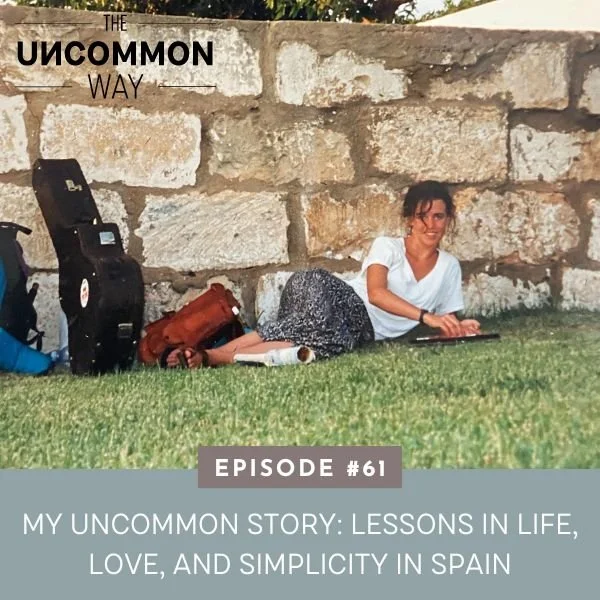
Ep #61: My Uncommon Story: Lessons in Life, Love, and Simplicity in Spain
Lean in and listen to a tale from my young adulthood. Learn about my first love, travel, and hidden gems. Discover how navigating cultural differences built my love for my Spanish boyfriend, along with the beauty and lessons of slow living.
Episode Summary
Jenna continues her Uncommon Story series, unpacking the slow life, romance, and the wisdom of other cultures.
Join us in the Clarity Accelerator by scheduling a call here.
Enjoy the show? Leave a review to help other like-minded entrepreneurs gain clarity in their businesses.
If you'd like to talk about working together, book a call here.
Show Notes
In the last episode of this series, I hinted that when I made the decision to not leave Spain and go instead to Seville, that one decision was going to really change my life. This is how decisions are. So often, you can never imagine the ramifications that could come from one simple decision.
This week, you're going to start to see how this was so true in my life. My Uncommon Story picks up in Spain, hitting the Eurail and all that goes along with improvising as a poor college traveler. This is a rag-tag story of youth, beauty, love, and learning.
Lean in and learn about my first love, travel stories, and the hidden gems I learned along the way. Discover how living in Spain led me to question the traditions I was raised with, the comfort zones I was used to, and my perceptions of other cultures.
What You’ll Learn From This Episode:
How my perception of Americans evolved.
My experience of being immersed in Spanish language and culture.
The surprising normalization of drug use across social classes I observed.
What I learned (and loved) about simple living.
How I realized I didn’t need as much as I thought to survive.
Listen to the Full Episode:
Featured on the Show:
If you'd like to talk about working together, book a call here.
Click here to sign up for my newsletter and find out how the Connect The Dots Method has helped clients in all stages of their business.
Follow me on Instagram for behind-the-scenes content and daily value bombs!
Click here to learn more about the Clarity Accelerator.
Full Episode Transcript:
You're listening to The Uncommon Way Business and Life Coaching Podcast, the only podcast that helps you unlock your next level in business and life by prioritizing your clarity and your own Uncommon Way. You will learn to maximize your mindset, mission, messaging, and strategy in order to create a true legacy. Here's your host, top-ranked business coach, and reformed over-analyzer turned queen of clarity, Jenna Harrison.
Welcome back to The Uncommon Way everyone. I hope you are enjoying your September. When we first began this series, it was meant to be just a few episodes that you could listen to when you were on the beach or having some downtime. It was just going to be a summer series but it hasn't turned out that way. So, I guess these will be, I don't know, spicing up your fall, heating up your winter. We'll see. I'll continue to drop a few here and there.
But this is a special episode. I hinted last time that when I made the decision to not leave Spain, after studying in Alicante, and go instead to Seville, which is where we left off last time. I hinted that that was going to really change my life, that one decision. This is how decisions are. So often, you can never imagine the ramifications that could come from one simple decision.
You're going to start to see how this was so true in my life, in this episode. But before we even get to Seville, I had some time to kill in between semesters. This is a time when transcontinental flights were still very expensive, and my mom grudgingly conceded that it probably wouldn't make sense for me to fly all the way home just for a week or two.
So, I decided I would stay in Europe and just use the Eurail pass that my parents had gotten me when I first went over there. I don't know if they still exist, probably, but it gave me pretty much carte blanche to go anywhere that I wanted to via train. I had a friend who was an exchange student in my high school back in Washington who lived in Germany, so I figured I'd go visit her up there.
But I had something else up my sleeve, too. Which is, what we didn't know back in the States, is that in Europe they were really getting into the charter. There was a very big charter flight industry. And so, I had found a charter flight that flew from Madrid to New York, I think it was every couple of weeks, and I decided I was going to go back and surprise my parents.
I want to say I had seven days to kill, or a little less. So, I thought, “Oh, perfect. I'll just go see my friend, and then I'll take this scenic train trip through the Alps, come back to Madrid, hop on the flight and fly out.” Meanwhile, there was a person who was a coordinator for our exchange trip in Madrid who would always meet the group when they got off the flight and get them all to Alicante.
So, I asked him if I could leave my suitcases at his house and then take a travel suitcase that would be more convenient. He said, “Sure.” But there was a little hiccup when I got to Madrid, because he wasn't home. I had a train to catch to go up to Germany. Mind you, there are no cell phones in this day and age, there was really nothing I could do.
So, guess what? I just left my bags outside of his house. Now, he lived in an apartment building, so I had him leave them straight on the streets of Madrid. But I did have to wait until somebody was exiting the building, and then basically sneak into the building, get up to his apartment, and just leave the suitcases right there. Hopefully they’d be there when I got back.
I made it to the train station, hopped on a train, and I was the only person in my compartment. It was like a six-seater compartment. I saw a young man walk past the door, and then come back a minute later. He came and sat in my compartment as if that's where the seat was. He was very handsome. We got to talking.
In the middle of the night, we had to transfer trains because the train tracks in Spain were a different size than the train tracks in France, so we had to get onto another train. It must have been something about the late-night hour, but when we got back on the other train, something sparked up and we just started kissing and cuddling.
Now, there was a conductor walking by so it wasn't going to go any further than that. But I did find it all very romantic and exciting finding romance on this international train in Europe; very much fit the schoolgirl fantasies. Luckily, we exchanged numbers but it never went anywhere after that, and I'm really glad because there's more fun stories coming up.
I remember the trip in Germany being so fun. Then was time for my Alps adventure. So, my train went from Germany down to Paris. In Paris is where I would catch this loop that would go through the Alps.
This is before the Euro; I'd mentioned that before. And so, every time that you were in a different country you had to exchange money, and you always lost money on the exchange. I didn't have that much money. Remember, I pretty much spent everything for this flight to get back to the States. So, I changed the minimal amount that I could.
I walked around Paris, looking for something to eat that I could afford, that would be the most bang for my buck. Something warm, and hopefully hearty, to hold me over. You all, I have to confess, the best thing I could find was a Burger King burger. Yes, that was my first time in Paris and what I had was a Whopper. But I figured, that's okay, I'm about to have the true experience on this beautiful train through the Alps.
But I had a couple miscalculations about this. One, is that as the train went through the Alps, it was passing through several different countries for which I did not have currency. So, I actually wasn't able to eat on this train trip. I mean, I could have, but I was so stubborn. I didn't want to lose any more money in the exchange fee. And so, I didn't.
The second miscalculation was that it was winter break in the Alps. The trains were packed skiers. I, of course, had bought the bargain basement ticket. You all can see, right? I hope you're understanding now, my journey from complete scarcity towards abundance. The way I talk about money now, you would never imagine, right? But this was me. This was me.
I was the poor college student saving every single little cent that I could, or peseta, or whatever currency I happen to be in at the moment. So, I had bought the bargain ticket, and there were no seats for me. So, not only had I not eaten, I'm wearing this big backpack traveling around, but I was having to stand up on the train going through the Alps.
But at least I got to see the Alps, right? Wrong! Because guess what else happens in winter? It gets dark so early. By the time we actually got into the Alps, it was after four in the afternoon. It was so dark; I couldn't see a thing.
What happens, later in the night as we're going through, I faint. Yes, I faint, probably from dehydration. And so, someone has to move aside, give me their seat, and bring me back. Nowadays, they probably would have called the ambulance or something. But back in those days, they were like, “She'll be fine. Just give her some water.”
We continued on, I got off in Milan, and I had nowhere to sleep. And so, I just had to kind of hang out in the train station all night until I could get on my train to Madrid, and then catch my flight back to the States; on this charter flight which would bring me to New York. Then from there, I would catch another flight to Washington.
I'm really wondering if you find this as crazy as I do. I crack myself up, obviously, just thinking about my younger years. But for those of you whose thoughts are actually going to my poor parents, I’ll tell you that of course, my mom really never even wanted me to study abroad. We were very, very close and she didn't want me to be away from her.
And so, she was disappointed when we realized that I couldn't fly back to the States for that interim period. I knew that she would be so happy when I walked through the door, so I wanted to make it a surprise. I had a friend from high school pick me up at the airport to bring me home. My friend said, “What will you do if your parents aren't there?” I said, “Oh, they'll be there.”
I guessed that mom would be in the kitchen, and Dad would be watching TV. Guess what? That's exactly where they were. I just walked in and I said, “I'm home.” To this day, mom says it was the best present ever. She was so happy and it was so good.
Now you're caught up to the point where I finally did get back to Seville, to study Economics at the University of Seville. My first order of business was finding somewhere to live. This is not like nowadays where you can look online and get everything all arranged before you actually get to a city. You would never think about going to a city and having nowhere to live.
But back then, especially when you're traveling in Europe, what you would tend to do, you'd get off the train and there would be ladies there that had a room for rent or something. They would just call out “Rooms for rent,” you’d meet one of them and you'd go back to their house. That's where you would be staying for the night, or the three nights, or however long you were touring that place.
I knew that I wanted something more than three nights, so I did not stay with them. I stayed in a hostel at first, and then somebody told me… Oh, I know, it was my friend. I had a friend that I mentioned on the last podcast, who had also studied in Alicante, who convinced me to continue and study in Seville.
He told me that at the university, there was a board where people would post notices of rooms for rent. So, I went there, and there happened to be somebody hanging up a notice right as I got there, and I got it. I went to see this place. Immediately, I fell in love with it.
Now, if you don't know Seville, first of all, is the most beautiful city you've ever set your eyes on. It's just magic, with its little yellow and white buildings. It also has the largest Gothic cathedral in the world, a beautiful plaza, a round plaza with horse drawn carriages, and it's just so picturesque.
Well, this apartment was in a building right on that main street leading straight to the cathedral. We were on the top two floors of that building; with balconies, and I mean, the view was to die for. It was a really fun apartment made up of all different international young people, really. I was paying the most of anyone there so I got the room that was right on this main street, Mateos Gago, looking straight at the cathedral.
There was the woman who had the lease on the apartment, she was a Dutch woman, and she lived downstairs with her boyfriend. Later, it came to pass, that apparently, she was never passing on all of our rent to the landlord. Apparently, supposedly, she had some sort of sexual liaison with the landlord so that he didn't kick her out. But she was, meanwhile, taking all of this money.
Upstairs, there was another American woman who had a Spanish boyfriend, who also lived in the apartment. There was an older American couple. I say, older, they were probably my age now, but they were empty nesters. They were just doing the kind of vacation where you actually learn the language. So, they would come over for a month or so, and were studying Spanish while they were there.
There was another Dutch woman. Boy, was she a character! I had never met somebody so sexually liberated and out there. It just absolutely knocked my socks off. I think I'm forgetting somebody. But anyway, it was a large group of international people all there for different reasons. Such a fun environment.
I remember that once, somebody brought some people from New Zealand over to the apartment. When they met me, the woman said, “Oh, you're American. So, I know one thing about you for sure, and that is that you are way more repressed than I am.”
I somehow had grown up under the impression that Americans were the most rebellious, and the most sexually liberated. That the world thought of us as like little James Dean rebels.
It was so eye opening for me to realize that actually, that's not how most of the world saw us. I have to give it to her; she was 100% right. I was very, very repressed and very conservative at that point in my life, which is probably why kissing on a train felt so naughty. In hindsight, it was nothing. But hearing that and then contrasting myself with this Dutch woman who lived there, who really just seemed to have another man every night…
She was very much like, “I say where. I say when. I say who.” Pre-Julia Roberts. She would do things; she would just have fun being the object of desire for all of the men in the neighborhood. There was a pizza place across the street. You had to take like four steps up into the restaurant. She was famous for sitting there at the first table with a very short mini dress and no underwear… As people would walk by, seeing who would notice this and who wouldn't.
I'm laughing. It's completely inappropriate, and so fascinating for me. All of this is the backdrop to the life that we're living there, my friends and I, as we were able to really get further into Spanish culture. There was this little flamenco tablao that we would go to at night, and we really felt so transported.
What was amazing, was that after hearing that music, when I would come home, I'd go back up to my top floor, have the large windows open… of course, no air conditioning… and I would hear beautiful strains of guitar, flamenco guitar, classical guitar, coming up. I realized that one of the workers in these restaurants down below, one of them played guitar. So, it was like I was getting serenaded. I loved it.
I'd tell all of my friends, “Well, I've got to leave now, because at midnight the serenade starts and I want to be home for that.” Now, I had no idea who this person actually was. Because, movie perfect, the orange trees that line the streets of Seville were in full bloom at this time. And so, not only was I hearing the beautiful music, but there was also the wafting fragrance of orange blossoms coming up to me, as I would stand out on my balcony each night and listen to this.
My friends would say, “Don't you want to know who this person is? Wouldn't you rather hang out with us a little longer so you can actually see this person face to face?” I said, “No. No, that's a terrible idea. Are you kidding? This is the perfect romance right now. I can imagine whatever I want about this person who serenades me, and in truth, I know. He's some abhorrent Spanish man.”
If you've listened to my earlier episodes, you'll have heard that I had some unfortunate experiences in Spain. I had a bad impression about Spanish men, in general. I thought they were uncouth. I thought they were arrogant. Now, if this is not the perfect setup for a romance novel, I don't know what is.
There's one other little detail that I have to tell you about. So, in order for anyone to come into our apartment, because there was no buzzer or intercom, and we lived on the fifth floor, we had a key. These doors are probably 20 feet tall, and made of old wood. This is old Seville architecture. The key was probably four or five inches long; one of these old-fashioned keys. We had that tied to a rope.
And so, whenever anyone would come over, they would have to shout up to us from down below. We would lower the key down on this rope, they'd untie it, use the key to get in the building, and then they'd come up to see us. We'd reel the rope up again and we'd retie this key, right?
All right, one afternoon, I'm walking home from the university. and there are two young Spanish men lounging against a car that's parked outside of the building. As I got closer, I swore that one of them made one of those Spanish sounds.
Now, I've talked in an earlier episode about what was called piropos, about little compliments that people would throw out. One of the most common kinds of sounds to get a woman's attention was something like tut-tut. Now I swore I heard that; he denies it to this day.
But as I walked up to my actual door, he goes, “Oh, you're the girl with the key. You're one of the girls with the keys.” I turned around and I said, “Yeah, that's the only way we could get people in.” He said to me, “Well, maybe one night, you'll lower the key so that I can come up.” I said probably not, “Probablemente, no.”
I walked into the house, shut the door in his face, and locked it. Remember, we're on the fifth floor so I have all these flights of stairs to walk up, and listen to the combatting voices in my head. One of them is saying, “Jenna, you are such a prude. Leslie never would have said that to an attractive man. Why are you like this?”
The other voice was saying, “You know what? Maybe it's time to let loose a little bit. This could be a fun Spanish little fling. Why are you so in your head?” By the time I got up to the fifth floor, something had shifted within me. I walked into the house and I said to my friends, “Why did nobody ever tell me that the father of my children was working across the street?”
I forgot to mention that the reason I knew he worked across the street is because he had said to me, yes, we see you all lowering your key all the time. So, as soon as I burst into my apartment, said this, and I described the person, they said, “Oh, we've told you about him. He's the one that we've said you missed hanging out with a few times, who plays the guitar.”
It was one of those moments where it's like you lose the ground beneath you and you're just sucked into a vortex. It all comes rushing to you so quickly. I realized that that man was the one who had been playing the guitar and serenading me each night. Now, in truth he wasn't serenading me, with the orange trees there, he had no idea I was standing out on my balcony. But in my mind, he was serenading me and it was really a coming together of worlds.
Within a week, we were throwing a party on the rooftop and coincidentally, this was an event that both I and Paco could actually attend at the same time, so we met officially. We were like two magnets. We basically moved in together from that point. Because he was staying with his sister further out of town, and since he worked right there, it just made sense that he started spending more and more time with all of us in the apartment.
Now, because of that, because he was working, he'd need some food, something to eat. He got a little sick of just eating the pizza, from the pizza place that he worked at. I think I had one dish that I had learned to make by that point, which I proudly made for him. It was cooked spaghetti with lemon juice and a lemon pepper sprinkled on top and some parmesan cheese.
My mom is an amazing cook, and she always kind of shooed me out of the kitchen. So, I went straight from her house, to the dorm room, to this place, where luckily the older Americans at least showed me how to boil pasta. But I was really clueless in the kitchen. Paco told me, “Hon, I'm just really hungry for a nice hearty chicken soup or something. Could you make that for me?” I said, “No, I would have no idea how to make chicken soup.”
He wrote me a little list to take to the marketplace, exactly what vendors to go to, and what foods to buy. Then, all I had to do was throw all the ingredients into a pot and boil it, and he'd take care of the rest when he got home. So, dutifully, I did exactly as was told.
I remember watching with horror, when, part of what the butcher was wrapping up was chicken feet. Now, you hear nowadays about nose-to-tail cuisine. The Spanish were famous for nose-to-tail cuisine, historically. So, apparently, they thought the best flavor came from the chicken feet.
I brought these home, I held the package out as far away from me as possible, I undid the tape, and then I kind of plopped it all into the pot. I just thought it was the grossest thing ever. I put the lid on; I didn't want to see anything else about it.
Well, here's something that I didn't know. It sounds so bad, but did you know that you should clean out the chickens feet before you put them in there? Because the chickens have been walking around in a bunch of poop, and you don't just want to throw it into the pot. Yes. How would we have known this? But apparently this is a solid truth.
When Paco opened up this pot, what did he see but a bunch of shit floating around on top of the water. Bless his heart. He kept it together. He let me know how they usually would have handled the chicken feet. He skimmed off the top, and would you believe he still ate the soup, which had been boiling for hours. I'm sure it was okay. But man, if that's not love, I don't know what is.
Our relationship was so sweet and so special. Really, it was my first true love. I remember people saying to him, when they thought I couldn't understand the Spanish… Of course, my Spanish starts getting better and better as I'm in Seville… They would say, “Why are you with her? She's not even sexy.”
You have to remember, this is the 90s, so it was a very kind of androgynous culture and fashion, back in the States. This is pleated khaki pants, big button-down shirts cut very loose with big arm holes and tucked into your pants, and loafers or something. I don't know. It wasn't attractive. Yet, this is pretty much all I knew. I wasn't wearing a lot of makeup. I tended to have my hair up in a bun.
Remember, I'm coming from my very intellectually driven college where we don't care about superficial things. It’s very granola. He would just say, “She's amazing. She's like no one I've ever met.” We were so attached that when that spring was coming to a close, and it was time for me to return home, I didn't want to leave and he didn't want me to leave.
So, he said, “I'm going back to the place where I'm from, which is an island in the Balearic Islands. A very small island called Formentera. I'm going back there for the summer, and I think you should come with me.” I said yes. I decided to go.
Now, my parents freaked out over this decision. You're doing what? You met who? You're living in sin? They were not very religious, but it was that kind of atmosphere, right? It was like, “You guys are going to live together for the summer? What does this mean? You're only 19.” I think I had just turned 20 actually.
In their fear and worry, what they did was they cut off my bank account in an effort to force me back home. I'm a little foggy on the details of this, but somehow, I had already withdrawn some money. Some money just for my initial ferry trip and everything, to go back. But when they saw I was serious they cut off the money, which was a big falling out for us.
I think we still have some of the angry letters, snail mail, of course, going back and forth where I was talking about how they need to trust me now. I'm an adult. All of those things that happen when you're that age, and you make decisions about not coming back and running off with your Spanish boyfriend.
But honestly, you all, it’s one of the best decisions I ever made. Formentera is paradise. It is so special. Years later, when I was a travel blogger, that is the one place I would not write about because I didn't want it to be discovered. I didn't want it to be found out.
Now, it very much has been found out, which is why I'm talking about it. But for years, it was the best kept secret. It's very, very small, and very remote. There's no airport on the island, which is what helped it stay hidden for so long. But it's also right next door to Ibiza, so any of the super-rich people that are coming through on the yacht circuit would obviously know about Formentera, and sail over to Formentera.
So, you got this strange blend of the super-rich, although you'd never know it until they jettied back to their yacht. You had the super-rich, and you had all of these dropped out hippies. They had just decided to drop out of the rat race and leave the corporate culture or academic culture, wherever they were coming from, and just really live the true, simple life on this forgotten island.
You also had these locals that were absolutely lost in time. The older women still wore the traditional black dress, and they drove horse-drawn carriages. They had been a culture that was repeatedly attacked by pirates or invaders from all different cultures; The Romans, the Catalans, all different Italian people. Because of this, they had become a very closed off culture. They were very suspicious of outsiders. It was almost like an Amish community or something. They were just very, very tight.
But for me, who had never seen anything like it, it just fascinated me. Oh, and they lived off a barter economy still. It was like, “Hey, Francesc…” By the way, I couldn't even communicate with them because they didn't speak Castilian Spanish. They spoke a dialect of Catalan. Catalan is the language spoken in the Barcelona region. They didn't even speak Catalan; they spoke their own dialect of Catalan.
It was very much like, “Hey, Francesc, I'll trade you my pine nuts for your wine. I'll trade you wine for cheese. I'll trade you cheese for bread.” Well, probably not wine, cheese and bread, because I think everyone made wine, cheese and bread in their own house; they were all homesteading. But they were definitely trading items for subsistence.
And they were very wealthy, because they owned all of the property on the island, which was now being rented out to tourists. There were tourists as well, and it was very interesting how it was staggered. The Europeans very much tended to go vacation at the same time, right? Then they'd come back year after year to the same place.
So, I remember, June was mostly British. July was German. August was all Italian tourists. My boyfriend and his family were anomalies because they were from the south of Spain. His parents had come over in the 60s when electricity was first brought to the island. It was a big thing. They had recognized a business opportunity, and so they stayed and they opened restaurants there. So, he was very much in between worlds.
But all of these different groups very much had a respect and an easy kind of commingling between them. So, you'd never see a hippie that was best friends with a payas. Payas mean the local people of the island. There was a very large level of acceptance and tolerance, and we're all just living our best lives here.
So, we went to stay with Paco’s parents, and what we were not anticipating was that his mom did not like me at all. She thought that I was putting new thoughts in his head. Crazy things, like maybe using a little less oil when you cook your chicken. She thought that I was after his money because he was a good hardworking man, and I didn't have any money.
It was true, at that point my parents had cut off all of my money. I hadn't worked since I was at that towel shop, back in Washington, before the Spain trip. But really, deep down, her biggest gripe with me was just that I didn't behave the way a daughter-in-law should behave. There was this big unwritten code about how a daughter-in-law should behave, which I of course, didn't know.
So, I should have been the first one up in the morning in the house, helping prepare breakfast for everyone. I should be the last one to sleep. I shouldn't be cleaning the house. I should do everything I could to have my mother-in-law sit down. And I, of course, would be cleaning the dishes or I do anything I could to take any kind of burden off of her. I didn't know that.
I thought I was a guest in her house. I mean, my mom would have freaked out if a guest tried to jump up and start cleaning the dishes back then. “Am I not a good host? What are you trying to insinuate here?” I very politely let his mom do all the work, and she very adamantly thought that that was ridiculous and self-centered and lazy. Yeah, lazy.
So, this finally blew up, to the point where they said, “Get her out of the house.” To the point where she said, “Get her out of the house.” Paco said, “Fine, we're leaving.” She said, “If you walk through the door with that girl, you are never coming back.” And he walked out. He walked out.
We went to scout around for a place to live, because of course, by now it's June and most of the places on this tiny little island are rented out to tourists. Luckily, he knew people. He'd grown up there. He heard that clear on the opposite tip of the island, there was maybe a small house that he could rent.
Now, the way this island formed is that there's a lower half, which is very flat. This is where all of the tourist activities are. All of a sudden, the other half, it's called La Mola, juts out of the sea, and it's this plateau. So, you have to wind up this windy road to get up to the Mola, up to this plateau. And then once you're there, that is where most of the most isolated local people lived.
There was a hippie commune there, as well. At the very tip, there's this lighthouse and plunging cliffs, straight down to the sea. It was so beautiful. Well, the very last house, by the lighthouse… supposedly Bob Dylan stayed in the lighthouse, who knows?... but the last house apparently was vacant.
So, Paco went to talk to the payas, speaking the local dialect of course, and was able to get us in there. Now, like many houses, and most houses up there on that part of the island, this house had no electricity. It didn't even have a bathroom in the house. There was a bathroom outside of the house. There were two little houses next to each other, and that's what they shared.
That's where we were living for the summer. Now, when the payasa inquired about me, Paco tried to tell her that I was a foreigner, that I was from far away. She looked, I remember her head kind of tilting, and she said, “Barcelona?” He said, “No, no, further away than that.” She looked at me again, and she said, “Holland?”
Because they were, in the very beginning, the first tourists that came; there were a lot of Dutch tourists. So, that was stuck in her mind. Like, people that lived really, really far away must be from Holland. He tried to tell her further than that, and she just couldn't conceptualize what that might mean.
So, because there were no other tourists around us… There was one bar where the hippies would go, and some mainland locals that live there, would come up to sometimes. Needless to say, this is when I finally learned Spanish. I mean, really learned Spanish.
Because Paco didn't speak any English, hardly any English, I was forced to learn Spanish. I really think that that is what allowed our relationship to flourish for so long. Because what starts to happen when you both speak the same language, is that you become so attuned to intonation. There are little barbs that you can throw in when you start getting frustrated or annoyed with a person.
Paco and I didn't have any of that. We had the most simplistic language. We had to be very clear with our communication with each other, and it really cut out any of the misunderstandings, I think, that can start to bubble up in other relationships.
The only time I spoke English was once every three weeks when my parents would call. Now, there are no cell phones. Again, there's no landline, no phone coming into our house. So, remember that bar I told you about? They would have to call that bar at a certain time, every three weeks, and the bartender would pass the phone to me so that I could talk to them. I was trying to hear them over the noise.
I was always cognizant of the fact that I was tying up the phone line of the bar for the 10 minutes or 15 minutes when I talked to my parents. My poor parents, in hindsight, they had no idea what was happening with me. But other than that, I was fully immersed.
Now, we had been hoping that Paco wouldn't have to work. By the way, that's not his real name. But we had been hoping that he wouldn't have to work, and I used all the money I had, that I'd taken out of the bank, to rent the apartment, the little house that we were staying in. Which was super cheap because he got the local rate, of course.
But then we had no money for food or for gas to get around the island, and so he did have to get a job. He's an amazing cook, so he started working at a restaurant. He was earning the equivalent of $400 a month. That’s what we had to live on for the whole summer, including our gas, including food, including all the things, utilities, of course.
But it's amazing how far $1, or in this case a peseta, can stretch when you're in love. When you're just determined to make it work. That really was my first lesson in sufficiency. Everything that I thought, the amounts, that I thought it would take to survive actually weren't true. Now, we were lucky; often, one meal of the day, he would bring home food from the restaurant. So, there was that. But still, $400 a month!
Because he was working at night, we would have these really lovely days together. Honestly, just making love, exploring the island, going to the beach, and then eating maybe it at a little… they call them chiringuitos… tiny, little shack-a-boo type restaurants on the beach. They don't necessarily have any electricity; they just catch the fish completely fresh. They have a little gas burner and cook up the fish for you, you have some drinks, and that was island life.
On days that he was off, we would stroll down, at sunset, we'd get a glass of wine, and we'd play some backgammon with the little old men that were playing backgammon around us. But most nights, he would head out in the late afternoon for the 30-minute drive down the island to the main city for work.
I remember my heart hurting; I was worried. What if something happened to him on this drive, especially up this winding road late at night? I remember, we didn't really have a closet. He had gotten a long branch from outside, and that was our kind of our closet, where we hung clothes. I remember just touching his shirts hanging up, so lovingly, so much missing him even for those few hours that he was away from me. I just couldn't stand it.
Then, after midnight, because the Spanish eat very, very late, he would ride home, usually carrying a pizza box for our dinner. Sometimes after that, we’d drive back down again to go out to the bars and clubs that night.
But this really was a whole new world for me. All of these groups of people were not ones that I would interact with back home, and also, to see how they interacted. How the tourists interacted with the hippies and the super-rich out in these clubs was just fascinating. That was really my first exposure to…
I suppose Seville was my first exposure to different sexual mores, but this was really my first exposure to drugs. There was a lot of hash, specifically hashish, being passed around. People would just pull out the cocaine right on the table of the clubs, and cut up some lines and be snorting up the cocaine right there. It was very normalized.
I noticed, what I think blew my mind even more than the fact that the drugs were so normal, was that it crossed classes. I started to come up with a theory about middle-class values, which is that really, the way I had been raised here in the middle class, we lived in a bubble of ‘do's and don'ts.’
Meanwhile, people that tended to be on the lower end of the economic spectrum really didn't live by those same rules. So, there were more drugs. You tended to have more sexual partners. When I looked at the super rich, it was exactly the same; they were doing drugs, and they were switching partners. I started to think, “Huh, I wonder which one is actually more beneficial and is actually more natural for humans?”
But that kind of got blown away when the house next to us, up there on the Mola, got rented out to some people from Madrid. They were what we would have… they’re called pijos… what we would have called yuppies. So, they were kind of well-to-do, had money, had good jobs. So, upper middle class, right?
I expected them to be really aghast right when Paco would be sitting out on the porch smoking a joint. But actually, they're like, “Oh, great. Yeah, we brought some too, you want to smoke together?” I just realized that there was a completely different national attitude around recreational drug use.
Now, I, myself, I didn't enjoy smoking hash, it tended to make me really paranoid. But cocaine, that was fun. The biggest eye opener of all was definitely the way of life on the island. I already alluded to this, or already talked about this in the last episode. It’s just this true desire for the good life, to understanding what is “the good life,” and simplifying down all the things that really don't matter, not stressing so much.
I very much saw that embodied here, even more so than in Seville. There was a character that I loved so deeply; everybody called him Joaquin Francaise. He was actually from France. Supposedly, he'd been a famous journalist or professor, and had finally realized that basically, the modern world was just shit.
He really wanted to drop out of it, so he went to Formentera and just never left. He never really had a job. He did have a house he lived in, but he'd just be eating off… You’d always see him at different dinner parties and things. He looked like the Spanish artist, Salvador Dalí. He had this long, gray, handlebar mustache.
You'd see him on his little motorbike, going down the road, with a scarf wrapped around his neck and flowing in the wind behind him. He was just such a character. Of course, nobody wore helmets. He was such a character.
He told me once, I'll never forget, he said, “Jen, do you know what true freedom is?” I said, “What?” He said, “True freedom is waking up in the morning, stepping out of your doorstep, stretching in the sunlight, seeing that beautiful tree in the distance, and saying, ‘I want to go to that tree,’ and then actually doing it. Yeah, not saying, ‘Oh, I'll do that later. I'll do that someday.’ But actually, doing it then.”
I remember once, this was later but I'm going to bring it in now, in Spain they had a huge Christmas lottery. Everyone played the lottery for Christmas. I remember getting all excited about the big pot of money that was available. I said to Paco, “If you won, what would you do?” Because I knew, chances are you're not going to win, but part of the fun is just daydreaming.
He said, “What do you mean?” I said, “No, what would change in your life? What would you want to do differently?” He just looked at me, and he's like, “Why would I want to change my life?” Oh my gosh, the lessons, the lessons, just non-stop hitting me.
Imagine living life truly the way you want to live, and really not wanting to change anything. It just blew my mind. Right? There was nothing about that, in my hustle striving, get into the best school, to get the best job, to have the best car, to have the best house, kind of life that I had been raised in.
I was also noticing how a lot of the hippies lived. Not just the hippies that were living in the commune raising livestock together and growing fruit and vegetables together. But there was another type of hippie that were vendors. They would sell jewelry and sarongs and things like that to the tourists.
What they would do, was they would sell all of these trinkets during the summer, they'd take the proceeds and they would go to either Goa, up in India, or somewhere in Mexico. They'd buy their inventory over the winter, but they'd also live in a beautiful climate, continue to party, and continue the life until it was time to fly back to Spain for the season. Then they'd sell off all of their inventory, and they'd get the money to travel again.
Oh, on top of that, because it was a socialist country, every two summers that they worked, if they made those six months, then they'd get to collect unemployment throughout one of the winters as well. The absence of striving, and the way that they lived in these premier locations, that other people only vacation in a week or two a year, really opened my eyes to possibilities.
And to the fact that we, back in the U.S., maybe the way we chose to live wasn't the way I really wanted to live. Maybe there was a much better life available to me another way.
The last thing that was happening, there was really kind of a form of anti-intellectualism, and not in the Trumpist way that we have now. But I started to really honor and listen to the local people and the wisdom, the natural wisdom that they'd acquired.
It really, when I thought back to my philosophy professors and the way that we all lived, it really started to challenge my worldview of who is the fit person to teach, right? Who do I really want to learn from? So, it made it difficult, very difficult, for me to even think about returning to college.
I felt so divorced from that world, and so much like I'd found home there in Formentera. I did consider dropping out, but I was afraid. Now, this is pre-internet, of course. There's no way to telecommute or to even think about communicating with your family back home once you leave and move to another country. We'd get a letter in the mail every month or something.
I thought I “needed” that degree, right? That's the smart, adult thing to do. I could die homeless and penniless if I didn't do it now and continue this education. Looking back, it’s so interesting that I considered myself a person who always broke with expectation, and did live such an uncommon life, but here we're really seeing exactly where my rails were.
I could go this far out of the norm, this far out of the comfort zone, but I couldn't really push beyond that. That is the place where I think so many of us find ourselves. Where we're able to go so far, but not really all the way.
So, on the final day, when I was due to leave and go back home, Paco took me to Ibiza, to one of the nicest restaurants to have lunch. I just couldn't eat. Tears kept overflowing. I was having to choke them back. I felt sick in my stomach, and I just couldn't eat a bite.
We were standing in line at the airport and it was distressing him so much to see me like this. I had my arms wrapped around him, and I just wanted to soak up every single second that I could. He finally said, “You know what? I'm coming with you.” I said, “What?” He said, “If I can get a ticket for this flight, I'm going to hop on. I'm going to take you to Madrid,” where I'd catch my international flight. There was a place available for him.
This was a wildly decadent, to buy a plane ticket to Madrid just for a turn-and-burn. But I was euphoric on the plane. We were so in love. It looked like we were probably honeymooning or something. When we got to Madrid, I called my dad, my biological dad, whom I was going to go visit first, before seeing my parents, my mom and stepdad, and then going back to school.
I knew he hadn't seen me in over a year so I knew he was missing me. I said, “Dad, here's the situation. Would you mind if I just stay one more day, and I come home one day later?” I am forever grateful for his understanding. He said, “Jen, I remember being that in love. I remember my first love, I completely understand. Absolutely. We'll see you tomorrow.”
Paco and I had a wonderful night in Madrid. I have very keen memory of us hanging out in the Plaza Mayor, with time just feeling like it was stretching out. The next day, I felt so much more prepared and optimistic. There was something in that token move that showed me that somehow, we're going to make this work even though we come from two different countries and two different worlds.
So, my friends, I will close this chapter here, and wish you the very, very best week to come.
Hey, if you want true clarity about your secret sauce, your people, your best way of doing business, and how you talk about your offer, then I invite you to join us in the Clarity Accelerator. I'll teach you to connect all the dots, the dots that have always been there for you, so that you can show up like you were born for exactly this.
Come join us and supercharge every other tool or tactic you'll ever learn, from Facebook ads to manifestation. Just go to TheUncommonWay.com/schedule and set up a time to talk. I can't wait to be your coach.
Thanks for joining us here at The Uncommon Way. If you want more tips and resources for developing clarity in your business and life, including the Clarity First Strategy for growing and scaling your business, visit TheUncommonWay.com. See you next time.
Enjoy the Show?
Don’t miss an episode, follow the podcast on Spotify, Apple Podcasts, or Google Podcasts.

Ep #60: An Uncommon Guide to Maximizing Your Results in Any Coaching Program
Learn the key components you need to maximize your results within any coaching program. Discover how to support your coaching by taking responsibility, forming a community, and leveraging time, and how to open yourself to think bigger, grow more, and expand to your greatest entrepreneurial expression yet

Episode Summary
Jenna the key components you need to maximize your results within any coaching program.
Join us in the Clarity Accelerator by scheduling a call here.
Enjoy the show? Leave a review to help other like-minded entrepreneurs gain clarity in their businesses.
If you'd like to talk about working together, book a call here.
Show Notes
Have you ever wondered why some people get great results from a program and others in that very same program don't? Would you like to know how you can be the person who's getting the great results rather than the mediocre kind? This week’s episode will show you how.
We can be really hard on ourselves when it comes to our results, but the more we believe in our vision, the more likely we are to transform within any coaching program we are part of. This week, I share some of the highlights I’ve learned and discovered along the way regarding results and show you how to amplify your own.
Learn the key components you need to maximize your results within any coaching program. Discover how to support your coaching by taking responsibility, forming a community, and leveraging time, and how to open yourself to think bigger, grow more, and expand to your greatest entrepreneurial expression yet.
What You’ll Learn From This Episode:
How to get amazing results from any coaching program.
Why you need to take personal responsibility and how to do so.
How to decide whether private coaching or group coaching is more appropriate for your needs.
Why continuing what works is so important.
Why it takes time to assimilate new ideas.
Why my clients get such amazing results and how the same is possible for you.
Listen to the Full Episode:
Featured on the Show:
If you'd like to talk about working together, book a call here.
Click here to sign up for my newsletter and find out how the Connect The Dots Method has helped clients in all stages of their business.
Follow me on Instagram for behind-the-scenes content and daily value bombs!
Click here to learn more about the Clarity Accelerator.
Full Episode Transcript:
Have you ever wondered why some people get great results from a program and others in that very same program don't? And would you like to know how you can be the person who's getting the great results rather than the “I mean, I think it helped me,” kind of results? We are going to get you there today.
You're listening to The Uncommon Way Business and Life Coaching Podcast, the only podcast that helps you unlock your next level in business and life by prioritizing your clarity and your own Uncommon Way. You will learn to maximize your mindset, mission, messaging, and strategy in order to create a true legacy. Here's your host, top-ranked business coach, and reformed over-analyzer turned queen of clarity, Jenna Harrison.
Welcome back to The Uncommon Way, everyone. We are currently enjoying beautiful weather here in central Pennsylvania. I hope that you are not stuck in a heat dome at the moment. Of course, we were just watching, with dismay and amazement, so many of the weather patterns that are happening around us, and we certainly experienced it when we were in Spain.
Right here, we seem to be in a little bubble. We have this inverse effect going on where normally our August are just the hot and muggy and bug ridden, and now we're having weather in the 70s. It feels pretty ideal, and I am loving it.
My son Dylan has started kindergarten. My team and I are getting back into the workflow after the slightly chaotic and travel heavy summer that I've had. Specifically, we've got a retreat focus going on; just shoring up those final details for the Clarity Collective retreat that's happening in Mexico in October.
Along those lines, we were having a conversation in our Clarity Collective call the other day, where I asked everyone if they had an intention for the next quarter coming up, the next three months of fall. The first woman who spoke said that she was just looking forward to routine. She just was looking forward to this steady routine to really continue with the work.
I said that's really how I'm feeling, and someone else in the collective said, “That's exactly what I'm looking forward to. I just really am looking for this maintenance and this maintaining. It's going to feel amazing.” I found this so interesting, because I very clearly remember a time in my life where fall was very much about that hyper productive energy.
I would just feel so energized this time of year when the weather started to turn cooler. After the times in summer, where maybe I’d been kicking back more and just feeling the heat and the lethargy. September would roll around, and I would just wake up again. I'd have so many great plans, all these things I wanted to do.
I don't know if this is just a sign of the times, that we are all very overloaded and just generally trying to do way too much and cram way too much in, and that's why we're feeling this way. You'll have to let me know your take on this.
But if you are feeling like a lot of us, and maybe you are looking at your business and thinking about what is next, and what is the right container to support the place that I want to be, the place that I want to go with my business. Where you really are kind of looking at just buckling down, and perhaps working with a coach or joining a coaching program in order to create your results better and easier.
I know for a lot of you when you start thinking that way, then the next set of thoughts is: How do I choose the right one? Will I really get the results that I'm hoping for, or will I beat myself up about it later? This episode is directly, specifically, for you, my friends. Because you have seen how some people in programs do get great results, but others not so much.
If you think about it, it's sort of like when you are in college, or high school, whatever. Some people in that class will get A's and others will get D's or F's. Yet, there's the same teacher or the same professor teaching all of them. So, what accounts for all that? Well, I am the person that my coaches usually invite on to their podcasts or feature on their testimonials page because of the results I get in their program.
Today, I want to peel back the curtain on all of that and let you know what has created that for me, because it definitely wasn't always the case. So, I'm going to share some of the highlights of what I've learned and discovered along the way, so that you can amplify your own results this year.
Because the entire world benefits when women get better results; their families benefit, their communities, their clients. It is such a virtuous cycle, and I want you to understand more fully why my clients get such amazing results. How they are so quickly able to transform and then step into such decisive, grounded, focused, calm leadership in their minds first, and then in their companies.
It's because they learn this skill set of creating great results when they're getting coached. It's just like a muscle you build. I'll be breaking down some of those key components, so that you can apply it for yourself. If you are, maybe, on the fence, wondering about whether you should go with private coaching versus group coaching, I'm going to be addressing that too.
This is a very meaty episode today, it's a one of the longer ones. So, strap in. You'll probably want to listen to it two or three times, because there are going to be some very new concepts in here for some of you. And so, in order for that to sink in, you'll probably need some repetition. Just speed up the playback to 1 ½, or whatever you're comfortable with, to shorten the time, put it on, and enjoy.
All right, first of all, you have got to choose a style or a philosophy that feels aligned. Alignment is the assignment, after all. But also, we want to make things as easy as possible for our brains when we can. So, this is a concept that I'm going to refer to several times throughout this episode. We'll just give it a name right now, so that we can get back to it quickly.
Let's call it “brain honey.” Because I'm thinking of that saying, “You catch more flies with honey than with vinegar,” and that's the same concept. When we have the opportunity to make something much easier for ourselves, then do it, lean into it. As you learn more and more about how the brain actually works, you can use this to your advantage over and over again in different ways.
You can find out how to get the brain working for you. Like, when you know a child will resist bath time because of course, the child is having fun playing Legos, he doesn't want to take a bath… Ask me how I know. So, you say something like, “Are you going to take a bath or a shower now?” Because when the shower is what feels best, and it feels like it's their idea and something they can get on board with, the transition is so much easier.
In business, it's the same. You're creating change in your brain every time you sign up for coaching or any kind of business development program. That is hard enough. There will already be resistance in your brain on some level, so the last thing you want is more resistance.
The truth is that every business building method can work if you work at it. You’ve just got to get in there and do the work, on yourself, on your skill set, on your clarity about your offer, your people's wants and needs, your secret sauce, and your zone of genius. So, do that in a place where you're leaning in as much as possible.
There's a tendency, and it's very natural, to say, “Well, I'm weak in this area, so I need to go get slapped around, basically.” Or, “I need to really work with a different kind of coach that complements me,” meaning, they’re way different than me.
I was there myself. The first coach that I ever worked with was someone that I perceived to be super analytical. Very quantitatively oriented, where we were just going to dig into all the little micro adjustments we could make; into a Facebook funnel to look at all the email open rate percentages and all of the link click percentages. We were just going to dial all of these numbers in.
I moved towards that because I thought I was a very big picture thinker and I needed somebody that could help me with my huge perceived weakness. But what I found out is that I flourish, and my business flourishes, so much more when I'm with coaches where I can also lean into the somatic, the body based, practices and the spiritual aspects of my business too.
Am I tuning into my nervous system so that I'm actually tapping into my highest creativity? Or am I falling back into hustle mentality, becoming less productive and missing clues left and right, and ignoring and dismissing my intuition?
I do much, much better when I'm taking a holistic approach to business building. And my clients are exactly the same. Now, it's very rare to find somebody that is coaching in that style and addressing all of those different needs, but it is what I look for now that I know.
So, you might be a person who only wants the quantitative. Or you only want somebody that is talking about your thoughts and your mindset. Or someone who's only talking about the energetics and the “woo.” So, a holistic approach wouldn't really work for you. It would have you going in thought loops because it really doesn't apply to you.
Yeah, maybe that person hit a huge financial goal because they tapped into their intuition, but maybe it's really just because they write really good copy, dammit. All of those thoughts will be slowing you down. Not that you'll never have those thoughts, but you want minimize them. It's the equivalent of yelling at your child, “Put down the Legos and get into this bath, now!” It just won't be the favorable experience that you're envisioning.
Now, small caveat here, there is a time and place for stretching into your growth edge. But when you do that, you want to be in the energy of ‘I really want to see what this is all about. Maybe there's something to it.’ Versus, ‘This other shit hasn't worked, so I guess I need to try this. But it better get me my results.’
All right, the second thing you want to think about is to take personal responsibility for your results, not to outsource them to your coach, and to really focus on the long game. So, back to that professor analogy. It's highly likely that the students getting the best grades are the ones that are taking advantage of office hours and doing extra credit reading, or have built a skill set for themselves of being able to study very quickly and productively, and to retain information.
When you make only yourself responsible for your results, you will see such a dramatic increase in what you're able to accomplish. On my intake form, when people are inquiring about working with me, I say right up front, “The right candidates are resourceful, and they want to learn to figure things out for themselves, with coaching support. Why is this attractive to you?”
This is the same way of thinking behind why I encourage my clients early on, to think of coaching as an operating expense rather than an investment. You invest in infrastructure, right? You're building a bridge, you hire the contractor to build it, the bridge is done.
If you come into coaching thinking you're outsourcing the building of your company to someone else, you're never going to see the results you want. Because nobody but you can build the bridge, my friend. A coach can help you figure out what you want the bridge to look like, your best practices for sourcing materials, etc., etc., but you need to build it.
If anyone tells you they'll build your business for you, you might want to ask them why they're not as rich as Elon Musk, because they've obviously uncovered the best business in the world. They're printing money for other people, and then those people can just sit back and continue to rely on it for the rest of their lives. It just doesn't exist.
But when you think of your support as an operating expense; a smart, ongoing expenditure that is not indulgent, not something shameful that you shouldn't have to pay for if you were smart enough to figure it out on your own…
When you shift away from that toxic thinking, and instead decide that you will always be prioritizing the growth of your mind and the shoring up of your mind because it is your most valuable resource… When you believe in the future success of what you're building so much that you're willing to play that long game, you step into a new sense of power and of seriousness about what you're doing?
You start thinking differently, acting differently, showing up differently, because how you see yourself is different. Then, what gets reflected out is different, and the results you see coming back to you are different. This is key to the success for many, many very successful entrepreneurs, CEOs, athletes, my coaches, me.
This is what I believe has allowed me to build this business, is that I never stopped getting support. I never said, “Oh, this is good enough, I don't need support now.” I was always interested in continuing to grow, and continuing to collapse my timeline for my growth.
When you think of your support as an operating expense, you also avoid pitfalls that you might otherwise encounter that really set you back. So, instead of falling back, you're falling forward. Let's say you're thinking of it as an investment, you get the immediate result that you were hoping for, and then you think, “I'm good, right? Why do I need to continue?”
So, you stop working with a coach. Or maybe you context switch into another program with a mentor who doesn't know you as well now. Then something happens in your business, and the business owner isn't prepared to handle that thing yet, and so it actually sets them back.
I have a client who's an acupuncturist. She said, part of the problem is retention for her, because she does help people get results and then they think, “Okay, I'm good,” and they go off. Maybe later they come back and they have to redo so much of the work that they'd been doing in order to get them back; get their body back into its aligned state again.
It's funny, because another Clarity Collective member piped up and she said, “Oh, my gosh, you're calling me out. Because I was going to acupuncture and I stopped going, and I've been having problems.” I realized that when things are going well that's the sign to continue with what got you there, rather than stopping.
To put this in other business terms, I have a client who really got amazing results with me the first time we worked together. She just couldn't really imagine what was next, why we would continue working together, why she would continue with that operating expense. But she decided to go forward with it, and what ended up happening was that she got to a place where all of a sudden, her main client, the higher-ups, weren't even sure they were even going to continue with that line in their business anymore.
She might have lost everything. She had a couple of tough conversations that she needed to have with people much higher up than the one she had been working with. She was feeling very, very nervous about it. We're talking about hundreds and hundreds of thousands of dollars on the line here. Just imagine if she had not had the support, and had really been kind of spinning into worst case scenario as she was showing up with those calls.
What we actually identified was that this was an opportunity for her to create even better clients of those same people she'd been working with. To get even the higher-ups to really back this project, and really lend support to it and understand their own roles and responsibilities in its success; a lot like coaching.
And so, in standing her ground and calling on her clients to actually rise up to even a higher level of investment and engagement, she had the opportunity to earn even more money and to have a much more favorable experience working with these clients. Or even to separate now rather than later, before she's months in and realizes that these people were never going to be committed to their results.
These are the kinds of things that you can't even foresee that will come up in your business, and you want to have support when they do. So again, taking personal responsibility for your results, and taking that long-term approach.
I actually have an episode on this, it's Episode 43, called “How to Win at the Game of Entrepreneurship.” If you want more about thinking long term as an entrepreneur, and how to actually do that.
Okay, I'd like to move on to number three. But before we do, if you're noticing a difference in my voice, which you may or may not, I have to tell you the funniest thing.
I actually paused the recording right before this, and then an entire day has transpired during which my son was coming down with a cold, and then woke up in the middle of the night with this cough that sounded like a seal. Apparently, it's called croup, and it has to do with a constriction of the airways. Which would be unsettling for anybody of course, but definitely for a five-year-old. So, we were up for a large portion of the night.
I'm telling you this just because I think it's keeping it real, right? It's so important for us all to remind each other we're all real women, living real lives with ups and downs, and making real moves in our business. So, that said, when you're looking to maximize your results, you need to decide to be the best coachee that you can be.
That doesn't mean that you lose all autonomy and you stop thinking for yourself. But are you keeping an open mind? Are you hungry to get out of your way? Do you actually want to have different ways of seeing your own mind and your own habits and your own ways of doing things? I pointed that out to you so that you can decide if there's room for change, and so that you can gain visibility on something you might not have seen before.
Are you willing to try on new thoughts and new ways of doing things that may not feel perfectly comfortable at first? Are you willing to sit with that long enough to see if maybe it's something you want to grow into? Do you really listen to coaching calls? The brain is amazing at how it will only let in the information that it's ready to receive in that moment. That's why it's important to re-listen to coaching calls.
I have a client now; she is so good about this. She will go back to podcast episodes from six months ago and every time she does, she says, “Oh my gosh, I am just now really absorbing this in such a completely different way.” I'll have clients do the same thing with coaching calls.
I only figured this out, by the way, because once, I was going to a mastermind retreat, and I was reviewing my notes for the year in preparation for meeting up with my coach. I saw that the last conversation that we had just had was pretty much repeated in my notes from almost a year ago.
There's no shame in this, it really is just that our brains need to open themselves, to assimilate, and to then take on new ideas; be reminded of new ideas, integrate new ideas. You can facilitate that. You can accelerate your timeline when you repeat new things to yourself again and again.
One of my greatest personal accelerators is to treat the world as my classroom. So, when I invest with a coach, that is my way of signaling to myself, and my universe, what I want to change or accomplish or transform. But I don't expect it all to come from that container. I know that once I've opened that portal, if I open my eyes and listen, I'm going to receive lessons and learnings all around me.
I'm going to come across that podcast episode that really speaks to me, or explains something in a different way. And that podcast episode might come from a completely different teacher. Or maybe I'll have a conversation with a friend. Or maybe I'll have some event in my life that has nothing to do with business, but absolutely drives home the lesson that I need to learn in my business too.
And so, when you can keep yourself open like that, and be looking for your lessons all around, just think about how much you'll be able to accelerate results. Because you're not just getting it from one place, on a call once a week, or every time you hop into that Facebook group, you are 24/7… it’s going to sound intense to some people. But if you’re a transformation junkie like me, maybe it'll sound great, right? But you, 24/7, are open to whatever needs to happen.
It doesn't mean that you're constantly in a state of needing to be somewhere you're not. It just means that you're talking, listening, and you're looking for it. There is a podcast that I did with my client, Lindy Schmidt, where we were talking about this, because she's very much like me.
She was going to all different resources, and every time we'd get back on a call, she'd be like, “I had this epiphany! Oh, my gosh, I had this thing… This happened to me… I got this download.” I'm the exact same way when I talk with my coaches. It's like, “Oh, what happened? What we were talking about last week? That's so last week, this is where I am now.”
That is really when you start, not just taking responsibility for your actions and your change, but you start sourcing the transformation and the change from everywhere, right? You can't help but become the kind of person that stands out for their results in a group.
Another thing I recommend is to set high goals for yourself. Yes, set high goals for yourself. Except in certain circumstances, but we're not going to go into those right now. But tend to set high goals for yourself, and then don't just push those goals aside and not think about them, but relentlessly evaluate:
Why did this work? Why am I moving towards that? Why am I not moving towards that as quickly as I thought? So that you can learn and grow. We all tend to want to avoid the discomfort of failure, and so we refrain from making goals. Or once when we make the goal, then we really put it aside and we don't think about it anymore, in case we fail, right?
We don't think about it until we've reached that number, for instance, and then we get to celebrate it. But if not, we weren't really thinking about it anyway. But what if you could decide to 5x your investment every time you invest? This is what I tell my clients to set their sights on.
Because the only thing standing between you and setting your sights on high goals are the feelings that you're going to have about yourself, the thoughts you're going to have about yourself, and the way your nervous system is going to react. And so, if you can use those goals as a training ground for all of those things, then you may be able to reach and accomplish goals that are much more exciting than you ever even dreamed.
Now, if you're evaluating carefully, then you'll start to notice when your results are not matching up with your projected goals, and that is the time when you really want to ask your coach whatever you don't understand, whatever isn't clicking for you, and let them know where you're getting stuck.
Again, this is kind of going back to that professor analogy. Are you going to be the person that kind of hides away or disappears? Or are you going to be the client that shows up for it? I want my clients to help me work hard. I love finding out what could I explain even better, right? What could I transmit to them even more clearly, and succinctly? They give me an opportunity whenever they come to me with a question.
At the same time, are you answering your own questions first? So, when you say, “I don't think I'm really getting this,” you're saying, “Here's what I'm hearing… Here's what I'm interpreting… Is it maybe that you mean X…” and then let your coach respond from there. Or, “I'd like to do X in my business now. I'm thinking this will be the way to create that, for X-Y-Z reasons. Do you see anything that I'm missing?”
This is a critical skill. It's something that most of my clients don't come in with immediately. It's something that I help them ease into, because I know that it will benefit them so greatly to really start doing the thinking for themselves. Because figuring things out for yourself is how you learn to grow your entrepreneurial chops.
If you go to your coach saying ‘what's the answer?’ with no forethought, your coach's brain gets stronger at solving entrepreneurial problems, but yours doesn’t, right? You want your brain to grow. When you do this consistently, you can shift into the space of not needing a coach. Not needing a coat.
I want all of my clients to not need a coach, but to want a coach, right? You want a coach because it accelerates your results, and because it stretches you beyond your glass ceiling. But you don't want to have to be dependent on a coach.
So, all of my clients, after one round of the Accelerator, have the fundamentals they need in business, in mind management, in understanding how to accomplish the goals they set and the results they want in life to be successful on their own.
And then, if they choose to continue working with me, it's so that they can accelerate results, avoid pitfalls, and detours; all the things, right? Continue to stretch. Those really are the kinds of programs you want to look for, that are going to facilitate your long-term growth.
You want a place where your coach has high expectations of you and everyone else. Where you're believed to be fully capable, resourceful, smart, intuitively guided, so that you can rise to that occasion, and then surround yourself with others who are also moving through the world in that way.
Speaking of which, let's talk about the fourth thing. Surrounding yourself with like-minded peers is crucial. This is true for whether you're doing private coaching or whether you're doing group coaching. One of the biggest mistakes that I see people make is they decide private coaching must be best because of their own beliefs about how more time equals better results, or things that cost more have to bring better results.
And so, they go into private coaching, but they don't bother to also develop a strong peer network. What they don't realize is that the brain is a tricky thing. Because when your coach goes, “You’re amazing! You could totally do this,” the old negativity bias kicks in. This is something we all have. It's wired into our brains thanks to how we've evolved.
And you end up thinking, “Oh, she's just saying that.” Kind of like when your mom tells you, “You're definitely the smartest girl,” you dismiss it. Of course, she's saying that, she's my mom, or she's my best friend or she's my coach. Right?
When you're stretching yourself into new territory and you're creating new beliefs, you need a preponderance of evidence. You need to be hearing it from your coach and as many others as possible. Your coach is saying, “Yes, you can make $100,000. You can make $1 million.” And your peers are saying, “Yes, you can make $100,000. You can make $1 million.” And every podcast you listen to is saying, “Yes, you can make $100,000. You can make $1 million.”
And then, slowly, your brain will start to relax its disbelief. You'll notice yourself thinking, “Well, maybe it's possible for me.” And then, “I see how it could be possible for me. It is possible.” And eventually, you'll move on to, “Hold on, it's very probable. If I keep going, it's definitely going to happen. I mean, my friends are all doing it. So, I will get there.”
I remember I had a private client who had a goal of making $10,000 in a day. And so, I would suggest that she go out and make $10,000. But what I noticed over time, is that when we would meet back up, week after week, she either had kind of put that goal aside, or we would be talking through her disbelief on reaching that goal.
She was a person who was not choosing to attend to the Clarity Collective calls. I knew that if she were in that group, sourcing evidence from that group, not only would it have been evidence from her peers that it was possible, but it would also have been brainstorming ideas.
It would have been helping her see what she wasn't seeing about the value she was bringing, and how absolutely that would be a no-brainer offer for so many people.” Not at the 10k price point necessarily, but in ways that she had to create that money if she wanted to.
That is what I do not want for you. I want you to definitely rely on a group, even if you are in a private coaching situation. So that you can take advantage of, again, its brain honey, right? So, you can take advantage of the way your brain works. Get your brain working for you rather than against you. Because otherwise it is a drag on your results, every time. So, don't isolate yourself.
This is why both of my programs offer a group component. My programs, they're actually very similar. It's not that one is better in an absolute sense. It's only, which is better for you? Both offer a hybrid of group and private coaching. Because I've been doing this for seven years now, I've seen what really does create results for clients; groups are critical.
Both of my programs are the same length of time. The group, the people you get to interact with, are the same. It's not like if you enter at this lower price point, you're interacting with these people. But if you come into my higher price point, you get to interact with these people. That's not how we do it at The Uncommon Way.
That is a very, very unusual thing in the business coaching space. There are lots of things that are unusual about my programs. But that's me being true to The Uncommon Way ethos. Because I believe on creating really unique offers that make sense to you and make sense for your clients.
What is important to me, is that I keep the group very high level, filled with like-minded women, because that is how you truly mastermind. It’s that meeting of minds, that the group being better than the individual, the coming together, and the amplification. I don't love the name “mastermind;” we call our group the Collective. But it gets to be whatever you call it.
It has to be a place where you can be encouraged and supported and challenged, too. Again, it's one thing if your coach has high expectations for you. It's another if all of your peers do, too. We were on a call the other day and there was one person who was voicing some insecurities.
This is obviously, definitely, the place where you can really show up and allow yourself to be vulnerable. But to the tee, every single other person in the group was surprised by that. They were able to reflect back to her what they see in her. They were able to challenge her to step up into seeing herself that way, and to projecting herself that way.
That is a beautiful thing, my friends. All humans, but especially women, are wired for community. Our ancestors gathered together, they raised children together, they sang and danced and laughed and prayed together. Humans are pack animals. Fulfillment, and even longevity, skyrockets when people have strong personal networks; more than financial wealth or any other marker.
This is why reviews and social proof drives so much of our economy. Because our belief is so much higher when somebody “like” us is experiencing something; and that's positive or negative.
We also benefit from having something repeated over and over. So, whether that's just how people talk, and you're around it and you're hearing it over and over. Or if it's different voices, describing it in different ways, telling it with their own spin on their own story, or how it actually applied to them, how it worked in real life.
Or if you're watching someone get coached on something that maybe you've already even been coached on. But you gain so much by being in an objective space and being able to look at it from afar, that is sinking in for you, as well. It's as if you're getting coached because your brain is in a more receptive, open place when you're just watching someone else get coached.
That is reinforcing those new neural pathways for you. You don't even have to lift a finger; you're just sitting there and watching. But obviously, if you want to amplify your results even more, you should lift a finger. And here's what you can do, you can teach it. It's one thing to hear it, it is another entirely to teach it.
That's one of the big reasons that I have different women in this group; with all different types of businesses, all different levels of business, and all different life experiences. Because as they're learning and growing, they're teaching others that haven't yet integrated that belief. And in so doing, they are reinforcing it for themselves.
There are so many ways that you can take advantage of the groups; you can meet up for coffee chats one to one, you can do peer brainstorming, you can go to ‘in-person retreats’ to develop those bonds. Yes, it's fantastic to have a two or three or five or ten brains, working on your behalf, working on that specific issue in your business, but also developing the friendship and the emotional bonds.
We'll do all that background work for you, of seeing yourself as one of these people. These women who build successful businesses, who build successful six-figure or seven- figure businesses and make a lot of money… but money isn't everything… who do business differently.
They aren't afraid to walk their own path and create new things. Women who are creating more honest, conscious, and healthy ways of being in their business. Who do have full and interesting lives outside of business. Who have businesses that are highly purpose driven. Where it's okay to tune into your intuition, but also have the highest level of mind management and practical, proven, business tactics that all allow you to show up so competently, so resiliently, and to make bold moves.
You become one of those people who does those things, and then it's easy to act like one of those people. At least, those are the Clarity Collective values, right? Every group is different. But bottom line, when you establish those social bonds, it's much easier. It's almost automatic to become like the group.
We had another member in one of our hot seats the other day on a Collective call. She was talking about how she's been offered a job to be a CEO of another company. It’s very tempting for her, it would give her a lot of the accolades. She's under 30, and she'd be the CEO of a company. There would be money involved, there would be options, there would be… There are all of these great things, on paper, that would lead her to do that.
Yet, she is actually feeling pulled to build her own business, to stay with what she's building here, even though on paper it doesn't look as successful as the other opportunity. Again, everyone in the group was helping her build her belief in why that is the choice for her.
They were giving her so many other ways to think of it, that actually made it seem like it would make total sense for her to choose that option. I just love it. I love that you can have people together and develop kind of a culture and a way of thinking, where in any other group, she may be getting completely different feedback. Yet, in this one, the values are so aligned that everybody is like, “Yes, do you! Do that.”
Once you are a Clarity Collective member, you're always one. In the sense that once you have understood and really integrated our philosophy, then you can't unsee it. It makes me want to have alumni parties or something, because I'm still so connected. So many of us are connected to past members of the group.
I know, certainly in my own masterminds, I still have strong bonds with certain members of my groups. These are just the gifts that keep on giving. Also, when I'm meeting with new clients, that helps me screen for ‘What will amplify this group? What will add to this group?’ Because I am very mama tiger about the energy flowing through that.
It is for people who are very committed, and leaning in to creating this new way of being, and creating their business in their way. And so, I only make offers to people that are down with that vision. And also, of course, that I believe will get great results.
So again, this is an opportunity to use this brain honey concept to your advantage, right? We know that, for better or for worse, unfortunately, the brain really wants to become part of a bigger group, right? That's actually what so much of the divide in society and around the world is, right now. It's this exact propensity for us to take on and absorb the thoughts of others around us.
Knowing that, choose consciously. Choose who you want to surround yourself with. I want to surround myself with these kinds of people. I want to help my brain more easily create this kind of self-concept and this identity. I want to be around people who have high expectations of me. I want to be around the women who will rise to my high expectations of them, and rise to that occasion.
I want to be with people who aren't judging my capability based on what is currently happening in my life, or what I've done in the past, but from my potential. What are you capable of? We see your brilliance. We see what's possible for you. You can't hide from us. True friends will tell you some hard truths, and call you out when you're playing small.
And in order to really juice that for all it's worth, you need to create some level of safety, on purpose, about being there and receiving. That can come from your participation in the calls, it can come from the one-on-one calls that you set up with your group members, and it’s definitely amplified with in-person retreats.
I remember, I was having a conversation with a client who was unsure about going to the retreats. She was trying to ask me what exactly are we going to be working on while we were there. Like, “How is this going to move my business forward?” I was like, “Oh, no, that is going to blow you away.” But this is not just about that. Right?
During those days, you get to get out of your day-to-day environment. You get your creative juices flowing. You get to relax your nervous system in this wellness resort, eat that hyper fresh cuisine from those Michelin starred chefs, get your massages, do breathwork rituals and cacao ceremonies, and all the good things.
But this is so much about what's happening behind the scenes. It's about you developing true friendships so that all of this can be working for you. And, who are you when you allow it for yourself? When you're the woman who goes on business retreats and travels like this, accepts regenerative time is important, believes that this stimulates creativity and enhances of her work in the world?
I can so clearly see how the shifts in my business correspond to the groups I chose to make myself a part of. In my first mastermind, I remember seeing people getting amazing results. I realized that prior to that, I really thought that things would just take time. And seeing the evidence of things not taking time blew me away.
I remember the first time I went on a business retreat. I traveled to a business retreat, and it felt so serious. It felt like, “Okay, I am seriously doing the damn thing now, you all. Because I'm flying to New York on a plane, staying in a hotel, and walking to a conference space. Hell yes.”
I remember the first time I went on a retreat that was to a wonderful destination, and had kind of a relaxation component to it. That was a trip to Morocco that we took. It was also a time where I not only allowed that, but I gave my work in the world equal importance with motherhood. They became both forms of my work and my self-expression. I'm not a mom who just fits in some business activities on the side, right?
I had paid lip service to this in the past, that I wasn't just one thing, but I had never fully integrated it. That was evidenced by how I was acting in the decisions I was making. Which is, of course, very normal that we go through this; we've been conditioned. We're probably carrying some ancestral patterning around it.
But when you notice yourself in kind of a black-and-white thinking, where ‘I'm either a mom first, I'm either a good mom, or I'm this cold, hard business person,’ and you open yourself to ‘why can't I be both, a mom and a business person? A wealthy entrepreneur and a good person?’ That’s another dichotomy that we see frequently.
That's when you start to reflect on how the way you've been thinking about yourself has really been driving decisions that don't serve you; A, and don't even necessarily serve the people around you. It all happens very subtly and often subconsciously.
But breaking out of that often requires you to see it being modeled for you. Seeing women who are amazing moms, who are also making moves in their businesses, and growing to six or seven figures, or whatever their interest is.
Again, I remember other masterminds where women were making much more money than I had been used to in the groups that I was in, and that was really helpful for me and my self-concept. I remember masterminds and retreats where it was safer for me to be “woo,” and lean into intuition and be able to say, “This is the direction I'm going with my business,” for no, zero logic, on paper, reason but because this is the next expression moving through me.
So many shifts are directly related to the decisions I made about putting myself into specific rooms.
Another very important way to get results, and this is something that we find out a little bit later for most of us but it's, choose to be a leader. Again, you'll need a network for this. By the way, a network doesn't have to be a paid group, although that can be a smart way to do it because someone else has put in the time, the energy, the marketing budget, to curating a group of great women that you can connect with.
But you can also do it for yourself. You can find people who are as committed as you with aligned values, and then invite them to all meet together regularly. But once you are in there, choose to show up as a leader.
Offer to help people. Start discussions if there's a Facebook group, or if there's a Slack channel. Initiate get togethers. Show up. Lend support. Be vulnerable, sharing your own losses and wins to help others feel safe to do the same. All of this benefits you and it benefits the rest of the group.
You're developing your character, right? Because true leadership isn't something you really turn on and off. It is how you are, it's how you move through the world, and you are going to need the leadership in every aspect of your business; creating safety to buy and a way forward for your clients, your thought leadership, leading your team to carry out your vision. So, what better place to develop that leadership than in a group that offers that kind of safety?
It's like your own laboratory, where you can practice being seen. You can practice taking up space, sharing ideas, coming up with new ideas, and just growing your leadership chops.
Too many of us become so inward focus that we think, “What's in it for me? Unless I'm in a room where everyone's more advanced than me, then I don't want to participate. Oh, if it's not convenient for my schedule, then I don't want to participate if it causes me any discomfort. If I'm shy and I struggle with self-worth or financial discomfort… If I'm going to have to get up early, etc., then I don't want to participate.”
But think about the irony here. You're growing a business that will add something to the world, for the world. And yet, in the growing of your business you're so focused on yourself. How about closing that divide? And to clarify, I am not suggesting that you should devote half of your working hours to group participation.
In fact, some of you do that just to hide out from growing your business. You spend all day in the Facebook group or having coffee chats to avoid having to do the things that feel scary, and feel the feelings that you're resisting. That's not going to get you the results you want, either.
But you can create valuable impact in your world, in your group and your network, without having to be there all day. With getting that one download while you're walking your dog, and then just immediately sharing it with them, rather than holding it back.
And by the way, ask me how I know about both of these; about completely peacing out of the group, or spending all your time in the group to avoid other things. I have absolutely been there.
Again, I just want to help you with everything I've learned because now I'm in a place where I would never join a program that didn't have a group component. I'm always looking to amplify my results, and I've seen the power of a group to decondition my limiting beliefs and help me become more of the CEO I want to become; and it just feels better, dammit.
I'm so grateful for the amazing women I know, and how often I've turned to them, leaned on them, how they’ve supported me, how I've learned from them, and how they've given me their best practices that they've learned with other coaches.
Whenever you are teaching somebody or helping somebody else, giving them a leg up, I mentioned before, that you get to teach them. That you get to integrate that for yourself more fully. But also, you get to see how far you've come and where you aren't anymore.
That is truly important, for us to recognize our own progress. Because we don't naturally do it. We don't tend to do it. The brain will always focus on what we haven't done yet, and where we should have been by now. It's such a gift and an opportunity to be able to say, “I was there, too. Here's how I then started thinking about it, and what changed for me. Here's how I got out of that situation. Here's how I handled my Facebook ads account getting shut down. Here's what I suggest...”
You get to reflect, “Damn, they figured that out. The ‘old’ me would have thought of it that way. The ‘new’ me thinks of it this way.” I could go on and on about the benefits of groups, but this is already running long.
So, I'm going to move on to the final point, which is understand what true results are. True results are growth and transformation that leave you better prepared and more likely to continue creating the life you want in the future.
Now, that's very different than… How many of you think of results? For a lot of you, even though you say money's not everything in your life, money is everything. How much has my business brought in? What is my monetary ROI on this investment? Now, not to shame anyone, because my own brain offers me up those old thoughts and I have to redirect it.
I mean, we have been conditioned to believe that money is directly tied to our security, that it’s our only security, really. And even though very few of you are actually at a subsistence level, that patterning runs deep. You might even be carrying ancestral trauma, who knows?
So, survival is a primary need, and biology is driving you to bring in more and more. But luckily, we have an advanced reasoning part of our brain that can help us see that right now we don't have the same survival insecurity that our ancestors did, and actually, money isn't everything for us.
Balancing our lifestyle, creating strong bonds, taking care of our bodies, relaxing our nervous systems, finding fulfillment, doing work that truly matters to us, there are so many more results to create in your business growth containers than money.
Of course, many of us also carry guilt over almost any business expenditure. We're so afraid of making a “bad” financial decision that you can only live with yourself if there's an immediate monetary ROI. And if your business is profitable from day one, even though really that is an exception in the business world, not the rule, most successful businesses leverage debt strategically.
Now, I'm not saying all of this because I don't help my clients get financial results. Great financial results often go hand in hand with holistic business results. I've helped clients that spent years trying to get to $10k months, finally get to $10k months after just a couple of months. I've helped people create greater levels of profitability than ever before. I've helped people create their first $100k business, their first seven-figure business.
But what I'm saying is that you need to expand your ideas about results, because there is so much more in life and in your business. So many skills that you'll need to build, and so much resilience, aka mental toughness, also known as mental cha-chas, if you're in my world. So much of that to build, so much unpatterning and unraveling of beliefs and mindset that keep you from your greatest potential.
When you make decisions about your next growth edge based solely on the quickest financial return, you're short changing yourself. Let's say I came to you and said, “I'm going to build you a Facebook funnel that will bring in $10,000 months,” or $30,000 months; whatever you want. And then I do it, I start selling water to people in the desert and they buy, but you still need to deliver on those results.
Can you handle all those clients? Can you manage the team and the back end? What about when you realize those clients are actually a total pain in the ass? Can you pivot your messaging to draw in a different type of person? Or you decide you're just sick of helping people with that service, and you feel so unmotivated that you start distracting yourself with the dust bunnies under your sofa?
What about when the market changes? Which it will. People move away from Meta and they go to TikTok or to some new platform. Or people decide that water is passé and they want something else. Do you have the skills to pivot? Do you understand how to dig deep within to find what really moves you long term, and create an offer that people will bang down your door for? And get to understand your people so well that you can articulate the value of your offer with ease?
Can you weather the storm during recessions, or a team member who suddenly leaves? Or if you get a sudden influx of business and cash, can your nervous system handle it? Or will you spin out and self-sabotage?
It is a beautiful thing that building a business requires so much growth, because it's the greatest personal development, and maybe even spiritual journey, if you let yourself go there, that you'll ever experience. So, in that spirit, give yourself credit for the results that you are creating in so many different realms of your business and your psyche.
Open yourself to what you're achieving every day. Because what this generation of women is accomplishing is truly extraordinary. It is groundbreaking. It is glass ceiling shattering. If you're trying to wrap your brain around what I'm talking about here, I really recommend that you check out Episode 55.
We just released it as a ‘most valuable episode’ because my clients and audience have said that it was so valuable. But it's called “Setting Uncommon Goals and Taking Uncommon Actions. I'll give you one snippet from there that you can walk away with today, which is, if you look back on this point in your business journey, what was this time all about for you, really? What do you want it to be about?
Is this when you finally broke with hustle culture? Or is it that you learned to become comfortable with sales? Or become the woman who actually accomplishes the to-dos that she says she's going to accomplish? Just think about how those skills, and so many others, will benefit you over the lifetime of your business.
How it will ripple out into other areas of your life, and what will that mean for your revenue in the long term. Now, if what really is calling to you, is to set a goal that says ‘this is the time in my life when I really leaned in and reached that revenue goal,’ that one that seemed elusive, then more power to you. I love me some financial goals. I love supporting my clients who want to achieve them, as long as they aren't discounting or railroading over all of their other grows.
Okay, my friends, that is it for today. If you are looking for your right group to join, and you want to take your business to the next level, and are committed to doing so, then it's worth it for us to talk about whether the Clarity Accelerator is right for you.
We have our retreat coming up in October; it is going to be amazing. So, there is no better time to join us then right now. And I mean, now. You need to get on my books for this week, if it would be possible for us to enroll you and get you the information for attendance in time.
I have a very limited amount... I think I have one or two openings in the week after this is due to be released. Those might have filled out by the time you listen to this. If so, shoot me an email, and I'll see if I can work you in.
Regardless of where you go next in your business, I wish you so much success. Remember, you know who you are, and every day you're stepping further into what you're here to create.
Hey, if you want true clarity about your secret sauce, your people, your best way of doing business, and how you talk about your offer, then I invite you to join us in the Clarity Accelerator. I'll teach you to connect all the dots, the dots that have always been there for you, so that you can show up like you were born for exactly this.
Come join us and supercharge every other tool or tactic you'll ever learn, from Facebook ads to manifestation. Just go to TheUncommonWay.com/schedule and set up a time to talk. I can't wait to be your coach.
Thanks for joining us here at The Uncommon Way. If you want more tips and resources for developing clarity in your business and life, including the Clarity First Strategy for growing and scaling your business, visit TheUncommonWay.com. See you next time.
Enjoy the Show?
Don’t miss an episode, follow the podcast on Spotify, Apple Podcasts, or Google Podcasts.

Ep #59: Behind the Scenes of Our Upcoming Retreat (Dos and Don'ts of Retreat Planning)
A retreat amplifies the power of your community, it is all about connecting with your clients. In this episode, I share how I planned my Clarity Collective Retreat, why retreats are so important, and how I am setting myself up for success.
Episode Summary
Jenna offers special tips for developing your own retreat!
Join us in the Clarity Accelerator by scheduling a call here.
Enjoy the show? Leave a review to help other like-minded entrepreneurs gain clarity in their businesses.
If you'd like to talk about working together, book a call here.
Show Notes
Have you ever thought that a retreat may be a great way of enhancing connection with your clients? If so, this is the episode for you. Organizing a retreat takes scheduling and thoughtful planning, but it doesn’t have to be wildly overwhelming.
A retreat amplifies the power of your community; it's all about connecting with your clients. In this episode, I share how I planned my Clarity Collective Retreat, why retreats are so important, and how I am setting myself up for success.
Discover how to leverage the skills, power, and knowledge of your client base. Learn how to create a retreat that builds up your community, deepens your teachings, and allows you to shine with easeful upfront planning.
What You’ll Learn From This Episode:
The power of collective thought.
What the goal is for my Clarity Collective Retreat.
How I manage the cost of the retreat.
Where to host a retreat, and how to choose the most suitable destination for your goals.
How to create a retreat that will greatly benefit your clients.
Listen to the Full Episode:
Featured on the Show:
If you'd like to talk about working together, book a call here.
Click here to sign up for my newsletter and find out how the Connect The Dots Method has helped clients in all stages of their business.
Follow me on Instagram for behind-the-scenes content and daily value bombs!
Click here to learn more about the Clarity Accelerator.
Full Episode Transcript:
You're listening to Episode 59 of The Uncommon Way where I'm going to be taking you behind the scenes of our upcoming Clarity Collective Retreat, and talking through the exact things that I was thinking through in developing the various components of the retreat, so that you can use the same kind of framework going forward, if you decide to host your own retreat.
You're listening to The Uncommon Way Business and Life Coaching Podcast, the only podcast that helps you unlock your next level in business and life by prioritizing your clarity and your own Uncommon Way. You will learn to maximize your mindset, mission, messaging, and strategy in order to create a true legacy. Here's your host, top-ranked business coach, and reformed over-analyzer turned queen of clarity, Jenna Harrison.
Hello, my friends, welcome back to The Uncommon Way. I am really excited about this episode because I get to debrief for you and for me all of the details about our upcoming retreat, which I'm so excited about. Also, the thought process that I use to make all of the decisions about the retreat.
I know that a lot of you are also thinking about holding retreats, or you're just curious about what goes into them, and so this is really going to provide that framework for you, as well as some good do's and don'ts. Or at least, in terms of The Uncommon perspective do's and don'ts, the way we do things around here and the way we don't do things around here.
I thought I would start off, with the first point being, get buy-in from the people that you will be inviting to the retreat. Now, I know that a lot of business owners believe that ‘if you build it, they will come.’ And yes, but if you have access to the actual people that you want to invite to the retreat, definitely talk to them about it.
Find out what they're really hoping for, what they really love, because chances are, they're going to surprise you with some absolute brilliance that you hadn't even considered. Doing so, and engaging in this very act of listening with your people, is the basis behind the philosophy of the collective.
So, for those of you that are new, the Clarity Collective is the larger group of my clients that include both the members of the Clarity Accelerator, which is an ongoing group and one-to-one hybrid program. And also, my private clients that also will join in on some of our group calls. Because we believe so fully in the power of the collective that I would never want to offer any type of program that didn't at least include some group component.
But I don't really love the term “mastermind;” I love the term collective. Collective very much speaks to the power of all of us using our combined brilliance together. And in order to actually walk that talk, you've got to believe that your people have that brilliance that will absolutely amplify your own.
The core principles of building a service business in The Uncommon Way is that you know yourself, you know your people, and then you just speak about how those two things connect.
It really is about creating connection. I would not have been able to do that with this retreat if I hadn't listened to my people, if I hadn't had some really good, in-depth conversations and listened actively to what they were saying, and what they weren't saying, so that I could curate this experience that would just go above and beyond what they were hoping and dreaming about.
Now, let's talk about cost. When I was thinking about a cost for the retreat, I first had to get clear on my objectives. Again, that's the first principle of what we do here, is to know yourself. So, my objectives for this retreat are, of course to amplify my clients’ results, that's always at the forefront of my mind. But it was also to continue to build the bonds, the social bonds that are within this collective, within this group, because they are amazing.
My clients, they reach out to each other on the side. They get together for peer coaching. They help each other out. They brainstorm ideas. And that's just with seeing each other on an hour long call every week or every couple of weeks. We already have that culture in our program for how we're different and why we're choosing to do business this way, why we're choosing to do business differently, and how beautiful it is that we've all met up to do this together.
However, I know that if they could spend concentrated time together in person that they'd have even more of an opportunity to know each other like I know them. I know that they haven't even scratched the surface of what each of the different group members can do for them, and how those people can complement their own strengths and weaknesses.
But I also believe in my heart of hearts, that a rising tide lifts all boats, and the stronger they are as a group and as a collective the more they will all be able to thrive.
When I was thinking about cost, I wanted to make this such a no-brainer, and to be able to clearly articulate with integrity the value of them coming to this retreat and why we were doing this retreat. So, I decided to make the retreat completely free. My clients will pay for their airfare, they will pay for their lodging, but there will be no additional charge for the extra value they're going to receive while they're there.
But let me tell you what else needed to happen in order for that to be a good idea. I needed to know my people very well. I needed to be able to discern whether they would actually be aided by paying some sort of entry fee, or some fee, in order to come. If that would actually help them put more skin in the game, take this more seriously, if it would uplevel their soul in some way, to see them as the type of person that goes on retreats.
If that had been the case, then I might have considered some sort of fee. But that does not describe my clients. My clients are extremely committed, that is part of who they are. My programs aren't cheap, so they do pay a significant price when they decide that they are ready for this type of high touch coaching.
When they come into my programs, I'm very selective about who I let in. And when my clients join, they're rolling up their sleeves. They're like, “I am ready, let's dive in.” So, it made a lot more sense for me instead to say, “Hey, collective, let's get together. We've all enjoyed hanging out here. Let's nurture that and let's take our businesses to the next level in this amazing space, in this amazing time, and create some really magical memories.”
We had the cost decided, and we had the location decided as well, because that was a decision we made as a collective, with people that would be going to the retreat. We decided we wanted something that was near nature, potentially with water, or a beach element there.
We knew we wanted a location outside of the United States that would help us really get out of our day to day, out of our fishbowl as I like to call it, and help inspire new creative ways of thinking. We knew we wanted there to be some sort of ability to move our bodies and be out in nature and not just be sitting in a conference room. We knew that we wanted to nurture both body and mind.
So, I took all of that information and I started doing my research. I looked around, I reached out to people that I trust asking for recommendations for wellness retreats, and unfortunately, we weren't able to find too many that were at the standard that I was hoping for outside of the United States. There were plenty inside the U.S. but it was challenging to find outside.
We could find some places that were maybe serving great macrobiotic food and would give you lots of exercise classes, but nothing that really was combining mind-body-spirit. But then I found it, and I just knew it was our place.
So, we have managed to find a wellness resort that is on a beautiful isolated stretch of Mexican coastline. It's totally all inclusive, and includes amazing healthy farm-to-table meals prepared by Michelin starred chefs. There are so many wellness opportunities, like Sunrise yoga and stand-up paddleboarding.
As well as so many healers and spiritual leaders that are brought into the space to host cacao ceremonies for opening the heart, and sound bath experiences to really open us to our next most creative inspiration and to clear out any blocks that have been keeping us from moving fully into who we are here to be and what we're meant to express next.
I also have some favored vendors that I'll be having either pipe in over Zoom, or potentially, even come in person, some extra little surprises in store for my clients. Oh, and did I mention all of the spa rituals? We also get discounts on spa activities.
The reason I’m mentioning all these things is because I stopped to think through, again, what are the objectives here and where do you really get the most value from a retreat like this? I know that for my clients to get the mega results that they're hoping for, the mega boost that just turbocharges them, they are going to need to get out of their fish bowl, like I mentioned. We need to get out of our day to day and start seeing things differently.
I know that you need to relax your nervous system, you need to tap into your higher self or the universe, or the most creative part of your cerebral cortex, however you want to think about it. And that you need to be in a space of potential and ‘why not’ and ‘watch me.’
Those are some of the key components for allowing clarity to really surface, allowing your most powerful self to surface, and allowing all of the downloads and intuitive hits to surface. I know that those things are created, of course, like we mentioned, getting outside of the country, or outside of your typical routine, but also with downtime. And so, I made sure that when I'm thinking about this schedule, there is plenty of downtime.
That they will have time to get a massage. That they'll have time to journal or even just sit on the beach watching the waves, and integrating whatever we have activated or whatever new ideas have been coming to them. I also know that so much of the value will just be them digesting everything that's been coming up with their fellow sisters in the collective.
Really been able to talk through your experience reinforces and helps you integrate, and fully understand, what's been happening. And to remember it as well, so that it doesn't become just one of those times where you had a great couple of days, or a few days, and then you were back to real life and you forgot all about what you learned.
That really comes through talking about it and through understanding it on a deeper level. Sometimes having people challenge you on a certain direction that you're heading, and you being able to talk through your rationale for why, is helping you build up that huge reserve.
That huge bank of thoughts and beliefs that will propel you forward so that a month or two from now you're not saying, “Oh, I don't know, maybe I should do this instead. Maybe I should have done that,” and you're going through all the FOMO and all the second guessing.
No, we do not want that around in The Uncommon Way. We want to get very clear on our deepest knowingness. Then, we want to cut out all of the extraneous stuff, and be able to take very decisive, methodical steps towards our future that we know is inevitable. That is how we create the business and life that we want, our way versus some other way that somebody thought might be good for us.
This is a new way of business, making decisions from this place and then moving forward in this way and daring to do things your way. It gives me chills. It is such a privilege to get to support my clients as they're doing this; as the ground breakers they are. And of course, to see the incredible results that they manifest because of it.
Alright, the next point is, don't overthink it. It can really be as easy as finding an all-inclusive, this wellness resort that fits your needs. Or if you're not going to a wellness resort, finding the venue that fits your needs. Knowing your objectives, knowing your people, and then calling and asking for a group discount.
I just compare this to so many stories I've heard from mentors of mine that have talked about extensive contracts that they would get into with a different vendor, and how if enough of their clients don't come it costs them such financial hardship. That they would do it here but then they can't bring in the vendors that they want to. That there are all of these problem areas that come up around trying to run a retreat.
I think that keeps more of us from doing it. Which is unfortunate, because, especially for women, being together, in person, and building really strong bonds, is everything for our business. Our brains will integrate on such a deeper level when what's going on is just part of how people are.
When our brains start to believe, “Oh, this is just how it's done, right? It's very normal for women to make money. It's very normal for women to step into their power. It's very normal for women to be taking risks. It's very normal for women to be making large purchasing decisions on behalf of their business. It's very normal for women to be excelling and succeeding, and being able to still have lives outside of all of that.”
A coach could tell you all of that until they’re blue in the face. I can sit here on this podcast and be like, “Seriously, girl, it's so possible, just go after it.” But until you are in an environment where everyone is eating and breathing and shifting this stuff out, it won't feel real in your brain. It will still seem like something that you hear about over there, rather than who you are and who you are going to become.
And so, I want more of you, if you're interested in holding retreats and get-togethers and having in-person events, I want you to be doing them because it's so powerful for us, all of us. Most of us listening to this podcast, are interested in bringing some sort of change to the world.
So, I didn't go for any of the fancy contracts. Now, that meant that I had to give up some control; I didn't know exactly how many rooms would be available. I just had to tell my clients, “Here's the opportunity, go ahead and call the hotel using this discount code,” and when the hotel runs out of rooms, that caps the size of our event.
And I was okay with that because I fully believe that whoever is meant to be at that retreat will be at that retreat. At the time of this recording, there are still rooms available.
All right, here's my next point. Allow yourself to be supported. Allow yourself to be supported. Allow yourself to find a venue that can support you so fully in this way that you really just get to show up, and then lead the retreat. Allow yourself to go to the slightly nicer venue that is going to have your needs well accommodated for. Allow yourself to rely on your clients to figure out their transportation, to be able to call the hotel, and to support you in supporting them.
Allow yourself to believe that your family will support you while you go do this thing that's so important for you and your business. Allow yourself to believe that you will find the money, that you will be supported, and/or recoup the money, by what you're able to do there. Related to this, but I do think it's a separate point, is to manifest it.
So, this is why it came together so seamlessly and effortlessly for me. It's because I allowed myself to lean into the vision of it long before it ever came about. Also, I allowed myself to experience other retreats. I'd probably been on six or seven business retreats, in all different places, and I kept doing it until it felt so normal to me that it just felt strange to not be running these myself. I do not recommend trying to sell something that you haven't experienced for yourself.
I remember I spoke with a woman the other day on a call, who was talking about how she's wanting to move into group programs at some point. But when I mentioned the group component of my program, she said, “Oh no, no. I only want to do one-to-one. I'm not interested in showing up on a group call.”
I thought that was so interesting, that she would be thinking about moving into group. How would she be able to sell that to her people with integrity, if she herself doesn't believe that she can get great results, even better results, from a group than she could with one to one with a coach?
So, because I believed that retreats are so normal, because I experienced retreats, because I went to all different types of retreats to see that there's no one way of hosting a retreat, I was able to lean into the vision of what would make my retreats different. How I would want to do retreats. And I was able to feel it so clearly, that when it came time, it was really just like putting those pieces in place.
There wasn't a question of “if.” It was only, “Okay, how?” Oh, and I'm just realizing, I said that I don't recommend selling something that you haven't experienced yourself. You may think, “Well, you're not actually selling it, Jenna, because it's free.” But actually, I'm selling them on the idea of this and the time that they're going to give.
So, even if there's not a financial cost, there is always some investment that your clients are making. You have the opportunity to sell them on why. Why it will be so transformative for them?
Last but not least, decide it is perfect. That it's going to be perfect, ahead of time. Just decide, right now. Release your expectation and open up to whatever magic is going to occur. I don't know if you're like me, but I am a woman with very high expectations and high standards. And those can kind of get in the way sometimes, when the reality turns out differently.
And I really enjoy the opposite experience of not having any expectations, and just deciding ahead of time that it's going to be wonderful. If we can truly get into that place, wouldn't that wipe out so much of the fear that we have? So much of what holds us back from actually moving forward?
It may not be a retreat for you, it may be some other big type of thing that you're planning in your business. But you have these expectations, and what if the expectations don't come to pass? But I know it's going to be amazing. I'm pretty lucky, I have pretty amazing clients. And so, even if we were just hanging out all the time drinking, I don't know, pineapple juice or margaritas or whatever, even just the conversations that would flow will be amazing. Then we add on all the other things we're going to be doing.
And yeah, I really, really don't have to worry about this one. This retreat is happening the week of October 9th. If you have been thinking about joining us, there has never been a better time. This retreat is only open to members of the Collective. So, those are my Clarity Accelerator clients, and my private clients.
This will be an experience of a lifetime, opening you to deeper levels of clarity about where your business is going, and how, matched with, down and dirty here on the 3d plane, business tactics that will propel you forward and accelerate your timeline.
You will be creating your plans here, with my help. Making the hard decisions about what to cut out, or what to lean into, and activating that confidence and that knowingness that will allow all of this. Allow you to simplify. Allow you to be supported by your business. And to cut out all the things you don't need, so that you can gain massive traction where it counts.
You'll return so deeply grounded in your body, and your nervous system will feel so safe and supported after a week of luxury and pampering… or three days, however long you choose to join us… that you'll be able to make major moves on whatever you've been holding back on. You’ll show up to your audience and your clients and your teammates, your family, friends, everyone, in an entirely new and powerful way.
I love this analogy of ‘the ramp versus the steps.’ So much of our change and our personal development, it's as if we're going up a ramp. We go up a little bit, and then we slide back down. And then we go a little bit further, and we slide back down. It's kind of this very fluid back and forth.
But sometimes you get a step; you take the staircase instead of the ramp. That will happen when you've had some kind of epiphany or awakening. Something clicks, and you take that step up. And because it's a staircase, you can't slide back down. You can never see reality the same way again; there's just no way for you to ever go back.
It's like when you've been dating the loser, you finally see the light, and there's just no way you're ever going to date someone like that again. You've so clearly identified where the red flags were that you completely ignored, and it's just not going to happen again.
This retreat will be one of those staircase moments. And on top of it all, you will get the bodily experience of retreats like this, so that you can more easily manifest yours. Or you can more easily manifest more supportive times like these in your business.
All right, my friends. That is what I've got for you today. I hope it was helpful, let me know. You can always reach me in the DMS, on any of the socials, at The Uncommon Way. You can write a review of this podcast.
And if you would like to book a call, to talk about what it would be like for you to join the Clarity Accelerator and what that would do for your business, you can do that at TheUncommonWay.com/schedule.
Remember, you know who you are, and every day you're stepping further into what you're here to create. Have a great week.
Hey, if you want true clarity about your secret sauce, your people, your best way of doing business, and how you talk about your offer, then I invite you to join us in the Clarity Accelerator. I'll teach you to connect all the dots, the dots that have always been there for you, so that you can show up like you were born for exactly this.
Come join us and supercharge every other tool or tactic you'll ever learn, from Facebook ads to manifestation. Just go to TheUncommonWay.com/schedule and set up a time to talk. I can't wait to be your coach.
Thanks for joining us here at The Uncommon Way. If you want more tips and resources for developing clarity in your business and life, including the Clarity First Strategy for growing and scaling your business, visit TheUncommonWay.com. See you next time.
Enjoy the Show?
Don’t miss an episode, follow the podcast on Spotify, Apple Podcasts, or Google Podcasts.

Ep #58: The Top Shift to Make in Your Business NOW
This week, I share methods for working through your indecision, how to get clear about your business, and the process of clarifying. I explain why your business will have its own unique needs and creative problem-solving that only you are able to discern.
Episode Summary
Jenna shares methods to move from indecision to action.
Join us in the Clarity Accelerator by scheduling a call here.
Enjoy the show? Leave a review to help other like-minded entrepreneurs gain clarity in their businesses.
If you'd like to talk about working together, book a call here.
Show Notes
Do you feel like you don’t know what you're doing? That you're not original enough? Maybe you find yourself waffling over options when you need to make a decision. Falling into periods of indecision is normal, but detrimental if left unchecked.
This week, I share methods for working through your indecision, how to get clear about your business, and the process of clarifying. I explain why your business will have its own unique needs and creative problem-solving that only you are able to discern.
Discover how to find your Uncommon Way and the importance of it for your business's success. Learn 4 paths for overcoming indecision, when to ask for help, and a simple nudge toward reclaiming your power and action.
What You’ll Learn From This Episode:
How to identify your business’s needs.
Why getting clear is different for everyone.
When a coach is necessary.
4 actions to overcome indecision.
Listen to the Full Episode:
Featured on the Show:
If you'd like to talk about working together, book a call here.
Click here to sign up for my newsletter and find out how the Connect The Dots Method has helped clients in all stages of their business.
Follow me on Instagram for behind-the-scenes content and daily value bombs!
Click here to learn more about the Clarity Accelerator
Full Episode Transcript:
Do you sometimes feel like maybe you don't really know what you're doing in your business? And that maybe other women are better business women or they have better info or more original things to say? That you must be focusing on the wrong things or people or just not doing it right, because otherwise business would be much easier and you'd be much further along right now? Today, we are going to shift your thinking around this and create much different results because of it. Ready? Let’s go.
You're listening to The Uncommon Way Business and Life Coaching Podcast, the only podcast that helps you unlock your next level in business and life by prioritizing your clarity and your own Uncommon Way. You will learn to maximize your mindset, mission, messaging, and strategy in order to create a true legacy. Here's your host, top-ranked business coach, and reformed over-analyzer turned queen of clarity, Jenna Harrison.
Hey, friends, welcome back to The Uncommon Way. I guess I should welcome myself back. We are back from our month in Palma now, where we've been looking for our international base. For years, we really thought we would want to split time between the U.S. and somewhere in the Mediterranean.
Each year we'd been scouting out a different location, and now I think we found it. Majorca really checks all the boxes for us, having a cosmopolitan city, and just 20 minutes away you can be in beautiful nature. There are tons of international schools. There's a bustling airport that will help us get home quickly, and to just travel quickly. It was fun.
When I was there, I was rebranding, and my photographer said she leaves every month on a discount flight somewhere in Europe, just to get a different breath of fresh air, inspiration, the whole thing, and then come back and resume or shooting. So, on the one hand, it is a happily ever after story. But on the other, I want to be real about the fact that it was a very hard a month.
These months are always challenging because of the full time childcare. My son really functions best with a lot of routine. So, travel is challenging. Each year it is getting so much better. But at five, it's still emotionally draining on all of us, him included, of course. So, for those of you who are parents, think about your child's crankiest times. When they are hungry and tired, they haven't exercised, they've been pent up, and when they're very disappointed over something.
Think about how they are, okay? And now, imagine that lasting for a month. And to really exacerbate the situation, let's just crank it up a little, right? There was a heat dome over southern Europe when we were there, so it was over 100⁰. It was so hot; we just couldn't leave the house except in the mornings or the late afternoons. And so, we were all on top of each other. We were in a pressure cooker, literally.
Now, of course it was punctuated by some great moments. They often coincided with saying yes to candy or pizza or an iPad. Or maybe right when my son had woken up from a nap and he was so cuddly and sweet. But overall, he was quite annoyed about everything.
He's very articulate for a five-year-old, and he does not hold back when it comes to telling you exactly why he is dissatisfied; what you're doing wrong and how it should be done so much better. And that just wears on you day after day, or it was wearing on me I should say, day after day.
In the midst of it all, he decided that he didn't like my mom anymore, and he was being quite mean about it. She eventually started getting upset and sad, and so now I'm busy thinking about how I can help her feel better while I'm trying to mitigate my son's mood, and trying to show my husband the best of Spain and keep spirits up because, of course, I want us to choose Spain.
I finally just lost it. I had this huge cry fest. I just started bawling. I went outside into our little courtyard and I just sat there and sobbed and felt so much better afterwards. I realized a couple things were going on. I had been trying to manage everyone's emotions. Funny how your life coach training can go right out the window in times of stress, right? I forgot that I can't control everyone's emotions.
And then two, I had really snapped back into the kind of hypervigilance and anxiety that you have, or at least I had, when you have a newborn. So, it was very much like all of your attention’s going to, have they eaten? Have they eaten well? Is it time to eat again? If he hasn't had enough sleep, when do we fit in the nap? How do we get him to take the nap? He's going stir crazy. He needs exercise.
Trying to be emotionally supportive of him while he was obviously having a difficult time, and even while he's hurling insults at me. It just became exhausting. To let you know, the last part of the trip got much better. We had planned in advance to spend part of the time in the country and part in the city. And once we moved to Palma, the heat dome dissipated. So yay, we could get out throughout the day, and there was tons to do.
There was a park with a playground right across the street. By then we were over the jetlag, we'd figured out how things worked around there, and it was a much better experience. So much so, that Dylan and Ben both say that they want to live there now. So, stay tuned for that next summer.
The reason I'm telling you all of this is not to elicit your sympathy, but it's for a few reasons. One, is that I hope you've been following me on Instagram. I still have more content from Spain that I want to get out to you all, but everything you see on Instagram is not the truth.
I know you know this, we're all sophisticated consumers at this point. I just find it helpful myself, when anyone I see on Instagram tells me this isn't the whole story. And so, I'm just telling you all, it's not the whole story. I'm going to be saying that on Instagram too, but you're hearing it first.
Another thing that's so helpful to hear, and that I want to continue to say as well, is that when we're building our businesses, we do tend to think that when we get to some certain magical level… and it's different for all of us, we have this number in our head… and when we get there, everything's going to be better. Life is just going to be so much easier. When truthfully, what happens is we exchanged problems for different problems.
We still have human brains that create negative experiences for ourselves. Obviously, money is life changing at a certain level, but most of the people in my audience already have a fair amount of financial security, more than we all want to admit. And so, we're just going to continue having human experiences.
That is why we should just learn to love the exact stage and the exact place we're at, because you’re skill building, and you're bringing that into the future so that you can enjoy the totality of your life more no matter what is happening.
The other reason that I want to tell you this is because, just because it's hard, doesn't mean it's not worth it. Every year, when we go overseas… and for those of you who have been here for a while, yes, we've been looking for the place that we’re going to live in Europe.
But also, even before we were really thinking on that level, I was committed to having Dylan growing up where he couldn't even remember when he first started traveling, and couldn't remember when he first started being a part of other cultures and seeing how other cultures lived. It has gotten easier each year.
But those are tough months for us when we do that. But just because it's hard doesn't mean it's not worth it. Every single client of mine has a moment when they ask, is it really worth it? Is this whole building a business thing really worth it? I still think those thoughts, too. We all think those thoughts. And usually, the assumption is because it's so hard. But so what if it's hard? Embrace the hard if it's moving you towards what you want.
Because when you do, there will be a moment when you look up and you realize that your family has just enjoyed this amazing dinner with fresh fish caught that day, and the dinner was filled with laughter and love. And now you all are strolling along through the beautiful paseo, the beautiful boardwalk by the sea, and the moon is shining on this beautiful ocean.
All the families, the Spanish families, are out and about; their children, their grandparents. Everyone's greeting each other and saying hi. The temperature is just perfect.
And you feel your heart swell, knowing that you're living in this exact moment. One of those moments that you will remember for the rest of your life. Your son just happens to be the perfect age, and because he's the little rebel that he is, he has snuck into a playground they're still building and had cordoned off, but he's managed to find his way in there. He's swinging gleefully, laughing and throwing his head back, and swinging as high as he can.
People are stopping to just smile and shake their heads, and you're living it. I'm tearing up. You're loving it, in that moment. And so, you've probably already felt that in business, as well. You felt the moment when the client is so thankful. You've felt the moment where you've reached a financial goal, you've signed your first client, you have successfully launched your program, you've received some sort of accolade or award. Whatever it is, those moments sneak up on us.
They shouldn't be discounted. They should be grasped with both hands, and squeezed for every ounce of life and magic as it's available, because they're so worth it. Alright, I had an epiphany while I was there, another one, and I wanted to share it with you, because I think it really relates to what so many of you and my clients are going through.
It was when I felt myself sink into indecision. For those of you who've been with me for a while, my husband is retiring from the military next year, and we have been considering where we were going to move. And we were thinking we would have a house in the U.S. and a house in Europe. Then over time, as we spent more and more time in Europe, we'd maybe be able to transition to full time life there.
But I have been longing to live in Europe again for about a decade, and that was coming out more and more when we were actually there. Of course, right then, I'm just oh, loving so many aspects of that lifestyle. Ben and I started wondering, do we even want to move to Durham like we had been planning or do we want to just go straight to Spain?
That is when I felt myself sink into indecision, weighing all the pros and cons, trying to do all of the analysis that we've been taught to do. And for those of you that have not heard my early podcast episode called “The Decision Tree,” you might want to go back and listen to that.
Because weighing the pros and cons is not how I recommend we make the majority of our very important decisions. I believe that most often, deep down, clarity already exists for us. It's already within us, and we have to be the ones to take that leadership position in our brains, remind ourselves that we do know, so that we can transition into decisive action, and stop doing all the spinning and the staying up late or waking up in the middle of the night, or the exhausting back and forth, and the anxiety spirals.
And so, I'll tell you now what my epiphany was and how it relates to business. I realized that the most urgent shift that I needed to make in the moment, and the most urgent shifts that I know so many of you need to make, is the shift from ‘I don't know what I'm doing. I don't know what to do,’ to ‘I know what I need to do.’
Think about all of the focus and momentum and traction you'll gain once you're in that place. I know what I need to do. Now, let's talk about how to get there.
Sometimes the shift is just like a snap of your fingers. It's like an optical illusion that needs to happen, where you focus your eyes in a different way. You kind of cross your eyes, and then you're able to see a different picture. But what if you weren't clear? If you were just taking your best guess, what would it be? What would the answer be? I can't tell you the brilliance that comes out of my clients’ mouths. Sometimes when I ask this, often what ultimately reveals itself is, I do know what to do. I'm just not doing it.
Maybe you don't want to do that, it's not that you didn't know. Not knowing was a convenient way to keep yourself from examining the fact that you could do it but didn't want to. Maybe you're afraid to do it. Or you don't want to be wrong or miss out or whatever.
But once you identify that, at least you now know what to work on. I know what I need to do. I need to work on that… I need to work on that fear. Once we know, we can actually make a plan and do things. You can't accomplish anything in life without some direction and focus.
It's like the GPS analogy. You know you want to go to a certain town but you don't have your GPS turned on. And so, you have two options. You either ride around aimlessly, or you just sit there. But it never pays for you to stay stuck.
Now, those of you who have been with me for a minute know that I am not just a ‘randomly throw out different actions and see what works. Just start heading out in any direction, and maybe you'll end up in New York.’ No, but you can use all of the information at your disposal to at least make your best educated hypothesis about the direction New York likely is.
But sometimes it's not just a matter of shifting your mind. For instance, you really don't know how to grow your business. Or like for us, we really don't know some things about moving to Spain. We really don't know about tax implications and visa restrictions and whether we’ll like the schools and many other things.
So, sometimes you just don't know what you don't know. And in that case, you work with someone who can help you get clear. Notice that I didn't say tell you what to do. I said, “To help you get clear.” Because, yeah, you may need additional info so you can see the full picture. But get clear on your truth, the way you want to build your uncommon business.
Everyone's business is different and built differently. There are no two people that have taken the exact same path building their business, because every one of us are different. So, we are hiring some legal, tax, and relocation people. We're not turning our life over to them to make our decisions for us, but they're going to help us clarify our choices.
When you look for a cookie-cutter template, even if you've tried to implement it perfectly, it just won't turn out the same as the thing that you were starting from, as the original model, because that template wasn't created for you and your audience and your offer.
It's like my very a wise travel loving photographer said to me. Before I got there, she asked me to browse Pinterest to get an idea for what kind of poses I'd like and what kind of shot angles I would like. But once I had them, she was basically like, “Throw it all away. It was just a clarity exercise.” My words, not hers. I'm paraphrasing, but that was the gist of it.
She said, so often people spend so much energy trying to recreate something they've seen, like the perfect Instagram pose that others have done, but it never really looks the same. Instead, they could have been putting that same energy into creating, rather than recreating. To create something new and original and unique and beautiful.
That is what Anna and I did together, my photographer. We created some beautiful art and visuals; I'm beyond excited. I can't wait for you to see them. Your business is your own work of art. Even though right now it might not feel that way. It might feel like a hot mess. It might feel like a stagnant plateau. It might feel like this runaway beast that you have no control over; depending on what stage you're at.
But by the way, the first shots Anna and I did together, they were so clunky it reminded me of a Will Ferrell movie. My husband loves comedy of any kind, and there's this movie called Talladega Nights where Will Ferrell, he gets instantly famous as a racecar driver. As he's being interviewed, he keeps doing these really awkward things with his arms and his hands.
You see him as if you're watching on a newscast, and you have this closeup of his face, but his hands keep floating up. Finally, he goes, “I'm sorry, I don't know what to do with my hands.” And, it was just like that. It was like, “I don't know what to do with my hands.”
But even that stage, that clunky stage, was me getting into me. It was finding out what I do want to do with my hands. What I do know feels like me. What does feel like something I’d do and what doesn't. That is the precursor, and the good stuff doesn't happen without it. If I had spent the whole time recreating the other poses, I wouldn't have found my way to me.
If Anna had been directing me the whole time, I wouldn't have found my way. She and I are very similar, we believe in our clients. We believe in their brilliance. Now, I never hold back giving my clients all the info, so they can decide. In fact, I'm often really broadening their minds with things they've never even thought of.
But I do not make their decisions for them. I always trust their intuition. But when I look around at the entrepreneurial space in general, I unfortunately see too many people becoming carbon copies of someone else. Maybe you're recreating the website or the way of talking or the business model, and then you cry because you don't stand out. Why aren't I standing out? Why aren't clients coming to me?
People are price shopping between you and others, and you aren't known for anything specific and you haven't stepped into your thought leadership. Or maybe you're upset that you aren't highly respected, and you know you're a good coach. But of course, you really never did the work of finding you, of finding your uncommon way.
Your business needs to become the creation you're here to create, with the ideas and opinions you're here to share, and the process and products that you're here to work with. You need to find your uncommon way or it will end up being an awkward copy of something else rather than something truly yours.
Find a group of women who can support you to be more you, rather than wanting you to conform to some kind of group think. Find a mentor who can help you clarify your path, rather than feeling insecure that you don't do it her way or his way; maybe that means that they don't know what they're doing.
Find the flashes of clarity and belief that you can lean into, that can help you shift your mind away from the very toxic and unproductive thought, “I don't know what I'm doing.” That is a position that way too many women have been conditioned to believe about themselves for far too long.
Shift into, “I know what I need to do,” at least in your next step. “I know I need to try putting my hands this way next, so I can feel into whether this is right.”
And if you need help learning to feel your intuition, learning to tap into your brilliance, and unearth your clarity, then you must join the Clarity Accelerator because it is the only program of its kind. We not only build amazing and interesting and successful businesses, but we use business as a training vehicle for our growth.
That is why my clients all experience such profound transformations. “I'm like a new person,” I hear that often, almost every day. “I'm like a new person; decisive, calm, knowing, strong, capable, powerful.” Those are the words that my clients use to describe their before and after. You can hear, if you listen, you can hear that frequency transmitting through their voices on this very podcast.
People have remarked on it to me. They're like, “Your clients are amazing. How do you find them?” And yes, they are forces of nature. And their clients are too, because they're vibrating at such a high level that it's magnetic. That confidence and that certainty, it attracts.
So, what are your next steps? Is it to hire the expert? Is it to work through the real fears holding you back so you can finally spring forward? Is it to just do the thing you've been avoiding? Or declare the thing you've been holding back from declaring” Or start moving and feeling into your intuition?
Do it. Whatever it is, do that now. Don't waste another precious moment spinning in circles. It serves no one. It certainly doesn't serve your future clients, and it doesn't serve you. Whenever we play small, on some level, we know it. And then we end up beating ourselves up about it.
So, get clear, get focused, and get into decisive, calm action, and weed out all of the extraneous crap that you don't need. Focus on the simple essentials that matter until you master them, so that you can create what you're here to create and do what you're here to do.
I think maybe I've just spoken The Uncommon Way manifesto. Dare to dream big, and dare to live your own uncommon way, in business and in life. Take responsibility for working through all the bits in your circumstances, and in your own mind, that are keeping you from walking that walk.
My friends, I wish you a week filled with insights and epiphanies, and very exciting surprises. Remember, even if it's clunky, you are heading in the right direction. You know who you are, and each day you're stepping further into what you're here to create.
Hey, if you want true clarity about your secret sauce, your people, your best way of doing business, and how you talk about your offer, then I invite you to join us in the Clarity Accelerator. I'll teach you to connect all the dots, the dots that have always been there for you so that you can show up like you were born for exactly this.
Come join us and supercharge every other tool or tactic you'll ever learn, from Facebook ads to manifestation. Just go to TheUncommonWay.com/schedule and set up a time to talk. I can't wait to be your coach.
Thanks for joining us here at The Uncommon Way. If you want more tips and resources for developing clarity in your business and life, including the Clarity First Strategy for growing and scaling your business, visit TheUncommonWay.com. See you next time.
Enjoy the Show?
Don’t miss an episode, follow the podcast on Spotify, Apple Podcasts, or Google Podcasts.

Ep #57: My Uncommon Story: Hustle Culture, Feminism, and the Marrakesh Express
Traveling in Spain in my early 20s was a defining time, I witnessed life outside of high-pressure American models, and cultivated my feminist roots. Join me as I discuss the challenges of the trip, how it excited and encouraged me, and a fork in the road that changed my life forever.
Episode Summary
Jenna unpacks her college trip to Spain and the unexpected along with it.
Join us in the Clarity Accelerator by scheduling a call here.
Enjoy the show? Leave a review to help other like-minded entrepreneurs gain clarity in their businesses.
If you'd like to talk about working together, book a call here.
Show Notes
Welcome back to "My Uncommon Story," where I share moments from my life that have defined my path. This week, I speak to my experience traveling in Spain and Morocco during college. I reflect on sexism, moments of beauty, and life on the edge while traveling.
Traveling in Spain in my early 20s was a defining time, I witnessed life outside of high-pressure American models and cultivated my feminist roots. Join me as I discuss the challenges of the trip, how it excited and encouraged me, and a fork in the road that changed my life forever.
Learn why travel is so helpful for putting your life in perspective. Discover how gumption, being open to new experiences, and creating friendships with people who challenge your sensibilities can help you move beyond your comfort zone and towards what truly resonates with you.
What You’ll Learn From This Episode:
Why travel is so fulfilling.
How to travel with gumption.
The power of friendship.
What to expect when you’re open to new experiences.
Listen to the Full Episode:
Featured on the Show:
If you'd like to talk about working together, book a call here.
Click here to sign up for my newsletter and find out how the Connect The Dots Method has helped clients in all stages of their business.
Follow me on Instagram for behind-the-scenes content and daily value bombs!
Click here to learn more about the Clarity Accelerator
Full Episode Transcript:
Hey, this is a new series where I'm giving you the context behind what I share in this podcast. I.e., what went on in my life to get me here. Think of this as part entrepreneurial mindset building told through stories, part historical nonfiction, and part audacious, salacious, beach read. I hope you enjoy.
You're listening to The Uncommon Way Business and Life Coaching Podcast, the only podcast that helps you unlock your next level in business and life by prioritizing your clarity and your own Uncommon Way. You will learn to maximize your mindset, mission, messaging, and strategy in order to create a true legacy. Here's your host, top-ranked business coach, and reformed over-analyzer turned queen of clarity, Jenna Harrison.
Hi, everyone, welcome back to The Uncommon Way. My family and I are just back from our month in Spain, just this week. I'm back in my closet, my recording studio, and I'm really excited. I'll tell you about Spain in a future episode, about this recent trip. But in this episode, I'm going to be talking about the first time that I was in Spain, when I was studying there as a college student.
I really wanted to record the episodes in Spain. I thought that would just be so fun, but it didn't work, for reasons you'll hear about in another episode. But I still feel that the Spanish vibe. And so, I'm really excited to be talking about it full circle, about the first time I went there.
So, when we left off, I told you that I was taking my sophomore year of college to study in Spain. The scene opens with me going to a vending machine at the hotel in Madrid, I'd flown in the night before, and I wanted to get some water out of the vending machine. A voice behind me says, “Are you American?”
I swiveled around and I said, “How did you know?” Which is so laughable to me, in hindsight, especially at that point in time. Nowadays, Europeans dress a lot more relaxed, a lot more like Americans. But back in the day, you would know if someone was American. We tended to dress in a more relaxed way. But also, imagine everyone in the U.S. is wearing white socks with their tennis shoes, and everyone in Europe is wearing black socks with their tennis shoes. I mean, it was that striking of a difference.
But I had dressed up. I had dressed up for this excursion in Spain. I laugh because it's how history repeats itself. Because that's kind of what happened just now, when I was going to Majorca and I had my photo shoot. I was upleveling some pieces of my wardrobe.
I do see it very much, as I've been feeling this moving through me, as I'm stepping into this new phase of life and this new phase of business. I'm just feeling called to quality pieces of clothing that feel a bit more, I guess, chic, rather than the mom of a toddler life that I've been living here. But anyway, I digress.
So, I was dressing up in the same way there, thinking of this as a grand adventure, and I remember I was wearing an Ann Taylor dress. An Ann Taylor dress, which ooh-la-la, for a college girl was very expensive and really adult. I was really adulting for this trip.
And so, I was kind of shocked and a little miffed maybe, that I was called out on being an American. Although, like I said, in hindsight, it was glaringly obvious. And also, I do think that I was very carefully counting my change. Which by the way, wasn't euros. Y'all, we're talking dark ages here; it was Spanish pesetas. The European Union had not formed yet, at this time.
So, I was in Spain, counting my pesetas, and trying to put them into the vending machine to get my water. The boy says, “Are you American?” I spin around asking him how he knew, and I was confronted with this sight, which was so out of place in Spain. He was covered in piercings, and covered in tattoos. Again, early 90s.
I mean, back then, yes, Hells Angels had tattoos, but it definitely was not like today. Maybe punk rockers had some piercings, but he was covered in piercings and tattoos, and was very, very tall and very pale. He was just very much, Josh. That was the beginning of a beautiful friendship. When I think back, it’s about how pivotal it was for me meeting him, and then becoming such good friends and spending so much time with him. He really was so much of the uncommon way of life that I wanted to live.
When I think about the earlier times, yes, my life was uncommon. I had been at parties in Greece and sheep farms in New Zealand. And it wasn't typical for the people I was living around. But everyone that I was with in each of those environments, were very much living like the world they were in. So, I was flitting in between worlds observing everything, but they were all, really, in their own world.
Like, that's just how teenagers were in Greece. They drink when they're 14, they go out, and there was nothing really uncommon about how any of them were living. Josh was the first person who was very uncommon within his own world; with the way he thought, with the way he chose to express himself and look, and with the decisions he made.
So, just in case I don't get to tell you the story later. He was a Crit Theory major, Critical Theory, in the States. Very cerebral, very, very intellectual, and you easily could have seen him just going off and staying in academia. He ended up falling in love with Spain and dropping out of school. He dropped out of college, and to this day has not left Spain. He still lives there, has a daughter, a happy life.
I didn't know anyone else... I was the closest I knew to anybody that was making decisions like that, just daring to think differently. But Josh was ahead of me in this, and I was enraptured, enthralled. I wanted to know all the things and just pick his brain and know everything.
So, it was wonderful that I made those connections right away. There were other really wonderful Americans on the trip, as well. We were all going to Alicante, to study there in the university. We were from different schools in the U.S.
While that was wonderful, the effect of that was that we didn't really learn a lot of Spanish. Except for Josh. He was smart. He went and made an effort to hang out with a lot of Spanish speaking people. He even had a Spanish girlfriend. So, he was able to really immerse himself. But I remember being so shocked and baffled…
There are many Americans, as you all know, that only grow up speaking English. And so, maybe they have a few years of language instruction at a school and they feel like they're fluent, right? Other Americans might consider them fluent because they can converse with their teacher when they pass them in the quad.
But what they don't realize is that that teacher is slowing down their speech by about 75%, and that they're talking about topics they practiced in the classroom. Then you get there and everyone's speaking so quickly. Back in those days, hardly anyone spoke English. It was a little humbling. But don't worry, I will learn Spanish, it's just further on in my story. Probably not in this episode.
One of the other things that was different than I had expected was, again, this topic of how Mediterranean men behaved in that time. So, I've already talked about when I was in Greece, the Greek boys are saying to me that they thought foreign women only came in the country in order to have sex and then go home.
At that time, in Spain, there was, unfortunately, quite a bit of sexism. Spain had been living under a fascist dictator for many decades; Franco. It really kept Spain decades behind some of its European counterparts. So, when I got there, they were just a couple of decades out of that. The people that were living there still very much remember those times.
Part of what I did love about Spain, I'll talk about that more, but I think because of that there was very much a drive to better themselves, really. To expand their minds, to catch up, and to become “modern.” It felt like an amazing energy. When a city is just starting to take off, for instance, and there's really this feeling of, ‘we are creating ourselves.’
But there were some lingering things that were still kind of dark ages. One of those were, in my opinion, the way men behaved. I had my first flasher experience in Spain. Actually, first and only, now that I think about it. Thank goodness. It wasn't just young boys. I remember once when my Spanish was starting to come online, I was walking along and I passed what I thought of as a very sweet little old Spanish man.
I passed him on the street and he said something to me. I took a second, he'd passed me already, and I registered what he said, which is that he wanted to suck on a very specific body part of mine. I was horrified and immediately distrustful of anyone and everyone.
There was a practice called piropean. And so, piropo is like a compliment, or a sound that you can make or something to describe this. It was even a verb. You could piropear; you could compliment someone. But it's almost flirty. Groups of men, like when you would pass… You know, in the old days, the stereotypical passing by construction workers, and all the construction workers would turn and whistle. That's how it was.
If you've ever seen the very iconic photo called “An American Girl in Italy,” it was taken in the 50s, and it's an American girl walking along and the sport of Italians following her. That is actually what it was like in Spain in the 90s. It would often define my whole day. The direction that I would walk to the bus stop. Or asking someone to walk with me home. I hated this feeling so much of being ogled.
I think that's a normal thing to say nowadays, but at that point, in Spain, it was considered a little strange. So, I remember, one day Josh's girlfriend got on the bus. We were all happy to see her but she was a little down. We said, “What's up?” She said, “I didn't get a single piropo on the way to the bus today.” That was like a self-judgment that she must not look, I don't know, appealing enough.
That started a conversation. I perceived that it would be so difficult to grow up in Spain. And she was really puzzled. She thought it was just a nice flirtatious way that men appreciated women. If you read about this iconic photo, “An American Girl in Italy,” it was published in Cosmo in the 50s, and what was underneath the photo was this:
“Public admiration shouldn't fluster you. Ogling the ladies is a popular, harmless and flattering pastime you'll run into in many foreign countries. The gentlemen are usually louder and more demonstrative than American men, but they mean no harm.”
Forty years later, that was still the prevalent attitude. These kinds of experiences, growing up with being told that I could never be a pilot like my father because I was a woman, and obviously women can't do certain jobs that men can do, women need to be protected, women should stay in the house and be commented upon on their husband’s evaluation reports...
Experiencing these kinds of situations in Spain, and also at home sometimes, this is very much what has fueled my feminism and my determination to help women achieve both financial but also emotional and life independence.
To really help us be our own women, be able to make our own choices, live the way we want, and create an equitable society. So, if I seem a little vehement at times about that, you're now getting the backstory and to everything that built up.
Now, in tandem with all of this, our fall break was coming up. I wasn't the only person, many of us had an interest in going to Morocco, but there was a perception that Morocco would be even more difficult than Spain. That they had even more sexism there. And for that reason, none of the men on our trip, the college students, would go with us, would go with any girls.
They didn't want the girls with them. They considered it a huge liability, and didn't want to have to be protecting us through the whole trip. A friend and I found this so frustrating that we finally decided to go alone, just the two of us heading into Morocco. What's funny, on the way there we stopped in the port town of Algeciras, which is on the southern point of Spain. It's the closest place to catch a ferry to cross the Mediterranean and go into Morocco.
A man came up and he said something in Spanish, held out his hand, like to shake hands with my friend, she put her hand out and he used that opportunity to brush past her hand with his hand and cup her breast. Then kind of laughed and walk away. What's funny is we had that experience in Spain, right before going to Morocco.
In Morocco we had the most enchanted experience, with seemingly very respectful and gracious and kind men. When we came back, and we told our stories, we just couldn't believe that Morocco got such a bad rap. Now, who knows what they were saying in Arabic? It was like my Pollyanna perspective of those sweet, little Spanish men. Who knows?
But what I will say is that the contrast between the two countries, I think led us to really let down our guard. Now, don't worry, nothing bad happens on this trip, but it definitely could have. So, we were so caught up in this sense of safety and invincibility, that we had just gone out on our own.
We were on a train, we'd arrived in the port town of Tangiers, and we were catching the Marrakech Express to go straight to Marrakech. In this train cabin, there were the two of us, a Japanese woman that was traveling by herself, go girl, and two Moroccan men.
We all started talking, and they suggested that we not go to Marrakech, that we instead get off the train at the stop in the town where they lived. And then they would show us around and we could have dinner at their mom's house.
Looking back, I'm so grateful for whatever angels were watching over me. We were so naïve. Of course, no cell phones in that day, no geo tracking devices, nothing. And no parents have any idea where we are.
We're just getting off the train without telling anyone and following these people through the medinas, through the soucks, which are these winding, tiny, little streets of vendor stalls and marketplaces and going into strange places we never could have found our way out of.
And yet, it was such a beautiful experience of really seeing something that most people don't get to see. We really got to see how the locals lived. I remember we stopped in this plaza for mint tea, and it was all men; I'm sure the women were home caring for children and cooking and doing all the things.
But the sweetness of that tea and the beautiful weather and just hearing the calls to prayer, you can tell I'm so exoticizing all of this. But it was very, very fascinating and beautiful to me. And then, sure enough, they did, of course, take us to some of their friends, their vendors, that were selling things to see if we wanted to buy anything.
Then they took us to their mom's house for dinner, just as they had promised. She was so kind and sweet. We had this feast, I mean, just this beautiful meal sitting in the home, sitting on the floor, eating with our hands; the whole experience. Then they brought us back to the train station.
I remember looking, and I saw this man galloping on his horse towards me. It really looked like something where you would see a man galloping across the Sahara. We paid them handsomely, gave them a tip, and we got on our train and headed off to Marrakech. It was just a beautiful memory.
It was something that I prided myself on for years. For being so daring and to see people live their lives so scared they don't get to experience these moments. Now that I'm a little older, I understand how that could have gone south. Mom, if you're listening, I'm very sorry to tell you this story. But everything turned out okay, and I did end up falling in love with that country.
That was the first of now three visits to Morocco. I love so much about it. I love the architecture. The architecture is something that I get to experience in Spain, as well. But I was fascinated by the idea that Arabic art, which is mostly geometric patterns. It’s really meant to allow your mind freedom to dream and imagine, and to become closer to God, of course. They're very religious.
It would be considered too constraining to paint, for instance, a picture of a landscape or a picture of a still life or anything that would kind of lock your mind into seeing what the artist hopes you will see. I also loved the idea of these very plain looking outer walls surrounding gorgeous courtyards filled with tiles and fountains and plants and birds, and not needing to showcase all of this to the world around you.
Contrast this with America, where I'm coming from, just having lived through the 80s and excess and lots of bling, and I'm here and I'm just seeing people that choose to keep it all private.
Here's something else I loved. So, we were actually there during Ramadan; we didn't know that we would be doing that. And so, everything was very sleepy during the day because they're fasting, and then at night everything comes alive. It's like Morocco on steroids during Ramadan at night.
Everyone would be out. We were in Marrakech and we were all in the medina area. And oh my gosh, it was crazy. Yes, snake charmers, of course. But there were also dentists. If you need a tooth pulled, you go into the big crowded plaza, to the dentist, and he'll pull your tooth right there.
What really captured my heart, to this day, is that the most crowded performer or vendor, whatever you want to call it, in the marketplace, in the plaza in the middle of the night, was the storyteller. He wasn't speaking in English for the tourists, he was speaking in Arabic.
People would gather around to hear the storyteller tell the stories, and then would tip him at the end. That was how he earned his living. Oh, gosh, how can you not love this? I'll tell you such an interesting thing. When we got home and told everyone about our experiences, those guy groups that refuse to travel with us, they had a completely different experience.
One of them got their backpacks robbed. They ran into people that they felt were kind of hostile and in their face. I have a feeling they went in so defensive and so scared that, who knows… Their experience, it was night and day. Maybe they should have hung out with us girls. Maybe they would have had a different experience.
Returning to Spain, I've already told you the influence of the architecture and certain ways of thinking. There were so many things that I did love about Spain, despite the neanderthal men. Just to clarify, I think that Spanish men are amazing.
Nowadays, just even in this last trip, I saw so many dads spending one-on-one time with their kids. There's a love of beauty there, of history, of really understanding what matters in life; the simple life, family, good food. There's obviously rich history and traditions.
I find that people are very conscientious and worldly. They know a lot more about world events than Americans tend to. They know a lot more about a music, popular music and culture. They're extremely warm and family oriented.
And the number one thing, besides natural beauty, of course, is this joie de vivre. If you ask someone, and I was talking to someone in Spain, who was saying this is still pretty much true. But especially back then, if you asked someone what they do, they would tell you what hobbies they like doing. It would never occur to them to define themselves by their work.
This was such a radical concept for me. I had come from working my tail off to get into the best college that I could get into, so that I could get the best job I could get, so that then I could keep climbing the ladder and keep struggling. And there, the most coveted job was the postal worker. Yes, my friends, the postal worker. Because the postal worker works the fewest amount of hours and gets the most benefits.
Later on, I did try living this life and found out that it wasn't for me. But there, I could not deny a deep awakening and a deep yearning inside of me that told me there was something here that I really needed to learn about and integrate into my life. That somehow there had to be a better way than the model I was being brought up in; and children, really, at my school, committing suicide because of the pressure.
Wouldn't you know, right about then my friend, Josh, was also falling in love with Spain. He was not going home at the end of the semester. He was transferring to a different Spanish city, to Seville. The more that he talked about it to me, the more I realized that I wanted to go too.
As soon as I said that, you know that he was like full court press, with the perfect logic; I told you he was really smart; for all of the reasons that I most definitely should not go home. That I was just beginning this awakening. It was so true, and I just needed more.
I felt like a veil was lifting and I wanted to see what was on the other side. So, that's what I did. I called home. I broke my mama's heart. I told her that I was staying for a year. But it turns out it would be much less expensive for me to study there than to go back to my ivy-covered private college. Also, my parents were still struggling to get back on their feet, so I got the permission.
It turned out to be such a life changing decision. I know I keep saying this, but really, you'll never guess what happens next. In fact, it's probably the last thing you'd guess based on what I've told you so far. But I will tell you about all of that next time. Be well, everyone, have a great week.
Hey, if you want true clarity about your secret sauce, your people, your best way of doing business, and how you talk about your offer, then I invite you to join us in the Clarity Accelerator. I'll teach you to connect all the dots, the dots that have always been there for you so that you can show up like you were born for exactly this.
Come join us and supercharge every other tool or tactic you'll ever learn, from Facebook ads to manifestation. Just go to TheUncommonWay.com/schedule and set up a time to talk. I can't wait to be your coach!
Thanks for joining us here at The Uncommon Way. If you want more tips and resources for developing clarity in your business and life, including the Clarity First Strategy for growing and scaling your business, visit TheUncommonWay.com. See you next time.
Enjoy the Show?
Don’t miss an episode, follow the podcast on Spotify, Apple Podcasts, or Google Podcasts.

Ep #56: Finding Our Way Out of the ‘Ick’ with Kat Haugh
Learn why your negativity biases can help you identify boundaries and the core values of your business. Discover tools that Kat uses to get honest with shortcomings, shift quickly, and celebrate where she is in her entrepreneurial journey.
Episode Summary
Jenna and Kat Haugh get honest about business by identifying thoughts that hold them back and sharing tips for moving beyond false limitations.
Join us in the Clarity Accelerator by scheduling a call here.
Enjoy the show? Leave a review to help other like-minded entrepreneurs gain clarity in their businesses.
If you'd like to talk about working together, book a call here.
Show Notes
Life as a female entrepreneur can be exhausting, especially when a wrench is thrown into the mix. Our brains can keep us feeling low while unbalanced expectations of our business run rampant. This week, Kat Haugh shares her perspective on negativity biases, getting honest with our emotional roots, and much more.
Kat Haugh is a client of mine and the founder of the Convive Collective, a learning and strategy partner to social good organizations. Kat comes on the show to share some of her current challenges within her business-life balance and how she's been able to work through her negative self-talk.
Learn why your negativity biases can help you identify boundaries and the core values of your business. Discover tools that Kat uses to get honest with shortcomings, shift quickly, and celebrate where she is in her entrepreneurial journey.
What You’ll Learn From This Episode:
How to reverse negative biases.
How to be honest with shortcomings.
Tools for addressing your perspective.
How to celebrate micro-wins.
When to pause and check-in.
Listen to the Full Episode:
Featured on the Show:
If you'd like to talk about working together, book a call here.
Click here to sign up for my newsletter and find out how the Connect The Dots Method has helped clients in all stages of their business.
Follow me on Instagram for behind-the-scenes content and daily value bombs!
Click here to learn more about the Clarity Accelerator
Full Episode Transcript:
Having a business can be an emotional roller coaster. Let’s just call it like it is. And one of the hardest things is that as women with powerful visions of what this business could be, the reality of where we are now compared to that can bring up a lot of dissatisfaction.
And those negative thoughts and feelings get in the way of your current enjoyment and the way you show up for your audience, your clients, your team members. And it blocks you from manifesting more of the good things you want. It is a vicious cycle.
Today, we’re talking about how to reverse it. No, really, I mean, really, what are the secrets to reversing that brain tendency? My guest has some great answers.
You’re listening to The Uncommon Way Business and Life Coaching podcast. The only podcast that helps you unlock your next level in business and life by prioritizing your clarity and your own uncommon way. You will learn to maximize your mindset, mission, messaging and strategy in order to create a true legacy. Here’s your host, top ranked business coach and reformed over-analyzer turned queen of clarity, Jenna Harrison.
Hello, my friends, welcome back to The Uncommon Way. Big treat for you all, today my friend and client Kat Haugh is back on the podcast to share amazing pieces of wisdom with us. I say us because you’ll hear me later on getting my own epiphanies based on her words. And I did not throw her a softball topic, I asked her to come on and talk about nothing less than reorienting the human tendency to see what isn’t working, instead of what is.
Kat calls this being in the ick. And we’re talking about managing our brain’s negativity bias, which is an inherent part of our biology that has been a helpful bit of our evolution, but also keeps us in the experience of seeing the glass half empty instead of half full and all of the dissatisfaction and inner critic bullying that comes with it.
Now, previously on the podcast I’ve told you that I see a distinct difference between the results of clients who are beginning the work of rewriting this negativity bias, meaning their brain still tends to go to the negative, versus clients who have been doing this work for a bit more and can be okay or even excited about the present. And I want to help you be one of the people seeing better results. So let’s talk about this.
Now, what I don’t want is any shaming around where you are on this journey. There is nothing wrong with you, it just means you have a working brain. Kat and I really want to normalize this for everyone, we were talking before we started recording.
I remember being so dissatisfied in my corporate job and having people say, “Why can’t you just be happy with all of this that you’ve created?” And so on top of beating myself up for not having the life I wanted, I was beating myself up for not being grateful. And that was not serving me.
So the point of this episode is just to offer some helpful tips and advice. It’s women giving other women a hand from a place of I have been there too. And for any of you in the Clarity Accelerator listening to this, please don’t go the route of not talking about your doubts or dissatisfaction or other negative thoughts because you either want to look like a good student or you want me to approve or whatever.
Gaslighting ourselves and slapping happy sounding sound bites into our experience when we don’t really feel it will just delay the process of creating change. Kat is where she is and how she is because she’s willing to get real and then do the work around it.
So yes, this is not a softball topic, but I knew Kat would be up to the challenge. Not only because she walks the talk herself, but because she’s used to taking complex ideas or situations and distilling the learning and the wisdom from it.
For those of you who haven’t had the pleasure of listening to Kat’s first podcast, she’s the founder of The Convive Collective, which offers strategic partnership and coaching to philanthropies and investment agencies that are investing in social or environmental good. Convive works at the intersection of evaluation, so evaluating how well different social good projects have worked, at that intersection of evaluation, strategy, visual storytelling and organizational design.
And that lets her see all of the moving pieces within those organizations that no one else can see in order to help them make better decisions about funding and even to implement cultural change within the organization itself so they can step into the vision of the organization that they want to be, and be even more effective and create even more change in the world.
So Kat did a fantastic job of breaking down for you how she’s been able to shift our mindset. And then shortly after we recorded this, I had the happy surprise of receiving a voice note from her saying that there was something else she’d remembered. So I’m going to share that with you now, and it’s the idea that the difficulties we’re going through right now might be our treasure later on.
She said that of all the podcasts and female entrepreneurs that she listens to, the stories she’s most drawn to are about how they’ve overcome something and then turned that into their passion. So wellness coaches that struggled with emotional eating, or financial coaches that struggled with managing their money.
So based on all of that, the secret hack or the advice she came up with would be to zoom out and really think about how all the pain points you’ve had in the past have really led you to the brilliance that you have today. I love that so much and I know you are going to love this entire episode. Enjoy.
Jenna: Kat, thank you so much for being here again.
Kat: I’m so excited. Thanks for having me on again.
Jenna: So I’m realizing that there’s a big disconnect between the last time you came on the podcast and now. And, of course, I know it because I get to see it every week, but not everyone else does. So I just thought it would be fun to quickly go back in time and remind both of us that when you came on last time you were a freelancer that was wanting to grow into something different, but you were wearing so many different hats.
I remember you described it that way. And it was difficult for you to synthesize for yourself, let alone go forth and talk about it to clients. And you didn’t really know how to talk about the work you were doing. And I think there was also a component of you feeling like you might make the wrong decision and spending a lot of time in your head talking things over with different people trying to get other opinions.
And then also until recently, and that’s what we were talking about on the podcast, you hadn’t understood that you could choose the kind of clients you wanted. And so you were just talking, you never knew who to say yes to who to say no to. And so you were just saying yes to everyone.
Kat: Yep. Yeses everywhere.
Jenna: It’s fun to look back on that. But just to now let people know, kind of catch them up, you do have an agency model now. You are providing a much broader service to your people and you know what it is that you provide.
Kat: Yes, absolutely. I was even looking back at my messaging document this morning and rereading my words and being like, wow, I have so much clarity on paper about what my company is and who we serve and what we do and how we do it. So it was really affirming to read that back this morning.
And I’m really grateful to have had the time with you on the podcast before, because I think you really caught me at a moment in time in my transformation where it’s exactly as you described, going from freelancer who didn’t quite have the words to describe what I do and why I’m such a badass, to now really running my own company and building my own team.
And it’s really an awesome opportunity to have this moment to reflect with you too, as I’m very much in the thick of it, as we’ll discuss in a moment, like kind of the good, the bad and the ugly.
Jenna: Yes, yes. And so I love that segue, that’s exactly where I wanted to go because I want to stay away – We’re going to be talking about basically a really challenging thing for any human, which is overcoming our negativity bias. And actually being able to be really happy with where we are in the moment and use that moment very constructively to build the future, an even better future than what we have right now.
But I don’t want people to make the assumption that it’s because of the good things you’re bringing into your life right now, in the business. I want to really get real about the challenges that are in your business right now. Because I know six months from now we’ll look back and we’ll think, oh yeah, that was a tough time where you are now.
And capturing it, but still really being able to dissect how it is that you think differently than so many other people, I think, will be so helpful. Because I’ve seen over and over again with my clients a pretty big distinction in terms of how the brain works, right, where they are in their journey of managing their mind. And then how that translates into results.
And so it’s so important that we can help accelerate that journey for anyone else going through it because it’s only going to be a net gain for them.
Kat: That’s so great. I love that.
Jenna: So let’s dive in and let’s just talk about all the things that are challenging in your business right now.
Kat: Well, the list is long, I will say. There’s lots of things that are challenging me. I think the thing that comes to mind first, and that we’ve been speaking about, is really that I’ve been burning the candle at both ends. And this looks like working really long hours, sometimes even working on the weekends or late into the evening.
But also, in reflecting on it, doing a kind of a lot of like energetically or intellectually draining work that’s oftentimes really rewarding, but asks a lot of me. To come to meetings with an agenda prepped, to really facilitate workshops or things like that with an extra personal touch that’s signature to my company. And so that when I reflect on how I’m spending my time and my weeks, it’s very much, yeah, a lot of my energy and time is going to my work.
And the downside of that is that I often have less energy and capacity for the people in my life. So oftentimes, even now, I struggle after work to go hang out with friends and feel that I can be my energetic, curious, available self. I’m usually like, I have to get home and go to bed soon because I have had such a crazy day.
Similarly my relationship, like having the capacity to even ask my partner like, oh, how was your day or what happened today to you? Usually, when I have been overworking a lot, it’s been more like just trying to survive. Not to be dramatic, but being like, what are we eating for dinner? And we have to respond to that message from your mom or something, and less time for spaciousness and spontaneity in our relationship too.
And I think in my lower moments it has made me feel less of myself because I feel so tired and so spent when I’m not working that, yeah, it’s made me question in moments like, wait, why am I working this hard? I wanted to set up a freelancer lifestyle and my business also to help me live the way that I want to live with more spaciousness and slowness and relaxation.
I think another big thing maybe folks who are listening will key into or could relate with is my nervous system kind of always being in overdrive when I’m working like this. So I’m drinking coffee, I’m doing lots of HIT workouts, I’m pumping my body full of kind of like, I don’t know if it’s adrenaline or what, but I’m psyching myself up for my days. Or starting my day sometimes with dread, not necessarily about what I have to do, but the amount that I’ve put on my plate. That, I think, has been a key continued pain point and challenge.
I’m experiencing a bit of a reprieve right now, mostly circumstantial. A lot of my clients are off on holiday or are retreating, they’re on a retreat this week. So I’ve had kind of a normal week this week to step back and re-remember what it’s like to live with a bit more balance. But I know that in the coming weeks I will likely be pressed to maintain my wellness and work life balance goals that we’ve been talking about.
Jenna: Right, right. And I also, you know, when you think about the structure of your company as well, you have some people that you’ve brought on, but there are still some big holes in areas that could be filled. And that is contributing to the fact that you’re having to take so much on yourself and kind of do project management and organize everything and also be the client-facing person and also be the genius.
Kat: Yeah, everything is coming. I’m my own bottleneck in my organization right now because I have about five consultants that work with us who are outstanding, but they haven’t really been client-facing. And I haven’t learned the skills or I don’t feel quite confident and comfortable yet in having them take the lead or, for example, do something kind of different than I would have done it.
So I’m kind of everywhere in addition to my bookkeeping, my taxes, and my financial advising. I joke with people, I’m like, I’m head of marketing, I’m head of finance, I’m like all the heads in my company right now. And while I can see that this is a pressure point of growth that I’m in right now and I am devolving more, I guess, ownership to the consultants that I’m working with and kind of training them and giving them feedback Convive style and coaching my clients on how to work with us, not just how to work with me.
It is definitely a pressure point right now that I can see I’m very much in the thick of it of being an octopus and having like eight arms. That’s what it feels like a lot of times.
Jenna: Right, right. And I think maybe something else as well, that if we’re looking forward to kind of the ideal business and how it will be. Right now there’s also a bit of financial insecurity, even though you’re earning well, you’re bringing in. But there’s the idea that you can’t necessarily bring in more clients right now because of the capacity that you have to fulfill that. And then what happens if you lose a client or two? Talk about that.
Kat: Absolutely. I’ve brought in a huge client this year doing work that I really want to do at the intersection of all of my skills. So that’s been a really happy mirroring, as we’ve discussed, of my clarity and my ability to speak about what we do and then clients coming to us for what we do. So that’s been a really happy match.
But because they’ve been such a significant client for my company, that also presents, while it presents some kind of like awesome financial return, a bit of stress or insecurity as well. Because I’m bringing on more consultants to support that work, as you mentioned. That also, I think, in planning and making life decisions makes me feel insecure or out of control sometimes thinking about how much of my income and the income of Convive is contingent on one client.
So I think it’s a blessing in some ways, but also presents some challenges in others. And I think I haven’t quite nailed my level of calm and confidence that I’d like to have with my own financial planning for Convive of looking at my numbers, enjoying that process.
I’ve started to enjoy that a bit more. But I think I’m also evolving quite quickly from looking at projects and thinking like, okay, how much would I charge? And now I’m thinking like, how much would we charge with multiple people’s costs embedded? And, yeah, trying to find the right way to do those kinds of projections is definitely a growth edge for me right now.
Jenna: Yes. Yes. And so if I were hearing a different client talking about the exact same thing, I might also in tandem be hearing things like, I’m never going to get out of the grind. I’ve always been in the hustle. Is this what it’s going to be like? Why can’t I ever get some peace? Why can’t I ever get to the point where I feel like I’m secure financially? Why isn’t this working? Why aren’t I further along by now?
And these, I just really want to normalize these thoughts because one of the things that we have to be careful of in having this discussion, which we really want to use to help people, is to watch out for building more shame for people, right?
So if someone’s already thinking, my business isn’t where I want it to be and I’m having thoughts and feelings about that, and now Kat and Jenna are telling me that I should actually be happy and positive about that, then there’s even more shame. I’m doing it wrong in yet another way now. And that’s not where we want to go at all because we are wired with a negativity bias.
And so the brain is constantly scanning all the ways in which we’re not content just to make sure we can optimize. And I think that it’d be really helpful, Kat, if you could just help us normalize by talking about some times in your life previously where you also were kind of having that pattern, that very normal human pattern that we all have.
Kat: Well, I can say at least some of the thoughts that you just mentioned, I definitely still have those now.
Jenna: Okay.
Kat: So I don’t have to search that far into the past for like, oh yeah, I used to feel that way sometimes and now I’m evolved and all as well. I definitely still struggle with a lot of the things that you mentioned. Sometimes wondering like, oh, this should be moving faster, or I wish that I was better at this or kind of like getting down on myself sometimes.
One thing that I am struggling with recently, of the many struggles we’ve discussed, is actually my comfort in trusting other people to lead the way and stepping back. We’ve spoken about this, even with my clients I’m like, okay, let me do this for you. Let me finish this. I’ve got this. Don’t worry, you can sit back and relax.
And I think that actually is parallel to my personal life of having some reluctance or resistance to receiving being taken care of or letting other people control like, okay, this is what we’re going to do tonight or you sit on the couch and relax and I’m going to cook dinner or things like that.
So that’s one example of a very present struggle for me that I sometimes think like, why am I the way that I am? Why can’t I just trust people or let them lead the way and kind of let go of control? So I’m sure that will be coming up more and more in our forthcoming sessions.
But I can definitely think of, I mean, two examples beyond that in the past, the recent past come to mind. First is something that I was struggling with and still sometimes struggle with in our work like a few months ago, where I was really hell bent on proving to myself and others that I was credible and legit enough.
You may remember I was like, I need a website so people know that I’m legit. I need to go to Harvard Business School and get a certificate in business so people know I’m legit. And even I had said something to you recently about, oh, we are similar to McKinsey, so people will think that we’re legit. And so I think that that’s something that is very revealing to me now about my own thoughts about my legitimacy and credibility as a person.
And I think I can see now in retrospect how that was holding me back. Kind of this level of desperation or choose me or prove myself energy that I brought to calls or meetings or when people asked for information about my company. So I think that’s in the recent, like the past few months I’ve definitely been struggling with that.
And maybe about a few years ago I was working at a company that had a five year contract with USAID and it was closing down. And at the end of it we kind of found out that some people from the team got selected to basically be on the next five year contract and other people didn’t. And I was not selected and that bruised my ego.
I was so upset, I just could not understand. It felt like not being chosen for the kickball team and standing there and being like, why not me? I work so hard. And feeling really lost and confused. And what made it worse was that of the remaining folks who were with me in that kickball line that weren’t chosen, they were also getting job offers from other companies. And they were like, oh, well, don’t worry because I actually already have this job offer with this other company.
And I was like maybe the last one or two of people who didn’t have a job offer and I had to go out and find one with extreme desperation at that time. And I think, I mean, that is a very obvious, I think, struggle. It’s an obvious struggle, it’s not a great experience for anybody. But reflecting on that time and what I thought about myself was very, very negative.
Like what I made that experience mean about me. I was like, I’m dumb. I don’t know what I’m doing. I’m not legit. People don’t want to hire me. And I think it potentially seeded some new thoughts there, like the reason why people want to hire me is because I’m a relentless hard worker. I will put in the hours, I will work on the weekends, I will work on the evenings, not because I’m brilliant and I have my own zone of genius.
So I ultimately ended up finding a job and kind of my life moved forward from that point. But I distinctly remember that time of being like, this is a terrible situation, I don’t see it getting any better. And being really the breeding grounds for some pretty negative self-talk that I think I’m still undoing.
Jenna: Yeah. Yeah, thank you so much for sharing that and for being vulnerable because I know there are moments like that, that we all can relate to. But especially in business, that actually translates so well to business where you’re thinking, why aren’t they hiring me? And why are other people seeming to have it so easy and I’m not, right? And when will it get to the point where it just comes easily and I’m the one getting all the job offers? And so, yeah, it’s so, so applicable.
So let’s go now and kind of then jump back in time to the future. We’ve already laid the groundwork for the challenges that you have now. And let’s just start talking then, and I want people, A, I want them to hear how you think now because when we don’t know what’s different, it’s just hard to know what we don’t know.
And it’s so helpful to hear other people’s thoughts and to start playing with those for yourself, right? And be like, I guess I could think of it that way. And then let’s kind of dissect why you’re able to think of it that way. So yeah, so how are you thinking about your current situation?
Kat: Well, I think one of the things that I have been doing lately is really thinking of my business as separate from me and my worthiness as a human. I think reflecting on that time in my life where I couldn’t find a job and nobody was choosing me.
Which I think I’ve also had other experiences in my dating history where I’ve also had moments where I was like, no one’s choosing me. And what I chose to make that mean about myself and how I responded, ironically, very similarly, with kind of like overworking and trying to meet as many people as possible and bringing even more desperation energy. Just reflecting back on those kinds of experiences in my life.
I think a trial by fire learning is really that if folks are coming to me for work or not, it doesn’t make me, as a person, any less worthy, any less brilliant, or less legit. So I’ve kind of separated, what’s happening in my business and who I feel and how worthy I feel as a person.
So I think that’s been, yeah, a maturity in me that I feel happy about thinking about the future because I’m like, no matter what happens, it’s just information for me. And I can take it in and consider it as like data or information that I’m like, oh, that’s interesting, this person emailed me. Or like, oh, that’s interesting, that person never emailed me back, that’s interesting. Where I’m not like, oh, they didn’t email me because I suck or my email sucked.
Jenna: That is huge. That is huge, taking all the experiences just as data and stepping back from it. That is so huge, and we’ll talk about kind of how you got there. But that’s so good. What are some of the other ways you think about the situation?
Kat: I think one thing that I was reflecting on and preparing for this conversation was about the level of faith that I feel about the future. Where this happened to me recently, and I think as we’ve been talking about, this is kind of like nascent thoughts that I’ve been having, so it’s a great moment in time to capture this.
And I think recently I’ve had some experiences where I’ve been working on things and I’ve just been so absolutely sure that what I can see in my mind’s eye about what my company will do and what’s possible for my clients will absolutely happen.
And in a weird way, it’s allowed me to kind of let go of the need to make sure it will happen or needing it to happen on a specific timeframe where I’m just like, that will happen and I’m so excited, and it will happen. Like I just trust the process, which as you know me very well at this point, I’m not really a trust the process kind of gal. I’m like a plan for it and execute it and control it kind of person.
Jenna: Right, right.
Kat: And we can probably get into that a bit more, like the thoughts undergirding that. But that’s been a new transition of the faith in the future.
And I think the one last thought that I have now that’s been different is that the future state won’t be any better or worse than my current state. I feel like even in my life, where I am in my life, this applies to my personal life. Sometimes I’m like, oh my gosh, it’s going to be so fun to have a family and have small kids running around and to be a homeowner and to do all of these things.
And sometimes I have to catch myself and remember that when I’m there, I might miss where I am now, of being without children right now, being able to travel, having lots of free time, lots of time and energy. Not that that’s not true when you have kids, of course. I’ll probably have to like uncouple that in my own mind, but just like how joyful and amazing my life is now and holding them both in tandem.
I think that thought, like, I will miss this someday. I will miss where I am in life one day. And that I think also helps me feel not like I’m reaching towards a desired future state, but more like that’s going to be so fun and I’m also so psyched about what I’m doing right now.
Jenna: Oh, that’s so good. Yes, because in the future, also, you’ll have more opportunities for that negativity bias to take over in that situation, too, right? In that future you could be thinking, oh my gosh, it’s so hard having these kids and I never, right, whatever, whatever, as many people have already heard me do on the podcast, so no shame if that’s how you are.
But noticing that really it’s about the way we’re thinking about our present and that’s how it’s going to be in our future as well. And so learning to love where you are, the sooner we can do that the better.
Kat: Yeah, I think I used to think, especially when we first started working together, I was really fixated on the future. I was like, and then in the next couple of months I’m going to be here and then the next couple of months I’m going to be here. And I almost had moments where I couldn’t tolerate the presence because it gave me the ick. I was like, I just don’t want to be here anymore, I just want to be there.
Jenna: Yes.
Kat: And I felt that a lot. All of the time. I think even one time I told you, I was like, I think I’m in a dark place because I just, the ick was sometimes, yeah, really overwhelming and the desire to exit the present moment and be like, this sucks, I hate this. Yeah, just feeling really down or overwhelmed, really committed to getting out of this and getting there.
And I think in reflecting on that time and even what I’m experiencing now, I think my key reflection is asking myself, what do I hope I’ll feel in the future? So the legit-ness is a thing, like, oh, well, once I get this client, or I make this amount of money, or I have a website, or I speak at a conference, then I’ll be legit.
But I think it’s like, I’ve been on this path long enough to know that none of those external things sometimes happen. And just those things alone, obviously, didn’t change my mind about how legit I am or how good enough I am. I used to be in a pretty negative cycle, and I think I can still go there with ego and money and setting certain financial goals.
And I think I remember telling you never knowing where the ceiling was for myself. Where I would set certain financial goals, and then I would reach them but I would just keep going. Like this not enough bottomless pit feeling, which is very much related to my own feeling of feeling not good enough or not legit enough and needing external validation in either how much money I’m making or otherwise.
So I think asking myself like, oh, what do I hope I’ll feel? And then feeling that now, feeling it ahead of time and being like, I am legit. And having you look at my work and talk to me and be like, you are legit. And me being like, I am legit and I actually believe that, I think has been a game changer for me to decrease the haste and desperation and the focus on the future.
Jenna: If you can tap into how you already have that now.
Kat: Yeah.
Jenna: And help your brain see because the brain won’t just naturally bring up all that evidence for you of the ways in which you are legit, because it’s so busy helping you prove that you’re not legit.
Kat: Yeah, absolutely.
Jenna: So when you can start to direct your brain to start picking all the supportive evidence, right, then you will create a different narrative for yourself.
Kat: The other exercise that you helped me do that I think has been helpful, and I didn’t even realize that I have now been doing it a little bit more, is the kind of like when you think of all the positives and you think of all the negatives and then you flip them.
Jenna: Yes.
Kat: Because I think that even as we had just talked about, we’re working with a large client who’s paying our company a significant amount. You might think, oh my gosh, that’s such outstanding, fabulous, success. But also the other side of it is that it presents a lot of volatility and scarcity. And it’s also more paperwork, invoicing, like there’s maybe like eight sides to every story.
But kind of seeing one thing from multiple angles, I think also has helped me help my brain see that even if I got this thing that I wanted, I’m not 100% convinced that it would make me happier. For example, I might be like, oh, actually, if we did win that contract I don’t even know that we could say yes because I might want to prioritize my wellness, or that actually might not be the thing that’s going to make me happier.
It could actually, like I think I sometimes I’m like, oh, that would be awesome. And then I’m like, wait, but it could also not be that great. And actually doing that reversal with myself, I think, has been really useful.
Jenna: Yes. Yes. So that’s a great point because in the podcast before we’ve talked about choice neutrality, which is in The Should I Say Yes or Should I Say No podcast. But there’s also circumstance neutrality that you can create with your brain.
So if you’re really wanting that client or that, I don’t know, that contract to come in, you can create some neutrality around that by looking at what would be best possible, maybe if you didn’t have that client and you had more space to then bring in a different kind of client. There are different ways that you can help your brain detach from its hooks into that particular thing that you think you want so much.
Kat: Yeah, exactly. Exactly. We’re looking to buy an apartment, I think I mentioned this to you. And one of my friends, I was telling her, she was like, oh, it’s such an emotional roller coaster buying an apartment. And I was kind of like, I don’t know, I think it’s because of the work that we’ve been doing. I’m just like, again, like if it’s meant for us, we’ll find each other.
I’m just like, yes, I love that apartment. Let’s put a bid on it if it’s right. And I just, I don’t know, I think because I can see both sides and I’ve developed this kind of like faith in business, but also in life, that’s like what is meant for me and when my energy is right it matches, that I’m less, I guess, up and down volatile myself. I’m like, oh, we didn’t get that house. I’m like, okay, that just means that it wasn’t our house. Like it’s not our home, great. We self-select.
So I hope I can listen back to this mantra if I need it in the future. Maybe when clients are a little bit sparser or I’m feeling a little bit less sure about my future and the right things coming. But I have seen it show up in other areas of my life.
Jenna: Yes, yes, thank you for sharing all of those and all the hacks and tips you’ve been using. I’ll say there’s one other thing I’ve noticed that I consider some of our most important work, and I’ve been seeing you do it. Which is in the moment of ick, or in the moment of frustration when our brain could go negative, I see you analyzing that for what it’s teaching you and the skills you’re building.
And you get so excited. You’ve left me voice messages saying this shitty thing just happened and I’m so excited because it’s really helping me see that X. And that is the difference, I think. It’s such a huge difference. So talk about that, please.
Kat: Thank you for bringing that up. Even just thinking about it makes me smile and makes me want to laugh because, honestly, I think it’s like the best coping mechanism that I have found for navigating life’s negative shitty twists and turns sometimes and having circumstances where, for example, I have to disappoint someone or I’ve had a tough conversation or things just don’t go my way or clients don’t respond or like all sorts of things are always happening.
And I think I’ve developed that muscle, I think it’s like towards self-development and self-reflection. Because I’m like, where’s the fun and, as my partner calls it, the golden lining?
Jenna: Oh, nice.
Kat: So it’s not the silver lining, but what’s the golden lining of this? And I love that, I think I’m very much a person who I value, I think, finding that golden lining and the positivity and learning and self-development. I can think this is so shitty, but I’m going to grow and I’m not going to have to experience this again. And then I see myself communicating more clearly with the next consultant that I hire.
And I’m like, wow, look, I did not have to experience that again because I really sat with the negative feeling or the experience and I learned from it. So I think that in all honesty, it’s my way to kind of cope and evolve so I don’t have to feel shitty and then keep feeling shitty because I’m not learning or really allowing myself to say this was an absolute disaster and I don’t want to experience this again.
Jenna: Right. So often clients will say something like, I just wish I were at this level of income, right, bringing in this many clients. And I’ll have to ask, is your business prepared for that? Could you really handle that if you brought that in? Would you know how to manage that? How would you feel about the fact that you weren’t there to have the control with each client making sure they were getting the results? Are you mentally prepared to step back and let them get their results?
There are so many pieces that go into it, into creating that goal. And if we can understand as we’re doing it exactly why we’re doing it and the capacity we’re building, I think it just helps us ease our minds around the situation.
And for you, a perfect example is, well, first of all, last time we talked you were having a problem, a difficulty with one of your contractors with some work. And now you’ve learned so much about how you want to set up your contractor relationships and the people that you hire and bring in so that now you’re in a place where you’ve seen the difference and you’re having really, really wonderful, creative and supportive experiences with the people working with you.
Kat: Yeah, absolutely. It is really amazing to see the other side of it and to think I actually had a very similar thing happen as what happened in the past. And I was like, oh, this is my approach and my feelings about it are totally different and I really could see it very distinctly. Like, wow, I’ve actually really grown because I’ve been presented with the same situation and I feel completely different, much more calm and respectful and less reactive than in the past.
One thing, I’m not sure if you would agree with this or not, that I have been reflecting on is, I think sometimes it’s also helpful for me to hear other people’s perspectives that helped me do that thought reversal. So I think I mentioned to you that one of my friends here also owns a business and she has employees. And she mentioned like, oh, I actually am not sure that that’s the right model for us anymore. I think I want to go to having consultants for XYZ reasons.
And I just thought that was so fascinating because I had built in my mind having employees would be good for XYZ reasons, the exact opposite. And she was basically saying like, oh, basically, your situation, the way you have it set up is I think where we want to go. And I was kind of like, I’m kind of coming for your situation.
So it was a fun moment to actually reinforce that neither is better, you know, like, oh, well, I’ve arrived at success or happiness once I have employees or this much money or a website or whatever. And I even heard other freelancers who have been like, I haven’t wanted to start my own business and my own team because I really enjoy these elements of earning at a cap, maybe this amount, specifically earning less or taking more time off or being more intimately involved with clients and managing everything.
And that has also made me think, like, yeah, that’s such a good point. I could also go down this journey of building my own team and realize, oh, actually, I don’t know that I like this as much as I liked freelancing and be like, okay, guys, I’m going to roll it back.
So I think it’s a good reminder for me, again, also in friendships and other circumstances that no one situation is better than the other. And I won’t necessarily feel better just by changing something in my business. It’s really, what am I seeking? And how can I feel that already now with what I’m experiencing?
Jenna: Yes, yes. And noticing all the things that are going right, that are wonderful. All the really positive interactions you’re having right now. And I know we mentioned earlier, we started the podcast talking about how you are working so much and you’re the bottleneck, as you described it. But there’s a reason for that, too.
And the reason is that you’re doing it yourself first, so that you’re more able to build out that team and see exactly what the players would be and what people would be doing.
And so I hear that a lot when you’re talking to me. This situation helped me see both where I want to draw my boundaries and why that’s important to me and I’m choosing to be okay with it, even if my clients are disappointed. But also, I’m understanding better how I am going to build that future, which I feel so certain about. And you’ve talked about how your belief is so high, and now you’re just putting all the pieces together.
Kat: Absolutely. I think it’s also for folks listening who may be in a moment where they’re in the ick or they’re kind of experimenting a lot with things and learning. I think the small wins are really important to me in noticing I got marginally better at this time. Or like I had that experience and now I know how to bill better, or I know how to recruit for somebody who’s aligned better.
Just the very small wins, because I think that keeps me going. So really paying attention to, yeah, even if it’s marginal like, oh, I now know to offer this as an option to this client, where a few weeks ago I wouldn’t even have thought of that. So I think that helps me find the golden lining while I’m evolving and while there’s a lot of challenges to me right now and a lot of like pain points that I’m feeling in my work.
I think the other piece that keeps me having faith in the future, I think, is a shift that I have noticed in myself and my thoughts about my work being about me and my ego and me being like, I need to go out there and prove that I’m legit. I need people to hire me so I know that I’m legit. And I need to show them what I can do.
And something has shifted, I think pretty recently, maybe in the past month or two where I’m like, I’m just so convinced, kind of like Georgeanne said, I love my company and I love our offer. And I’m just so deeply convinced of its value and the need for it in my field, that I’m like, I’m going to be on this journey for a long time. I’m going to be working on this for a very long time.
And I think that commitment also helps me feel a sense of faith in the future where I’m like, the world needs this. I’m creating it. I can see, I’m like, I’m going to have this training and even I’ve told you, I want to write a book. And I’m like in due time, because it’s not about me and my ego. It’s about my brilliance, of course, and my zone of genius, but it’s like the world needs this and I’m seeing a gap. And I’m like, we’re going to be filling in.
And I think that is much more deeply motivating. It’s like a gravitational force than what I felt previously, which was maybe like a small engine of my own individual ego. I feel pulled by something rather than pushing my way in there.
Jenna: Ah, what a great metaphor. I love that so much. And I just love seeing the power of clarity played out in real-time like this. That level of belief. And we think that, so often we get into the trap of thinking we either are or aren’t there, rather than realizing we build that shit.
Kat: Yeah.
Jenna: We create those thoughts and that belief for ourselves by eliminating all the baggage and crap. And then also really doing the work to understand it more fully for ourselves, so that then we can go out and see it in the world and help others see it too.
Kat: Absolutely.
Jenna: And what you were saying before, I’m so glad you brought it up about seeing the micro wins and the small shifts. That is the key to manifestation. And so, again, not to shame anyone for the negativity bias that they may be experiencing in the moment because, just like you said, I experience it too. And it’s just I don’t spend as much time there as I used to, is really what it comes down to.
But when we can start shifting into this other energy, it just makes the manifesting happen sometimes at warp speed, right? We start seeing the shifts and the changes so quickly. And that has certainly been your experience, which I can see from the outside. And I see that direct connection to the way you’re thinking, right?
But it’s hard when you’re not there to see it. And that’s why I wanted to bring you on the podcast, is to help people see the difference and to give them a roadmap for what they can start implementing themselves.
Kat: Yeah, I love that. And I think I was just reflecting on this this morning because I was back in my company’s messaging document, just looking back there. And I thought, you know, reflecting on some of the values that I put down there, one thing that I have kind of, I guess, built in myself is a practice of appreciation, of noticing the small wins and appreciating myself.
But I notice that when I do it for others, it generates, like it mirrors back into me. So when I notice, for example, or give appreciation that’s from a genuine place, not a people pleasing place or notice like, oh wow, you really up-leveled or this got even better of the people that I’m working with, it strengthens the muscle and the attention to that.
So I think that thinking about my future self feeling stuck or caught up in the ick or feeling like why can’t I just get this right? I definitely have sticky points with my financial management or my boundaries with work and relaxation that continue to come up for me.
But when I’m in those moments I think I would like to give myself and other people listening the advice or tactic to try to like when you mirror it and exercise it because sometimes it is easier to see it in others. And I think that the practice of doing that is very generative. I think it leads to really healthy and beautiful relationships.
But I’ve noticed that the more that I do it for my consultants, the more I do it for myself where I’m like, oh my god, Kat. I can be very self-congratulatory in the best way because I’m seeing that I’m exercising the muscle with the people that I work with too.
Jenna: Wow. Okay, I love this so much. You just gave me the big epiphany of another reason in which coaching is such healing work. Because you’re right, I’m doing that all the time for my clients, helping them see the micro wins that they don’t necessarily see themselves. And you’re right, that’s strengthening my muscle, my ability to do it. I never thought about that. A great benefit.
Kat: I definitely hear your voice a lot in my head, especially on the deeper thoughts where I’m like, I’m not legit. And I hear you being like, but you’re so legit. And I’m like, I am so legit. So you being there as a champion for me in the micro wins and the fact that I can voice note you and be like, the shittiest thing happen and do that with laughter and being like, okay, but this is going to get better because I learned.
This is such a tremendous value to me that has really encoded itself in my brain. I don’t know that I would have had this revelation had we not been working together. So I’m glad that my epiphany also mirrored an epiphany for you.
Jenna: Right, right. So symbiotic, as all of these relationships should be. And as everyone listening, I want you to also have this with your clients, regardless of if you’re a coach, or a web designer, whatever you do, right? Feeling like you know why you’re doing this, who you’re doing it for, why they love you, why you love them, how clear it is for you to talk about it and be joyful, and why you’re doing it. And then just start reaping the results.
Kat: Yeah. And the last piece on that is sometimes we’ve spoken about in the past I can have the tendency to judge my clients where I’m like, why don’t they have their shit together? Why is this such a mess? And I think that is very much an extension of my own tendency to judge myself, like why don’t I have my shit together? Why am I such a mess?
And I think that probably one of the reasons why noticing the micro wins is beneficial and mutually reinforcing is really because it shows you kind of like what you’re thinking. So I noticed that even with my clients where I’m like you’re nailing it, you did an incredible job on this. I don’t know that they always expect to hear that from people that they’ve hired. And actually, when you speak to people’s brilliance, I think it just reinforces that they then kind of say like, but you’re so awesome at this.
And I really do believe that that creates a mutually reinforcing dynamic where I just now, through our conversation, noticed I don’t struggle as much with judging my clients. I find kinder ways that are more understanding and empathetic and more real because I’m like, I also don’t have my shit together sometimes or I also had times where I was the last to be chosen or I didn’t know what to do. And I think that’s very humbling and very magnetic for the clients.
Jenna: Yes, absolutely. And I too needed to learn the skills. And that’s why now I’m going to help you with these skills and I’m going to lead the way so that you also don’t have to be burning the candle at both ends, right?
So good. So good. Kat, it’s been amazing, as always. Thank you so much for coming on again and sharing all of this evolution. I know it’s going to be so impactful for people.
Kat: Thank you so much for having me on. I love being on your podcast. I’m your number one podcast fan, number one fan in general. So thank you so much.
Hey, if you want true clarity about your secret sauce, your people, your best way of doing business and how you talk about your offer, then I invite you to join us in the Clarity Accelerator. I’ll teach you to connect all the dots, the dots that have always been there for you, so that you can show up like you were born for exactly this. Come join us and supercharge every other tool or tactic you’ll ever learn from Facebook ads to manifestation. Just go to TheUncommonWay.com/schedule and set up a time to talk. I can’t wait to be your coach.
Thanks for joining us here at The Uncommon Way. If you want more tips and resources for developing clarity in your business in life, including the Clarity First Strategy for growing and scaling your business, visit TheUncommonWay.com. See you next time.
Enjoy the Show?
Don’t miss an episode, follow the podcast on Spotify, Apple Podcasts, or Google Podcasts.

Ep #55: Setting Uncommon Goals and Taking Uncommon Actions
This week, we revisit two of my previous episodes back-to-back. I share ways of pursuing uncommon goals alongside tips for taking aligned action. Together, these two podcasts feel like a secret recipe for success.
Episode Summary
Jenna invites you to craft goals and take actions with uncommon thinking in mind.
Join us in the Clarity Accelerator by scheduling a call here.
Enjoy the show? Leave a review to help other like-minded entrepreneurs gain clarity in their businesses.
If you'd like to talk about working together, book a call here.
Show Notes
This week, we revisit two of my previous episodes back-to-back. I share ways of pursuing uncommon goals alongside tips for taking aligned actions. Together, these two podcasts feel like a secret recipe for success.
In both episodes, we look at our needs as individuals and entrepreneurs to set goals and take actions with efficiency and grace. We tap into unconventional thinking as we check in with our methods and unpack unnecessary beliefs.
Discover how to develop goals and take actions that celebrate, challenge, and grow you alongside your unique entrepreneurial journey.
What You’ll Learn From This Episode:
What makes a goal common and uncommon.
How to develop your goals.
Why your goals are not tied to the past.
Two types of actions.
Methods of viewing growth.
Questions to ask yourself to align your actions.
Listen to the Full Episode:
Featured on the Show:
If you'd like to talk about working together, book a call here.
Click here to sign up for my newsletter and find out how the Connect The Dots Method has helped clients in all stages of their business.
Follow me on Instagram for behind-the-scenes content and daily value bombs!
Click here to learn more about the Clarity Accelerator
Full Episode Transcript:
Hello, my friends. Welcome back to The Uncommon Way. I am speaking to you from sunny Spain. I have so much to tell you, and I've been getting so much inspiration. But in the meantime, I'm just going to say, definitely come follow me on social media because I'll be putting out a lot of behind the scenes here in Spain. I'm rebranding my website. I have been already halfway through part of a photoshoot, and I have another day coming up.
I'll be sharing little tidbits about where we're staying and what our life is like here. So, it's just a lot of fun stuff; it's eye candy and beautiful scenery and things like that. It'll be a good time. In the meantime, I have something special for you. This podcast has now been airing for a year; big celebration.
I polled everyone on my newsletter list. If you're not on my newsletter list, I put out distinct content there, sharing very quick little tidbits. So, I recommend that you get on there. You can go to my website on the homepage and select any of the opt-ins, any of the little freebies that you want, then you'll be subscribed.
So, I polled everyone on my newsletter list, my clients, and some people on social. I asked everyone what episode was the one that they would want to either hear replayed again, that they considered their favorite, or that they would share with their friends.
It was very evenly divided between two specific episodes. One of them was called Uncommon Goals, and the other was Uncommon Actions. I think those two things fit together so well, and it would be really helpful to hear them back-to-back so that you can see how they build upon each other.
As a special treat we are combining those two episodes. I know that when I listened to it, I got so much more out of it, hearing it again. I really hope that you do, too. Alright, without teasing this anymore let’s get down to it.
You're listening to The Uncommon Way Business and Life Coaching Podcast, the only podcast that helps you unlock your next level in business and life by prioritizing your clarity and your own Uncommon Way. You will learn to maximize your mindset, mission, messaging, and strategy in order to create a true legacy. Here's your host, top-ranked business coach, and reformed over-analyzer turned queen of clarity, Jenna Harrison.
It's November, everyone. It's an exciting time, right? We tend to not be just cruising along this time of year, right? It's not same old, same old. I love any time when we are off autopilot and when we're really paying attention. So, maybe we're reflecting on the year or we're prepping for the next year.
In the Clarity Accelerator, this specific time is pretty magical. It's an eight-week journey, so when you enter now, you're perfectly set up to hit the ground running in January. I love that for my clients. You finally know what to put on your vision board to really take advantage of that new year energy. You have clarity around your people, your offer, the work you're doing. It's always powerful work, but it's extra now.
But let's be real, right? There are some other emotions, besides excitement, that tend to show up this time of year. I don't know about you, but my brain can start to offer up some scarcity thoughts. We have this ritual at the house where we all get together the first day of the month and we turn over the calendar page together.
Each year, I make this calendar for all of the relatives with pictures of Dylan, so every calendar month has a picture of Dylan from the year before. Of course, it's themed to the month and everything. The grandparents love it.
But the favorite part for Dylan is I pretend to be really, really sad. It's not that much of a pretend thing, you know? I pretend to be very sad when the calendar page turns over. I'm saying, “Oh, I'm going to miss seeing that picture, so much. That was such a special time. I remember that,” when we did X thing.
Then he flips the page, and I go, “Oh, I love that picture. You know, I'm going to be so happy to see it for the rest of the month. I loved when we did that.” It really is emblematic of what we're leaving behind and what we're remembering, and being joyous.
But there's something about November/December, and I know there's only two pages left in the calendar. Which reminds me, I really need to start making the next one. Anyway, there's only two pages left. For me, there’s that feeling of ‘where did the year go? Another year. My baby's growing up,’ all the things. So, that's what my brain does.
But how about you? What does November bring up for you? Maybe you're having thoughts come up about goals and what you expected for your business this year? Why don't I have the business that I thought I'd have by this point? Or, if you surpassed your goals, why did I play small with that goal? Why was I playing small, again?
Or, the rush is beginning towards the holiday, so how will I get everything done? I don't have time to make my year-end goals. Or, you know what? Game over. I don't even want to think about the business or my goals. I'll try again next year. I'm just going to give myself some grace and focus on what truly matters, my family.
Having personally worked with well over 100 women to grow their businesses, and being a woman building a business myself, if you're having any of this come up, you are so not alone. This is such a natural product of how we commonly set goals and what we make our goals mean.
Unfortunately, that can sabotage our results, just like so many New Year's resolutions that are unsuccessful. If you're showing up too dejected or frustrated or just totally checking out, that's not your highest energy. It’s not a place you want to hang out for long, otherwise it is going to get in the way of your potential.
Luckily, there are uncommon ways to set goals, feel a lot better, and generate more growth; business and personal growth. I'm very passionate about this topic. I know that this one thing, just getting women to set uncommon goals, can start to unlock everything else.
A goal is an intentional statement about what you've decided to believe is possible for yourself. When you can do that, as the captain of your own ship, tuned into your inner guidance and doing things your way, it's very powerful.
Of course, that is what the Clarity Accelerator is about. It’s helping you get clear on that within yourself, and then own it confidently. You heard my client last week, Ale, being an example of that and how confident she was in her decisions.
So, in this episode, I'm going to tell you how to spot a common goal. I'll tell you what's typically being left out when you set common goals. Then, I'll share some mindset perspectives that support uncommon goal making, and what those goals might look like so that you can either set a really fantastic goal for yourself for the next two months, reinvigorate your existing goal, and/or set yourself up for success in 2023. That is my wish for you in the new year.
Let's just dive right in. Here are some common characteristics of common goals. I'll list them off first: They're made in a very fixed way. They're reactive. We have an unintentional relationship with them. We're highly attached to the results. We don't do thorough planning for actually accomplishing the goal, or managing our minds after the goal. Even if we do evaluate our results afterwards, we don't do it constructively.
I mean, yuck. This is why lots of us don't even set goals. On my intake form or when people book a call with me to talk about coaching, I have several questions for them to answer. I recommend going to TheUncommonWay.com/schedule to look those questions over, because just reflecting on them will give you insights about yourself and your business.
Anyway, I ask; What results do you want to create in the next six months? And then sometimes, on the call, I get curious; what goal setting have you done around those? What steps are you taking? There are people that say, “Well, I haven't, yet. That just kind of came to me when I was filling out the form.”
So, they think that question is kind of their wish list. It's about their wish list, right? Which they can then give to their coach to make happen, rather than a check-in about where they are when it comes to actually manifesting those results. But I digress.
Anyway, let's break down common goals a little bit. They tend to be made in a very fixed way, typically. It's the same way you've done it in the past, or it's based on what someone else is doing. “You know, I've always set revenue goals. My coach is telling me to set revenue goals. This other person is setting revenue goals so I'm going to set a revenue goal.”
They also tend to be reactive, in that it's either a stretch goal or an incremental goal. All based on the meaning that you've created, and the emotions you’ve felt, from past goals or circumstances, right? We let that past then dictate our goals for the future. So, maybe we tend to have 15% growth, and that's our goal, another 15% growth.
Another thing we see is the relationship with that goal. It's unintentional. It tends to follow really fixed patterns, as well. Because how you do one thing is usually how you do everything. So, if you have the ingrained belief that you have to work really hard to get your results, then the goal, the relationship with that goal… The goal represents your taskmaster, it's driving you to work harder. That's the relationship you've set up with this goal.
If you tend to use things as a way to beat yourself up, your goal here is to show you the ways you're failing; that's the role of your goal. If you tend to postpone your success, believing that things take a long time, then your goal will be that far off carrot dangling in the distance. It's that elusive thing, that's too far away.
If you tend to procrastinate and put things off, then the goal is that thing you dismiss or ignore, and you show that it's really not that important. We do that with our dreams too often, unfortunately. “Oh, I want to create this new thing, but I'll do it later. I'll do it after the holidays. Yeah, January, that'll be a really good time to start the project or work with the coach,” whatever.
Look, if this is you, I'm saying this with love, your dreams don't care about the ways you're inconvenienced by them or the drama your brain will try to create around the fact that you're taking action on them. They just know that the reason you haven't materialized them yet, is because you're dismissing them, you're de-prioritizing them.
What if you really believed your dreams were worth it and they were imminent, what would you be doing? What I notice here, a lot, is black-and-white thinking. Where either it's the dream or some other part of my life. “I can either build my business or enjoy the holidays. I can either build my business or have some self-care.”
What if going after your dreams is self-care, the greatest self-care, and it doesn't preclude other forms of self-care to think of it in that way. Learning to build a business that exists within your life. And I mean your real life, not the life when there's this convenient lull after the holidays, or you've whipped yourself into self-loathing during the holidays and now you have this fire under your butt. But all of your life; your integral, whole life.
That, then, is a real sustainable business. Right? Definitely listen to the episode on “Business Minimalism” for a refresher on working smarter, not harder. Your dream wants you to be like, ‘You matter. You belong here. Welcome into my life. I'm willing to manage my mind around the self-created overwhelm in order to welcome you into my life.’ Okay, off my soapbox.
People are typically highly attached to the outcome of common goals. They make a result mean everything about them; about their worth as a person, about their prospects for the future. There's lots of pressure on these goals, so you're not going to plan for managing your mind after the goal time frame.
It's almost like we don't even want to think about the goal not coming to be, because then we'll jinx something. Or, it's a sign of weakness or disbelief or something like that. But I’ve found, over and over, that this step is what lets you make peace with whatever happens, right?
It creates more neutrality, and then, you put all that brain space into actually accomplishing the goal. That way, by the end of the timeline, it's not like you're tired of thinking about it and so you don't want to evaluate it. You do; you want to learn and grow.
So, when people are making common goals, here's what they don't stop to consider. You can use this as a list for yourself, and ask these really powerful questions before your next goal. Which of the unlimited possibilities for a goal do I want to pursue? Maybe it's revenue. Maybe it's a number of clients or consultation calls. Or, it's some form of action goals like, I'm going to have this many webinars. There is an infinity of options.
Ask yourself: What's the “why” behind my goal? What's driving me to make it? Is it scarcity; “I need five clients”? Or, is it growth? Is it something that you want to learn to do? Some way that you want to prepare yourself for the future? What do I need to first clean up in my mind about past results and events? How can I set this goal from a clean place?
People rarely stop to intentionally create the relationship in going forward with that goal. What is my relationship going to be with this goal? What will fuel my results, rather than sabotage them?
A goal isn't the benchmark that you measure your failure against; the goal is here to serve you. It's your partner. It's not the goal’s responsibility to make you feel happy or accomplished, only you can make you feel that way, from within. But a good relationship with a goal means that it can definitely serve you.
How am I going to achieve that goal? Some people don't have any kind of plan. This is something we do, in detail, in Module 10, which is called “Your Success Plan”. We talk all about goals and intentions, and it includes a lot of the material I'm sharing here. But as we all know, setting the goal is just the tip of the iceberg.
How are you going to create success? I'll tell you this, it's far more than just the actions you take. We break it into five essential categories. With common goals, you also tend not to ask; what would need to be true for me to detach from the outcome of the goal?
Here you want to think about; how can I both go all in on these results and detach from the outcome? You can ask; what are all the things in my power that I want to focus on related to this goal? Notice I said, “In my power.” Looking at it from this perspective is how you nurture the power within yourself.
With common goals, you're probably not deciding in advance; how am I going to treat myself after the goal, if I have the desired result and if I don't? Or, what about, you do get the desired result but it doesn't happen the way you were expecting? What will you allow yourself to celebrate? Will you actually allow yourself to celebrate? By the way, you can celebrate regardless of the goal outcome. I know, so different from how we've been brought up, right?
Okay, now let's talk about uncommon goals. Uncommon goals are more tailored to you, independent of others, and in service of your highest potential. First, they're not tied to the past. I know that's how we're taught to think, that the past predicts the future, but that's far from true when it comes to human ingenuity.
Your next goal has nothing to do with the results of your past. But if this is a stretch, then at least tell yourself a creative story about your past that fuels you instead of tearing you down. One way to do that, I'll let you know, is to get creative with time.
I have a client who had a goal of signing five new clients by the end of the year. “But I've had no consults in the last two weeks,” she told me, and there was this very dejected look on her face, as if that really meant something. As if that statement really meant something. But really, it has nothing to do with what can happen over the next months.
But our brains want to establish worrisome patterns, right? If they can decipher the danger ahead of time, you stay alive. Or, in this case, you won't have to deal with disappointment, right? “I'm not going to sign five clients, so I won't get my hopes up.”
When we dug around a bit, it turns out in the last two months she'd brought on three clients. So, she could just as easily choose to tell herself, “If I just keep doing what I'm doing, being how I'm being, there will likely be three more, right? Why wouldn't there be if nothing changes?” So, instead of looking at the timeline of the last two weeks and using that against her, she can choose to look at the timeline of the last two months and how much that serves her.
Or, you could look at the rate of change compared to last year. “Oh my God, at this rate, it's very possible that I'll be booked out by early spring.” Or, “Who knows? It could happen overnight. Things are obviously accelerating.” So, the moral of the story, if you're going to hang out in the past, then at least use the past for you, rather than against you.
Feel the energy difference between, “Ugh, I'm not getting any people booking in for consult calls. I'll never make my year end goals.” And, “This is so exciting. I'm sliding right into being booked out. This momentum, it's just rolling.” So, of course, then that's what we tend to create, either of those two.
This does not have to be bypassing. It's not Pollyanna positivity, it can be intentional. “Oh, I see that negativity bias at work. I also see how the other is equally true, and I'm choosing that one.”
Alright, we've talked about how uncommon goals are not tied to the past. They're also highly individual and self-determined. They're totally up to you. They're here to help you become who you need to become in order to have that result. I know this is a mind bender, but the result of a goal is secondary. Again, they're here to help you become who you need to become in order to have that result.
The learning that happens, the transformation that happens, that's the true reason for the goal, and once the growth has happened, you'll have your results. But you don't know when that will actually happen. You've never done it before; how can you know? You don't know what mindset blocks will come up that need to be worked through or what life events will happen.
I've mentioned this before, but my business grew less quickly than might have been expected, on paper, given other things I'd accomplished in life. But I don't regret it. I had some stuff to unpack that I probably wouldn't have done if my business had just taken off. There are things that I still see people working through that have far larger businesses than me.
I am very grateful for where I am, and when I think back, I realize I might have had an idea for how my business and my life should go, but that's not necessarily the best thing, right? I believe we have a higher intelligence guiding us. So yes, you get to set the goal you want, in the way you want to set it. It really is possible to set sparkly goals all of the time; goals that make you feel excited and lit up. Why not choose that experience?
You can choose however you want to feel, so feel amazing about this thing you're working towards. Do the work you need to do to feel amazing. “Why aren't I feel amazing about this goal? Oh, interesting. Good to know. Okay, well, that's where my work is. How different will it be when I'm no longer carrying that baggage around.” Just imagine! It’s a game changer! This is going to be so good.
Okay, I'll give some examples of these in a second. But after first talking about how the goals are not tied to the past and how they're very individual and self-determined, I just want to go into how they have a very strong, intentional ‘why’. That step of creating that ‘why’ really helps you detach from the outcome.
Because if your goal is just 10 clients, you're failing all the way up through nine clients. But if your goal is 10 clients this year, so that…, among other things, you vastly refine your messaging and your understanding of what helps your people feel safe to buy.
Because your goal is to one day help 1,000 women create this change in their lives, right, and 10 is the stepping stone to get there. Then, every time a new piece of your messaging locks into place, you’re like win, win, another win. Who you're becoming, is a woman who confidently owns her value and expertise, and can articulate it.
So, it's not that you lose the desire or intention for the 10 clients, but the attachment has completely shifted. Of course, you need to figure this out for you. What it is that feels real to you and is exciting enough to help you detach from the result? It's different for everyone, as it should be.
I always say, no two businesses are alike because no two people are alike. But again, the only purpose of a goal is what that goal’s going to do for you. Who will you become in the process of trying to achieve it? Once you become that person who achieves those results, the actual results come.
I'll say that, again; once you become the person who achieves those results, the actual results come. Take away the business of a billionaire, and they'll build back to that level more quickly than you or I will because that's just who they are now.
So, where is your growth? Is it in stretching yourself? Is it in maintaining? Is it something different? Stretch goals are great for helping us think outside of the box, and about accomplishing something that blows our mind, just to see what's possible. “Now that I've doubled, or exceeded doubling, my business revenue in a year, that doesn't seem far-fetched to me anymore. That was great growth for me. I was willing to fail, and willing to have a relationship with myself if I failed, in order for that growth.”
I can remember, in December of last year, I was so deep into my goal and I was paying such attention to my drivers. What was really driving my emotions and my thoughts about all of this? I uncovered lessons that far exceeded the value of that goal, right? I remember saying, “If I'm not meant to achieve this, then it's okay. Because this other thing is worth so much more, I will sacrifice that to have finally understood this about myself.”
I think it was about recognition. There was some recognition I was craving and I needed to give recognition to myself first, or something. It was really deep at the time. I can't remember it now because, hey, the entrepreneurship game is just one lesson after another. So, I can't remember if that was a specific one, but it was very deep.
I do remember I was in tears. I remember exactly where I was. I was across the stream behind my house in another field, and I was throwing the ball for my dog. I remember kind of just having one of those moments where it's like the earth stops and you finally gain that awareness. It finally clicks and you're like, oh, oh, it was so good. It was so good.
So, where was I going with that? Oh, right. Okay, so I was saying I was willing to fail and willing to love myself through that failure, in order for that growth that I knew it would take to get me there. So, once you set a stretch goal, then you stretch yourself, in order to stretch your mind and your belief.
Maybe your growth for this period isn't about revenue or clients. Maybe it's about stretching your visibility. Maybe it's to desensitize yourself to doing Facebook Lives. I had a client once that did 30 straight days of Facebook Lives because it scared her to death, and afterwards, it didn't scare her anymore.
So, your goals do not have to be revenue or client based. Who says revenue or clients should be the main measure of success? We get to choose before we get to choose. I've had clients come to me who were making seven figures, and they didn't really know what they wanted to do. They did not feel successful because of the revenue. They wanted to feel self-actualized. They wanted that personal growth rather than monetary growth. I honor that.
Now, you know me, I do think there can be both, right? But if in this period of your life, you're giving your full attention to one, great. Your growth may be in setting a maintaining type of goal, right?
“I'm going to maintain exactly what I've been doing because my growth is to believe this is just how I do now. This is my new normal. My growth is to work through my judgment about that, about me not striving. How will my nervous system react to me not doing more and more and more? Can I allow myself to really stretch in something outside of business maybe, and not stretch so much in business right now?”
That was, for me personally, another period of personal growth; I did that. Now, as you'll see, as I've been explaining this with maintaining goals, none of this is to help you get out of challenging yourself. Right? I love challenge. I think good stress is great for all of us.
There can still be challenge within the maintaining. There can still be growth within the maintaining. All I'm saying is that sometimes the real challenge is not in setting a bigger goal, especially if that's what you're used to doing. The truly uncommon thing is following the beat of your own drum, rather than striving to reach someone else's benchmarks.
You could even choose to throw out the whole idea of yearly or monthly goals. You can just decide, “My goal is my one next client. It could happen today. As quickly as it can, surprise me Universe. I'm bringing in my next aligned client, and it will feel like we've known each other for ages.”
Some of us create far bigger results. We really blow our minds when we're not setting specific, smart goals. Our nervous systems can relax, and we aren't sabotaging our goals with our brain drama. If this is where you are, do what works for you. Allow yourself to show up amazingly well, and see your results compound, not diminish, because of smaller goals.
There all sorts of combinations of the above. Maybe, “I want to maintain revenue while not feeling stressed.” Or, “I want to grow revenue while working fewer hours per week.” You get to play with all of this. You purposely leaning into your true growth, knowing it will be a challenge, is such a gift to your future.
There are so many people that just stay with what's working, even if they know it's not good for them. Then, over time, their problems just compound or something new happens. They have a much bigger business and they aren't prepared, so they go through a really rocky time. I encourage you to play with all of these different types of goals and really see what works for you. Because this is you testing how you manifest.
Yes, there are some universal principles. Obviously, if you're in a really negative place and you're having to show up in front of people, that's probably not going to work for you. But really, only you can figure out the specifics for you. I love helping people figure that out.
It is so fun when you see somebody really starting to feel out their groove and get their groove. Like you heard Ale last week, right? Just a really lovely level of self-knowledge.
Okay, so we talked about uncommon goals not being tied to the past. We talked about them having a strong, intentional ‘why’. We gave examples of how that ‘why’ will fuel different types of goals. And now, you want to decide the relationship you'll have with that, ahead of time. Right?
This isn't my taskmaster. Maybe, this is my lighthouse. For instance, when I think of my goal, I imagine her shining through in foggy moments, being like, “This is the way. You can reach me.” Then, you decide, holistically, how you're going to accomplish the goal.
I said before, we zero in on five things in the Clarity Accelerator. For instance, you know your brain pretty well. You know what it might start saying to you part way through when it's feeling doubtful. Or, in what ways it might try to distract you from actually creating that success and inviting in all that dangerous change. So, what are you going to do when those things happen? What's your plan?
That is a plan on how you're going to accomplish the goal. It's a plan to avoid self-sabotage. That's just as important as, “I'm going to do 10 webinars.” Far more important, I'd argue. You also decide in advance how you're going to treat yourself with different outcomes.
Your brain likely will forget when the time comes what you decided, by the way. “Oh, I just forgot to celebrate and reward myself. Oops, I just forgot not to beat myself up.” No, you go back to what you wrote down at the very beginning. You, as the CEO of your brain, as the adult in the room, you need to intentionally set up a positive feedback loop that tells your brain, “See, brain? Going after big goals, or slowing down to focus on true growth goals, this feels good. We like this, let's do even more of it.”
So, to recap: The way we commonly set goals is far from the only way to set goals. Uncommon goal setting is more powerful and far less painful. To get there, you've got to put the past aside. You've got to get clear on your ‘why’; use that to determine your goal. Establish a healthy relationship with your goal. Then, plan in advance for how you'll accomplish it and how you want to treat yourself afterwards, given all different possible outcomes.
That will help you detach from the result itself, fall in love with exactly where you are, and then you'll probably be surprised with what you call in from that place. But even then, you still want to evaluate them. You want to get clear on how that happened so that you can replicate it.
Circling back to what you want to accomplish in the next couple of months. Or, if you're listening to this after November, whatever you want to accomplish next. If you made your current goal from a clean, aligned place, then stick with it. We don't want to reactively change goals, ever. We want to hold beliefs throughout. We want to keep learning until the end, and then evaluate afterwards, so we can 10x our results next time.
Now, if you didn't make a goal, or if you don't like how you’ve made your goal, if this discussion’s opened you up to a different way, then change it. You're your own boss; don't wait another day not walking your uncommon way in your business and life.
As entrepreneurs, we can do a lot of spinning, right? We spin in action, we are spinning wondering why our actions fell flat, or spinning as we scheme about the next actions we need to take. In this episode, I want to help you categorize your actions into two categories.
We've got our traditional or common actions, and then our non-traditional or uncommon actions. I'll show you why relying on common actions is holding you back, and we'll deep dive into this concept of non-traditional actions so that you can see how they'll amplify everything else you're doing. So much so, that you'll never think about actions in the same way again.
So, our first line of thinking is when there's some gap, right? There's some gap between what we have and what we want to create. We start thinking, “Okay, what do I need to do?” In order to create different, you need to do differently or be differently; something has to be different.
But let's break it down a little. What is “do” exactly? What do we mean when we say “do”? Usually, especially for entrepreneurship, we think about actions like, “Okay, I'll add in another webinar. I'll write a post more frequently on social media.” I do encourage my clients to think out of the box ideas when it comes to these kinds of actions, right?
Because who says we have to do what everyone else is doing? So, even with the common traditional actions, there can be uncommon ways of doing them. But there's another type of action that I want to focus on today that isn't usually considered at all, and I'd argue is far more important.
So, the last episode was a podcast on uncommon goals, and one of the things I asked you to do there is to get clear on where your growth is for the next period. In this episode, I want to ask; what if your real growth isn't about stretching into higher revenue through, like I said, increasing your visibility with webinars or whatever? What if your real growth lies somewhere else? What if there is plenty of room for you to bring on more clients just doing exactly what you're already doing?
Sometimes I'll talk to someone and they're like, “Well, I need to do this thing. I need to add something in.” I'll say, “Okay, well, how many people are on your list?” They'll say, “About 300. That isn't working, people aren't buying from my list.”
Okay, so maybe we just need to keep doing what we're doing, and enhance how we're doing it. There are 300 people, and you're looking for one client. But in order to lean into that, you really have to believe that there's plenty of room already, right?
Even just through social media there is plenty of room to call in that one next client. Some of you are blogging, even through that there's room to call in your one next client. Really, “If I just work on that belief, I will show up in a different way, and that will create my result.” We'll go into these a little further on.
But another idea is, what if it's just increasing your capacity to receive and finally dealing with that nagging feeling that this just feels too easy or too good. Right? What if you finally tackled that over the next six months, or whatever the period is? What if it's practicing not thinking this one thought, that one thought that always sends you spiraling into a pattern of unhelpful behaviors which then show up in your output and results?
“What if this is where I'm learning not to default to that thought?” How would that change things for you? Sometimes, when I broach the subject with new clients who aren't used to the work, they say, “So, what, I just sit around and my business results are just magically supposed to happen?” No, friends, this is work.
This is work. This is far harder, in many ways, than busy actions that we take, than keeping a buffer between our conscious brain and what you're really feeling because you're so busy with stuff and thankfully, you don't have time to feel. Since it's harder, few people really do it. If this were more common, the world would be a very different place. We'd be much calmer, kinder, and less self-sabotaging if we were working on ourselves.
So, just stretch your brain with me here. This doesn't have to be what you adopt. But just for the next, I don't know, half hour that we're on this podcast, just start playing with; what if those are actually the best, most productive things I could do for my business?
I can't tell you how many of my clients have finally given themselves some time off. They've taken a vacation or something; maybe you’ve felt this too. Then they just come back supercharged, and that proves that their growth, their true growth, is in giving themselves a chance to rest. Because what would they be capable of if they were always in that state? What kind of thought leadership, what kind of contribution would they be bringing to the world?
When you're at that level you can't help but attract interest. You know, what if you take today off, and then within a day or two, you whip out this really inspired newsletter? You just sit down and just comes right out. Versus spending a week writing and rewriting, forcing yourself to push through, but your brain’s feeling like molasses and you just can't seem to formulate your ideas.
I mean, I don't have any personal experience with that myself. Of course, a friend told me about it; just kidding. This was the story of my life for the first years of my business. But what if the “do” of the ‘what do I do to call in my next client’, what if that action you need to take is, work on myself? There are some people that spend too much time working on themselves, and they aren't taking any action.
That is not who I'm speaking to, right now. I'm speaking to y’all that are always trying to do-do-do, even if it's coming from desperation, and sometimes even if it's not really stretching you. So, let's open up to the idea of uncommon actions or non-traditional actions. They’re actions, just like any traditional action you might be used to. I said, in the “Goals” podcast, the only purpose of a goal is what's that goal going to do for you? Right? When you look back on this period in your life, how can you say, “That's the time when I was learning to X.”
Right now, pick a random year of your life. Let's just take the pandemic, because we can think of that quickly. In hindsight, what were you really learning or accomplishing in your life, or doing then? “That's the time when I was learning to be more truthful in relationships,” Or, “That's the time when I was learning that there was a completely different way of working than I'd ever imagined. That everyone would be fine if we telecommuted.”
“That's the time when I was learning to really be with my fear of the future.” Or, “That's the time when we were changing cities. We decided to make this change. And then, I was really getting to know this new city during that time.” You can do the same thing with this period now in your life. What is it really about? Think that through for a second for yourself, about the pandemic. I'll give you a second.
Okay, now continue that connection with your highest knowing when you ask: What is this next period in my life really about? What am I needing to learn on behalf of my future self that's far more valuable and important than the actual result I'm shooting for?
How will I be able to look back and say, “That's when I was learning to do X, when I was really improving my copywriting. I was doing it then, in order to bring in X number of clients. But I had no idea then, that that skill was really what was going to allow me to bring in millions of dollars of revenue. That's what it was really about in that moment.”
Okay, I'm just going to run quickly through some ideas. This list is not complete, obviously. Stretch your brain to see what you really need. As I'm reading these, just feel in your body for a little hit of acknowledgment, of knowledge, of recognition; like, yeah, I do need to work on that.
One is, I've mentioned before, increasing the capacity to receive; I have a whole podcast on that. So often, the reason that we're not receiving our results is because of all the stories we have around what it will mean if we do actually accomplish that thing. And/or it's just so unfamiliar to us, and it feels so scary.
Maybe this is a time when you really work on your decision making. You really learn to just make a decision, and then feel it in your body. Go with your intuition; trust it, move forward, learn from it, evaluate. You're just practicing making a lot of decisions and firing up that muscle; that self-knowing muscle.
Maybe this is a time when you're really clearing old baggage and conditioning. Maybe you're building a new belief, like, “I am the right coach for my clients,” or “I don't need to do anything more.” Maybe you're working on the belief that more time doesn't create my results; I do. I do, through my brain and thinking up ideas. I create results.
Maybe you're growing your self-concept, right? You're starting to see yourself as that business owner or as that coach, rather than whatever it is you used to do. Maybe you're practicing noticing what it is that you really want, and then giving it to yourself first. Right? What is that thing? Is it you want more downtime? You want more recognition? How can you give it to yourself first?
Maybe you're breaking bad habits. As many of you know, I've been breaking the bad habit of overworking. Maybe you're breaking a bad habit of an unhelpful thought, or an unhelpful way of thinking, right? You're catching that and you're redirecting it. Even if you can do this with just one unhelpful thought, it could be the most important thing that you'll do for your business right now.
For me, one thought that seemed completely innocent was, “I'll just do this first. I'll just do this first,” and then, I would get involved with something; time would run away with me; I would let time run. I would then not have accomplished what I wanted to accomplish.
So, just working on catching that one thought, if I had spent three months doing that and that was my primary focus, that would have paid off so much in the long run for my business. In fact, it did, because I got it. That's what I ended up doing.
Recently, with a client, we caught a really unhelpful thought of hers. She didn't even realize that she was disqualifying her audience. Her thought was, “I don't think they want to work with me.” So, she was going in to give a presentation, but she'd already decided these weren't actually the people that were going to buy. So, what did she create? She created these people that didn't buy. No one bought.
We realized that if we could just work on that thought, like really believing that, actually, someone here either wants to buy or knows someone that wants to buy; like, this is working. If she wasn't disqualifying anyone, that that could have a massive impact.
Or, sometimes the underlying thought is, “I don't think they know they need this. I have to show them how much they need this.” Well, why would you sell to those people who don't want it? Who don't want you? This is the work we do in phase two of the Clarity Accelerator; “Know Your People”. You have to get very, very clear on who you're actually speaking to.
When I say ‘your people,’ it's not just the broad or even the specific niche, right? There's so much variation and nuance within that group. Within the niche of, I don't know, physicians that want to be more present for their kids. There's a huge variation of what we in the marketing world call “psychographics.”
What is that psychological makeup that brings you the best clients? Speak to them. Maybe your work is about leaning into the work that you are teaching specifically. So, if you are, I don't know, teaching time management, how can you, yourself, better manage your time?
Maybe it's tuning in and really listening to yourself, your higher self, and seeking internal guidance, right? You tend to just kind of go fast, go furious, and you don't really do those check-ins. What if you started doing those check-ins throughout the day? How would that change things for you?
Maybe it's practicing rest and enjoyment. I had a client, and she was reflecting on this because she knew this was her work. She was saying, “It's hard to believe that that is the challenge.” I think of challenge, the word challenge, is something that doesn't let you enjoy life. But now actually, my challenge is to enjoy life.
It's hard. We say, “I haven't reached X goal, how can I enjoy life yet? I’ll enjoy life when X.” But really learning to do the work of letting yourself rest and enjoy where you are, that’s work. These things, all the things that I just mentioned, tend to be very supported energetically.
First, it behooves humankind that you work on these kinds of things. That you then radiate that out for the benefit of everyone. Also, you're a higher vibe, and so you attract different things into your life. You, in your highest vibe state, it makes sense that the universe would want to connect people with you.
It would know that you'd be able to help other people take that step closer. Because when you start to do these things, you really show up differently. We've talked about this in the past. I mean, just think about it. A person who gets really inspired and shares on Instagram. That's a completely different energy than someone who's thinking, “I need to put out this many content pieces in order to trip the algorithm and get this many clients.”
What's really going on there, is that that form of communication is just what you do; it's just a reflection of who you are. You felt, you are a person who's inspired, from that inspired feeling you decide to share with people, and they receive it from that place. It's so different than, “I need to put out three pieces of content a week, even though I don't really feel like doing it.”
Now, I’m not saying that we always have to feel 100% inspired in order to take action. What I'm saying is that your traditional actions can be a reflection of who you are. Another thing is that your nervous system’s relaxed, right? Your mental state is in a different place, so you have access to all sorts of thoughts and creative solutions that you normally wouldn't. You move into this expectation of ‘how could it not work? It has to. So many people need this. This is so exciting. This is so good, I'm almost tingling.’
Really, your identity is shifting in that process. Who are you? You are a person that leads with your ideas. So, the big punch line of all of this, is what we think of as those common actions, the webinars, whatever, they're actually just the byproduct of the real work; they're the result.
For those of you that are LCS coaches, or you're familiar with the model, try taking the webinar or whatever action, out of your A-line, out of your action line, and put it into the result line. The webinar is the result of what? What do you have to be thinking and feeling, for the natural result of that to be, “Oh, my gosh, this is so good. I must call these people together. Let's just do a live training,” as an example.
I'm not a big webinar person; there are infinite ways to grow a business that don't involve webinars. I'm just using that as an example because it's something we tend to think about. The results that come from the thoughts you put into the webinar, are reflection of who you are and the work you've done on yourself.
It's just occurring to me, about this podcast for instance, I put off having a podcast for years. Really, this podcast was just a reflection of the work I'd done on myself. Of me believing that I did have the time in my schedule for one. That I would just hire this out and get support, and that I could be supported like this. Also, that my ideas were ready to go.
I think I used to have this thought that I might be changing my ideas in the future about what I wanted to talk about. Therefore, I didn't want to have anything out there that I then look back on and think, “Oh, what was I thinking? How was I leading people down the wrong path?” I don't know, this was, now that I'm remembering, this was a big fear of mine. Right?
So, the work I've done on myself, of believing that everything I have right now is meant for someone right now, and that it's okay for me, in the future, to say, “Hey, you know what? I used to think of it this way. Now, I think of it this way.” That that all was perfectly okay; perfectly okay.
This podcast then was a reflection of that. This podcast has never been about, “I need to create more clients. I'm going to do it this way.” It was very much about, “I've got all of this great stuff. We're doing all this great stuff over here, and I need to let other people know. I need to let them know about this other way of doing business.”
So, before we sign off, here is what I suggest you ask yourself: How would I show up if I truly believed that everyone needs to hear this? Would it be, “Hey, we all need to get together for a big webinar?” Or would it be something else? And then, what action? What uncommon action am I going to take in order to grow into that belief?
All right, my friends, that is it for today. Remember, on a certain level, you know who you are, and each day you're just stepping into what you're here to create.
Hey, if you want true clarity about your secret sauce, your people, your best way of doing business, and how you talk about your offer, then I invite you to join us in the Clarity Accelerator. I'll teach you to connect all the dots, the dots that have always been there for you so that you can show up like you were born for exactly this.
Come join us and supercharge every other tool or tactic you'll ever learn, from Facebook ads to manifestation. Just go to TheUncommonWay.com/schedule and set up a time to talk. I can't wait to be your coach.
Thanks for joining us here at The Uncommon Way. If you want more tips and resources for developing clarity in your business and life, including the Clarity First Strategy for growing and scaling your business, visit TheUncommonWay.com. See you next time.
Enjoy the Show?
Don’t miss an episode, follow the podcast on Spotify, Apple Podcasts, or Google Podcasts.

Ep #54: How to Feel Totally Prepared to Start Your Business with Amanda Popovski
Join me as I explore the potential of the Clarity Accelerator. Amanda shares how she trusted her intuition, found her business in the Clarity Accelerator, and committed to her next-level life. Learn why coaching is a partnership, how to go big, and methods for building support into your growth.
Episode Summary
Jenna and Amanda discuss how to feel prepared to launch or grow your business.
Join us in the Clarity Accelerator by scheduling a call here.
Enjoy the show? Leave a review to help other like-minded entrepreneurs gain clarity in their businesses.
If you'd like to talk about working together, book a call here.
Show Notes
Sometimes it takes bravery, time, and experience to take your business to the next level. Alternatively, you might be a ready-to-launch leader but haven't yet honed in on your offering. No matter which camp you fall into, today’s discussion will show you how being prepared will allow you to step into your greatest entrepreneurial self.
I’m joined by a member of my Clarity Accelerator, Amanda Popovski. Amanda is a coach who helps people who are ready to climb the ladder in their careers find out if their current ladder, their current line of work, is leaning against the wrong wall. Her time in the Clarity Accelerator has shown her the power of preparation as she grows her business.
Together, we unpack Amanda’s experience and how she discovered her true desires in business and life. Amanda shares how she has prepared herself to achieve her dream of coaching, and how she trusted her intuition and committed to her next-level life. Learn why coaching is a partnership, how to go big, and methods for building support into your growth.
What You’ll Learn From This Episode:
Why things that are meant for you come back around.
Why coaching is a partnership.
How Human Design is woven into the Clarity Accelerator.
Why you’re not so weird after all.
What the Clarity Accelerator can do for you.
When pressure can be helpful.
Listen to the Full Episode:
Featured on the Show:
If you'd like to talk about working together, book a call here.
Click here to sign up for my newsletter and find out how the Connect The Dots Method has helped clients in all stages of their business.
Follow me on Instagram for behind-the-scenes content and daily value bombs!
Click here to learn more about the Clarity Accelerator
Amanda Popovski: Instagram | Website | APCS | Little Miss Minimalist
Full Episode Transcript:
Do you feel prepared to create the kind of business you’re going after? If you were about to scale a mountain, are you ready? Or are you more like, “Hmm, wait. I should probably bring some food and water. But I’m not sure exactly what kind. There are probably a lot more things I’ll need that I don’t even know about. Also, am I a good enough hiker? Which trail should I even take to get to the top?” Today, we’re talking about what goes into creating the feeling of readiness for yourself. You ready to get ready? Let’s do it.
You're listening to The Uncommon Way Business and Life Coaching Podcast, the only podcast that helps you unlock your next level in business and life by prioritizing your clarity and your own Uncommon Way. You will learn to maximize your mindset, mission, messaging, and strategy in order to create a true legacy. Here's your host, top-ranked business coach, and reformed over-analyzer turned queen of clarity, Jenna Harrison.
Welcome to The Uncommon Way. I have my friend and client, Amanda Popovski, here with me today to share her secrets and advice about what it takes to create a situation where you feel fully prepared to launch or grow your business. Amanda is a coach. She helps people who are very driven and ready to climb the ladder, but they suspect that their current ladder, their current line of work, is leaning against the wrong wall.
She helps them figure out what they're truly about and supports them to create that different life. But a few months ago, Amanda didn't know if she wanted to start a business or if she just needed some objective help to find a better fit career, in the way she was able to help other people do for themselves.
She certainly wasn't feeling prepared to start and then succeed at creating her own uncommon business. So, I wanted to have her on because by retracing her clarity journey, between there and where she is now, which is feeling fully prepared, and by letting her share the insights that she now has about that transformation, I know this is going to be wildly helpful for those of you who are also toying with starting a business.
But it will also be helpful for those of you that have a business, and yet, still feel a bit like you're winging it most of the time. Because not everyone gets to start off their business dialing all of these core pieces in at the very beginning, like Amanda has.
I know because I was one of them. This is definitely the perspective that I would have loved earlier rather than later in my business. So, let's dive in, and go ahead and welcome Amanda.
Jenna Harrison: Okay, Amanda, thank you so much for coming on.
Amanda Popovski: I'm so happy to be here. Thanks for having me.
Jenna: The reason that I wanted to have you on is because of something you said in a recent call. It was a while ago, maybe a month ago. You said, “I just feel so well prepared now after going through the Clarity Accelerator to start my coaching business.” What does that mean to you? What does prepared mean to you?
Amanda: Prepared, to me, means, and I think of this analogy of like a backpack and a trail. So, me having the success that I want, that I see for myself, and that I know I'm meant for it's kind of like the top of this mountain, right? I feel like for the past year and a half, or since I learned about coaching and knew I wanted to be a coach deep, deep down, I've been kind of walking the base of the mountain not sure where to start.
ut the Clarity Accelerator gave me all of the things that I need in my backpack. I got my granola bars, I got my extra socks, I have everything that I need to get up the mountain. Now, it's okay, so now I'm building the trail. It's the most prepared than I've ever been to really let myself make this a profitable business.
Jenna: Oh my gosh, I love your metaphors, so much. That was so good. Just the way you speak is always so colorful. You always bring in such fun ways of saying things that it just humanizes you immediately. Which is what I want everyone to experience when they're listening to you. Because for other people in this position, I want them to know they're not alone.
I also think that so often, when we are at the base of the mountain, we're like, “I just don't even know where to start. It's going to take me so long. There are all these things.” Or they'll think, “Oh, yeah, this will be a breeze,” and then they get into the real time aspects of it and they're like, “Oh, what just happened?”
I really want to help people see that for you this has just been a matter of a couple months to get you from ‘I'm not sure. I'm not even sure if coaching is for me’ to ‘now I feel completely prepared for a coaching business.’ So, let's go back in time. Let's rewind a bit.
When we spoke on our discovery call, you weren't 100% sure that you even wanted to start a business. You just wanted some help with clarity, right? So, tell us about that.
Amanda: Yeah, I had spent, at that point, almost a year and a half in corporate, coming from owning my own digital marketing business. I was like, “Okay, something is not working here. Maybe I want to jump into the startup life. Or maybe I just need a different full-time position, or something like that.” Owning my own business, I kind of shoved it in the back of my head, because I didn't think that that was possible for me, or that I would be “successful.”
Then, when we actually came onto the call, you would ask some really insightful questions about, “Well, if we take it to the grand scheme of things, are you going to actually be happy if you're in a full-time job working for someone else?” And I was like, “No, absolutely, not. Definitely not.” Then, you said something along the lines of, “Okay, let's keep going with the mindset that you maybe do want to own your business.”
That was really helpful for me, because it allowed me to unlock the permission within myself to be like, “Oh, yeah, I do want to own a business. I just don't know quite what it is yet.” Over time, when I came into the Clarity Accelerator, I was like, “Yeah, I really want to build out my digital marketing business.” But something, still deep inside, was like, “Not want you to do.”
I remember specifically posting in the Facebook group about this. This realization that I had of… I'm sure a lot of your audience can relate to trying to make something feel right, or trying to want to want something, and that was what I wanted to want. It was this massively successful digital marketing agency. I knew that I was capable of it, and I knew that I could charge top dollar because that was so experienced.
But every time that I tried to give it a full body yes, it just was a full body no. So, I started to play with and entertain the idea of, okay, if I was totally honest, if I was #SorryNotSorry, which is something that you taught me, what would I actually do? It was 100%, integrated, full body, life coaching. And, that was it.
There was no other information. My intuition just gave me that little nugget. I was like, “Jeez, if I only live once, and the first 25 years have flown by, then this is something that I definitely have to do.”
Jenna: Yes. Oh, my gosh. Thank you for sharing that, that fear that ‘maybe I just won't even be successful at my own business.’ I remember having that, as well. I remember being like, “Maybe I'm not one of the chosen ones. Maybe you have to be super savvy at marketing,” which you are, but those were my thoughts.
“Maybe you have to be super savvy at marketing. Or maybe you have to be really, really lucky. Or maybe there's some secret thing that I don't have, that would keep me from this ever been buyable. So, I'll just spin my wheels for a few years and waste my time, and then wish that I had just not been such a dreamer. I don't know,” that thought. So, I love that.
I also think it's important for us to go back even a little further and say that you had thought about a coaching business and really gotten burned. I think a lot of people can relate to that. Like, “I did hire a coach before, right? I have had this experience, and it really was negative. So, I'm really gun shy about taking that leap again.” Can you talk about that?
Amanda: For sure. Yeah. I first got interested in coaching after receiving a self-help book in college. After I read that self-help book, and I started to see more coaches on social media and everything, I was like, “Oh, my gosh, this is amazing. This is what I want to do. I feel really called toward it.”
The first coach that I hired was more of, I guess, what you would call a “talk therapy” kind of thing. Where we would meet and talk about my goals, but there wasn't necessarily this actionable-ness behind it that I've seen in the Clarity Accelerator. But I didn't know what I didn't know. Right? I didn't know that there were other options out there. I thought that life coaching was just talking one on one with your people.
So, I got burned, in the sense that I felt so ashamed of the decision that I had made to invest in coaching without the result, that I was like, “I am never going to hire a coach again. It's just something that I won't even consider again, because I feel like I made a huge mistake.”
But as these things often do, if you're meant for something, it's going to come back around. So, when I met with you the first time, we actually had our first discovery call about a year and a half ago, or two years ago, and I was still kind of one foot in, one foot out with coaching. I was like, “Okay, this is something that I really want to do. But I'm,” like you said, “Still gun shy. I feel so like burned by this experience.”
You were really great in just saying, “Hey, you can take your time with this. This doesn't have to be something that you decide on right now. If you want to be a coach, you can. If you want to do marketing, and then it kind of leads into coaching, that's okay.” I kept that in mind, and a year and a half later, here we are. I signed up for the Clarity Accelerator.
Jenna: Yeah, yeah. What do you think shifted between then…? What are your thoughts about that year and a half? Just for anyone else that also, not necessarily has had a discovery call with me, but with a coach. They're considering it, but they're still feeling gun shy. Was that helpful for you to take that year and a half? Would there have been different thoughts that would have helped you move forward?
Amanda: I honestly think that it was helpful for me to take that year and a half. Because the person that I was then, was still thinking in a very small-minded way, I guess. I didn't have the self-belief that I have, and I didn't have the experience of the antithesis yet, which would be corporate work or a full-time job. I didn't have that experience, yet.
So, I didn't have that fuel, that motivation, that sense of ‘Oh, my God, I don't want this for myself. I don't want this for my kids, I don't want this for the people I care about.’ That year and a half, what I really did was, I started to be okay with who I was as a person, and not necessarily relying on an external source, which is what I had done a lot during my coaching years.
It was like, “Okay, my coach is my idol, I want to be them. I want everything that they have. I want to escape my life right now.” I think that's a really unhealthy mindset for anybody to go into with a big decision.
So, the next year and a half was about really working on my mindset, my self-love, and respecting myself enough to know that a coach is a guide, and a helper and a mentor. I couldn't imagine my life without a coach. But it's also really a two-way street. It's a partnership. It's really up to me to make those decisions and to utilize every single resource that I can.
Jenna: That is so, so, so good. As I'm listening back to you, I'm like, “What might I have been able to help Amanda with if we'd work together sooner?” And, “What wouldn't I have been able to help you with?”
There's one thing you didn't mention, which is, when you had invested the first time and made a go of a coaching business, there were some people around you also saying, “See? You shouldn't have done that. That wasn't a wise decision. We kind of told you.” So, I think there was also healing that occurred in that year and a half, from that experience, in order to then be able to make the decisions that you've made now.
That might have been something I could have helped you accelerate, those feelings. Those thoughts and beliefs about what had happened, why it had happened, what that means about you, what your future could be. But that part that you said, about really tasting the other side, in order to give you this fuel, to then make sure that you can make it work, and the certainty that this is the right decision for you, that I couldn't not have helped with.
I could have sat here, and all the Clarity Accelerator members that had worked in corporate could have told you this is the best, but until you experience it and feel it in your bones, and make the decision for yourself… Because for some people, that is the right way to go, staying in corporate.
Amanda: That's something that I learned that was bolstered by Human Design, which is something that we work with in the program. It’s that the person that I am, I just can't take people's word for it. I just have to experience the thing myself. That Human Design piece is one of the most helpful things that I've found. It's not even a central part of the Clarity Accelerator. It's just a really nice cherry on top to validate everything that we do in the program.
Jenna: Yes, yes. I love that self-understanding. It's exactly that thing that helps you just drop in and give yourself permission to be like, “Yep, that's exactly how I have to do things. I have to find out for myself,” which is ,oh my gosh, so, so, so good.
So, we talked again a year and a half later. Two things. One, is that I think sometimes when people aren't used to speaking to coaches and aren't used to making really powerful decisions for themselves and investment decisions for themselves, there can be a little bit of fear getting on the phone with somebody. Like, “Oh, they're going to twist my arm and make me do this thing.” That is the last thing in the world I want.
I want people to be chomping at the bit and longing and yearning to join this program. I remember you even said to me, at the end of the call, “This is amazing value. Thank you so much, Jenna.” That's how I want my new clients to feel, like this is so win-win. So, there's that thing.
The second thing is that I did have a little bit of an ace in my back pocket, because I remembered you so clearly. You were one of those people that I always kept thinking about in my mind. “I wonder how she's doing? I wonder what she's up to?” So, when you reached out to me again, I had all of our notes from our first call.
On your intake form, you said, “I'm not sure that I want to start a business. I just want some clarity.” It was actually the VIP Mindset Coaching page that had really intrigued you. It was about just absolutely knowing you were meant for more, and knowing that there was this thing inside of you, but you weren't quite sure what that was or how it would be expressed in the world. That really called to you.
I brought the old notes from our first call, and on those notes you were so clearly talking about what you wanted, and what you wanted your life to be. I did approach it from a place of curiosity. I thought, “I wonder if her thoughts have changed? Or if this is what was deep down and then it's just the adulting and the fear and everything, that's covering up that truth?”
I sent you all those notes to kind of prep you for our call, so we could take it from there, which was so fun.
Amanda: Reflecting on those notes was such a great way for me to prepare for the call, as well. Because I had all these things in the back of my mind, and I guess we often just forget, in the hustle and bustle of life, who we are at certain points. It was so great for me to take a look at what I had been thinking the first time that I reached out to you because it was so similar.
It was really a gotcha moment from the universe. Like, “Yeah, you think you're going to move into this one thing, but Amanda, it's been talking to you your entire life. You do want to own this business. You do want to do coaching.”
Even at the time at our second discovery call, the most recent one, where I was like, “I don't know what I want to do,” rereading those notes that you had taken was like, you kind of do know what you want to do.
Jenna: I was open to it. I remember when you first got on the call, I was like, “I have no idea where this will go. Let's just talk.” In fact, I was thinking of referring you to a different person, perhaps, if you didn't want to start a business. Because now I'm only working with people that want to start a business. But I was more than happy to refer you to somebody else.
Luckily, it just all gelled in that conversation, and we both got to a ‘hell yes.’ We were like, “Yes, let's do it.” Which is so fun. I love it. Okay, I think that really sets the scene, because there's so many parts of that story that different people can relate to and can feel within themselves.
Now, let's talk about what happened over the next couple of months, and how it is that you feel like you have the granola bars and the water bottle, all the things you need.
Amanda: Okay, so when I got into the program, I felt so excited. Something great that you have us do is write down 10 reasons why we’re super excited when we signed on. That has been a great life lesson for me because as we both know, the brain does not like change, and it'll try to throw all kinds of things towards you. So, to have that buoy of, ‘these are the things that you were really excited about when you signed on Amanda, they're still true.’ That was great.
When I first got into the program, like we had established, I kind of had coaching in the back of my mind, but I was more like, “I think I want to do digital marketing. Digital marketing is going to make me really successful,” those kinds of things. All in all, I just knew that I wanted more, and I knew that I wanted to be a business owner.
So, I very distinctly remember the moment, and I talked about this at the top of the interview, but I very distinctly remember the moment of being just completely accepting of the fact that I wanted to be a coach. It was kind of an awesome moment for me, because instead of seeing my life purpose as a burden, it started to become an ‘oh my god, I’m really meant for this? That’s so amazing.”
As we've discussed in this interview, there was a lot of baggage around that word “coaching.” There was a lot of stuff that I had to get through; some shame and guilt.
Jenna: You're right. I remember, once, in the Facebook group, you posted and you're like, “I'm just having these thoughts of, why did I have to choose such a weirdo profession?” I'm like, “Actually, it's the number five top-growing industry, according to LinkedIn. It's not so weird. Lots of people are doing it.”
Amanda: Exactly. You followed up on that with this awesome story, or analogy, about farm fresh eggs. I don't know if you remember this.
Jenna: You want to share it?
Amanda: Yes, please, I'd love to. You had said something along the lines of, “Okay, let's say that you're just living in your town, doing your thing. For some reason, you just really want to start eating farm fresh eggs. You don't want to have the regular eggs, they’re not good enough. You just want to have the farm fresh eggs. Everyone around you is like, ‘Why are you doing that? That's so weird. Just eat the regular eggs. What are you doing? You’re crazy.’
Then, let's say that you fly or travel to a different city and everybody loves farm fresh eggs. It’s all that they use. They use organic, whole grain, all that kind of stuff. If you move to that city, or you were in that city, you would feel like, ‘Oh my god, I'm totally normal. This is totally awesome.’ So, the moral of that story was that even though you're in an environment where what you do may not be acceptable or normal, it's where you are, it's not who you are.” Did I get that story right?
Jenna: Yes, absolutely. It’s so funny that that popped into my brain, the eggs, but that's actually a true story of mine. I remember, when I was younger I was feeling that way. Then, I went to my yoga teacher training, in Venice, California. This was, I don't know, 15, 20 years ago. All of a sudden, every single restaurant that I went into was serving cage free, organic eggs. It was just a little note on their menu. Like, of course, these are all cage free, organic eggs.
I remember being blown away. Here's an entire city of people with the same value. But I had never experienced that. I was always the weirdo. As we get into these worlds, where we think that the thing we're thinking about is so strange, until we get into programs like the Clarity Accelerator.
We see that other women also want to have a multiple six-figure or seven-figure business, right? That this is also important to them, to define something that's completely unique to them, and create their way in the world and blaze the trail. Then, they talk about all the other people they know that are doing the same thing.
Then, you start thinking, “Maybe I've just been in the wrong community, or a different community. Maybe there are tons of people out there doing that.”
Amanda: Exactly. Like we've talked about many, many times with the mindset and the brain function, the brain doesn't like it when you're the only person in the room, when you're the lone wolf, because of the whole being on the savanna thing that you always talk about. So, it totally makes sense that I would feel that way.
That's also something that I've been learning from you, and learned from you in the Clarity Accelerator, is the idea to just have compassion and say, “Of course,” when your brain is feeling a certain sort of way. Just like, “Of course, you're going to think that way. That's the water that we swim in. That's the conditioning that we have. That's the brain’s tendency towards negativity bias.” That's been really helpful, too.
Jenna: I love it. Okay, so the first bit that goes in the backpack, of course, is feeling completely grounded, certain, and clear about exactly what you are doing, and why and who. Then, what are some of the other things that you think your brain needed to feel prepared?
Amanda: The coaching that I did before, kind of felt like throwing spaghetti at the wall. It was coming from a place of following trends and giving my power to external sources. The best of Clarity Accelerator, the thing that I absolutely love about it and was so blown away by, is not only the breadth of content that you cover, but also the fact that you build, piece by piece by piece, a strategy that is based on me, based on science, based on marketing, based on business best practice.
We take this amorphous blob that is my soul and my spirit, and what I want to do, and I have all of these abstract thoughts in my head, and I know that I want to do something, but I don't know exactly what it is. Then, we put it down on paper, step by step, week by week, and we build the foundation of this business strategy, that is based entirely on this shining diamond crystal within.
So, we've taken all of that stress off, we've pressurized them into a diamond, and now I'm standing so much in integrity and calling in my people. Because it's not just the feminine, it's the masculine action that supports the feminine.
That is now giving me the tools to be like “Okay, I know exactly what I want to post on social media. I know exactly what my next steps are in my business. I know how to launch this puppy. I know what my people are thinking and what my people want.”
That was absolutely huge. Because before, when I started my coaching business, like I said, I was kind of just posting random stuff and reacting to random things. But now I feel like I have a really thoughtful strategy that's going to call in the right people.
Jenna: Huge. There you go with your amazing metaphors, again. The diamond, I won't be able to get that out of my head. But I love that idea. I love the idea of we're taking all these little, almost like carbon, floating through the universe, and then somehow it comes together on this planet, in this way. There's the right conditions of pressure and heat, and then, wow, there's the diamond. The components were there all along. We just couldn't put them together.
Amanda: Yeah, exactly. You showed me how to apply the right pressure in the right places, and just get this beautiful, sparkling thing out of it.
Jenna: Oh, I love that. Yeah. It's interesting, because there's always room for us to ease off the pressure and give ourselves a little bit longer. But I did build the container specifically so that there was a certain amount of constraint, i.e., pressure, that helps our brains make the decisions that they normally wouldn't make.
The only way that I've seen that come is when you finally lock into this inner knowing. You get down to the wire, and you're like, what is it Jenna? Or what is it Amanda? Then, you're like, “Obviously, it's this. Shit, that's going to be really hard.”
Amanda: Right. Stealing thoughts out of my own head. Yeah.
Jenna: So nice. So, is there anything we've left off? Is there any other bits of advice that you would give now that you're on this side, that you'd give to kind of the earlier you about, I don’t know, anything?
Amanda: I would say that in my previous coaching experiences, the packages were longer. So, I'd find a nine-month coaching experience, and it was great. I learned so much from it, of course. But I have to agree with you, that that reduced time, with the Clarity Accelerator being the 12 weeks that it is, it really forced me to make really big decisions.
That very first decision was born from getting on the phone with you again, even though I was shaking in my boots. Even though I was terrified. The part of me that I was shedding was really scared and like, “Oh my god, if I go into coaching again, I'm going to be seen as a freak, super vulnerable, just this total weirdo.”
But the part of me that we both, you and I, Jenna, knew was inside of me was like, “Now it's time to play the game. This is it.” So, I would say to my earlier self, to just really keep trusting. Even though I was so nervous to get on the phone with you, I'm so glad that I trusted my intuition over any doubts or fears that I had. Because I wouldn't be here three months later, starting what I really want to do.
Jenna: Yes. Just to clarify, when you're talking about the 12-week container of the Clarity Accelerator, that's actually the curriculum portion where we're making these decisions. It's a six-month container now, where people can really come in to the mastermind and start to apply the work.
Which is so wonderful, because that's yet another reason I don't want to bring people into the program who are like, “Oh, I'm not sure. Okay, great, I'll do it. I need to prove this to myself,” by paying this money. It's because the women in here are so committed and so amazing, and I just want to make sure that we keep bringing in that energy of people who are like, “I am here to win it! We are going all in.”
None of this, “Maybe I don't even want to be doing it anyway.” Even though that's a human thought. It's not a big deal to have the thought, right? But we don't want to be in that space all the time, and bringing that uncertain energy.
We want to create this beautiful home, I think, which is really hard to find in the real world. Where all of these women are joining together, and just give full permission to each other to live the biggest versions of themselves, and create the biggest dreams for themselves, and not have to hold that and not feel weird about it.
Amanda: That’s 150% right. That's such a great point. Very similar to the cage free egg story that we talked about, nobody in my community, or where I live, is really digging into this work. Or is really thinking about, “I want to live the best, most massive life.” I'm surrounded by a bunch of normal, adorable, amazing people, and I love them.
Also, I wanted to respect myself and say, “Okay, I want to do this, and I also want to be surrounded by other women who have this on their mind too. So that I can take the initiative to normalize it, and not rely on just the people in my community to make it normal for me.”
I have to say that being in the Clarity Accelerator with these other women has been such an unexpected gift. Because I'm a very, get it done, do it yourself kind of person, but to kind of relax into the sisterhood and be like, “Okay, I have something to offer you. You have some amazing insights to offer to me,” that's been a beautiful deconstructing of the shell of a tense, anxious, get it done person.
Jenna: Oh, yeah. I love hearing you all say, “Oh, I was on the call and Gabby helped me see that. Amanda helped me see that.” I just love that there's that ability to pool resources. We all get so much higher together than if we were just working in isolation, really.
Another thing occurred to me to ask you. You're now thinking about moving forward and continuing the work even deeper. Like you said, you have everything in your backpack, and you're going to go up the mountain now. Yet, you're still here to be part of the sisterhood, you're continuing with us, and we still get to be with each other as we're building the business.
So, tell me about that way of thinking. Because a lot of people think… I mean, not a lot, but I've definitely seen people. Actually, I was one of these people whose like, “Okay, I got my clarity. I'm good. That was the hurdle I needed to get over, and now I'm good to go.”
You have a different way of thinking about it. I don't know, I don't want to put words in your mouth. Let me hear what are your thoughts?
Amanda: I think it's really tempting to think that way. I certainly felt that way, at first, when I first received that clarity is coming to a close email. Like, “Oh, this has been awesome. Now what?” I was kind of thinking, “Oh, okay, well, what do I want to do?” Then, I started thinking, “Well, do I want to focus on my Instagram strategy with this newfound clarity?” Which is totally something that I could have done.
But a bigger part of me was, in order to hold myself accountable, I need to stop hip-hopping from one place to another place to another place. I just want to see if I can build this business to six figures within this container. I had a very playful and inquisitive kind of energy with it. I just want to see what I can do.
More importantly than that, it just felt like the next right step. Like we talked about before, there wasn't any part of me that was, in order to build a six-figure business, I need to work with Jenna again. There was no need. There was no attachment. I knew that I was perfectly capable of doing that over time.
But I knew that to accelerate my timeline, and to give myself that real edge of being like, “Well, what if I did do it again? What kind of results could I create?” I knew that this was the right next step, and that I just wanted to keep following my intuition and taking great action.
Jenna: I love it. Love it so much. I'm so glad that we'll get your presence for another six months in the group. Amanda, thank you so much for coming on, for just being vulnerable, and being able to share the thoughts and the ups and the downs. I really think a lot of people will be able to relate to your story.
Amanda: I'm so happy to hear that. I'm just beyond proud and grateful to be on the other side. So, if I can help someone make that decision for themselves, I'm happy to do it.
Jenna: So good. Okay, I'm sure people will want to find you and hear more of your amazing metaphors and wisdom that you dropped left and right as if it's nothing, all the time. You're just so fun. It's so fun to be in your presence and your energy and see the fun ways that you talk about things and describe things. So, where can they find you?
Amanda: Of course. My Instagram is @AmandaPopovski. Kind of a mouthful, so you can check the title for my full name.
Jenna: Yeah, absolutely. We'll link to you, directly to your Instagram in the show notes too.
Amanda: Perfect.
Jenna: All right, Amanda, thank you so much. Bye.
Hey, if you want true clarity about your secret sauce, your people, your best way of doing business, and how you talk about your offer, then I invite you to join us in the Clarity Accelerator. I'll teach you to connect all the dots, the dots that have always been there for you so that you can show up like you were born for exactly this.
Come join us and supercharge every other tool or tactic you'll ever learn, from Facebook ads to manifestation. Just go to TheUncommonWay.com/schedule and set up a time to talk. I can't wait to be your coach.
Thanks for joining us here at The Uncommon Way. If you want more tips and resources for developing clarity in your business and life, including the Clarity First Strategy for growing and scaling your business, visit TheUncommonWay.com. See you next time.
Enjoy the Show?
Don’t miss an episode, follow the podcast on Spotify, Apple Podcasts, or Google Podcasts.

Ep #53: My Uncommon Story: Getting Off Autopilot, Outsider Insecurities and Spreading My Wings
Discover more about my background and the roots of my Uncommon Perspective on life and business. Unpack moments of my impressionable youth, days of rebellion, adventure, and hardship.

Episode Summary
Jenna shares influences from her teen years and how travel, moving to suburbia, and heading to college impacted her perspective.
Join us in the Clarity Accelerator by scheduling a call here.
Enjoy the show? Leave a review to help other like-minded entrepreneurs gain clarity in their businesses.
If you'd like to talk about working together, book a call here.
Show Notes
Welcome back to my Uncommon Story Series, where I share experiences from my youth that helped shape my perspective today. This week is all about my teenage years: parties in Honolulu, a summer in Greece, finding my independence, a shocking move to Washington State, and my college experience.
My teen years were a collage of experiences that, in some way, challenged and changed me, causing me to dull my light and stay quiet. At the same time, my college years questioned my identity and pushed me to adapt as a small fish in a big pond.
Discover more about my background and the roots of my Uncommon Perspective on life and business. Unpack moments of my impressionable youth, days of rebellion, adventure, and hardship.
What You’ll Learn From This Episode:
The importance for grounding into your “why.”
How travel opens your perspective and builds confidence.
How to identify programming rooted in childhood experiences.
Why words matter.
Listen to the Full Episode:
Featured on the Show:
If you'd like to talk about working together, book a call here.
Click here to sign up for my newsletter and find out how the Connect The Dots Method has helped clients in all stages of their business.
Follow me on Instagram for behind-the-scenes content and daily value bombs!
Click here to learn more about the Clarity Accelerator
Full Episode Transcript:
Hey, this is a new series where I'm giving you the context behind what I share in this podcast; i.e., what went on in my life to get me here. Think of this as part entrepreneurial mindset building told through stories, part historical nonfiction, and part audacious, salacious, beach read. I hope you enjoy.
You're listening to The Uncommon Way Business and Life Coaching Podcast, the only podcast that helps you unlock your next level in business and life by prioritizing your clarity and your own Uncommon Way. You will learn to maximize your mindset, mission, messaging, and strategy in order to create a true legacy. Here's your host, top-ranked business coach, and reformed over-analyzer turned queen of clarity, Jenna Harrison.
Welcome back to The Uncommon Way. I am recording this just a few days before we leave for Spain for the month. In fact, when you're listening to this, I think we'll still be on our way, maybe our second flight, from Paris to Majorca. So, we are in the midst of the last-minute packing. My brain is telling me that this is hard and that there's so much to do, which there is.
But it reminds me a lot of what I see in business, with myself and others, where our brain just likes to have an opinion about it. It's my job to just direct it back into why I'm doing this.
Really grounding into how it is to be raising a son, that from his earliest memories, is learning that how we do things here isn't how things are done everywhere else. That there are pros and cons for everywhere. That paying attention to those details, and holding that truth, helps you make decisions about how you want to live your life.
See? Even just saying that out loud, which is why we do this in our mastermind, The Clarity Accelerator, we ground back into our “why,” and to what we are clear on and what we do know. Even just saying this to you all is making me feel excited about the trip. So, thanks for being on the listening end.
That whole topic about getting intentional about how you want to live your life, it's just the perfect place to hop back into my story. Last time, we left off where I had gone to New Zealand. I'd had my mind opened, and from there was able to make decisions about what were truly important to me.
One of the things that weren't important to me, were logos, anymore; clothing logos, brands of clothing. From there, all material goods; cars, zip codes. In releasing that, I was becoming more intentional about what I like. Asking myself, “What do I like?” I was really a changed person, and that showed up in a lot of different ways.
One, was that I had a new group of friends that last year. I'd already mentioned to you my Italian boyfriend, who was just beside himself that he couldn't impress me with material things. That really was part of the fun spark of our relationship. That I was just so over it, and he was so aghast and determined to prove to me, at least, why his Italian brands were very much worth paying attention to.
Now, my parents were pretty beside themselves about this boyfriend, or at least my dad was. My mom just swooned every time he came to visit. But I was raised in a very strict environment. I've already mentioned growing up on the military base, and how everybody knew who I was. All of a sudden, it's like you have tens of parents and older siblings.
My parents had told me that I couldn't single date until I was 18. I couldn't go on group dates until I was 16. When I met my Italian boyfriend, I was 15, so that was a problem. Especially coming back from New Zealand, that felt very, very restrictive to me. Because in New Zealand, we'd been going to parties, we'd been drinking alcohol, and I missed that freedom.
But I did have a little ace in my back pocket. Which is the fact, that ten years ago, when I was five years old… Yeah, we're going there. Ten years ago, when I was five years old, there was a time where I didn't get my way about something and I was extremely disappointed.
My mom was lying in bed with me that night, and she said, “Okay, you know what, honey? Tomorrow, we'll do what you want to do.” Even at that age… I was always a very strange child… I thought about it and I realized that that promise would have so much more value to me when I was older than it would at that age.
So, I said, “Actually, I want to be able to do it for my 16th birthday. On my 16th birthday I get to do whatever I want to do.” She said okay, assuming, who would remember that all those years later? That way, she got out of having to cater to me the next day.
Except that I didn't forget. I had this amazing memory back then. I would keep reminding her of this throughout the year. So, it was something that grew and grew. My boyfriend, by the way, was a senior. Wouldn't you know, that prom was coming up right around my birthday? So, I told my parents that that is what I wanted for my birthday, I wanted to go to prom.
Not only did I want to go to prom, I wanted to stay out all night with all the other friends that were renting hotel rooms down in Honolulu. Because that's where the prom was being held, at a hotel down there. I wanted to stay there and hang out with them all night. Somehow, my mom convinced my dad that, yes, she had to maintain this promise that she had made.
But I remember the rule is, I think I had to call home every hour throughout the night. As if that would stop anything. But bless their hearts. Being a parent now, I'm seeing the other side of the story. But it was such a magical night. I just felt so free. I had so much fun.
You know when you're one of the younger kids in high school, then you show up at the senior party, and all of a sudden you're seen in a completely new way? That's really what was happening. I just felt so old and mature. That led to another event, which was soon after that, because I was now part of this group that could party together, right? Friends that party together, stay together.
My boyfriend and I were invited to another party that was happening one night, and it was on the North Shore. So, I lived close to Pearl Harbor. This was going to be across the mountains. For those of you who are familiar with the geography of O‘ahu, we would actually be going through the Likelike pass, so it was not a really safe drive. Something that my parents never allowed me to do, especially at night. Especially after being at a party.
Now, there were four of us girls who were best friends. We were all pretty much on the same wavelength, except for one of us, who was the good little girl out of the group. We knew we couldn't tell her about this party. The other three of us decided that we were going to have a sleepover at someone's house whose parents really didn't care what she did or where she went. I think she was older than us. We weren't going to invite our other friend.
Now, everything was going well, and nobody would have been any the wiser, except that the friend that we didn't invite, just happened to call my house that night and ask for me. My mom, who is the consummate people pleaser, was just devastated that we would leave her out of a party that we were having.
She decided to call my friend's house and have a conversation with me about it, right then and there. Not wait until the next morning, but to actually talk about it then because she felt so bad for my friend. Well, when she called she got the news that we weren't there, and all hell broke loose.
I still remember driving up to my friend's house, and her parents came straight out and said, “Jenn, your parents want you to go home immediately. Here are your things.” That's definitely the most trouble that I'd ever gotten myself into. My parents grounded me for, I think, a month.
This happened to be exactly when, not only were a couple of my friends graduating, including my boyfriend, but we were all splitting up. So, my dad had by then retired, and we were going to be moving to Washington State. Of course, my boyfriend was going back to Italy. A couple of my friends were moving away. So, this really was our last month together.
We'd had just such a great year, and I couldn't participate in any of it. I couldn't see my friend get awarded as valedictorian. Couldn't go to any of the final parties, of course. I remember being so devastated. But I really only had to endure it for a month, because I had already lined up my second exchange trip for that summer, going to Greece.
So, I had mentioned in an earlier episode, that my mom had not allowed me to do a yearlong exchange trip. But if I were able to find financing and work everything out for myself, they would let me do two shorter exchange trips. I already had this other exchange trip lined up to Greece, and so while they were in the process of moving from Hawaii to Washington, that's where I went for the summer. Off to Greece, just a newly minted sweet 16.
That's where finally I could stretch my legs a bit. By legs, I mean, screwdrivers and peanuts for breakfast at an outdoor café, before hitting the beach. Because there was an interesting situation going on with my host sister, in that her parents were also very restrictive. She also had a fairly significantly older boyfriend, and her parents were very against this relationship.
What she had done on her end, hooking up with me, I was like her governess. For some reason, her parents would trust me going out with her during the day, when really, she would just drop me off at the cafe in the morning, and then go off with her boyfriend. Then, we'd meet back up to go home in the afternoon.
So, I was left hanging out with all of her boyfriends, friends, and some of the other Americans on my exchange trip. Also, another American who was traveling through Greece with her grandmother at the time. It really became just a golden summer.
I just have such vivid memories of… Well, in fact, this is one of the pivotal memories when I think back over my timeline, and the strange little things that really sunk in and make you wonder, “Why did my brain focus on that? What was really going on?” One of the ones that I always refer to, so that my clients can see what I'm talking about, is this time where I was on a city bus in Greece, and I was feeling so elated.
When I think back about that memory, I just have to wonder why. Why would I be so elated on a city bus? What was it about it? Then, I remembered the steps getting there were that I had to use my limited Greek to try and accomplish this thing on my own. Ask people the way to the bus stop and buy the bus ticket. Talk to food vendors in order to buy food; I was going to the beach.
So, I was buying peaches, a loaf of freshly baked bread, and a bottle of water, because I didn't have a lot of money; I guess spending it on alcohol. But that was what I just loved to eat for lunch. I'd finally made it. I was on this bus by myself, 16 years old, which I wouldn't be doing back home. I felt so elated. When I think back, yes, it was the freedom, and it was the accomplishment. But really, what it came down to for me, is that I was so awake and so alive.
I couldn't help comparing that to times when you're driving down the street, and you honestly can't remember if the stoplight you just passed was red or green. You just assume it was green, because these are the things we do on autopilot. But you're not fully in the moment. In that moment, I was fully in the moment.
When you're traveling, especially back when no one spoke English, you just had to concentrate on everything. Oh, interesting. Yes, I think I was feeling a little heartbroken or something from my Italian boyfriend. I think that might have been part of this, as well. There were times where I'd be waiting; did he write today? Did he write today?
In that moment, I wasn't thinking about any of that. I was just there, and it felt so delicious. There was also a lot of learning going on. I was with my host family; we were taking trips around Greece. They were amazing hosts, in that regard. I really got to see how they lived and how they traveled and be inside their minds.
I came up against some ways of thinking that absolutely floored me. Like these friends, of my host sister’s boyfriend. They would tell me, looking me dead in the eye, that foreign women only come to Greece in order to have sex with Greek men. I was so dumbfounded. I'm like, “Not for the history? Not for the architecture? None of that? Just to be with you guys?”
They would say yes. Now, of course, this is not representative of all Greek men, but it will play into something I'm going to tell you about later. They just seemed really confused about why I wasn't having sex with them. I had never been exposed to casual sex before, and I found that idea really interesting. Not something that I wanted to engage in at that point, but just really fascinating to even think about.
Another fond memory was the first time I went to the beach with my host family. We all peeled off our clothes, I was in my bathing suit, and I remember them kind of looking at me, looking at my body, and saying, “Oh, wow, you'd have a really great body if only your hips were a little bigger and your breasts were smaller.”
I remember being really caught off guard, because back in the 80s, before JLo ever came around, really small butts were kind of the right thing that you wanted, and large breasts. So, just in the same way that New Zealand had taught me that so many material goods and material things that I'd taken for granted were completely arbitrary, I started to understand, oh my god, ideas of beauty are completely arbitrary as well.
As I looked around at, for instance, magazines… Oh, that's fun. Because even just the little weeklies, that would come in the weekly newspaper or whatnot, would have topless women on it. I'd never seen that before. But even Playboy magazines, sure enough, there would be these women on the covers that kind of looked like the body of Venus de Milo.
Apparently, the perfect breast size was like a champagne glass; not a flute, obviously. But a glass with much thicker hips. Then, the big, big eye-opening experience for me, of course, was just the freedom that teenagers had in those countries.
There was no drinking age. People were always out and about on their motorcycles. I remember many evenings where I'd be with these friends, and they'd say, “Oh, you have to come check out these special little doughnuts that this one little town makes over there.”
So, we'd hop on the back of their motorbikes, and we'd go for, I don't know, half hour in the dark, driving to who knows where little town, in order to get these special little things they made there, these special little pastries. That was just the way kids spent their time.
I never saw a Greek person drunk. Never saw a Greek person drunk because they all grew up with wine and alcohol. They just learned to manage it from a very young age. Now, us Americans, we got a little sloppy, I have to say. I remember people looking at us in a rather shocked and unfortunate way.
That served me so much, because by the time I got to college, I just really felt like I had it all under control. At a party, maybe I'd have a couple of drinks, and then pretty much be done. But anyway, I'm setting up the scene for you so you can see the life that I was living there at 16.
Then, cut, frame, to Issaquah, Washington. A little town outside of Seattle, which is where my parents had decided to move. Now, this area has grown up a lot. It's actually where Costco is, and Microsoft is right on the same lake as Issaquah. But back then, it was pretty sleepy.
Every one that I met there; I was so amazed because they had communal memories. They would all remember the same things that had happened when Johnny fell down and broke his leg or something. When they were all in first grade, and they could all remember that. As military kids, none of us had communal memories.
One of my first nights there, we were heading up this hill into the mountain where we lived, and we saw something rolling down the street past us. Then we saw another thing rolling down, and we thought, “What in the world is going on?” Well, it was a small enough town, that every week they would print the police report in the newspaper.
We were reading that, the next, whenever it came out, I guess it was Sunday or something, apparently some teenagers had been caught rolling cantaloupes down the hill trying to hit cars. Now, first of all, that's the kind of fun the teenagers were getting into there. Second, who can afford to buy all these cantaloupes to roll down the hills?
I think that's a great story to really set up the sheltered environment that my parents had moved me into, and the privilege, like white bread privilege, that was there. In fact, on the first day, when I went to register for high school, I was standing in line looking around and noticing how white everybody was.
I said to somebody that I was talking with, standing next to, “Wow, this town is really white bread.” She looked at me and said, “No, we have five black people.” Which, in and of itself, is a thing. I told you that I'd grown up in Hawaii with racial diversity. Then, in the military community, there's so much racial diversity.
So, this is the first time that I had ever been anywhere in the US where there was so much whiteness, and where somebody would think that five black people constituted a diverse community. But here's the real kicker, four of those people were Filipino, it turns out. So, there was this homogenous culture. There was a high standard of living. There were these wholesome kids, and a very, very low crime rate.
For the first time, my parents are like, “Be free, young thing, you're free. You can date. You can do whatever you want.” Because there was nothing to do. The worst trouble that I could get into there, and it wasn't really trouble... The worst thing that I kind of shouldn't be doing but I was doing, was friends and I would drive out to Snoqualmie Falls. Which is where the show Twin Peaks was filmed, a cult classic back in the day. I don't know if you've seen it.
But we would drive out there at night. We knew a special pass to get down to the bottom of it. We'd walk along, and we'd go sit at the rocks at the base of the falls, they were always lit up at night, and we just sit there and talk and have fun.
Not drink, though, because the people there didn't drink alcohol, and they didn't swear. It was a really strange environment, I think, for any teenagers I've encountered anywhere else. It might just be that point in time, maybe things are different today. I know that so many young people are a lot healthier, they are drinking less alcohol. But from what I had seen, in that point in time, this was way outside the norm.
There was this thing in Seattle; this is pre grunge. This is right around… I think “Smells Like Teen Spirit” came out when I was in my senior year of high school. There was this attitude, in Seattle and the surrounding areas at the time, that our kind of coolness or hipness is displayed by our type of humor; the way we talk and the kinds of jokes we make.
I mean, they're just the pre hipsters, right? So, the ironic music that we listened to, that is kind of what defines us as cool. But drinking alcohol and swearing, and any of that, is definitely not cool. So, I really think of this time here in Issaquah, as the most challenging cultural immersion, in all of my travels.
There's this movie called Keeping Up with the Joneses with Gal Gadot. They're CIA agents, and they've had to travel all around the world and fit into different environments, and not be noticed or seen. But she's saying to her husband, Jon Hamm, “You don't know, this is suburbia. You don't know how hard it is. The women here are vicious.” I think that's what she says.
Here, when I was getting to know people, they would ask me questions about myself, I was introducing myself, and I had already accumulated so many stories, lived in so many different places that it seemed like a divide between us. I noticed that when those stories were over, there was really nothing left for us to talk about. And/or we'd created too much of a divide for them to perceive that we would have more to talk about.
Sometimes, with things I would say inadvertently, that would come out of my mouth, I'd see a couple of the girls kind of look at each other and then kind of raise their eyebrows and laugh, and think it was just something very strange and weird for a person to say.
I've mentioned this on other podcasts, how I didn't lean into that difference. At that point in my life, I did the opposite. I made sure not to really talk about myself, not to talk about any of my past experiences, and to make myself really as vanilla as I could.
I actually continued that when I went into college. I'd have to trust somebody in order to start telling them these things about my life. I had to trust them as a friend first. That reinforced, in my brain, that this was a sound strategy. That really, it was better not to shine, and not to stand out.
On one level, I got over that, to a certain extent, fairly quickly in my 20s. But on another level, we all know that we have this complexity. It’s something I'm still working on. In fact, here I am now, sharing these stories with all of you, many of you for the very first time. But it kind of worked out well that I didn't have a strong social life there. I wasn't dating anyone.
Because by that point, I was full on positioning myself for college. I was working all the time. I had student council, different clubs, and had a job. My very first job was $3.85 an hour working at a chocolate factory. I remember they had us wear…
It was in an area called the Issaquah Alps, because it's very reminiscent of the Alps. This was an Austrian chocolate factory. The place was built to look like a little chalet in the mountains. They had us wearing these dirndls. The things that you see women wearing at Oktoberfest, where there's kind of a corset that cinches them up, and a little white blousy thing covering their breasts.
Looking back on it, oh my God, horrible. But this is just what the girls wore who worked at this chocolate factory. By the way, yes, we could eat as much chocolate as we wanted to. It was really delicious. It was really good.
Of course, I was in the most difficult classes that I could get into. Definitely in math, because, like I mentioned in the last episode, I had taken a class in summer school specifically so that I could finish calculus as a junior, and then not have to worry about math my senior year. But that was the only accelerated class that they would let me take.
Because in Hawaii, if a child excelled, they would very easily and quickly and supportively move them up into any class, any grade the that they were capable of participating in. But in this school, they had a really strong level of academics at the median level. So, everyone was doing really pretty well. But no one was doing great, because they wouldn't allow people to move out of their grade level.
So, they made me retake classes. I had read the exact same curriculum of books, and I had to retake the same classes again. That was true not just of English, but other subjects as well. To this day, I just have such a problem with rules for rules’ sake.
But I was still working just as hard as I could. I've never been a very fast worker; I've always been a very determined worker. So, I think I went both of those years with just about four or five hours of sleep a night. It was noted. In the end, I was voted Most Likely to Succeed. Which, actually, came back to haunt me very soon, and I'll tell you more about that.
I really couldn't wait to get away from this town. I'd set my sights on going back to the east coast for school. I'd grown up in the west coast and in Hawaii, and I really wanted to see the other part of the country. People asked me why, “Why Swarthmore? Why did you choose that school?”
To be completely candid with you, at the time, it was the number one liberal arts school in the country. That meant a lot to me. I've talked earlier about the life of the mind, and how frustrated I'd been, over and over again, when I couldn't stretch my legs academically or intellectually. I was longing for the hardest school that I could get into. I had a big ethic; still do. Still breaking it; that working hard equals success. That working hard equals my value. I've done so much work on that topic.
But the other thing I liked, was the very broad approach to academics that liberal arts gives you. They really promoted themselves as a place with a lot of diversity of thought. There was a story I remember, about two best friends on the same hallway. One was the head of the Young Democrats, and the other was the head of the Young Republicans. I just thought that was really cool.
I loved the history of the school. It was one of the first co-ed schools in the country. It was founded by Quakers, who believed from the beginning that women should be educated just like men. So, I applied early decision, and I got in. Which, on the surface, is great news.
It was certainly great news for me. I felt like I had been working my entire life to get there. Even since third grade, if you listened to the last episode. But most of my family, except for my mom, and my biological dad and stepmom, most of my family were not really happy about this.
My parents had fallen on some hard times financially when my dad retired. Because they'd always lived on a military base, they hadn't accrued equity in a house. So, they'd had to put all of their savings into a down payment for a house, thinking that they'd be fine with dad's retirement and any new job that he would get then; because people retire so young in the military.
But what happened just at that time, is that when President Clinton came in, they did a huge contraction on military spending. So, all of the defense contractors were losing bids and couldn't afford to hire people like they used to. Now, I have no problem with that. But it did affect us very hard.
There were many people that thought I was being extremely selfish by going to this expensive liberal arts school. But another promise that my mom had made me, and this one she made over and over and over again throughout my life, was that if I worked hard and studied hard, I could go to whatever school I wanted. Once again, she determined to hold that promise.
I remember, I did get a third of the tuition in scholarships, and we did a third in student loans. But then, for what was left over, it was split half between my mom and stepdad, and my biological dad and stepmom. Even making that part of the payment was so difficult for my mom. I remember, she sold all of her beautiful jewelry in order to afford that. Talk about a mom’s sacrifice.
I loved my college experience. I was so grateful to her for making that possible for me. But it wasn't just my family, it was everyone in the community too. They just couldn't understand why I would go so far away. Every four or five years, someone would end up going to Stanford, and that was somehow accepted and understood. But every other person stayed local and went to state universities or colleges.
We didn't have the money for me to go back and visit all of these schools that I was considering. I remember a friend's mom asking me, “But what if you get back there and you don't like it?” I just looked at her and I said, “I've just decided that I'm going to like it.” I probably said, “I've just decided that I'm going to love it, I just will.” She tells me that story to this day, it made such an impression on her.
I love how, even then, somehow, I had figured out that power of the mind to create our experiences for us. I found it so interesting, because my roommate had a very different experience. So, she had grown up in New York City. When she went to Swarthmore, she found it very provincial, very difficult, and isolating.
I could kind of see what she meant, because she and I would go back sometimes, for some of the shorter holidays that I couldn't afford to fly home for, like Thanksgiving, I would go with her to New York. So, I got to live that experience with her. This was back when New York was still pretty gritty. I just thought it was a blast. I thought it was so fun.
We had certain little bars that we could get into. I just remember it being so dark, and so different, than the brightly lit New York that I think of now. As I would interact with her, her friends, and her parents, there was just a different type of conversation than ever would have happened in Issaquah. So, I could see why she didn't need Swarthmore to fulfill those, I don't know, those buckets of yearning, like I did.
But for me, having that personal freedom, and that intellectual freedom, the ability to use the biggest words that I wanted to and be around people that really cared about these ideas that we were discussing, and where there was absolutely no shame. In fact, there was extreme competition to be the person that can synthesize these concepts and most clearly articulate them. It felt thrilling. For the first time in my life, I felt so free.
Except that it was also quite hard. Not just because the curriculum was hard, but because I was no longer the smartest person in the room. Or knowing what we know now about all the different types of intelligence, I was no longer that book smart person. I had gone from a small pond to a large pond, where I was just an average fish. It really rocked my self-concept, and sent me into years of spirals of self-doubt.
Looking back, I can clearly see what a fixed mindset I had. I'd grown up being told, “Oh, you're so smart,” and I'd attached my identity to that. If, in fact, I wasn't smart, or I wasn't the smartest, then what was I? Who was I? There was no room for growth. I had no idea.
When Carol Dweck did the study at Stanford, about the people that could succeed and be resilient and go on in life to figure things out and do new things, I was the one that really floundered. If I wasn't good at math, I just wasn't good at math. If I had been proved to not be the smartest, then I just wasn't as smart as I thought I was going to be. Or I just wasn't as smart as I thought I was.
We really didn't have a lot of personal development work in those days. There wasn't a lot of interest in it. I remember there was a book called My Mother My Self, that my stepmom had told me about. But the only people that were really talking about this in the mainstream, and for instance, going to therapy, were kind of either neurotic New Yorkers, or really disturbed people went to therapy.
So, the only way that I knew to cope with that was to have tremendous self-doubt, a very strong inner critic, and to work my ass off. I also, especially in this first year, had not learned yet to work smarter, not harder. So, I was reading every single thing on the curriculum that I could, trying to do all the work.
We had a computer center on campus. There were a few students that had their own computers, but that was a big deal. Most of us didn't have our own computer. So, I was having to do my work at the computer center. It closed at 3:30 in the morning, and I was there closing the place down every night, and then taking a shuttle back to my dorm.
I survived, again, on four or five hours asleep for so long. Which, of course, didn't help my academics. But again, no personal development work. We didn't know any of this stuff. It wasn't that I was going after the A's. Because A-, and even B+, were badges of honor at that school.
There was a big problem, or it had been brought to light, how many schools were undergoing grade inflation. So, we were all very proud of the fact that a B+ at Swarthmore was like an A at another top school.
In fact, people from other schools would transfer to Swarthmore because they wanted a more rigorous and challenging academic experience. We were all just little gluttons for punishment. We wanted to work really hard, and prove that we were working harder than anyone else. But what I really wanted, was just to hold my own in discussions with people, right? To hold my own in these classes, as we were debating, as we were discussing.
The students around me, it seemed they'd come in so much better prepared than me. They had such a breadth of knowledge. I remember, my boyfriend and my roommate, they knew so much about art history. They had already studied economics in high school. They knew so much more about social issues.
When I was there, my first year, that's when the Rodney King riots broke out. We were in New York at the time, all of us. We were in a place in Long Island, very close to the city, where the riots were getting closer and closer, and it was a very fearful moment.
But in discussing this, in the weeks that followed, both with them and on the Swarthmore campus, there was just such a different perspective on what the riots were and why they had happened. Specifically, on the level of understanding about the rage that was bubbling up to the surface for Black Americans.
So much of what we talked about during George Floyd, is what we were talking about in these campuses, back in the 90s. But I certainly hadn't been exposed to it growing up, and I wouldn't have been if I weren't at that school. Understanding that words matter, that was a big one as well. I remember my parents laughing at me when I would say something like firefighter instead of firemen.
I just want to share here, that anything that you feel passionately about or strongly about right now, and that maybe some people think you're making too big a deal over in your community, chances are that very thing, 20, 30 years from now will just seem so normal. Or maybe with the way information spreads nowadays, and the Internet, maybe it will only take a decade.
You just happen to be on the tip of the spear, right now. But that's what social change takes. It takes enough people making the same types of decisions, saying the same type of things, around more and more people, for those changes to become accepted on a broader level.
Okay, so travel was still a huge priority in my life. Now that I was an adult, I really did want to take that full year and live abroad. So, I ended up going to Spain in my sophomore year. It's interesting that I chose Spain because I assumed that I would spend most of my career in Latin America. I was an economics major. I really wanted to work in the fields of micro lending. That was just so cutting edge back then, though it's become such a successful model now.
I thought if I were going to be spending my life in Latin America, and I would need to be speaking Spanish, wouldn't it be fun to just go play for a year in Spain, and learn Spanish there?
Also, I had had this dream ever since I was a child. I used to love to ride horses, I was riding competitively, and I dreamed of being in the Olympics. That all came to a halt when my dad retired and we hit hard financial times. But I still dreamed of wanting to go back to the Barcelona Olympics in ‘92. Even if I couldn't ride there, I at least wanted to watch it.
So, I set myself up, in order to be studying that year and going forward. But I couldn't actually make it to the Olympics because I had to earn money. Instead of being in Barcelona that summer, I was in Issaquah, Washington, working in a towel shop folding towels all summer long, listening to the Olympics. Which was a good character builder, as my dad would say.
Let me tell you, everyone, that Spain trip changed my life. It was such a huge fork in the road, and such a great, great story that I am so excited to tell you about next time. Have a great week.
Hey, if you want true clarity about your secret sauce, your people, your best way of doing business, and how you talk about your offer, then I invite you to join us in the Clarity Accelerator. I'll teach you to connect all the dots, the dots that have always been there for you so that you can show up like you were born for exactly this.
Come join us and supercharge every other tool or tactic you'll ever learn, from Facebook ads to manifestation. Just go to TheUncommonWay.com/schedule and set up a time to talk. I can't wait to be your coach.
Thanks for joining us here at The Uncommon Way. If you want more tips and resources for developing clarity in your business and life, including the Clarity First Strategy for growing and scaling your business, visit TheUncommonWay.com. See you next time.
Enjoy the Show?
Don’t miss an episode, follow the podcast on Spotify, Apple Podcasts, or Google Podcasts.

Ep #52: How Clarity Helps You Safeguard Against Burnout
This week, I show you how to identify the root cause of your burnout. By building clarity within your business, you cultivate confidence and allow all that is unnecessary to fall away. When your boundaries are clear, you can stay in your flow state longer and become the calm, grounded entrepreneur you want to be.

Episode Summary
Jenna shares why, when you're edging toward burnout, taking things away isn't always the answer. Finding clarity is.
Join us in the Clarity Accelerator by scheduling a call here.
Enjoy the show? Leave a review to help other like-minded entrepreneurs gain clarity in their businesses.
If you'd like to talk about working together, book a call here.
Show Notes
Burnout always stems from a deeper place that strict rules cannot solve. Your tactics of keeping burnout at bay by setting hard limits, holding back, and bringing more and more people on are not efficient or inspiring. They don't even guarantee less work!
In this episode, I reflect on a conversation I had with my client, Rachel Hale, in which we talked about burnout. I break down how I worked with Rachel to unveil the mechanics of finding clarity and, in the process, safeguard against burnout.
This week, I show you how to identify the root cause of your burnout. By building clarity within your business, you cultivate confidence and allow all that is unnecessary to fall away. When your boundaries are clear, you can stay in your flow state longer and become the calm, grounded entrepreneur you want to be.
What You’ll Learn From This Episode:
How to avoid burnout.
Why black and white thinking or endless rules won't help.
What burnout stems from.
How to get out of inner-critic habits.
Listen to the Full Episode:
Featured on the Show:
If you'd like to talk about working together, book a call here.
Click here to sign up for my newsletter and find out how the Connect The Dots Method has helped clients in all stages of their business.
Follow me on Instagram for behind-the-scenes content and daily value bombs!
Click here to learn more about the Clarity Accelerator
Full Episode Transcript:
If you are overworking or have a tendency to overwork, you might think the answer is to remove something, to take something out of your business. But I've found that when that's happening, the truth is my clients are actually missing some key essential. And so, it's actually about putting something into your business. Because then, all of that unnecessary stuff starts to fall away naturally.
You're listening to The Uncommon Way Business and Life Coaching Podcast, the only podcast that helps you unlock your next level in business and life by prioritizing your clarity and your own Uncommon Way. You will learn to maximize your mindset, mission, messaging, and strategy in order to create a true legacy. Here's your host, top-ranked business coach, and reformed over-analyzer turned queen of clarity, Jenna Harrison.
Hey, friends, welcome back to The Uncommon Way. Though I am recording this episode before we leave for Spain, I just wanted to keep you updated that we will be having weekly episodes. I've prerecorded most of the content because while I'm there, I, of course, will be enjoying my time with family and friends in Spain.
But there's also very little that I have scheduled in terms of work. So, I'll be maintaining our mastermind calls, and I do have a few individual private client calls scheduled, but really my main focus is going to be Instagram. I really love the idea since I'm not usually on Instagram. Which, any of you that have already looked me up there probably know. But I really love the idea of doing so when I can make it very playful and fun, and I have nothing else on my plate.
Who knows what I'll actually be sharing, but I imagine it'll start off showing you all the clothes that I have ordered for this rebranding photoshoot that I'm going to be doing. I live in the middle of nowhere. Well, we definitely have Targets, and if I wanted to, I could get to a Macy's, and that’s about it. So, I've had to order everything in. Which means, I try it on, it doesn't work, I send it back. I think I have become every online retailer’s worst nightmare.
But it does make for a fun story. And who knows, maybe you all could help me pick out final decisions on outfits. I can be showing you the houses we're staying in, and what the lifestyle is like.
Listen, you all, if you have any suggestions for me or any pointers, please write. I will not be offended, at all. This is not my zone of genius. So, if you just want to drop in and be like, “Hey, you should put in a question box and ask people will blah blah blah. Or have them ask you questions. Or you should try doing this. Or I'd really like to see, show me when you guys do this thing you talk. Do a video of that or something.”
I don't know, I'm open to everything. Like I said, this is just going to be a time to play. I hope that you all come along with me on this fun trip for a little taste of ‘la buena vida’, which means ‘the good life’, right? The things that really count and make this life so magical and special.
I did an episode recently, with Rachael Hale. As we were recording it, my mind hadn't crystallized on what I now think is the biggest takeaway. By the way, that episode was called “Safeguarding Against Burnout with Rachael Hale”. You can find it at TheUncommonWay.com/47.
Now, it's a really great episode, I think a lot of us can relate to it. But I probably would have structured it a little differently if I were trying to help everyone see what I see about how this work does safeguard against burnout. So, I wanted to just come back in and give this short, quick episode where I kind of break it all down and dissect it.
Because I realized I was so clear about the mechanics of how this work really helps safeguard, but if you haven't been through it, you wouldn't know. You wouldn't see the connections, let alone see them glaring and obvious like I do.
So, I'm going to give you the behind the scenes of what created a such a different business for Rachel, and such a different experience of her business for her. It'll then, hopefully, make sense to you how those of us in this mastermind are able to do business so differently. How we're creating really unique, uncommon businesses and lives. It'll make sense why you hear them coming on the podcast to talk about how everything changed for them, you'll see those connections.
Overworking is such a problem in our society. And usually, when we try to solve for it, we think of taking things away from our business. So, I have clients that come to me who have a history of burnout, and they really, really want to make sure that they avoid it.
They're attracted to the language that I have on the website about really doing things their own way. They tell me, “Look, I just don't want to build a business if I could even get close to burnout again. So, I have made this decision, I will not let myself work past five. I'll make sure I don't push myself too much. I'll just hire someone to do that for me. I don't want to know anything about how to message to my audience, Jenna, because I just want to hire that out to a copywriter.”
I totally get this way of thinking. I'm an overachiever, myself. I have reached burnout several times in my life. I've tried all sorts of things to keep it from happening again, like the ones I just mentioned. But do you really want to live like that?
I was sharing this the other day with the people on my email list. I'm like, do you really want to be setting punch-in and punch-out times like you had in your corporate job? Because that's how you learn to fill the time, rather than working smarter.
Do you really want to be holding back, be hesitant and worried because of “what if?”. You may miss out on a lot of great opportunities when you're in that energy. Or do you want to be bringing on a bloated team and having to keep track of a bunch of contractors? You create more work and you lose profits. Especially when it comes to your messaging, you don't develop the muscle of really communicating effectively with your people.
So, no, of course not. You don't want those kind of hard and fast rules and black-and-white thinking. Above and beyond that, the sad truth is that those things don't even stop the burnout spiral. That comes from completely different things, like working within your zone of genius, and feeling confident that there are enough clients who value what you do so much that you can comfortably meet your income goals.
I get that all you ever really wanted is a business that runs so well that you don't have to feel like you're always stressed and striving or putting out brush fires. So, that your brain can go, okay, we've got this under control, we can relax. But that kind of business, it doesn't come from holding back, strict structure, or overspending.
Which is why safeguarding against burnout isn't necessarily what you take away from your business, although in some specific cases it is, but that's really a topic for another episode. But first and foremost, 90% of the time, it's about what you put into your business.
Like the time to sit back and look at the big picture. The work to deeply understand your people. The discomfort of identifying and then truly owning your secret sauce. The consistency of rewriting those brain and body patterns that got you to burn out in the first place.
That's what Rachel committed to putting into her business, temporarily. She said that it really wasn't as much work as she'd expected. She even went back and did a couple of the modules twice. But by doing that, afterwards, so much naturally just fell away, fell off of her plate.
Her business is cleaner. Her outreach and her sales are clearer. Her days are freer. Plus, the way she spends her free time now, I don't know about you, but I would definitely want to buy a plane ticket and just follow in her footsteps. Except, maybe, I'd be boating around Greece rather than the Bahamas, But, you know, twist my arm, I think I could handle it.
So, if you, my friend, are the kind of person who overworks or fears burnout so much that you keep yourself from working, I'm here to suggest that maybe what's going on is that you never got to the root issues of the problem. And that's why you keep repeating the patterns.
What's really going on is that you're lacking clarity and confidence in your secret sauce, your people, your offer, your messaging, or how to take leadership in your mind and body. Clarity is the answer to all of those.
You just realize, “All that extra hustle and bullshit and overdoing, I was compensating. I was compensating for insecurity and uncertainty. It made me feel better to be doing things, even if that made me depleted or annoyed. Even if those things weren't truly helping anyway, it felt better.”
I've been doing this interval training thing lately, and the instructor will always say, “Make sure you're not using these muscles, instead of this muscle. Make sure you're not just using momentum. That you're actually using that muscle to lift. Because if not, that muscle that we're targeting, isn't fully developed and you're compensating by using different muscles. But all that does is lead to overexertion and muscle strain.”
That alignment that you need when you're in that specific exercise or pose, and the mind-body connection, makes all the difference with how quickly you see the transformation. That's what happens. We have kind of a weak muscle in a certain area of our business and we don't want to exercise it. So, we overcompensate using a bunch of different muscles, a bunch of different skills that we have, but it doesn't really build that core competency.
Then, we're like, “Ow, why is my back always hurting? Why is my back always hurting?” Well, this is why. So, if you notice you feel like you need to be all the things, to all the people, that won't happen when you're clear on what you do and for whom. And you actually believe that that's enough.
If you're constantly proving that you're worth their investment, that won't happen when you understand just how valuable your services are, and you have actually talked to real people who say they'd give anything for help with that.
If you're constantly doing 10 times the sales calls and seeing so many rejections, that doesn't happen when you talk about what you're doing succinctly, you filter the people coming in to make sure they're fit, and you're confident in your delivery.
The same with promoting yourself, you'll be doing 10 times the work when you feel like you have to try all the things, rather than just getting very clear on what your people need and want to hear and focusing on that. I could drone on for an hour about how all the ways we overwork in our business comes down to some basic lack of clarity or confidence. But I don't want to do that to you.
I hope these examples lay out the argument in a way that hits home for you. By the way, the reason that I could give so many examples is because I know them well. Because I've been there. I'm always one step ahead of my clients, in terms of finding one more sneaky little way that my brain starts slipping something in.
Perfect example is this podcast. I realized I’d been spending quite a bit of time preparing. It finally occurred to me, I finally got outside of myself, to say, “This is interesting. This is a pattern that I recognize in myself. What's really going on here?” I started thinking, what would happen if I really believed that just me sitting down to talk to you all was enough?
That I have enough in my head to share that I could just sit down and talk or quickly bullet out some points, whatever, and that that would be highly valuable for you. It's interesting, because I've actually done that in the past. There were a couple of times where whatever had been going on in my life, I just had very limited time to create the episode. Those episodes have been really well received.
I remember when I was in Italy last year, I did one on the number one skill for entrepreneurship. It was on emotions; being able to tolerate and manage emotion. Yeah, that one was really well received. So, I have the evidence.
My brain just doesn't want to see the evidence because it really wants to stay in the energy of doing more. Spending more time helping my inner critic feel better that this will actually be a valuable episode for you. The way that I do that, is by spending hours and hours going back and adding more points or refining the language or just all sorts of things that really aren't what is actually helpful for you. I don't think.
I think that really, the clear message and a different way of thinking about things is helpful. Actually, even shorter episodes can be really helpful, right? It can be just enough for that to sink into your brain on that day, without too much extra stuff, to really make an impact.
So, I do have some prerecorded episodes that are still coming out. But you'll see, in a few episodes, I'm going to talk about how I'm changing that and doing some different things. You'll just have to let me know, right? You’ll just have to let me know what you think. It's all a learning pattern.
But I did notice myself going down kind of an old grooved pattern in my brain, and I caught it. Those are the kinds of things now, that when I see my clients starting to do it, I can say, “I'm just curious, if you believed that what you had to say was enough, just sitting down in front of the mic, how would things be different for you?”
So, if there's something else going on in your business, where you're thinking right now, “No, no, none of the examples you gave are me. I'm actually busy because of X,” feel free to write me, or DM me, about it. I do want to help you and I'll just tell you what I see. Maybe I'm completely wrong.
But I have been in this game for six years, seven years now, and I've worked with everyone, from people just starting out to seven-figure business owners. Usually, it’s something that's like a light bulb; when I just ask them one question. One question like, “What do you think you'd be doing differently if you really believed blah blah blah. If you really knew, blah blah blah?” Blah blah blah is the thing I've identified about the specific clarity gap that's getting in their way.
If you are asking what is a “clarity gap”, I have an episode for that. You can go to TheUncommonWay.com/1, because it was my very first episode. That's why it's #1.
Like I said in the intro to Rachel's episode, which was #47, again, if you want to go back and listen to that. By doing the work to understand her zone of genius and the value of what she's offering, she has set herself up for success both financially and when it comes to safeguarding against burnout.
Because it's hard to burn out when you're staying in your flow state, you aren't letting other people's desires infiltrate your boundary, and you're bringing in clients who value what you do so much that you can comfortably meet your income goals. But this is available to all of us.
We just need to stop spinning long enough to put in some high-level work, that will really make a difference. We need to think like CEOs rather than like little hamsters that are on the wheel. We need to shift into our calm, grounded, confident, kick-ass self so that our lives can start looking like the lives that belong to a calm, grounded, and confident woman.
Now listen, if you want to safeguard your business against burnout, like Rachel has, there is no better time than right now. I would love to help break that cycle for you. I would love to break it for every woman on the planet.
And if you're just starting out, let’s set your business up so you never even go there in the first place. You can join me and the other amazing women inside the Clarity Accelerator, who are rewriting how business and life is done by focusing on what matters; your clarity.
Because what you desire, that life, that business, those clients, they desire you too. They're just waiting for you to get clear, and your uncommon way is waiting for you.
All right, my friends. Remember, you know who you are, and each day you are stepping further into what you are here to create. See you next week.
Hey, if you want true clarity about your secret sauce, your people, your best way of doing business, and how you talk about your offer, then I invite you to join us in the Clarity Accelerator. I'll teach you to connect all the dots, the dots that have always been there for you, so that you can show up like you were born for exactly this.
Come join us and supercharge every other tool or tactic you'll ever learn, from Facebook ads to manifestation. Just go to TheUncommonWay.com/schedule and set up a time to talk. I can't wait to be your coach.
Thanks for joining us here at The Uncommon Way. If you want more tips and resources for developing clarity in your business and life, including the Clarity First Strategy for growing and scaling your business, visit TheUncommonWay.com. See you next time.
Enjoy the Show?
Don’t miss an episode, follow the podcast on Spotify, Apple Podcasts, or Stitcher.

Ep #51: My Uncommon Story: Racism, Snobbery and the Life of the Mind
I share my experiences with racism, snobbiness, style, and efforts to fit in during my adolescence in Hawaii. Looking back, I realize that the actions of my youth molded my future in positive and challenging ways. I overcame, I changed, and I pushed myself.

Episode Summary
Jenna reflects on her adolescence, unpacking stories of hardship and triumph that have molded her into who she is today.
Join us in the Clarity Accelerator by scheduling a call here.
Enjoy the show? Leave a review to help other like-minded entrepreneurs gain clarity in their businesses.
If you'd like to talk about working together, book a call here.
Show Notes
Join me for the continuation of My Uncommon Story, a series reflecting on and sharing experiences from my upbringing. By sharing stories from my youth, I hope to give a glimpse into the roots of my particular (uncommon) philosophies.
This week, I share my experiences with racism, snobbiness, style, and efforts to fit in during my adolescence in Hawaii. Looking back, I realize that the actions of my youth molded my future in positive and challenging ways. I overcame, I changed, and I pushed myself.
Enjoy this week's story, which takes a close look at being a teenager in the 80s. As you listen, you may consider experiences from your youth that have similarly challenged you, forced you to grow, or thoughts that you had to unlearn down the road.
What You’ll Learn From This Episode:
The habits Jenna learned and some she had to unlearn from youth.
How experience can impact biases later in life.
Why a willingness to change is essential.
Why you don’t have to do it on your own.
The power of groupthink.
How to reflect on your own life story with compassion.
Listen to the Full Episode:
Featured on the Show:
If you'd like to talk about working together, book a call here.
Click here to sign up for my newsletter and find out how the Connect The Dots Method has helped clients in all stages of their business.
Follow me on Instagram for behind-the-scenes content and daily value bombs!
Click here to learn more about the Clarity Accelerator
Full Episode Transcript:
Hey, this is a new series where I'm giving you the context behind what I share in this podcast, i.e., what went on in my life to get me here. Think of this as part entrepreneurial mindset building told through stories, part historical nonfiction, and part audacious, salacious, beach read. I hope you enjoy.
You're listening to The Uncommon Way Business and Life Coaching Podcast, the only podcast that helps you unlock your next level in business and life by prioritizing your clarity and your own Uncommon Way. You will learn to maximize your mindset, mission, messaging, and strategy in order to create a true legacy. Here's your host, top-ranked business coach, and reformed over-analyzer turned queen of clarity, Jenna Harrison.
Hey, welcome back to The Uncommon Way. Today, we're continuing the series where I'm talking about the stories and context coming behind all of the opinions and ideas that I share. Before we pick up where we left off, I just have two quick things to tell you all. One, is that we did make a decision on where we're living. We are going to be living in the Raleigh-Durham area.
So, any of you that know anything about that area, please fill me in on all the things. If you have realtor recommendations, different neighborhoods or towns we should be looking at, things we should be doing while we're there, I want it all. Thanks in advance. I’m so grateful.
The second thing, is that this episode will probably be coming out right about the time that we're heading off to Spain for July. We have some episodes lined up for you while I'm gone, but I won't actually be checking in here on the podcast. So, please head over to Instagram, and stay in touch with me there.
I'll be sharing a lot of behind-the-scenes things. We're rebranding the website. We're going to have lots of fun things that we're doing, people visiting us, and just kind of that snapshot into Spanish life. And the lifestyle of a coach who is kind of working. I'll probably be working about four, maybe five hours, a week. And also, really living it up. Come join me.
Now, I know when I first started this series, I was talking a lot about how fun it would be and there'll be all these little juicy tidbits. But any hero's journey really has ups and downs. And this episode is introducing one of the more challenging parts of my life. But I’ve decided to include it.
I think it's important because, one, it was so formative for me and led to so many different outcomes, I think, spurred so many different outcomes. This is after all, the story of my life. But I also think it's relevant to a conversation, a national conversation, that we're having. And it's a point of view that we don't get to hear.
All right, so this episode, I'm going to be completely honest, feels a little scary to record. I'm going to be talking about race. I don't think it comes as a surprise to anyone that I am a White woman. So, just with those two facts right there, this conversation may be disallowed or at least unappreciated in certain circles. It might even push some deep buttons.
I'm still going to talk about it from the best vantage point that I can, which is the one that I have right now, and is far from perfect. And quite honestly, not totally neutral. I have a lot of work I could do and will do, will continue to do, on this.
By speaking now when I don't have everything figured out, and knowing that I'll never have everything figured out, I hope that the net effect of what I share is a net help for our conversation, rather than a net negative. If I do offend, hurt or trigger anyone, I actually do feel that; that means something to me. If you're open to communicating with me about it, I would welcome that.
So, in the last episode, I talked about some of the benefits and the challenges of growing up in the military. I was born in the Virginia Beach area where there's a large Navy community. Then, we spent a lot of the time in my first few years in the Mediterranean, following my dad’s ships around. We were in the San Diego area until I was about five. Between five and eight, I was living in the middle of the Mojave Desert in California.
But this story picks up after that, when we moved to Hawaii. We had the most amazing house right on the beach. It overlooked all of Diamondhead and Waikiki. So, if you think about how O‘ahu is kind of like a circle, and at the bottom, Pearl Harbor comes in and takes a big dent out of the island. On one side, there's Waikiki, Honolulu. Then, on the other side of Pearl Harbor, there's an area called Ewa Beach.
Nowadays, that area has been turned into Ko Olina, which some of you might have stayed at. But back in the day, y'all, it was sticks. It was sticks. I still remember the first time my dad took us out to see where our house would be. He'd gone ahead of the family to kind of get everything organized, and I was finishing up school.
He kept driving and driving and driving through sugarcane fields. When you are in a sugarcane field, you can't see out of it, right? Because the cane is really high. So, it just felt interminable, these roads; and then the next turn, and then the next turn, and more cane fields and more cane fields. Then we finally got out there, and our jaws just hit the ground when we saw this house, or at least the property where the house was. The house itself was just kind of a ranch house.
I’ve got tell you, for the first few years, life was pretty blissful. Because we were on the military base, and so everybody that I was going to school with were the children of military people. Now, military people, of course, they live all over the world. Then, they often tend to marry people that they meet all over the world. So, us military kids, we're all different colors, and shapes and sizes. We just kind of grow up thinking that's how things are.
But it turns out, right outside the military base, in this area called Ewa Beach, and in many, many areas of Hawaii at that time, that's not how they think of the world. Specifically in Hawaii, with the history of colonialism. There’re basically two races in Hawaii; you are either local, or you are “haole”, meaning White. It is actually a derogatory term. It's used more and more in a friendly sense nowadays, but back then it was not something that you wanted to be.
I found this out firsthand when I reached junior high school. Because there was no longer a junior high school on the base, all of us military kids had to go into town to the local junior high school. There were some children that instead of going there went to private schools, I was not one of them. My dad had a very strong opinion that public school was just fine for his children. He wasn't interested in raising a prima donna, as he called it.
I remember him saying specifically, “I think this will build character.” I remember the first day, getting off the school bus and walking into that school. I didn't realize it at the time, but we were the bus that everyone was kind of interested in seeing. We were this group of predominantly White kids, or at least non-local kids. There were no other buses coming in that were like that.
But as we would walk down the hallways, the kids would line up on either side and they would shout the worst insults at us, that you can, I think, really imagine. Specifically for young girls who are going through puberty at junior high school, there were very graphic insults about us and our bodies and our whiteness, and even the smell of our bodies. If we were to look up… In local language, when you make eye contact with somebody, it can mean that you want to fight.
So, then they'd ask or shout in pidgin English, “What, you want to fight?” In their pidgin, it was, “You like beef?” Sometimes we could just look down again at the floor and kind of scurry away, and they'd leave us alone. But other times, if they were having fun with it and wanted to make a show of it, they would start to posture and come close.
The thing about the way that people would fight, is that you would bring in all of your cousins, right? All of your friends and everyone would have your back. But us military kids, we move every two or three years, we don't have a whole lot of loyalty with each other. Yes, we're friends. But when you're faced with a group of 20 locals, I don't know how much we're going to stand up for each other.
So, you definitely didn't want to be alone. But you also didn't want to be confronted, because then everyone would usually scatter; all the other military kids would scatter. Or some of, I guess, the braver or more higher temper people would get into fights. I mostly was just trying to keep my head down and get to school, get to class, where I felt safer with the teachers there.
But the thing is, I remember teachers walking through the hallways while this was going on. And while, for instance, some of the local kids would stand up at the top of stairways, they'd lean over and they’d just wait until they saw a White kid, and then they'd spit. It was a game to see what White kids you could spit on, and how many White kids you could spit on. So, we would have to wait at the bottom.
If we had a class that was in the upper level, we're always trying to find the less populated stairwells. Always having to make these roundabout routes to try and get to our classrooms. My perception, and that of my friends as well, is that this was condoned.
This was condoned because of the colonial legacy that had been in Hawaii. Because of the fact that, “White people shouldn't be here. We don't want you here anyway. We now have every right to do to your children what we will, or do to your children what we want.”
But somehow, there was safety within the classroom, at least physical safety. Because there were other rules inside the classroom. Such as, that you should never be too smart. There was very strong value placed in not being smart.
Not just among the children, I've seen this with adults as well. Where the default is just to say, “Well, I wouldn't know about that. I probably don't know about that,” or kind of laughing, even if the conversation does go in a direction that uses a four-syllable word, for instance, “Oh, big word.”
I don't have experience at other junior high schools, obviously. But from what I've heard, this is just a general age where you are staying within the lines of very strong social norms. Perhaps it was all just amplified because of our age. So, while there was a certain amount of safety in the classroom, that really vanished as soon as you left the door. Even people that I would talk to in the classroom sometimes, would get outside the classroom and then I'd have a completely different experience with them.
But the worst of all, I think, was going to the bathroom. Because when you went to the bathroom during class, I mean, you'd be completely alone walking your way to the restroom. I remember, there was one girl in particular who just hated me.
Now, something I haven't mentioned yet, is that I was an early bloomer and I've always been tall. So, especially compared to Polynesian and Asian ethnicities, I stood out. I was easily a foot-and-a-half taller than everybody, but really slight. I mean, not someone that would scare them in a fight at all. And way too curvy for the norm.
There was one girl who really disliked me, and could spot me, obviously, across the crowd, because I was so tall and stood out. I remember one day when I'd gone out to the restroom, and she just happened to be walking along the hall. I remember that moment when I saw her, and that decision point where I had to decide whether to go back to the classroom or keep going. I decided to keep going.
As we got close, she came and walked and stood right in front of me, so that I'd have to move either right or left. Then, when I would move right or left, she would move right or left. I remember keeping my head down, looking at the floor, in just complete subservience as she was saying things to me.
That type of environment, that type of situation has been so triggering to me over time. It's led to a lot of outbursts in my adult life. Because that feeling of having to keep it in, when every cell in your body is screaming at you to lift up your head… I don't really even have words. It's just palpable within me.
These instances with her were getting more and more aggravated. I was wondering how to manage this, when, luckily, I realized that in one of my electives, which was shop class, one of the people in there was her boyfriend. So, as we were all working together in teams for the shop classes and having to share tools and equipment; he actually seemed like a really nice guy. We kind of became friends.
I remember one time, when they were together in the hallway, she kind of stepped out towards me. Of course, I had my head down. I could see his hand, and it was just a few fingers, it was so slight, right on the skin of her arm. It was just enough to keep her from moving any closer to me. Right? That slight little indication.
She just stepped back against the wall, and I passed by. That was the last time she ever confronted me. I do think about the power of that one gesture, of just one person saying, “Hey, let's not go there,” and, of course, to what a deep imprint racism can have on someone.
I certainly only acutely experienced it like that for two years of my life. I could always go back to my very safe military home environment with other people that thought like me, and a lot of them who looked like me. But I'll be honest, when I say that for years, just hearing somebody who spoke with Filipino intonation, the hairs would rise on the back of my neck.
I would go out of my way to avoid interactions with people that, in any way, my brain thought were similar, or even were exhibiting a similar posture to what I'd witnessed. It's interesting, because as an adult now, I think back and I don't remember a time that I ever had a conversation with my parents and told them how bad it was.
I've even asked my dad about it. I'm like, “Do you remember me ever talking to you about this?” Because my dad in California, my biological dad, he was sort of the person that I could go to and talk about what was going on back home. So, I thought that maybe if I hadn't talked to my mom and stepdad about it, maybe I had talked to him. But he honestly does not remember any conversations about how egregious it was.
I think that part of it was just that day and age. That generation where we just thought we had to deal with things. Although, I think there's something else. I didn't really land on this fully until I was reflecting on this conversation with my mom, telling her that I was going to record this episode. She said, “You know what, Jen? You just didn't want help. I finally had to step back and just let you do what you were going to do. Because every time I talked about intervening, you said, ‘No, don't do it.’”
I know that's common with kids, that they don't want their mom intervening and maybe making the situation worse. But it really hit me, because of some events, that I'll tell you about later, in life. It was the same mindset that got me into so much trouble, or brought on so much suffering later on in my life, thinking that I had to do it all on my own. That if I needed to ask for help, I just wasn't doing it well enough.
But I also know that there was a level of shame involved, as well. I can't even imagine, if my parents had pressed me on what they were actually saying to me, what the insults and slurs actually were, I just can't even imagine at that age, telling them.
What I suspect, due to events that happened later in my life, that I'll tell you about, I think that there was also a level of thinking that somehow I deserved it. Or because my ancestors were White, that maybe it was a reckoning or it was fair that we were treated that way. Which I now so fully disagree with.
There's got to be room for adults to have conversations about settling the wrongs of the past, without the children having to battle it out on the playground. Because I know that wasn't just damaging for me, that was damaging for the kids that were bullying also. And those same children, placed in a different context, I guess, different surroundings, would have a completely different experience.
I know that, because there was a year that I went to summer school. And the only place that offered the class that I wanted, was at an inner-city school in Honolulu. I was literally the only White person. I remember sitting in the car with my mom, and the desire to go into that class was so strong, I really, really wanted to take that class in summer school, but looking around at all of those brown faces scared the hell out of me.
I got out of the car and I started walking. I remember the first people looking, and I felt like I'd seen those kinds of looks before, and then someone walked up to me and was like, “Hey, where are you from? Are you going to school here?”
Whoa, it was like I was the queen of the fucking party. People were so nice. They were introducing me to their friends. They were laughing and joking in the hallways. They just thought it was so fun, as if I were an exchange student from I don't even know where.
I was this novelty at the school. They were so warm-hearted, so open and excited. I even kept in touch with them later, when I was in high school. I ended up inviting one of the guys to my homecoming dance; we were really good friends.
While when I was younger, I did have some thoughts like, “I never would have done that. I never would have been like them.” The truth is, as I got older and older, every time I had a thought like, “I never would…,” it's like the universe would somehow put me into some sort of situation where I would see how I would go with the group think. Or how I would enter into a power dynamic, where I was making sure I'd come out on top. Or I'd make a judgment about a local person just because of the way they looked.
But when more and more and more people come in, it can quickly become ‘us vs. them’. Then, when even more of the minority group comes in, until the point where the balance is fairly equal, then again there's room for harmony. There can be room for harmony, obviously it doesn't always work out like that. I noticed a huge shift when I went to my high school, which I've said before, was a third Black, a third White and a third local.
So, there are a few different themes showing up in this story that really play into how my life moves forward. One of the things I haven't talked about, is why I was at that inner-city school going to summer school. The reason is because I was just a hyper driven child. I think there might be a few reasons for that. But it did not come from my parents saying that I needed to, for instance, get into the best school.
But somehow, I don't know if there was enough in the cultural conversation, I had decided at some point, at a very, very young age, in fact, that if I didn't get into a good school, I basically was going to have a terrible life.
We moved from the Mojave Desert in California, like I said, to Hawaii when I was eight. I had to test-in to see what level I was at, in terms of arithmetic and language. I tested into the top level on everything, but math.
Now you can see, I mentioned in the last episode, why I always had a thought that I wasn't as good in math. I can see now, in hindsight, why I thought that. Because little girls are taught that at a young age. And this really confirmed it. It felt like such a failure.
I basically had a little nervous breakdown at eight, because I had already forward-planned to my senior year in high school. I had decided that in order to have the best shot at a really good school, I needed to have completed all of my math requirements. I could not have math as part of my GPA when I was a senior.
If I were to do that, if I were to complete all the math requirements by the time I was a junior, I needed to take, I think, algebra at seventh grade. Because this had set me back, I wasn't going to be able to do that. So, I worked really hard. I know, I'm listening to this and it just sounds so ridiculous. But hey, that's the truth.
So, I had worked really hard. I'd gotten back into top math classes by, I don't know, fourth, fifth, sixth grade. Oh right, part of the thing was that in order to complete it by my junior year, I would have to take one year of summer school at some point. So, I wanted to do that between I think seventh and eighth grade, or eighth and ninth, I can't remember.
That is why I was at that inner-city school, because they were the only ones to offer geometry. Like I mentioned before, being at my junior high school was really difficult for me because there was no interest in academics at that school. That really helped me see how deeply I appreciated and valued the life of the mind.
I started looking to sources outside of the school to show me that there were people that existed that also valued academics and deep thought. While I don't remember telling my parents exactly how bad it was at my junior high school, I do remember continually reintroducing the conversation about going to a private school instead. And citing academics as such an important reason for doing that.
I really, really wanted to go to Punahou, which is where Barack Obama went to school. Of course, we didn't know who Barack Obama was at that point, but it was considered a really, really good school. But it wasn't meant to be. But that desire to not be like everybody else, it kind of came back to bite me when I entered high school, because… that is when boys entered the picture.
One thing Hawaii did well, was they allowed people to move up into academic classes that weren't necessarily at their grade level. So, because I had been to summer school, when I came into high school, tested in, I was in several junior and senior classes.
By the way, I haven't mentioned this yet, but the way that I was able to leave Ewa Beach… Because the high school was known as being even worse than the junior high school. So, the way I was able to leave Ewa Beach and go to high school in Honolulu… I went to Radford, which is where Bette Midler went to school. Not at the same time, she was there before me.
But the way you could finagle that, was you would say that they offered some course that you desperately wanted to take, that wasn't available at the other high school. That course happened to be ROTC, the military class. So, I was able to go to a different school, but the price of it was that, I think it was every Thursday, or maybe it was once a month. I had to dress up in my little military uniform and go do drills on the hot asphalt.
It was so worth it. We would all take a boat to school. We would take a boat across Pearl Harbor, in order to get to a pickup point where the bus then would take a bunch of us to this high school. And when we got off the bus on the first day, there were a bunch of guys waiting around just to see who the new freshmen would be.
There were a couple football players that kind of stopped me, and they're like, “Oh, hey, what classes do you have?” They looked at my little registration card, and it turns out I was in the same class as one of these guys. I just saw his face fall. He was like, “Okay, yeah, well, welcome to Radford.” He never talked to me again.
It was just such a stigma to be the smart one. I'm sorry to say that I did not lean into that. What happened at that point, is that except in certain safe circles, I would really make an effort to not seem smart.
So, in the episode I did for advice for women in their 20s, I talked about language intonation and the way that you show up. And that's only because I experienced how it feels in your soul to not show up fully, and to try and look a certain way. For men specifically, but for others around you, in general. And how it's always soul crushing to dumb yourself down.
But one of the other ramifications of this school, other than… This was positive. I really did position myself as deeply yearning for intellectualism. But one of the other things it did, is it really had me believe that I didn't want to be like other people, for better or for worse. Because I felt so rejected by those other people, of course.
This has served me, in some ways. It's helped me look around and think critically, and dare to do differently. But at that point, one of the ways that it also came out, was that I dove headfirst into another world that I thought I valued, that would position me as so different from the kids at my junior high school.
That was the world of designer brand, label clothing, and kind of well-to-do bougie preferences. I became quite a snob. I can clearly remember myself saying things like, “Ugh, that's so tacky. That's just not classy.” I’d like to go back and strangle her. This is really one of the conversations I have with myself.
I'm like, at some point, Dylan will just be doing something that I'm completely rolling my eyes at, and I'll just, remembering myself, believe that this is just a phase. Because when I was younger, in elementary school, that really wasn't me. In fact, quite the opposite.
Because my dad was a higher rank. We were earning more money. We lived in the really nicest houses right there on the beach. And the kids around me had younger parents, so therefore, were a lower rank and couldn't afford the things that we could afford.
I went out of my way to prove that I was just one of the gang, and that I absolutely did not think I was better than anyone. That my dad's success really had nothing to do with me, it was just circumstance. But even in that, there were so many times where I kind of “othered” myself, just by the things I would say that were so different than the kids around me.
I remember once, when I was much older, I met up with a friend of mine. She told me a story that she remembered about me that always stuck out with her. And that's that for a certain birthday my mom had leased, or no, I think rented, a brand-new convertible Mercedes. The kind that Magnum, P.I. would drive around. Or did he drive a Ferrari? I'm messing this up.
But anyway, someone famous, that everyone knew about this car, was driving this kind of car, and my mom rented one for my dad for like a week or something. Somehow, I mean, it was a small base, so this got out. Apparently, what I said to her was, “Oh, yeah, it's just a rental. It's not a lease.” She had never even heard of a lease or leasing a car, or what that even meant. She just thought that was so different.
She told me about this when I, gosh, I don't know, I must have been 30. Even in her telling me this, I still got a wave of shame. I got a wave of shame that I had messed up in that way and let that slip out. That had shown me as being the snobby, rich girl. But later on, somehow I slipped into it. It was some weird defense mechanism.
So, there I was, very, very intent on wearing the top labels. If you’re curious what they were, they were Vidal Sassoon jeans, Swatch watches, Members Only jacket; we're talking full on 80s. Another thing that was popular because Dirty Dancing had just come out, were little white Keds tennis shoes. Which is right when I went on my first exchange trip to New Zealand.
I had always longed to travel, longed to experience different cultures. And my mom, which I completely understand now, had said, “It would break my heart to have you away for a year.” I just think about that now, if Dylan wanted to spend his junior year abroad, for instance. I would think, “Oh my gosh, I wouldn't miss that entire year. And I only have a couple years left with him.” So, that's really where she was.
They also told me that they couldn't afford it. But that if I could find shorter exchange trips and scholarships, that they would support that. That's exactly what I did. So, they never actually thought that I would do that, that I would find that, but I did. I actually found two exchange trips fully paid. They really couldn't say no, because it was such a great opportunity.
So, the first one that I had found was going to New Zealand. My exchange sister came over and lived with us for a few months. And then, I went back and lived with her for, I think, four months. So, we had continuity together, of a longer period of time. So, it kind of felt like a cultural exchange, a longer cultural exchange. But I was actually only there for four months.
Okay, there's one other thing I have to mention. I loved riding horses at that point, and I dreamed of being in the Olympics. When I filled out my application, I mentioned that. And whoever, on the other end in New Zealand, I guess they thought because I loved horses, I would probably love living on a farm. That was the farthest from the truth.
So, when I found out that rather than living in the capital city, Auckland, I was going to be living on a farm, I was so devastated. But luckily, of course, my exchange sister, I loved her. She's still one of my best friends. It all worked out. It was absolutely the way it should be.
But when I got there the first day, to the sheep farm, which by the way, no horses, not a single horse; it was all sheep and cattle. It was a little town of 400 people on the North Island of New Zealand. It was a very, very rural. Everybody knew everybody. I think the high school had combined a few different towns. I went to this one high school, and I think there were 300 people at the school.
So, I got there in my little acid-washed jeans and my white Keds. They wanted to take me out and kind of show me the farm, and start getting me accustomed to farm life. And they looked at my shoes, and they're just like, “Are those the only shoes you have?” “Yes.” Well, the only tennis shoes that I would be going out and doing farm work in. They said, “Okay, well, we'll have to get you some different shoes, but they'll be fine for today.”
We went out and I proceeded immediately to step into a cow pasture, and it was all muddy, because it rains a lot as well. So, my foot just sank straight down into this horrible urine and manure and mud. And when I pulled my foot out, the shoe didn't come with it. Oh, of course, because we didn't wear laces with our Keds, that was so… No, we didn't do that. So, the shoe stayed in the mud.
It was really an eye-opening, awakening experience to, “I am not in fucking Kansas anymore. Where the hell am I?” But by the end of the time there, I started to realize those people had no idea what the labels were that were on my clothing. They had no idea how exciting it was to have that kind of outfit together.
I mean, they thought the fashion must be kind of fashion forward, but they didn't know the brand names. What I realized then, that I saw echoed later on when I worked in fashion, was that so often, the clothes get made in the exact same place. And really, it literally is a label. You can have, in the same factory in China, a very high-end designer, and then something that you'll buy at Target, for instance. Produced in the same area.
There are just slight differences. Such as,… little segue here. But such as, cutting the strings off. You know the little strings that kind of come out of the seams? That human labor is really what adds up to a large part of the price that you pay in the end. And of course, the profit margins. Designer labels will take a much higher profit margin.
Anyway, in New Zealand, I just started realizing that all of these labels were completely arbitrary. It really didn't mean anything about the clothing. And that the clothing, in itself, and fashion and anything that we would put value on as a material thing, was all a choice. It was all a decision. So, by the end of the time there, I was a different person.
I was wearing dark denim, and these really thick, scratchy wool kind of coats, called Swanndri. I was wearing big, black rain boots to walk around. I was herding cattle. In fact, we have a picture of me. We would have to move the cows down the road, and we just wanted to make sure that they didn't segue into the pastures, any open pastures.
So, someone would go ahead and they'd be closing all the pasture gates, but then I would stay behind and just kind of make sure that the cattle didn't get spooked and start coming my way.
The way that you do this, the way that you keep the cows moving forward, is you wave your arms up and down. Like, from your knees all the way above your head. And you go, “Shhh,” that's it. You just say, “Shhh,” and it's enough to scare the cows. Well, not scare the cows, but keep the cows focused on moving forward rather than wanting to approach you.
I have this picture of me that was taken, and I just have the biggest smile on my face. You see hundreds of cows beyond me, on the road ahead. I should find it and put it on social, so y'all can see it. But I'm kind of looking back towards the camera, and I'm just in my element. I fucking loved it. Yeah, I loved the people, I loved everything about it. I did come back a different person.
What is so ironic, because isn't this how the universe works? Is that when I came back, I was a sophomore in high school. I happened to have a romance start up with our Italian exchange student. Well, our Italian exchange student was very much into labels and into nice clothing. The earlier me… If only he had met me a year earlier, I would have been all about that. I would have just thought he was the bee's knees.
But I actually kind of looked down on him because of his attachment to brand clothing and everything. So, there was always kind of this push-pull in our relationship. Where I was above it all, I had no interest in that. And he kept trying to impress me with things that he would buy me, or things that he would wear. It just wasn't working. So unfortunately, we kind of had a disconnect just because of the timing. But he really was a wonderful guy, and very, very good looking.
That really, I think, gets you up to speed on the Hawaii years. Which were from when I was eight years old to when I was 16. At which point, I went on my second exchange trip to Greece. Of course, there's so much that ended up coming out of that too. We will leave this story right here, right now. I'll see you next time.
Hey, if you want true clarity about your secret sauce, your people, your best way of doing business, and how you talk about your offer, then I invite you to join us in the Clarity Accelerator. I'll teach you to connect all the dots, the dots that have always been there for you so that you can show up like you were born for exactly this.
Come join us and supercharge every other tool or tactic you'll ever learn, from Facebook ads to manifestation. Just go to TheUncommonWay.com/schedule and set up a time to talk. I can't wait to be your coach.
Thanks for joining us here at The Uncommon Way. If you want more tips and resources for developing clarity in your business and life, including the Clarity First Strategy for growing and scaling your business, visit TheUncommonWay.com. See you next time.
Enjoy the Show?
Don’t miss an episode, follow the podcast on Spotify, Apple Podcasts, or Stitcher.

Ep #50: My Cheat Sheet for Women 35-49
Where you are in your life, in your days, are you doing what you’ve always dreamed? Are you filling your life with meaning? Life is a juggle, a journey, a process. The more work you can do to accept more, receive more, and strive for more, the better your life will be. Tune in for tips for women 35-49.

Episode Summary
Jenna continues her celebration series by sharing stories and some uncommon life tips for entrepreneurial women aged 35 to 49.
Join us in the Clarity Accelerator by scheduling a call here.
Enjoy the show? Leave a review to help other like-minded entrepreneurs gain clarity in their businesses.
If you'd like to talk about working together, book a call here.
Show Notes
Where are you in your life, in your days? Are you doing what you've always dreamed of? Are you filling your life with meaning? Life is a juggle, a journey, a process. The more you can do to accept more, receive more, and strive for more, the better your life will be. This work is especially valuable in your thirties and fourties.
Join me for part two of my Celebrating 50 Years on Earth series where I offer tips for success and methods for entrepreneurial women to thrive. I share my moments of mistakes and moments of joy to encourage you to get clear on what you really want and make decisions with clarity.
I invite you to dig into my tips for 35 to 49-year-olds so you can feel empowered to make aligned choices in all areas of life. May these tips meet you where you're at and encourage you to grow with clarity. Listen in today.
What You’ll Learn From This Episode:
Why long term goals require prioritization.
The power of choice.
Why enjoying the journey is everything.
Listen to the Full Episode:
Featured on the Show:
If you'd like to talk about working together, book a call here.
Click here to sign up for my newsletter and find out how the Connect The Dots Method has helped clients in all stages of their business.
Follow me on Instagram for behind-the-scenes content and daily value bombs!
Click here to learn more about the Clarity Accelerator
Patriarchy Stress Disorder: The Invisible Inner Barrier to Women’s Happiness and Fulfillment by Dr. Valerie Rein
Scream Free Parenting by Hal Edward Runkel, LMFT
Paula’s Choice Skincare Liquid Exfoliant
Full Episode Transcript:
You're listening to The Uncommon Way Business and Life Coaching Podcast, the only podcast that helps you unlock your next level in business and life by prioritizing your clarity and your own Uncommon Way. You will learn to maximize your mindset, mission, messaging, and strategy in order to create a true legacy. Here's your host, top-ranked business coach, and reformed over-analyzer turned queen of clarity, Jenna Harrison.
Hello, hello, and welcome back to The Uncommon Way. I hope that you are loving your summer just diving full in. I had just the perfect summer experience this last week. My son, Dylan, and I went hiking on the Adirondack trail. This area of Pennsylvania has some of the highest elevation on the trail. And so, we had hiked straight up the mountain to get this beautiful view of the entire valley, Cumberland Valley, and the winding Susquehanna River. These are called the Blue Mountains.
It was just hill after hill after hill in the distance, and it was really magical. It was magical for that experience, the perfect little point in time where the weather was great, and there weren't a lot of bugs. But it was also magical, because for the first time, Dylan's five now, he could come with me on a hike.
And, of course, we were pausing every five minutes for him to look at a bug or a cobweb or to stop and tell me a story about how a flea got caught in his sock once and then a snake bit it off and he had no sock. You know, all the imagination. Which was just so cute to see through the window in the imagination.
But as some of you know, that have had younger children, there's a point where you're their best friend, and they physically can't do those things with you. You're doing a lot of things like, rolling a ball back and forth over and over and over. Or one of my specific ones, was he was in this phase where he would draw the planet Saturn. He would draw a hundred Saturns over and over.
Now, it's like, “Oh, he came with me, on something I love. I got to do something I love with him, with the camaraderie. It's just the two of us on a little day-long excursion.” I think it's very representative of this new phase that I'm stepping into, both with the business and life, where it just feels full of possibilities.
Summer feels like it is here. Right? It is here. This is full summer; the fruit is on the trees. And life is good. So, I am hoping that you have some experience like that going on for you that you can relate to, and that you're having that as well.
All right, so this series, this episode, is where I'm going to give some tips to women between the ages of 35 and 49. I did an earlier episode for younger women. It's because I recently was turning 50, in New York City, and I realized I felt differently about this birthday than I have about really any birthday in the past.
And that's because rather than being excited for turning the whatever age it was, or this year, I couldn't stop celebrating the fact that I have been around the sun now 49 times, and that I've had such an interesting life. And I have lessons that have come from that life. I just felt very moved to share them.
I did not want this to be too preachy. I got some really positive feedback from the first episode, so I'm glad it didn't come off that way. I definitely don't want it to. I don't want this one to, either. And so, I hope that one of these points really serves you. If you are a woman who is not yet 35 to 49, I love this episode for you too.
Because I love to plant seeds for my clients, and I love it when people can do it for me. They can drop a little nugget about something that will be coming up in my future, so that I can start to kind of breathe it in and get used to it. Be thinking about it and familiarize myself with it so that when I finally get there, I can hit the ground running.
For so many of us, we just don't know what we don't know. Well, for everyone, we don't know what we don't know. That's why it's so helpful when someone who's already been there can be like, “Look, here are some things that might be coming up for you, start getting used to that. Start thinking about it now.”
For those of you that are in the 35 to 49 age range, if you haven't listened to the earlier podcast, I do recommend you go back. I couldn't listen to it. Because it's the advice that I wish I'd had at that age, but I didn't have. A lot of you may not have had it, either. And so, those are the foundational pieces. That's what all of this advice will be building upon. And they’re things that we all need.
So, for instance, for the advice that I'll be giving here, I'm assuming that you've learned a good deal about managing your mind already. That, for instance, it doesn't surprise you when you have a human brain, when you feel fear, or when you have strong emotions. I'm assuming that you have some tolerance for failure. That you're able to hold discomfort in your body, and see it for what it is.
And lastly, if you have not listened to my earlier podcast on my thoughts about longevity, I really recommend you do that, either before or after. Because what we will not be talking about in this episode, is anything that has to do with getting older, being an older lady, being a middle-aged woman – yuck - resigning yourself to any of that. Definitely won’t be talking about any of that.
That may surprise some of you, and it may be hard for you to really lean in to some of the things that I'm talking about here, if that is how you think about this phase of your life that you're entering into. Maybe I’ll be talking about that stuff when I'm 100. I don't know, talking to my 80-year-old gals. But I sure as hell am not going to be talking about it right now.
Okay, with that, let's dive into it, shall we? The first one I have for you, is something around building your legacy or being very intentional. So, in the first episode, I was talking about building a business. While I hope that you can “do it right” the first time… I definitely would help all of my clients look for the thing that will be their business for life. But let's just say that wasn't your journey, and that you did have some different things you were doing.
When you're in your 20s, I think that's okay, if you're going to be experimenting. But at this stage, it's really a beautiful moment to get clear and to get serious. We may only have one life to live, and I know that you all really want this life to bring forth your potential.
How do I know that? It's because, over and over again, the women that come to me could have made money in corporate or whatever they were doing. And at some point, it wasn't about that, it was about something more.
It's about, what are we really here to do? What is the legacy that I'm going to be leaving? How am I impacting people? But that desire is always counteracted by the fact that we have human brains. And human brains are, of course, bringing up all the fears, all the reasons why we shouldn't be doing that. Our brains also have a short-term bias. And so, we heavily weigh the pleasure of something in the short term compared to the long term.
That's what I'm seeing, when I have clients that say, “Yes, I do want to be building my business. But actually, right now, I also want to be taking salsa lessons. I just really want to be laying around and watching Netflix. It just feels really good to watch Netflix. Maybe this isn't the right season. Maybe I just want to really be raising my children and spending these years with them. And then, maybe later, I'll do something that is meaningful for me, above and beyond my children,” because of course, children are meaningful.
While all of those choices are valid and fine, and a lot of people do live in that way... In fact, I was just having a conversation the other day with someone who had been in Spain. We were talking about how there, really, people are just working in order to live well.
When I was living there, the most coveted job was the postal worker. Because the postal workers get the most benefits and the most days off and they work the fewest hours. So, everyone wants to be, or wanted to be, a postal worker. This is 25 years ago.
I have a lot of friends like this. That really just want to work in something that's okay, that they don't hate, and then use that money to travel or do other things. And so, there's nothing wrong with any of those things. And if that is your truth, more power to you.
But for most of the people listening to this podcast, that is not your truth. There's just an issue where you're balancing that deep desire with all of the realities of your day-to-day life and your human brain. While I believe there should be time in your life for salsa dancing and for Netflix, even if you're building your business, you're never doing those at the exclusion of building your business. You're not making that choice.
When I say building your business, it doesn't have to be a business, obviously. If you're a researcher in academia doing important work there, right? That is where your mission lies. But it's your job to make sure that that is heavily weighted in your mind.
When you think of the desire of the short term, which is where the brain will go, and you think of the desire for that long term goal, you’ll need to do the work to create the desire for that long term goal.
That goal doesn't owe you the desire. It's not the goal’s job to make you feel excited about it. It's your job to lean into that desire, and to really prioritize and be intentional about the decisions you make, and the effort and focus you put into creating that reality.
Another thing I was talking to a friend about recently was this story... I'm sure you might have heard it; I'll just tell it quickly. It's about, I think, the tycoon and the Mexican fisherman. Have you heard this? The tycoon goes down to Mexico and he sees a fisherman in the water and says, “You know what? You could get a second boat, and then you'd have double the catch.”
And the fisherman said, “Well, why would I do that?” And then the tycoon goes on to say, “Because then you could hire even more boats, have a fleet, and have much higher profits.” And the fisherman says, “Well, why would I do that?” “It's so that you can build a factory, and start taking that part of the supply chain into your own control. Then, you'll have the profits for that.”
“Why would I want to do that?” “Because then you can do total vertical integration, all the way from catching the fish.” And the fisherman says, “Why would I do that?” And the tycoon says, “Because then you'd be able to buy a boat, and just fish all day off the coast of Mexico.”
It's such a fun story, right? It really helps us ground back into, what is it that we really want to be doing? If it's that we really want to be just spending our days fishing off the coast of Mexico, why aren't we doing that now? We're always chasing that carrot.
But here's the thing, when I really think about that story, and I think about the difference between the tycoon and the fisherman, you know what I see as two key differences? One, is choice. The tycoon can choose to fish off the coast of Mexico. The tycoon can also choose to go to Bali and do a retreat. The tycoon could also choose to be heliskiing in Canada.
The fisherman cannot. The fisherman doesn't have the choice. And for me, choice in how I live my life, the desires that I have, and my ability to follow through on them is everything. That freedom, and that autonomy in my life, is everything.
The second potential difference is meaning. Now, we don't know for sure, right? Maybe the fisherman finds such deep meaning in that work. Maybe the tycoon doesn't find any meaning at all in that work. But for me, no matter how ideal my life looked on paper, if there were no meaning, I would not want that life. Even if I get to sail off the coast of Mexico every day without a care in the world, I wouldn't choose that if there were no meaning.
I learned that firsthand when I lived in Spain. I'm doing a series of podcasts about all of the actual stories in my life that led to all of these tips I'm giving now. Definitely, that time in Spain was formative in the way I think here, in terms of really being intentional about what you do. There are a couple other things in my life as well, which again, I'll be talking about in other podcasts.
Okay, second tip. We're going back to the biological clock, like we did in the last episode. This is for those of you who do want to have children. Obviously, if you don't, more power to you. But I know for me, I toyed with the idea of not having children when I was younger. I wasn't sure if I would. But right at about 36, 37 years old, something happened within me.
It went from being a theoretical thought about, “It would be nice to have a family. It would be nice to have legacy. To have a conversation with a child. To raise a human.” It went from all of that, to very targeted. I could not keep my eyes off of babies and toddlers. Everywhere I looked, I was just riveted looking at them. I felt that desire build within me.
Now, I know it's annoying as all hell when you are focusing on important things in your life, and all anyone can do is ask you when you're going to have your babies. When you're going to become a mommy. When you're going to get started on all of that stuff. I get it.
In fact, there was a time, right when I got married, there was a woman who was the wife of one of my husband's friends. She came up and she pulled me aside. They had gone through several rounds of IVF in order to have their child.
She pulled me aside, and she said, basically, “I know you didn't ask for this advice, but I really think you should get started sooner rather than later.” I was so offended. I was so, so offended. Because at that time, I had this little strange thought in my head that I would never have a problem conceiving. That basically, as long as you looked fertile….
I know this sounds crazy, in hindsight. But as long as you looked the part, you were going to be able to make babies. “As long as I was feeling sexual, felt vibrant, felt young, I looked young, and all the things…” I basically was young. “And so, all those crazy statistics out there that you see, that is for other people. I hate to say it, but those are for women with other health complications, and potentially, in the US, are living unhealthy lifestyles. And that doesn't really apply to me. I'm going to be able to have children.”
I made that mean, when she said that, that she was thinking of me as old. And at the time, to be fair, when I got married, I was almost 38. And so, it was a valid point. But I still remember just getting so offended by it.
So, if I am that offensive person to you, I'm willing to do it. Because I wish I'd had maybe one or two or three more people saying, “Hey, if you do want to have children, maybe start earlier.” I mean, maybe there's a reason that all of these annoying people are saying this thing over and over.
Because it does get harder and harder to conceive. But it's not just that, it takes a toll on the marriage when you're trying to conceive. There can be all this timed intercourse, who's trying harder, who's doing enough, and fear and worry and stress that gets brought in. Which, of course, doesn't help with the problem.
It can take a toll on your savings account. A massive toll on your savings account. But even if you do conceive, there are more problems there too, potentially, when you're older. More problems with having what they call a “geriatric pregnancy”, which it’s just amazing to me. But anyone 35 and over can have more complications.
Here's what they don't tell you. It can also be harder to breastfeed later. It's all about the hormone production in your body. I was not anticipating that. That led to lots of extra pumping. I actually ended up finding an off-market medication finally to help, but would have rather not been doing that. Your body doesn't bounce back as quickly as it does when it's younger.
There are some genetic risks for the baby when their parents are older. And that's not just for the woman being older, it's for the man too, and the man's sperm being older. I get that this moment in time might not be the most convenient for you, but there's really never a perfect time to have children. Your thoughts about wanting it to be best for them... That's how I would think.
I would think, “My child will have a better life when I'm at this more established place. When my business is up and running. Then I'll be able to concentrate on the baby more, and that'll give the baby a better experience. Then I'll be able to have more security, in case I ever needed to take care of the baby. What if something happened to my husband or we got a divorce? I need to have that stability myself, that I can care for my child.”
I had a whole bunch of thoughts about all of these things. But really, those thoughts are about your perfectionism and your desire to control. Which is ironic, because so much of parenthood is about giving up control. The truth is, that your children will make you better at whatever you're doing. And yes, it will be hard, doing what you're doing and having children. That is going to expand your capacity, more than pretty much anything else ever could.
I had to learn to get so much more streamlined with my business. I had to learn to develop so much more compassion as a human. I had to learn to let go of control. There were so many benefits to my business from me being a mom. What is it Ginger Rogers said? It's like, “I do what you do, but backwards and in heels.” That's what being a mom is like.
It's like, “Hold my beer. Watch me do this now.” It is amazing what we can do, what we do do as women, and you can do it too. I've also heard, although I don't know this because I have just the one, but I have heard that every child that you have, it's like a new energy moving through you. That it brings a new level of the fiery tiger, or it brings this new level of sage and wisdom. Like, there's some new energetic development within you as well.
For those of you that are having problems conceiving, first of all my heart goes out to you. But if you're having any thoughts about why you wouldn't want to adopt. Why you wouldn't want to use an egg donor? Or why you wouldn't want anything but a completely traditional way of family formation? I just want to be one more voice in your ear saying that, if we can love puppies and cats… If we can become so attached to animals, we will become attached to humans.
You will love this child as your own, and you won't know the difference. Unless, of course, the thoughts in your head are creating the difference, which is another issue. But at a certain point, you deserve to be happy. After many tears, failed pregnancies, whatever has been going on for you, you deserve to be happy and have your family.
I don't know if I've ever told this here, but Dylan was our last embryo. He was our last little snow baby. All the other attempts had failed. All the other embryos were gone. I remember telling Ben, “I just can't do this. I can't handle the pressure of this being the last one.” Because we had already decided, after that we just we weren't going to do any more. It was just too much of a toll on me and us, and I couldn't handle that pressure.
We talked it through, and he encouraged me to try again, without the pressure, of course. But I knew that my next step would be adoption, or something. And so, I did a lot of the work. Part of that work was opening myself up to happiness, as opposed to the part of me that was like, “Keep going, Jenna. Try it one more time. You'll find a way. Where there's a will, there's a way,” all of that talk.
The part that opened up…. This was my truth, it may not be yours, I'm just sharing it. Of course, in case it's helpful. But the part of me that opened up said, “Jenna, you deserve happiness now. Allow that in the way that it's going to come to you.” Alright, enough on that topic.
Let's move on to the next one, which is about being everything to everyone. This can go hand in hand with the being a mom. What this really comes down to is that old cliche of self-care, and the fact that you really have to put on your own oxygen mask first. I know this is all over. Everyone's telling moms to focus on themselves. But it's so hard, isn't it?
Not just moms, we want to be a good partner. We want to be a good member of our community. We want to do all the things, especially as women that were raised to do. My only advice here, is to just see that urge, and be able to watch the urge, kind of from the point of view of the watcher, and be able to tolerate that urge without acting on it all the time. To be able to watch that urge.
Because let me tell you, even when estrogen starts declining… And I say estrogen, because estrogen has a lot to do with that urge, actually. It's been shown that younger women feel more of an urge to dress up and attract the opposite sex. Whereas older women, they don't give a fuck quite as much.
Now that I'm saying this, I realize that I don't actually have a cited study that I could refer to. So, I'm going to take that back, what I said about ‘it has been shown’, and I'm just going to tell you that that's definitely anecdotal in pretty much every woman I talked to. At a certain age, they just have let it go. I just remember in the back of my mind somewhere, seeing it linked. So, we'll put that aside.
But here's what I want to say. Even when estrogen starts declining, that patterning remains because you've been doing it your whole life. Because you've been brought up to think of it that way your whole life. That does not decline until you do the work on it. Again, it comes as that old dichotomy of being the wonder woman, being able to do it all, versus getting support.
I was talking to a woman just the other day, she’d sent a form. and she said, “I still kind of feel like, actually I should be able to do this on my own.” And so, I referred her back to the podcast, and I suggested that she spend some more time thinking through that, about whether she really did want to do it on her own, or if she wanted to avail herself of support.
That is so deeply patterned, and we have to be the first ones that say, “I'm willing to let this life change.” There's definitely a place of privilege where you could say, “Oh, I'm going to hire house cleaners. I'm going to do this... I'll work through and override that part of me that says I should be able to do it all.”
But even if you don't have access to those things, chances are there are some resources that you're not availing yourself of because of what you're making it mean in your mind. I remember times, earlier on when Dylan was really young, my mom had moved to live near us. Specifically, to be near her grandson.
Yet there were so many times where I was not availing myself of her help, because of what I thought it made it mean about me. In hindsight, that wasn't helping my mom, it wasn't helping me, and it wasn't helping Dylan, or Ben, or anyone, or my business, my clients, anybody. The only thing that was helping was my ego, that let me fulfill the role of the one who was juggling all of these balls.
I've been reading a parenting book; I'm always reading parenting books lately. I love one of the things the author said. I think I’ve mentioned this book a couple times, so I should definitely link to it in the show notes. But one of the things he was saying, is that self-care at a certain point, it's not even about you anymore, it really becomes about them.
Like, you need to do this for yourself so that… You need to be healthy in your body, so that you can show up better. You need to be more grounded and relaxed with your nervous system, so that you can show up better. And so, you overriding these egoic tendencies that really aren't serving anyone, is the greatest sacrifice, or the most difficult work, that you can actually do.
Staying in the old pattern is not that difficult work. Breaking the pattern is the difficult and very worthy work, because you and everyone around you benefits.
For number four, I have, don't be afraid of more. What I mean by that, is don't be afraid of receiving. I have another story to tell about when Dylan was young; it seems a lot of this came up for me then. Here's another book. If you haven't read Patriarchy Stress Disorder, that is another good one.
It talks about how a lot of things get triggered when we enter into traditionally female roles such as marriage or motherhood. And so, for me, when I had my child, a lot of fears got triggered. A lot of fears, specifically about upsetting the cart of too much.
I was so grateful that my baby was healthy, and that my baby was alive. I remember, once being stopped at a stoplight and I was thinking about business. I was wanting more in my business. I was kind of thinking about how to get that; I forget what it was, it’s so long ago.
But right then, a family crossed the crosswalk in front of me and there was a Ronald McDonald House right on the corner. The child was in a reclining wheelchair and hooked up to tubes. I just remember that I felt like a kick in my chest, as if a donkey had just kicked me in the chest. My immediate thought was basically, “Jenna, don't break this. Don't ask for too much. Just be happy with what you have.”
I've heard that kind of fear echoed among other women. Not just about their children, but just the fact that, is it right, is it moral, is it okay for them to wish for more, to keep striving for more? Does that mean there's something wrong with them?
And to talk about how difficult it feels to receive. Like I was just saying before, receiving support, receiving money. What does that mean about you? Receiving love, receiving accolades, receiving success. I've done a whole podcast on this topic, as well.
This is difficult for a lot of us. But guess what? This is the time in your life to make sure you're flipping that script. Because if not, it's like an anchor down on your boat when you're trying to drive forward. If you're saying you want the success, but meanwhile, there's a hidden agenda that you really don't want the success because you're afraid of ‘fill in the blank’.
You're afraid you'll isolate yourself from your friends and family. You're afraid you'll upset the applecart, and that some catastrophic thing will happen in your life. You're afraid of whatever it is, right? You're not going to call in that success. It's okay to want it. It's okay to go after it. And it's okay to receive it.
In the process of that, number five, is enjoy the process. This is really hard to do. Because the way we're wired, is with a negativity bias to be dissatisfied with how things are and to always be trying to make it a little better. This may sound like I'm going against what I just said, but I'm really not.
Because you can still be going for more, and see that more is available to you and desire more and be excited for more, while loving exactly where you are at this moment. It sounds so overdone, “Love the process, blah, blah, blah,” but it will change your life. Because if you don't clear up, if you don't get a handle on what your brain is doing, then even when you get to the desired goal, you'll still feel just the same.
It's such a worthwhile work to truly love the ride. I think I'm having a client of mine to come back on to talk about this. I can see the difference with my clients that get this work and are really diving into this work, and others that struggle with this work in terms of how long it takes them to move forward in their business.
Because on top of circumstances that are not ideal, that they don't want; which are natural in entrepreneurship. Because you're failing most of the time in your business as you're learning your way forward. No matter what level you're at in your business. But on top of that, we all have the negativity piled on that really, again, it's like that anchor. It's like that thing holding you down.
Even in a kind of negative circumstance. Maybe you're having an issue with a client that feels challenging and difficult. You can say, “This is so fascinating for me to be at this point in time really able to see this. Really allowing my brain to sink into why I don't want these kinds of clients anymore. Why I am choosing to change my messaging. Why I am choosing to get clear.”
Or you're building your audience and you don't have the clients coming in yet that you want. Why is it so wonderful? What desire are you building for this future end state when you do have a larger audience, and you do have more and more people recognizing your work.
What else is going on in your life? I mean, maybe it's really nice when it was just you doing all the things, learning all the things, and your partner supporting you, even though. The funny little things that your relatives say to you that help you see that you really are doing something different.
You really are a front runner on this way of a new economy, and a new way of being for women. This isn't just positive thinking. I mean, it is positive thinking, but it's not just slapping happy thoughts onto a negative experience.
It's really the awareness that we see everything through lenses of our biology, for instance. That we can be the watcher of those things going on. And that even though it feels real, it doesn't mean it's true, right? So, you can feel into the nature of it.
Whatever you're thinking, does it feel tight and compressed? Then it's a lie. Then it's your ‘not self’. Your Higher Self never has that perspective about your current place in time, because it knows exactly why this place in time was so necessary.
I was talking to a client who wants much higher revenue in her business. And I had to ask her, “Do you have the capacity for higher revenue, at this point in time? If you've got this influx of clients that you wanted, is your business set up to handle that? Are you set up to receive that? Is your nervous system calm enough to be able to step up in that way?”
Because if not, good. That's good to know. Because that's what we get to work on now. And then, isn't that beautiful? “I am creating that capacity. This thing felt uncomfortable, I'm creating that capacity for my future. Putting these systems in feels really tedious, but I'm creating that capacity. And that feels fun.”
Maybe some of you out there have some very extreme circumstances going on, and you’re like, “Jenna, it is not possible to find the silver lining in this or to enjoy the moment of this.” I'll just say that I'll be sharing these stories in other episodes. But there have been some very extreme circumstances in my life that I did not want to be in. And yet, finding the acceptance and even the beauty in those moments, was what allowed me to finally move through them. Enough said. To be continued.
Number six, I had noted this down as separate but it's very similar to what I was just talking about. I think they flow into each other. What I wrote was, “Accept what is, because resistance is so painful.” We don't want to do this in a gaslighting way, where we just refuse to let ourselves feel human and feel bad.
Hopefully, if you were able to get these tips for 20-year-olds, when I did the earlier episode, you've already been doing a fair share of life coaching type mindset work at this age. But even if you have, I sometimes feel like this is the final piece, right? The final piece that we know in theory, and yet is challenging, deeply challenging to integrate.
And so, whether it's circumstances in your life or interpersonal relationships, accepting what is, is such a beautiful emotional release. I feel it myself when I'm in resistance, how painful that is, versus when I'm in acceptance. Now, acceptance doesn't mean condoning. It doesn't mean you condone what's going on.
If this is kind of breaking your brain a little, I recommend that you listen to my episode on mental toughness. But it's really recognizing that this is the situation. That statement alone has saved me so many times.
My brain is saying, “But it shouldn't be. But they're doing it wrong. I deserve it by now. But it's supposed to have been like this.” But when I can just step back and say, “This is what is,” that's when I can find some mental relief. That's when I can start brainstorming ways forward. That's when I can learn the lessons that need to be learned from the current situation. All of the gold comes from that point.
I was coaching a client recently, and part of her was like, “I can't help it, but I keep going back to the situation at work with this coworker of mine, it's bothering me so much.” I told her, “Let's coach on it. You can't separate yourself from your business. You're right, you're spending all of this time thinking about the coworker that you could be thinking about your business. And so, let's go through it.”
I think it's worth talking about here too, in terms of acceptance, because we naturally spend a lot of time thinking about relationships, and how other people should be and how they're not acting according to what we want.
I told her, there's a couple things going on. One, is that we basically all have a written manual for how everyone else in the world should behave. If you're a mother, you should act like this. If you're a romantic partner, you should act like that. If you're just a human that's driving in your car, you should act like that.
But nobody else knows what our manual is. And then, we get so angry that they don't conform to our manual, or we get our noses out of joint. We make it mean so much, right? Maybe they don't respect me. Maybe they don't appreciate me. But we can really never control what anyone else does. Therefore, we give so much of our power away to them.
The only thing we can really control is how we're thinking about this and how we're thinking about our manual. That is where the work is. The worthwhile work, because you can just live so much freer.
Then the second thing is just being able to, again, observe your brain and realize that they push the button, but the button was already there. So, maybe they're showing you something that you don't actually like about yourself, and you don't want to see in yourself. And so, that is why you're resisting their behavior so much.
Or maybe it's a way you were in the past, and you haven't forgiven that part of yourself yet. Again, it's easier just not to look at it, and to judge it. Or maybe there's some part of that that reflects something in you that you actually want to grow into. Maybe you wish that you didn't give a fuck as much, or that you were freer sexually or whatever the thing is. Again, it's easier to reject that than to accept that part within yourself.
Because usually, at the end of the day, when we're talking about accepting circumstances or accepting people, what it really comes down to, is accepting ourselves. And my friend, this is the time of your life. If you haven't done it earlier, don't wait another day to start really healing all those bits of you, accepting your shadow sides, and your gift sides too. Because that can be really hard for us to accept. And really stepping into that self-love.
Okay, what are we on now, 6, 7, 8? I don't know. I think I told you, as well, I'm going to plan these episodes a little more loosely, and see what happens. It just means that my notebook has scribbles and numbers crossed out, and so I think we're about seven now. But this is your beauty tip for the day.
This is what I have learned watching myself in the mirror up through the age of 50, and being a keen observer of all the women around me on their own beauty journeys. My tip is that the best thing you can do for yourself is relax and love your life and have better sex. Which will all naturally happen
if you get into the practice of relaxing your nervous system. Which is what I talked about in the earlier episode.
When we're in the fight-or-flight stress response, it naturally brings up emotions of competition, of disconnect from our loved ones, of othering, of judging. That has a really important survival mechanism for a human that's under threat.
But the relaxed nervous system allows so much more connection and objectivity, not sweating the small stuff, gratitude, and all the juicy things that put our bodies in places where they can shed the toxins, release the frown, and regenerate all those collagen cells. I don't know. Not my area of expertise, just what I've witnessed and what I want to share with you.
For one little practical tip, for those of you who are like, “Give me a practical tip, damnit.” Exfoliate, girl. My very favorite one is from Paula's Choice. It's the leave-on 2% BHA (beta hydroxy acid) liquid exfoliant. It has salicylic acid in it.
That not only helps you, in the short term, look like you got a really great night's sleep. But it also helps with cell turnover for the long run. And it just really helps your makeup go on really smoothly. Again, no affiliate links, just sharing something that works.
Another point I've thought of, it's really important, I have to add this one too. That in order to live a truly satisfactory life or even a marginally satisfactory life, for me and a lot of people like me, I think even for it to be marginally satisfactory, you are going to have to do a lot of disrupting of patterns from generations past, and creating a new way forward.
That will feel very uncomfortable. It has just fallen on our shoulders, thankfully. Thanks to the tools that we have available, our ability to really see our minds, and see inconsistencies in gender roles. All the data that we have, all the benefits, all the possibilities for women to create companies or work outside the home.
All of those beautiful possibilities have created this opportunity/burden for women today, to really be the disruptors and to do things differently. Specifically, I'm thinking about this in two realms. One is in marriage, cohabitation, romantic relationships. Specifically for heterosexual relationships. Maybe the same thing happens in same sex relationships, I can't comment on that directly. So, I'm just going to go with what I know.
And then the other, is with child rearing. In both of those realms, what happens that you may not be prepared for, is that when you enter into those, a whole bunch of strange behaviors start getting kicked up within you.
You'll find yourself, unfortunately, so many times reverting to things that you saw your mother doing, or your grandmother doing. There's a book that I already mentioned, called Patriarchy Stress Disorder. In that book, she was really calling that out. That phenomenon where something sort of clicks when we get into a traditional relationship. It was definitely true for me.
When I was dating, I never let my boyfriends pay for anything. I was extremely independent. I think I held really great boundaries. I always owned my own homes. And then, when I got married, or when I started living with my soon-to-be husband, now husband, Ben, it was as if the little homemaker in me just came up, reared her head, and started taking over.
Now from the outside, I don't think my mother would have seen it that way. But it was definitely distinct behavior for me. I noticed all sorts of strange things. Like he would say, “Do you know if we have any more ketchup?” And I'd be like, “Oh, yeah, let me get it.” I'd hop up, and I’d think, “Why the fuck am I getting up to get the ketchup?”
To his credit, I don't think that he was expecting me to get the ketchup. I think before he got up, he was wondering if I happen to know. But when I would go back and analyze so many moments like that, I started realizing that it was so much more comfortable for me to just hop up and get the thing quickly, than it was for me to sit there and look him in the eye and be like, “Yes, we do.” Then, watch while he got himself up from the table.
I know this seems inconsequential, but it expands into so many other things. All of the emotional labor that women have been shown to carry. All the planning. All the keeping track of things. And when you add children into the mix, it just amplifies completely.
And so, for this, I just want to say, it's possibly coming for you. If it does, and if these things feel uncomfortable, especially for… I know many of you, as you're building your business, it feels uncomfortable to have your partner take over new responsibilities around the household. Or to have him watch the children.
And it’s so fun, my coach, Katherine Morrison, just recently said, “When you're asking your husband to watch his children, that is not a favor.” Do you? And I love that. Because so many of the things we ask for, if you notice the energy in your body, it can frequently lean into the, “Could you do this favor for me? Could you do this for me?”
That just goes straight to our deep, deep belief, that we would never even quite articulate, that this is our job. That we should be doing this. That this is what a good woman does. This is what a good mother does. This is what a woman that has her shit together does, right? That is able to manage all these things, and remembering to bake the brownies for the function, or bring the thing for the potluck.
If you were to chart out everything that you do, and everything that you're keeping track of, it's heavily weighted, studies have shown, to the woman. But if I hadn't been willing to move through that discomfort, start to make some changes, and ask for changes around here. Back even in the time when I felt like it was uncomfortable for me to ask because I wasn't earning as much as my husband.
If I hadn't been able to do it then, then I would never be at the point now where I am making twice, probably more than double, what my husband makes. That only happened because we were able to work together. So often he was completely open to it. He's always been open to it.
It was me, that had thoughts in my head about what it meant. Was making all sorts of meaning about me not being the mother that my mother was or his mother was, and I should be able to handle this, and I should be able to do it all myself.
I'm so thankful to that earlier version of me that started doing this difficult work. I just want to share that with all of you, that it is difficult work. It's uncomfortable work to break all the patterns and all of the generational legacy that we're carrying up until this point. It should feel challenging, because it's a big fucking deal.
It goes for parenting, as well. We are now reparenting ourselves as we're parenting our children. We're realizing that so many of the things that get us triggered, that they really aren't about us and them. So much of it is just about all of the meaning that we have carried forward about how children should act, how children should be raised.
One of the biggest turning points in my experience of how I've been raising Dylan, was when I started thinking about it in this broader historical context, and started realizing that it's always difficult to raise children. It's more difficult to raise children in this society nowadays where…
There was an article put out by the New York Times that talked about how statistically, working moms nowadays spend more concentrated time with their children than stay at home moms did in the 70s. That’s because in the old days, you just shoo your kids out the door and tell them to go play, and then maybe you'd see them again at dinnertime.
That adds a layer of difficulty. Then on top of that, you are really changing so much of your brain’s conditioning and wiring so that you can create a more satisfactory life. So that you can make this monumental change in the world.
Think about how the world changes, when we're able to raise children with less shame than we grew up with ourselves. Think about how the world changes when we're starting to create a society where we are less stressed, where we are balancing, fulfilling work in the world with also being able to take care of our bodies and our minds.
Think about when we've done that ourselves, how we're able to share that then with our clients. And create that ripple effect that goes out in the world where more and more people, even those just watching us, can learn from our example, and start to make some of those choices for themselves too.
All of these micro decisions create monumental change that we get to be a part of. I just want to stand with you in solidarity as you go through it, and also encourage anyone entering this phase of life, any woman entering this phase of life, to lean into this.
You are doing very, very important stuff. You're not being selfish. You're not being lazy. You're not trying to shirk responsibilities. You're doing the best you can with the tools you have, envisioning a way life could be and working your way there. I honor that in each and every one of you.
All right, my friends, this is what I have for you. I hope it was helpful. Remember, you know who you are, and each day you're stepping further into what you're here to create.
Hey, if you want true clarity about your secret sauce, your people, your best way of doing business, and how you talk about your offer, then I invite you to join us in the Clarity Accelerator. I'll teach you to connect all the dots, the dots that have always been there for you so that you can show up like you were born for exactly this.
Come join us and supercharge every other tool or tactic you'll ever learn, from Facebook ads to manifestation. Just go to TheUncommonWay.com/schedule and set up a time to talk. I can't wait to be your coach.
Thanks for joining us here at The Uncommon Way. If you want more tips and resources for developing clarity in your business and life, including the Clarity First Strategy for growing and scaling your business, visit TheUncommonWay.com. See you next time.
Enjoy the Show?
Don’t miss an episode, follow the podcast on Spotify, Apple Podcasts, or Stitcher.

Ep #49: My Uncommon Story: Growing Up
I look back on my own experience, the choices female leaders in my family made, strict cultural norms, and rule-breaking. I reflect on my memories, explore how they impacted my choices, and pushed me to rebel against cultural conditioning.

Episode Summary
Jenna does something different this week and takes a look back, sharing memories and moments from her childhood.
Join us in the Clarity Accelerator by scheduling a call here.
Enjoy the show? Leave a review to help other like-minded entrepreneurs gain clarity in their businesses.
If you'd like to talk about working together, book a call here.
Show Notes
Our childhood, our formative years, are one of the cornerstones of our life story. This week, I share with you moments from my upbringing and perhaps why I started to view the world in an Uncommon Way in the first place.
I look back on my own experience, the choices female leaders in my family made, strict cultural norms, and rule-breaking. I reflect on my memories, explore how they impacted my choices, and pushed me to rebel against cultural conditioning.
Tune in to learn about my unique childhood, and yes, I admit an extremely privileged one, to glean an understanding of my perspective and ability to aid others in their journey toward an Uncommon Way.
What You’ll Learn From This Episode:
The importance of experimentation.
Why it is powerful to be different.
Why champions and challengers are valuable.
Listen to the Full Episode:
Featured on the Show:
If you'd like to talk about working together, book a call here.
Click here to sign up for my newsletter and find out how the Connect The Dots Method has helped clients in all stages of their business.
Follow me on Instagram for behind-the-scenes content and daily value bombs!
Click here to learn more about the Clarity Accelerator
Top Gun - movie
Flight of the Intruder - movie
Full Episode Transcript:
Hey, this is a new series where I'm giving you the context behind what I share in this podcast, i.e., what went on in my life to get me here. Think of this as part entrepreneurial mindset building told through stories, part historical nonfiction, and part audacious, salacious, beach read. I hope you enjoy.
You're listening to The Uncommon Way Business and Life Coaching Podcast, the only podcast that helps you unlock your next level in business and life by prioritizing your clarity and your own Uncommon Way. You will learn to maximize your mindset, mission, messaging, and strategy in order to create a true legacy. Here's your host, top-ranked business coach, and reformed over-analyzer turned queen of clarity, Jenna Harrison.
Welcome back, my friends. Welcome back to The Uncommon Way. We're going to be doing something a little differently in this series. So, in an earlier episode, when I was sharing my tips for women 20 to 34, I said that I'd also, in a later episode, be giving you context and telling you the stories that form the reasons behind that advice. And that's where we are today.
When this idea first came to me, I was celebrating my 50th birthday in New York City. And as I've shared here, I really felt differently about this birthday. So, for the first time, rather than thinking about how I was getting older, I was really thinking about celebrating, “Damn, I have had 49 amazing years in this first half or third, or whatever it is, of my life. And that is worth celebrating.”
I'm really feeling called to step out in a new way as I enter this decade. But also, I want to celebrate all the years that have passed and really share that story. I explain this to my producer, and she advised me that just telling my story probably wouldn't be the best idea. Every episode really needs to provide direct value to your listeners. And so, perhaps what I should be doing would be sharing some bit a bit of ice, and then kind of bringing in a personal story to highlight that advice.
But that's a lot of what I normally do. And this hunch or urge or whatever you want to call it, felt very different. So, I was bouncing the idea off of acquaintances and some clients and around my own brain, of course, and I really kept getting back a unanimous “Yes”.
People were telling me, “When you drop one of your stories, I'm like, where does that fit? Wait, you also said you were here though… Weren’t you living there? You'll say something, and I'll be like, ‘Wait, wait, you did what? Rewind, rewind.’” They all really said they’d just love to hear it kind of start to finish.
When I was reflecting on what my producer said, which is such fantastic advice, and also was reflecting on how maybe the reason she was giving that advice is that she really doesn't know my stories, especially in my 20s. This was just like any other really juicy beach read.
I think the value really is in the fact that this is super entertaining. What better time than summer for me to release some just pure entertainment episodes? Now, if you also gain some nuggets, or some new ways of thinking, or if you just find kind of the history of it all really interesting, great. Take from these what you will.
Now, if you don't choose to listen to these episodes, I'm speaking to friends and clients here, I won't be in the least offended, seriously. This is just an experimental thing I'm doing and I encourage you to follow your hits and to not take things so seriously. To try and experiment and be willing to royally fuck things up. And thus, find your way to the gold that you never would have experienced if you'd stayed doing the same old things all the time.
Fair warning here, my life has been colorful. So, if you have littles listen to these episodes with headphones on. And also, know in advance that the stories I tell or the way I tell them might offend some of you. There's something almost inevitable that happens when you're listening to someone or watching someone from afar, and it's that you project your own ideas onto that person in order to create kind of a feeling of familiarity.
And so, the things I share may feel really unexpected. But I believe it's really our jobs, the people putting ourselves out there really, to minimize that gap to the extent that it makes sense for you in your business. Meaning, you talk about yourself.
For some of you these episodes might feel totally in line with what you've always thought of me. And then, this just helps you know more and maybe learn from more. But for some of you, this is probably going to fuck with your minds a bit. You are going to find yourself traveling to all different worlds.
From perfectly proper drawing rooms with white gloves and calling cards to Studio 54 type clubs and all the excess and impropriety that comes with them. From a rugged sheep farm in New Zealand to the top of the Sears Tower at Goldman Sachs events. And from a cosmopolitan, kind of contemporary art scene in New York City to a little shackaboos in Spain without electricity or running water.
But those places are not where this story starts. This story really starts in Greece, back in the time when Mamma Mia movies were set, with disco, and yes, Abba, coming from every radio. And my mom's yellow crochet bikini, plus her cute little one-year-old playing in the sand, me, which caught the eye of my soon to be stepfather.
So, you know how nowadays, people from the Americas and Europe will go and they'll just take extended time in Thailand because it's so inexpensive; because of the exchange rate and other global factors, of course. Well, when I was born, Europe was that place. Yeah, can you imagine?
When my father, who was in the Navy, would go off on cruise for six to nine months and would be traveling around the Mediterranean, they would stop at different harbors in Spain, Greece, Italy. And then just kind of circle back Spain, Italy, Greece, and then circle back.
And because it was so inexpensive, it made sense for the wives, and I say wives because all of the military spouses back then were women, it made sense for the wives to fly over and to live in the Mediterranean for the summer, for instance, or for extended periods of time. You'd really end up spending less there than you would just on normal day-to-day expenses back here in the States.
And that's how I ended up on my first international flight, right about the time I was learning to walk. And if you've seen the movie, Mamma Mia, that is kind of what it was like, given the stories I've been told. Of course, I don't remember it. But it was these tiny, beautiful, little fishing villages. And even the big ports that my dad was pulling into felt small town compared to what they are today.
My parents have gone back to some of the places and it's just so completely changed. But at the same time, you had this influx of people from Northern Europe, for instance, and kind of globetrotters, that really had a different way of thinking and living and being compared to the sheltered and very proper upbringing that my mom had been exposed to.
And so, for the next couple of years, we would spend extended periods of time over there; months at a time. And I don't know if that's why, but ever since I have been so called to that area of the world. I remember being in Hawaii, where I grew up the majority of my life when I was a preteen. And I remember sitting on the beach and smelling the salt air, and being like, “Yeah, it's not quite it, It's slightly different.”
So, even though I hadn't been back to the Mediterranean in all that time, I believed, I still had some memory, olfactory memory, of what it was like. I was the kid that would hang up pictures of Spain and flamenco dancers in my room, and watch movies set in that area, and all the things.
But, back to my parents. My father was a young pilot just out of Annapolis, and he flew F-4s. Which is a Navy aircraft meant to go in and do kind of the dogfighting, basically what you see in Top Gun. Now, the military had all different types of aircraft carrier.
And when one of those ships would pull out of a port, and maybe they'd be at sea for a while before they moved into their next port, say in Italy, for instance, the spouses would just continue hanging out where they had been. They weren't uprooting themselves until they were ready to fly to the next port where the ship would pull into harbor.
Well, at that time, another ship would pull into harbor, another US ship, and one of those carriers in that point in time, in that area of the world, had a different type of plane called an “attack plane”. And there's a big rivalry in the Navy, at that time, between fighters and attack pilots. My stepdad was an attack pilot.
If you've ever heard of the movie Flight of the Intruder, he flew Intruders, A-6s. And he was much older, 14 years older than my mom to be exact, and therefore, a higher rank. Everyone looked up to him. He was very well liked, very charming. And like I said, my mom was a cute young thing. I think she was 25 at the time. And sparks flew; major sparks flew.
But since they were both married, it was something they actively wanted to resist. And you all know what an aphrodisiac that is, when you really want to resist something. And it was hard for them to resist, because they kept running into each other again and again in different ports.
So, there did finally come a moment where a romance sparked, and they could no longer deny their love for each other. They ended up breaking off their current relationships. That's when I was about two and a half. My mom and I left Virginia, where I'd been born. And she gathered all of her things into garbage bags, and just took off one day and drove back to Southern California, where she’d grown up, to stay with her parents.
And then my dad, I do call him my dad, of course. Because I've known him since I could hardly walk, and he absolutely raised me. So, she and my dad married when I was four, I grew up thinking this was very normal. But of course, when I look back on it, especially in that day and age, as my mom tells me, it felt very, very significant for her to divorce. She didn't know other people that were divorced. And she was just so proper and such a little lady, that it felt very scandalous.
I also now know the military structure like I do, and I just cannot imagine a 39-year-old commander falling in love with the lieutenant's wife. That just would not happen now. In today's military, the officer would probably be kicked out of the military for indiscretion.
So, I'm telling you all of this for a few reasons. One, is that the fact that my dad was so much older than other dads, of people my ages, made a big difference as I was growing up, which I'll tell you about.
The other reason, is because my biological father ended up getting out of the military, as soon as he had served his time as a pilot. Because he went to Annapolis, the Naval Academy; I can't remember if I mentioned that. And so, he needed to fulfill a certain amount, a certain obligation, before he could leave, and then he did leave.
So, if they had stayed together, I wouldn't have grown up in the military. And I wouldn't have grown up moving from place to place and seeing different cultures. And also, being in a culture that was very regimented, with a strong undercurrent of conformity that really allowed me to position myself, even at a very young age, as not that.
And the third reason it's important, is because I actually come from a line of rule breakers. And even though as my mom would describe it, it was probably just a romance story where she had met her soulmate, and was kind of powerless to the circumstances, I still see her as the one who chose to follow her heart, the one who dared to be different.
And before her, I had grandparents who left a very close-knit community of Irish immigrants at a time when there was still a lot of discrimination against Irish people, and moved out to new lands in California to start a different life.
I've told the story of my great-grandmother before, but I'm going to do it again right now. She lied about her age by a full 10 years. And nobody knew this until her 90th birthday. And at that point, she was not opening her mail anymore; her eyesight was failing. And so, one of her daughters was opening the mail and got a letter from the President saying congratulations on your 100th birthday. And the daughter was like, “Mom, what is this?”
Turns out that when she was a working girl, a secretary, she would have been considered too old for marriage material. And so, she lied about her age, and never told a soul. I admire these rule breakers so much, for taking risks and making tough decisions. But I also cry for them. Because they weren't allowed to live out loud. They weren't fully allowed to own their decisions. It was either kept in hiding, like the story of my great-grandmother. Or justified and over explained, as is the case with my mom.
They weren't really able to have that just because energy and that is a different episode. If you haven't listened to that, we'll link to it in the show notes. I fully recognize what a privilege it was for me to be born into the time and place that I was. Where I could come in with such strong opinions about this just because energy.
I remember having conversations with my mom where she would say, I don't know, something silly like, “It's just as easy to marry rich as it is to marry poor.” Even at a very young age, I remember saying to her, “Well, I'm going to make enough money that I can marry the garbage man if I want to.”
And of course, that just shows embedded classism, that I would even say that in that way. But the underlying sentiment was that I didn't want my choices as defined by anyone other than me. I sure as hell didn't want my lifestyle defined by the person with whom I chose to fall in love. And that seems normal nowadays. But back then, it wasn't.
Women weren't thinking they’d just go make money, because they were secretaries like Dolly Parton in 9 to 5. Or teachers, or stay-at-home moms like my mom. And to give you the context of what I was growing up in, it is the white gloves and calling cards at the beginning of the episode. And that is actually something that had just fallen away when my mom married into the military.
So, there was a very strict way of being, even for the wives. And they would go to visit the commander's wife, for instance, and they'd wear their little white gloves, and they'd leave a calling card, and they'd all sit down and they drink tea. And it was a very, very proper. My mom experienced a little bit of that; my dad was stationed in the south.
But even if the gloves were gone, all of this propriety and hierarchy was still there. And a lot of conformity. There were things that you just did or did not do. And so, when my dad, when the officers, would receive their yearly evaluation, the behavior of my mom and even the kids would be noted on there.
Because there was a type of thinking, which was, you wouldn't be able to succeed in command, if you didn't have a wife that was going to be hosting the parties for you and helping out in that way. It used to be like, maybe not a full-time job, but definitely a high-level part-time job, just to be an officer's wife. And I experienced that when my husband was in command in Okinawa, but it was voluntary, and there was a reason I was doing it.
But back then, you just did it. And if you couldn't keep your kids in line, then you probably wouldn't be able to keep your sailors in line. So, you probably weren't cut out to be a commander. And so, I do remember growing up with a lot of pressure, or I remember feeling a lot of pressure, as in people know who you are, you need to act a certain way.
Or isn't it terrible that Captain so-and-so’s son was caught doing this and the other? Oh, and I hated that. I hated people being up in my business. And I didn't like The Stepford environment. Now, we didn't have a name for it, then, but that's kind of what it was. And ironically, it was the military itself that opened my eyes to all of this.
Because we moved around frequently, I was able to notice that all of the things that seemed so normal in one place, and like that's just what everyone did, was not how people behaved or acted or believed in another place. And therefore, all the things about how I was choosing to live were completely arbitrary. They were just made up. And even who I was, to some extent, was made up. Because I could reinvent myself every time we moved.
I could say I didn't like the fact that I got the reputation there of being the brainy, quiet one. I don't think I want to be the brainy, quiet one anymore. And I’d just experiment with being someone completely different. Now, I believe over time, the beauty is that we find out more and more what inherently is us. And what is open to us constructing how we are.
But all I know, back then, is that everything I would see I'd run through the filter of, would I want to do it that way? Does that make sense? Why is it done that way? And why do I have to do it that way? I don't want to do it that way.
I'll tell you another thing that contributed to that. I was visiting my other dad, my biological dad, throughout all the years that I was growing up. And when he left the Navy, he went to Silicon Valley, way back when it was just beginning. And one of the things that was a different about how they did business in Silicon Valley, was that people would leave every couple years or every few years to work at a different company.
Now, this was practically unheard of. That was a completely new way of doing business. Because back then, everyone stayed with the same company for 30 years, and then got their gold Rolex and their pension and retired. And here was my dad, as a young man, switching companies. My military parents were beside themselves.
They were genuinely worried for him. They thought, “He's not going to have any support system in his old age. He's going to die penniless on the streets.” Now, thankfully, that is not what has happened. He did very well for himself.
But you can see that he too, was an uncommon thinker and was realizing that if he could generate more money on his own, and then invest it himself, he could actually outperform what people would get if they gave their pensions over to their companies. And have a lot more fun while he was doing it and live in some really exciting times.
So, a lot of that was rubbing off on me. I remember, once having a conversation where he asked me what I wanted to do, and this is after I had graduated from wanting to be a professional roller skater, and I wasn't thinking about “serious” careers. And I think I was, oh, I don't know, like six or something at the time, or seven. And he asked me what I wanted to do, and I told him I thought I would be a secretary.
He said, “You could be a secretary. But you could also be the president of the company.” And I remember being so surprised, that had never even occurred to me at that age. And for full context, his wife, my stepmom, was a secretary and became an executive assistant. And he knew how key she was and how brilliant at her job and how much it took to hold that role.
So, he wasn't saying it against being a secretary. What he was doing was opening my mind to the fact that I could be anything I wanted, which I clearly hadn't grasped. And he knew that.
I was on a podcast recently, and someone asked who was my first champion. And to be honest, I'm very, very blessed, in that I had a lot of champions. I had loving parents all around, that always believed in me and always saw so much potential. But my dad, really, my biological dad, was my first challenger. He was the first one that really made me question everything.
Not just what I saw around me, but he made me question what I was thinking about myself, and about the way I thought. Early on, I had a very strong bias, believing that I wasn't that good at math. And so, he would put me in coding summer camps. And when I would go visit him, again, this was back in the 80s, we were coding in Basic.
He taught me how to do binary, which is all the ones and zeros, and then he would see how fast he could get me to answer. He'd throw out a number and he'd see how fast I could do it. This is how they all entertained themselves at their cocktail parties when I was visiting him.
He would just bring me along, there'd be a lull in the conversation, and he'd be like, “Hey, Jen, what's 39?” And I'd be like, “100111.” Everyone would laugh, and I'd get all of that approval. And I built the belief that I could be good with numbers.
And that is something that even today, I see women struggling with. Because there's such a huge amount of cultural conditioning on the other side that tells girls and women that they're not good with numbers, and that they don't have a mind for business.
And if right now, you're thinking, “Jenna grew up with a fuck ton of privilege.” I just want to say, yes, I grew up with so much privilege. And doing my best to disseminate that is a duty and an honor and a privilege because I know not everyone does.
And I also know that even if we do, for instance, have the parents that will champion you and have the food stability, and all the other things I've described, we all still grow up in a culture, and with a human brain, that both make it very easy to forget all that and focus on the other.
And with that, we will end the story for the week. I hope it was kind of interesting. And I hope you'll tune in next week, when I'll tell you about the event that had me going from prissy, or let's just say snobby. Let's call it what it is. Snobby, designer clothes wearing teenager to salt of the earth in just a couple of months, and how I got myself back to Greece at age 16. And what that ended up doing for me.
Hey, if you want true clarity about your secret sauce, your people, your best way of doing business, and how you talk about your offer, then I invite you to join us in the Clarity Accelerator. I'll teach you to connect all the dots, the dots that have always been there for you so that you can show up like you were born for exactly this.
Come join us and supercharge every other tool or tactic you'll ever learn, from Facebook ads to manifestation. Just go to TheUncommonWay.com/schedule and set up a time to talk. I can't wait to be your coach.
Thanks for joining us here at The Uncommon Way. If you want more tips and resources for developing clarity in your business and life, including the Clarity First Strategy for growing and scaling your business, visit TheUncommonWay.com. See you next time.
Enjoy the Show?
Don’t miss an episode, follow the podcast on Spotify, Apple Podcasts, or Stitcher.

Ep #48: My Cheat Sheet for Women 20-34
Listen in to discover 10 tips I wish I had as an early business leader and entrepreneur between the ages of 20-34. Learn the foundational skills and life elements that help all-powerful business leaders accomplish their goals and design their life on purpose. Tune in today to start unlocking your true potential.

Episode Summary
Jenna unpacks her entrepreneurial cheat sheet and identifies tips to help you fast-track your way to success.
Join us in the Clarity Accelerator by scheduling a call here.
Enjoy the show? Leave a review to help other like-minded entrepreneurs gain clarity in their businesses.
If you'd like to talk about working together, book a call here.
Show Notes
To celebrate my 50th birthday, I am sharing my best foundational advice for female entrepreneurs. Regardless of where you are in your business development, these tips serve as timeless reminders that will enhance your ability to thrive.
As a coach, it’s my job to help clients. Personally, it took me far too long to seek help in the pursuit of my dreams. Don't make the same mistakes that I did. Seek advice, act boldly, and take in this cheat sheet so you can lessen the entrepreneurial learning curve.
Listen in to discover 10 tips I wish I had known as an early business leader and entrepreneur between the ages of 20-34. Learn the foundational skills and life elements that empower successful business leaders to achieve their goals and purposefully design their lives. Tune in today to begin unlocking your true potential.
What You’ll Learn From This Episode:
Ten tips for success in business (and life).
How to be a disruptor.
Why your brain is designed to keep you safe.
How to discover your truth.
Listen to the Full Episode:
Featured on the Show:
If you'd like to talk about working together, book a call here.
Click here to sign up for my newsletter and find out how the Connect The Dots Method has helped clients in all stages of their business.
Follow me on Instagram for behind-the-scenes content and daily value bombs!
Click here to learn more about the Clarity Accelerator
Full Episode Transcript:
You want a cheat sheet? Of course, you do. Why recreate the wheel? That's a complete waste of your precious time and energy. And you, my friend, have big things to do. So, in this episode, I'd love to help you move along the learning curve faster than I did, and hopefully smooth out some of the bumps that I, myself, experienced.
You're listening to The Uncommon Way Business and Life Coaching Podcast, the only podcast that helps you unlock your next level in business and life by prioritizing your clarity and your own Uncommon Way. You will learn to maximize your mindset, mission, messaging, and strategy in order to create a true legacy. Here's your host, top-ranked business coach, and reformed over-analyzer turned queen of clarity, Jenna Harrison.
Hey, and welcome back to The Uncommon Way. I have a really big milestone to celebrate with you all. I am now 50 years young. Ben took me to my old stomping grounds of New York City and we did it up. He was like, “This is all about you. What do you want to do?” My answer was not have an agenda or anything that we have to do, except eat well.
And specifically, eat foods that we can't get here in rural Pennsylvania. Like, good sushi and farm-to-table. Which is ironic because we're in the middle of farmland here. And yet, all the restaurants are Applebee's and Chick-Fil-A's. It's very odd.
So anyway, we would just mosey around all day. We sat in Bryant Park. We'd have a refreshment, do some people watching. I did some shopping. We slept in. It was so, so fun. And while I was there, I was reflecting on what makes this birthday so different than last year's. Because to be honest, last year, I was all, “Oh, boohoo! The last year of my 40s, I'm so sad.”
And I remember when friends of mine, when they would hit a big milestone birthday ahead of me, they'd throw a big celebration and pretend to be all happy. That's what I thought, right? Because I was thinking, “Yeah, yeah, but they're not really happy to be that old and losing their youth. It's just a show.”
But this year, for the first time since, probably 25, to be truthful, I feel totally differently. I feel a kind of thrill for the celebration of 49 amazing years that I've lived. And how lucky that is, and how wild and beautiful of a ride it has been.
Now, if you happen to have an interest in Human Design, there's something else going on too. I'm a Conscious sixth profile line, and what that means is that you spend the first part of your life in a lot of experimentation, potentially with some hard knocks involved. But you've just got to figure things out for yourself.
And then the second phase of your life, roughly 30 years old or 50 years old, you withdraw a bit, in observation, maybe introspection. As if you're up on a rooftop and you're witnessing humanity play out through the context of everything you've learned, that you learned in the first part of your life. And then finally, right at about age 50, you're ready to really come into your own, and come down from that rooftop and out into the world and share what you've learned in its full expression.
So of course, I love this framework. It's much healthier for me to think that I am stepping into this great new phase, rather than the clearly ageist concept that I grew up with, where a woman hits a glorious peak, and then it's all downhill, right? So, as I was thinking about this over that weekend, I got a little download that I could create some episodes with the advice that I would give to younger women.
That would symbolically kick off this new phase, and it would also celebrate those years, those past years. Because there was a moment where I was about to blow out my birthday candle on my birthday fruit; long story. We were at a sushi restaurant and they gave me birthday fruit, which I loved. It was so nice. And it's such a perfectly uncommon way of kicking off this phase, so it was perfect.
And in that moment, when I was going to blow out that candle, truly my eyes welled up with tears because I couldn't think of what to wish for. Well, I feel so, so good. And I want every woman to experience this. And so, if anything that I share helps any of you, the way I wish I'd had someone saying these things to me, then that is my deepest privilege and honor.
So, I started thinking through what I would actually say. And I realized that it would all make a lot more sense if I also gave you the context in which I formed those thoughts and those opinions. And realized maybe I should tell you a bit about my life. But then, I decided I'm going to make those separate episodes, so that these don't get too long. But that is coming.
Now, this advice that I'm about to give is for everyone, even if you're not in your 20s or early 30s. In an ideal world, you would have received it then. In an ideal world, I would have received it then. But you know what they say, the best time to plant a tree was 20 years ago. The second-best time is right now. So, let's just say this is the foundational advice, even if you are 37 or 47.
And right before we begin, I just want to say to those of you who are in your 20s or early 30s, let's not minimize that. We hear everyone saying, “Oh, your 20s, it's glorious. You're so young and carefree.” But at least for me, and several of my clients, and several of my friends at the time, that was not the easiest decade.
It's a time of mood swings and existential crises and trying to figure things out. And a lot of pressure we put on ourselves, and all the ups and downs of dating and frustrations in the workplace. It's not for sissies, as my dad used to say. So, I want to honor all of you. All of you, my younger sisters, for the work you're doing now, and you are. To build for your future and be intentional about designing the life you want.
I hope at no point anything that I say here feels like I'm talking down to you, in any way. Okay, let's get down to those tips, shall we? I have about 10 of them for you, in no particular order. Just the way it came out of my heart and onto my notebook.
Number one would be watch how you speak, and train yourself to end with a question mark less frequently. Because asking, instead of stating, is very much related to our uncertainty and insecurity. Which makes a lot of sense, right? You're playing as an adult for the first time. Even 10 years in when you're 30, you're like, “Am I legit now?”
Ben and I still look at each other sometimes in amazement, and we're like, “We're grownups. We have a house and a son. What?” So, that's normal. But watching how we speak about it, watching how we speak, can be such an easy entry point for rewriting insecurity.
When I was an executive assistant to the chairman of the board for a large fashion company, my favorite thing to do, because I was transcribing; I was writing a lot of the emails. He would dictate emails, and I would write them. And I was fascinated just watching how he would respond and the type of words he would choose and how we would direct his voice. And the lack of “I think’s” and “maybe’s” and questions. And the lack of all the fluff and filler that helps us be more agreeable to people around us.
He really just didn't have it. He was very direct. Always polite, most of the time. But I was just fascinated about who is that person that speaks in that way? And why wasn't I speaking in that way? I started noticing that when we express our uncertainty through language, it not only affects how others perceive you, how others were perceiving me. And I know you want to be taken seriously.
But it also affects the patterning that's going on in your brain. So, right now just try saying, “I think we should try vanilla,” with a question mark. “I think we should try vanilla?” And try saying that while you stand tall and puff out your chest. Try it. It doesn't work, right? You reflexively hunch slightly and shrug your shoulders.
And now say, “We should try vanilla.” See? Your whole body changes. And just imagine what that adds up to, day in and day out. You start to purge the ‘who am I to do that? Who am I to say that?’ type of programming. You build the muscle of having an opinion, taking up space, and being willing to be wrong and take ownership of it.
And I understand that we get around groups of other people who are talking like that, and then we slip into that same intonation. But I recommend being a disrupter here. Be an example of what's possible. And all it takes, is you slowing down, taking a split-second pause to quickly adjust your intonation and word choice.
And this is also true for other verbal disqualifiers. Like saying, “I don't know,” or giggling or tilting your head coyly. And there's a time and a place for those, right? Maybe, I don't know, in the bedroom when you're acting out a Nabokov fantasy with your lover, right? Or maybe you're just having fun exaggerating it with some really good friends.
But in general, in real life, use those things sparingly. Because what they're really saying is, “Don't trust me. Don't trust me, because I don't trust myself. And so, I want you to take half the risk for this decision. Because I told you, I don't really know what I'm talking about. So, if you go with what I say, then you knew that going in.”
I've seen this with women in presentations or on sales calls, there's an energy of, ‘should I be charging this for my program? Is this really a great solution for you?’ And I just remember how many times I looked back on moments when I second guessed my opinions, or I let someone else steer the direction; maybe it was my dad or a coworker, or a friend or a boyfriend.
And in retrospect, I thought, “Damn, I was right. Why did I doubt myself?” Or worse, “Why did I pretend I didn't know the answer?” Which leads us to number two.
Number two, is assume you know your truth, and you have your best answers. And then test that decision-making process. So, breaking that down into the two parts: Number one, assume your truth is within. That clarity is within. This is not what I believed in my 20s by far. I so believed my brain's story that I really didn't know. I thought that maybe it was because I still had to go experience something or to wait longer or learn some more. But nope, your soul knows and has been trying to communicate what you're about for your whole life.
But I'm not just talking about big picture, the truth of my life kind of things. This philosophy is true for even mundane decisions. Assume you know your truth. Now, the truth might not be apparent to you in that moment. Because after all, you have a human brain. So, you might have patterning or conditioning or fears or conflicting desires that keep you from seeing the truth.
But just because you're not recognizing it, doesn't mean the truth isn't there. I'm going to say that again: Just because you're not recognizing it, doesn't mean the truth isn't there. And when you don't believe you have the answer, it's going to be really difficult to find it.
I had a client once that came to me for clarity, specifically. And this is something that she had been bouncing around in her head for years and years and years, in terms of what does she want to do for her career path. Which I could completely relate to. And she felt really nervous about signing on with me, because she hadn't been able to solve this. And it felt like such a leap of faith to think, “Can someone else help me with this?”
So, she decided to go forward with it. She paid me. And then, we got on her first call, and she said, “I got it. I know the answer. It came to me.” You had the laugh. I was like, “Well, you're welcome.” Because I hadn't done anything at all. But it was her commitment to the truth that allowed her brain to be like, “Alright, well, she's obviously going through with this, here's the answer.”
And so, there are strange things that our brains will do to kind of keep the truth from us, in order to keep us exactly where we are, which is the safety, and the comfort. And that's what our brains are designed to do. But that's just my example of how, and I've seen this over and over and over and over again, that so often we do have the truth within us.
And there's just like a tiny little veil, a little shadow that keeps us from seeing it. And when we can lift that, sometimes it's a commitment, like my client. Sometimes it's just a certain belief. Sometimes it's permission from someone around you. Sometimes there's some little thing that finally lets that thing release, and then you come to your answer.
And the most important thing to help facilitate that process is believing that you do. I actually have the answer. So, if you don't believe that this could be you, I've got something that I want you to try the next time you're feeling unsure or confused. I call it the grandmother question.
So, imagine that you are sitting with your granddaughter many, many decades into the future. You're telling her about this very point in time, this very moment in your life, and about the decisions, the fork in the road that you were facing, and you were trying to decide whether to do X or Y. Now, tell her why you chose what you did, and what you chose.
That usually helps illuminate your truth pretty quickly. Not to say you have to run out and do it immediately. You don't even have to do it, if you don't want to, at all. But at least you'll know, right? Then you can inform yourself, you can prepare, you can do what you need to do. But don't let your brain talk you out of that truth. Because the truth doesn't disappear. It just gets suppressed for a while.
Once you see it, you can't unsee it. And suppressed truth never feels good for very long. It will keep reminding you that it's there. So, assume you know the truth. And then the second part, as you're making your decision, pay attention to your process. Pay attention to what's going on in your body.
Treat your decisions like a science experiment, where you observe what was going on. And then you evaluate the consequences and the results. That is going to give you so much information about your blind spots, and what works and what doesn't work about your decision-making process. About whether or not that really was your intuition speaking to you, for instance.
And you can go back to my episode on “Should I Say Yes, or Should I Say No” for more on that. But these things are so important. Decision making, learning to become a great decision maker, and the experimental attitude around decision making, are things that I didn't cultivate until much, much later. I either avoided the decisions and did a lot of spinning and overthinking. Or I'd make the decision, and then I would second guess that and beat myself up about it.
But powerful decision making and having your own back, are the prerequisites for developing the self-trust and the growth mindset that are essential for entrepreneurism. And they'll serve you so powerfully for the rest of your life. If I had been honing that skill in my 20s, rather than in my 40s, oh, my God, what I'd be doing now.
All right, number three. This is the third thing that popped into my head, and I'm going to say it: Let's talk about your biological clock. If you're like I was, you are not plunging headfirst into baby making. In my 20s, I wasn't sure I'd want a family. But I suspected that I might.
And so, here's my advice to all of you who are even considering having children. And some people know for sure they don't want to have children, and that is great. I actually envy you. Because I had such a drive, and it was such a painful process for me to conceive my son.
But for those who might, who kind of have that little glimmer that they may want to, then my advice is to freeze your eggs, sometime in your late 20s, is what my reproductive endocrinologist told me. And to be clear, I did not freeze my eggs. I didn't even know that was a possibility. But it's just such a fantastic insurance policy that gives you options later on.
And I recognize that it's expensive, but it's not as expensive as the years of IVF later. Or the hospital bills that might come with increased risk to you and the baby of having a child that's conceived with older egg and sperm. And it's certainly not as taxing on your mind or body as going through those things later.
And not to bring a lot of fear here, what I'm actually trying to do is just normalize the possibility. Because the process of harvesting eggs is really routine nowadays. So, you don't have to worry about going to the very, very best, most expensive RE, Reproductive Endocrinologist, that you can find, right?
You'll want to be more discerning when it's time to thaw the eggs and create embryos, if that is the route that you end up going at that time. Again, this is kind of like an insurance policy. And of course, I'm not a doctor. So, fact-check all of this information for yourself. There's almost certainly tons of new knowledge and technology that's come out since I was going through all this.
But what I know that would have given me, is it would have taken off so much pressure later. And what I see my friends going through as well, when they're like, “Okay, I should probably get serious about finding a partner who wants to start a family.” And then, maybe they settle, right? Or the grief of knowing you'll never have a biological child. It gives you freedom, if you're in a position to do it. Just my humble opinion.
Now obviously, if you think you'll adopt or foster, or if you know you'd be just fine using an egg donor in the future, because a child is a child as a child, then this doesn't apply to you. The group I'm really talking to here, are those women who just have this deep longing, that even if it's very quiet still, at this point in your life, it can feel like ‘I dream of seeing myself and my child. I want to know that experience in this lifetime.’
And something to mention here, if you do decide to freeze your eggs, just know that it's not a foolproof guarantee. And I'm sure your doctor will talk to you about all this. But you might not actually get an embryo, even if you freeze your eggs. But your chances are so much higher. And even if you do freeze your eggs, you still probably don't want to wait too, too long to have a child, like I did. Because there are other issues that come up. And I'll talk about that in part two of this series.
Okay, even if you're not interested in having children, I still recommend something else. Get your fertility hormones checked. You'll want to know your baselines later in life. Now, there are different times of the month that you have to take different types of tests. So, talk to your doctor about all of that. But it would have been really helpful for me to have known my baselines later.
Okay, number four, prioritize mindset. Learning how to manage your mind and emotions, and use that to create results and accomplish goals, and to not beat yourself up, and then create balance and uphold boundaries. Everything really, right? That is the biggest business and life skill you'll ever acquire. And yet, they don't teach this in school.
I much more highly value what I learned in coaching school and from my coaches, than what I learned in college. And it has certainly brought me more money. Until you understand the ways in which your own mind isn't serving your best interests, all the hidden agendas that have you repeating unsatisfactory patterns and creating pain for yourself.
And until you can take responsibility for that, rather than giving your power away to things that you will never be able to control. And with that, understand how to create your results intentionally, to accomplish your goals and really design your life on purpose, and create your own joy rather than relying on someone or something else.
Until you understand those things, true satisfaction and peace will seem beyond your grasp. And you'll most likely be vastly shortchanging your potential. Seriously, these things affect literally every aspect of your life; these mindset skills, these personal development skills.
From the quality of your relationships, to the dreams that you're willing and actually able to pursue, to how much you're earning, to how well you perform in your day to day, to your emotional experience, everything. It's the key that unlocks everything else in your life. And I see such a difference in my clients when they do this work.
Number five, don't recreate the wheel. Get help. Shorten your timeline. Time is your most precious resource. And it's easy to see the glory in, “I did all by myself, the hard way,” until you've actually done it all by yourself the hard way. And seeing how long that takes and how painful that is. At which point, you start thinking, “Hmm, maybe I wish I'd done it the smart way instead.”
Maybe there's a reason that so many people at the top of their fields have had mentors or coaches or a support team or an accountability group or something. I was so hard-headed on this subject. When I give you all the background stories, you'll see. And don't do as I did, please.
Oh, and regarding help, clarity is something that you can get help with. I just want to point that out, because I did not believe it myself. So, if you're at a crossroads, if you're searching for your purpose, if you're trying to define that niche, whatever it is, it's okay to get an outside perspective.
Even a brain surgeon can't do surgery on herself. Yes, clarity is within. But sometimes our brains keep us from seeing it. And I think that's the one thing that I might have actually gotten help with, if I'd known it was possible to get help on this. Because I was so, so desperate to solve this one question in my life.
But like I said, I thought it was outside of me. There are clients who come to me that have been spinning for a decade. And now, I've never had anyone come that was spinning for two decades, like I did. But yes, maybe a decade. And they're able to get clear within a month or two. Sometimes even one call, like the client I told you about earlier. But who knows how long it would have continued otherwise.
It's just not worth it. It's not worth it to not get help with big questions of your life. It's not worth it to not get help with your emotional wellbeing. It's not worth it to not get help understanding how the brain works. It's not worth it to not get help learning to accomplish your goals. It's not worth it to not get help building your confidence. And the list goes on. It's all been done before. It's all out there for us. Don't recreate the wheel.
Okay, number six, be okay with fucking shit up. You've probably heard this before, but I'll say it again, break things and build them back. It's going to be okay. You're human, you're going to get some things wrong. You'll get some big things wrong. And you'll be okay.
I remember both thinking and being told things like, “But I'll never recover. But what will this mean for my life?” Actually, you're the one who decides what it means for your life. You're the one who decides if you will rebound, if you will grow from that, if you'll come back stronger from that. You're the only one who decides if you're going to turn that lesson into gold.
It's all up to you. Your fate is never sealed. I have so many clients who are so afraid of getting it wrong, that they don't give themselves the chance to get it right. They're worried about saying the wrong thing, pursuing the wrong niche or strategy, of underperforming and then suffering some terrible consequences.
Of course, our brains like to show us the worst possible outcome, that's normal. It’s a survival tactic. But it's really not reality. Because we have so much power. Now, I am all for aligned action rather than just throwing spaghetti at the wall, you know me. But I'm also in favor of some action over no action.
And when you do take action, take bold action. Lean in, so at least you'll know, rather than wondering, “If I'd put my all into it, then would it have worked?” You never want to look back and wonder like that.
I'll tell you more in the next episodes, but everyone was convinced that I had thrown my life away when I ran away to Spain after college graduation, rather than taking that fancy consulting job. My parents had watched me work my entire life to get into school. All of my college friends had worked their whole lives. And it was all to get a good job, so that we'd be safe in life.
So, to veer left at that moment was like a collective “What the fuck is she doing? She has gone off the rails.” But when I came back, it was like I hadn't missed a beat. In fact, I now stood out from the other applicants in a big way. And within a year of coming back, totally broke when I came back, I owned a co-op in Manhattan at 25. I did okay.
And then later, I don't know about you, but I was really caught up in this whole idea of compounding interest and how you just have to start early and you have to be an adult and really manage your money well. Y’all, I was so, so close to bankruptcy at 33. It's a miracle that I didn't go down that route, but I was at zero. And I'm doing pretty fucking okay, right.
I don't even miss that money. And I believe that I can always make the money I want to. All of that, back there, all of that led me here. So, in a way it actually contributed. And even a bankruptcy drops off your record, in what, five years? I mean, not condoning or suggesting bankruptcy, but we live in so much fear of the big things, like bankruptcy and homelessness and being cast out of our family or excommunicated, if you're religious, all the big things.
And we could be dedicating our brain power to something so much more productive. So of course, follow sound financial planning in general, when you can. But expect that some things aren't going to work out the way you expected. What's most important isn't the hiccups, it's that you keep aligning to where you want to be eventually, and how you want to be and who you want to be.
And if you do that, if you keep doing that, you'll get there. I teach this in the Clarity Accelerator. It's what I call the “alignment principle”. And it's based on something from a Stephen Covey book, where he talks about how pilots, when they're flying from destination A to destination B, the plane is actually off course about 90% of the time, I think he said. And they're constantly course correcting.
Because they know where they want to go, they start veering away from that destination, they turn back. And then maybe they overcorrect, so then they turn back again. But we're still going to get where we're going. We're just not predicting the exact path to get there. So, stay engaged with that process of designing your life. And don't sweat the small stuff.
Okay, number seven. This next one, I don't really have a perfect header for it. But it's something like, watch the judgmentalism. Being judgmental, it's very much tied to self-consciousness. Because then you think everyone's judging you, too. And that fear of what others think; friends, family colleagues, or just some unknown “They” with a capital T, right? They think, they might think, that’ll hold you back from a lot of things.
It holds back a lot of people in their 40s too, but it tends, I think, to be stronger when you're younger. And all of this is a close relation to compare and despair, right? It's kind of a general umbrella mindset where this all gets tied together.
Now, it's understandable for sure, especially when you've just gone through the teenage years where developmentally, there's a big psychological push towards independence, and you realize your parents aren't perfect. And you start noticing that you think differently than some members of your community. And you naturally become both critical and idealistic, and start wondering, “What makes me ‘me’? What do I stand for?”
And then, the brain answers its own question of, what am I not, with a bunch of judgment and comparison. Being a critical thinker and idealistic, those are fantastic qualities, in so many ways. So, my advice here really, is just to kind of temper it. Temper it with the fact that paradox is everywhere, and there are so many shades of grey.
We're all walking around with human brains, doing the best we can. And it's usually when you find yourself in a situation that you never expected. Maybe you experienced something that doesn't jive with your worldview. Or you, yourself, do something that you never thought you'd do, for reasons that seemed like the best or the only option at the time. And then suddenly, you look at the world with a completely different type of understanding and compassion.
I remember doing a lot of judging of the people around me; of my parents, politicians, the choices my friends were making, all the things. And even at generations passed, which is so funny, because it turns out future generations, they will be pointing their fingers at you and all the things you got wrong. Or could have done, that you didn't do.
So, I like to hold two things in my mind. Number one, sometimes the intentions were good, right? My parents used to feed me margarine, and they thought that was the heart-healthy choice. My mom used to put talcum powder on me to help me avoid diaper rash. In hindsight, not the best options. But mostly, we're just a bunch of individuals fumbling our way through daily micro decisions.
And the second thing I like to think about, is the tools of my enlightenment tend to come from the generation that I'm criticizing. There was kind of that minority of visionary thinkers who came up with the concepts and started laying the groundwork, even though it seemed so far-fetched or reactionary at the time. And thanks to them, I get to speak about this as if it's normal.
Alright? I don't know, I'm thinking about people who were developing really harmful pesticides and synthetic food chemicals. But others were out there spending their dollars on high priced, perfectly awful tasting, organic food. It used to be so bad, guys. But that led to creating the easy availability of the amazing tasting, alternative foods that we have today.
So, I personally like to think of change as a continuum. And just be so grateful for the possibilities and the awareness that I have now. And when I start to notice my brain becoming judgmental, I just like to soften and just see all the shades of gray. And even ways that I have done that same thing, or may want to do that same thing, or have been suppressing that same thing. I just always turn it inwards.
Because judging without understanding and compassion, it probably won't lead to the solutions that we want deep down. And from personal experience, it can really undermine your joy.
Number eight, start patterning slowness now, as a habit. What do I mean by that? You might have the energy to drive yourself hard. But all of that gets wired into your nervous system. The more often you do it, the more of a pattern you create.
It's like if you're dragging a wheel through the mud, and then the mud hardens, then that wheel is going to tend to keep going in that groove. Now, that groove is already there for most of us, just because of the world we live in. There's just a lot of stuff going on all the time. And a lot of noise and things trying to grab our attention, and one thing and then the next thing and the next thing. And there's this quality of fastness.
So, build in slowness time, where you reset, so you can feel that in your body. Because you don't want to go in loops of days or weeks where you look up and then realize, “I have been in this low grade panic the whole time.”
Now, what you do to reset will look different to everyone. For some people, it's you go for a run, or for others, it's you dance it out, or some people would like to meditate or do yoga. Or even just take some deep breaths and feel all the sensations. Like, do a body scan. Start with your toes work, your way up. It doesn't have to be anything major.
Don't do what I used to do, which is get so burned out that then I’d just run away from everything; over to be a hippie in Spain, or run to an ashram, or do whatever I could, rather than just managing the day to day. Rather than using my brain to recognize that I was in a stress cycle and it was time to slow the fuck down.
It's about setting up little guards, little checks, where you metaphorically shake your head out of the madness, and you come back to reality; come back to what our natural state is supposed to be. And whenever you feel that driving need to hustle creep up again. The one that's always going for more and more and more. And it's telling you not to rest, or it's telling you to work late night after night. When you feel that turn on, you just need to get in the habit of stopping it.
You need to get in the habit of doing something to break that pattern. And what that feels like, in your body, is peace and calm, even joy. Now at the same time, this is going to seem like I'm completely contradicting myself, but I want to say, don't become so dependent on that, that you can't manage a time when you are working more intensely. When you are putting your all into it.
Because there will be times where you want to be able to apply that focused effort without making a big ole drama about it. I've had clients that were so worried about burnout, that they really couldn't even go through kind of a push period in their business. And these are really important. I have a coach, Stacey Boehman, who talks about these periods where we're building capacity.
Like, we get used to doing a certain amount of work, or we have a certain amount of exposure in our lives, or we have a certain amount of vulnerability in our lives, and as we're stretching those boundaries, it feels uncomfortable, it’s different for our brain. And that can feel activating a little bit. Your nervous system can kick up.
Those very concerted stretches though, are not, and that feeling that's associated with it, is not the sign necessarily, that you need to dial it back. It's actually a time when you want to take some deep breaths and continue, and maintain that momentum, in order to create a new normal for yourself.
It's not about doing-ness, it's not about packing more things into your day. It's about being able to sustain a greater amount of value output into the world. And that strategic capacity building is very different than the ongoing hustle, low grade, anxiety that I was talking about before.
Number nine, build a business, duh. Even if it's a side hustle, the skills that you learn through stretching yourself in this way are golden, and completely transferable I might add. To parenting, to other investments, to lifestyle choices, even to going back into corporate. And I'll stick by my earlier statement, that for women, entrepreneurship is the single greatest personal development work.
On the practical side, it's going to be a challenge for you to live the truly unique, uncommon life of your choosing when you're working for somebody else. Your income is capped. The expectations are set by someone else. Your vacation is determined by someone else; all the things.
Now, it doesn't come without effort. But the long-term freedom it will give you, is so markedly different than what most of the world experiences. We are so lucky to have these opportunities. Just 50 years ago, in this country, you would have needed a man to vouch for you on loan paperwork.
My grandmother couldn't have said, “You know, I think I’ll just do this thing. I think I'll just start a business.” Even me, when I was in my 20s, when we would think about starting a business, we needed capital for some brick-and-mortar structure. Or maybe you became an author, and you just hope to get a book published by one of few publishing houses that existed back then.
Yeah, there were some visionaries like Tony Robbins and Marie Forleo, who were starting information-based businesses, but I had never heard of them. And so, I worked at jobs I hated. And I left someone that I truly loved, my Spanish boyfriend, in part because I just couldn't see a future together. Either he'd be miserable here in the US, where I could do something fulfilling with my life. Or I'd be miserable there with him, waiting tables.
But that kind of thing wouldn't happen today. Right? We could have lived anywhere; we can do anything. This is just such a golden opportunity, not something that you want to let your fears get in the way of. So, start. Start sooner rather than later. Even if it's a side hustle. This is the most security that you can ever give yourself.
Digital businesses are the best business model. There is no inventory. We have the lowest overhead possible. There are minimal investments. And you can take it anywhere, and even determine the hours you work. Have I mentioned how lucky we are? When you compare that to real estate or even the stock market, the returns aren't as high and they're not as reliable.
You know what's reliable? Me, because I can figure things out. Because I can work towards goals, and I can build skills. Because I can think creatively and I can adapt to whatever's going on in the market. No matter what's going on in the world, there is always an opportunity to identify a problem or a desire that people are having. And then help them with a solution. I would bet on myself any day; I am always my best investment.
Even if it takes me longer than I expected, or cost more than I expected, or whatever kind of expectations don't get met, I am the one who cares the most. And I'll do what it takes to figure things out. No one else is going to go to bat for me, like I'll go to bat for me. That same kind of attitude, and taking that leap, is what has made my clients so successful.
Okay, I have just one more, and it's a little more lighthearted. Just kind of a PSA: Wear sunscreen every day. There's a museum for Salvador Dalí, in Portlligat, Spain, which is where he had his house. There's a portrait there of his wife, Gala, and she has her blouse open so you can see her breasts, and her face is so aged from the sun. And then her chest is perfectly smooth.
I remember, I was on the tour with some other people, they were younger, and they were looking at that and saying, “That is just so unrealistic. Nobody looks like that. So young on the bottom and so old on the top.” And I remember just looking over and thinking, “Oh, just wait.”
Because when I look at my body, the parts that were exposed to the sun on the daily, those are the ones that look older. My skin actually looks darker, I have more lines, it's thinner, and I look older. Whereas, on my torso, my hips, and my thighs, it looks just like I did when I was younger, pretty much.
And so, it's not the times that maybe, not that I'm advocating you should go get burned on the beach, but just saying, like the times where maybe I got a sunburn and I thought, “Oh no, this is it. Now I'm going to age,” I would think. It wasn't that, right? Those, then, when I started putting the sunscreen on, it really it wasn't about those times. It was just about the daily sun exposure on my forearms, my hands, my neck, my face.
That is my little PSA to all of you, so you can just avoid the things that happened to me as a White girl growing up in Hawaii in the 80s, when the Coppertone tan was all the rage. And all the health and beauty things that crop up now because of it.
Alright my friends, I hope you have a wonderful week ahead. And as always, I just want to leave you with this: You know who you are, and each day you’re stepping further into what you’re here to create.
Hey, if you want true clarity about your secret sauce, your people, your best way of doing business, and how you talk about your offer, then I invite you to join us in the Clarity Accelerator. I'll teach you to connect all the dots, the dots that have always been there for you so that you can show up like you were born for exactly this.
Come join us and supercharge every other tool or tactic you'll ever learn, from Facebook ads to manifestation. Just go to TheUncommonWay.com/schedule and set up a time to talk. I can't wait to be your coach.
Thanks for joining us here at The Uncommon Way. If you want more tips and resources for developing clarity in your business and life, including the Clarity First Strategy for growing and scaling your business, visit TheUncommonWay.com. See you next time.
Enjoy the Show?
Don’t miss an episode, follow the podcast on Spotify, Apple Podcasts, or Stitcher.
Ep #47: Safeguarding Against Burnout with Rachel Hale
Rachel Hale is a member of the Clarity Accelerator. She joined the program with a need to identify what exactly she does, she knew she was talented, but needed to learn to sell herself with ease. Rachel shares her experience finding her passion and her path to ensure she set up systems to avoid and safeguard against burnout.

Episode Summary
Jenna talks to her client Rachel Hale about valuing her offer, her genius, and the path along the way.
Join us in the Clarity Accelerator by scheduling a call here.
Enjoy the show? Leave a review to help other like-minded entrepreneurs gain clarity in their businesses.
If you'd like to talk about working together, book a call here.
Show Notes
Do you worry about burning out, given how driven you are? What a hard worker you are? How much you care about your clients? How much of a people pleaser you are? You may have a proven track record of overdoing it and are concerned you might head down that road again. My guest today used to be right there with you.
Rachel Hale is a member of the Clarity Accelerator. She joined the program knowing she was talented, but needed help learning how to sell herself with ease. Rachel shares her experience of setting up systems to avoid and safeguard against burnout.
Together we explore being pushed to the edge, the reality of burnout, and some unexpected methods for moving past corporate manipulation and burnout.
What You’ll Learn From This Episode:
Why control and ease are essential in business.
Why a lack of clarity leads to burnout.
How to identify correct marketing.
Why confidence in your offer is key.
How the Clarity Accelerator helps you clarify your offer and avoid burnout.
Listen to the Full Episode:
Featured on the Show:
If you'd like to talk about working together, book a call here.
Click here to sign up for my newsletter and find out how the Connect The Dots Method has helped clients in all stages of their business.
Follow me on Instagram for behind-the-scenes content and daily value bombs!
Click here to learn more about the Clarity Accelerator
Rachel Hale: Website | Business Instagram | Personal Instagram
Ep #41: Really Loving Your Offer with Dr. Georgeanne Freeman
Full Episode Transcript:
Do you worry about burning out, given how ‘fill in the blank’? How driven you are? What a hard worker you are? How much you care about your clients? How much of a people pleaser you are? Whatever it may be, you have a proven track record of overdoing it. So, are you concerned you might head down that road again? Today, I'm bringing on a guest who used to be right there with you. So, she can talk about what's different for her now, and how she got there.
You're listening to The Uncommon Way Business and Life Coaching Podcast, the only podcast that helps you unlock your next level in business and life by prioritizing your clarity and your own Uncommon Way. You will learn to maximize your mindset, mission, messaging, and strategy in order to create a true legacy. Here's your host, top-ranked business coach, and reformed over-analyzer turned queen of clarity, Jenna Harrison.
Hey, friends, welcome back to The Uncommon Way. I am just home from a perfectly amazing week in Arizona where I was on my mastermind retreat. I sent an email to my list with a bunch of pictures, and I was telling them how we went full woo. We're talking shamanic breathwork, opening ceremonies, Sedona vortex experiences, sound baths, and some things I'd never heard of before.
But I was telling my friend beforehand, “I'm just down to ride. Give it all to me. I'm just going to open myself and see what happens.” And wow, it was so delicious and relaxing. Of course, when you truly relax your nervous system like that, it just opens up so much creativity and paves the way for so many downloads. And I now have even more clarity about what this business wants to grow into, and what that path will look like. I'm feeling really excited and inspired, and looking forward to sharing that all with you.
Just a preview; this is becoming much bigger than just me. And it's really about the community that has formed and will continue to form. All the groundbreaking that we'll do as a group, that awareness, it's been waking up within me. And then I started seeing more signs and manifestations. But then this retreat, it just was like boom. It really became so solid for me in my vision and I got flashes of the future. I just felt very dialed in.
So, in perfect timing, my clients and I we've been talking about the first Uncommon Way retreat, which is happening in October. Because adding that personal component, it just up-levels the group dynamic like nothing else can. So, we're getting together this month to collaborate on how we want it to look, where we want it to take place, and when exactly it will take place. Because this is a collective, after all.
And now, I have this fresh experience and new ideas to bring to that conversation, which is so, so fun. And speaking of fun, today, I am really excited to bring my friend and client, Rachel Hale onto the podcast. She is a luxury brand consultant, and she and her business had a really beautiful before and after in the Clarity Accelerator.
As we sat down to talk, I haven't quite been able to crystallize the angle, for lack of a better word, right? That made her story so important for you to listen to. Because I don't just want to bring people on that have had great results in the program, and then keep bringing on the same type of person working through the same type of thing. This would not be The Uncommon Way if we were just funneling the same person through the exact same process and spitting out carbon copies of one another. No.
So, I want to bring people on that are working through some specific situation that you can relate to, and then hear from them how they worked through it. And what those key pieces were that helped them build that bridge, so that you have the inspiration or a roadmap for yourself and you can accelerate your own timeline. Or I don't know, build resiliency or understand the process better or whatever it may be. I want you to have something that you take away from each of these.
In some ways, Rachel had some things in common with an earlier guest, Georgeanne, and that they both came to deeply love their offers and then see the value in their offers. And Rachel's journey seemed just a smidge different because she really came to deeply value herself and her skills in that process.
But after we recorded this, I was reflecting on our conversation, and I realized that there was, in fact, another theme there. And that's how the work she did in the Clarity Accelerator, allowed her to safeguard against burnout. So, Rachel had a history of burnout, and she was afraid that she might burn out again.
But by doing the work to really understand her zone of genius and the value of what she's offering, she has set herself up for success. It's hard to burn out when you're staying in your flow state. You aren't letting other people's desires infiltrate your boundaries. And you're bringing in clients who value what you do so much that you can comfortably meet your income goals. And that is really what Rachael has created.
It's so fun, because you'll hear about how one of her earliest visioning exercises, where she was just imagining herself completely at ease and in her happy place, I'll let her tell you what that happy place is, but as she was in this place, so just disconnected from work, knowing that everything was taken care of, she was able to manifest that exact thing, within these months together.
So, that is the framework that I suggest you listen to this conversation with, in order to get maximum value. Just ask yourself, as you listen to her story, if you don't feel that same sense of control and ease in your business, where are the discrepancies between you and Rachel? And what thoughts or ways of being does she share that show you where your work is? Okay, please enjoy this episode.
Jenna Harrison: Hey, Rachel, welcome to the podcast.
Rachel Hale: Hi, Jenna. It's awesome to be here. Thanks so much for having me.
Jenna: Yes, yes. I wanted to bring you on. We're touching on some of the same themes that we have with other clients. But there are certain nuances to yours that I knew were really juicy. And so, I thought we'd just kind of talk through your story, as you've been in the Clarity Accelerator and you've just completed that process. And I wanted everyone to hear it fresh.
Rachel: It is fresh and juicy. I love it.
Jenna: So, let's kind of let people know what we're going to be talking about first. I realized I haven't been doing that with some of the other podcast guests. And then, we'll go into your background and the experience working through, the kind of the insights that came to you that’s created what we have now in front of us.
But I just want to, if I can, read back something, word for word, that you said on a past call. And then you tell me kind of how you feel about it now. Okay?
So, you were saying that when you thought about coming into the program, you felt like you, of course already had a flourishing business by many accounts. You were, I think, at multiple six figures. And you also did really well when you were on the phone with somebody. It wasn't really a problem to bring clients on, once you had them in that position.
But I remember you saying that you really liked my website and felt like it resonated really quickly, and you wanted your best clients to have that experience as well. It would just help them very easily know that you were the one for them.
And then, the way you described it on the last call, is you said your biggest hurdle was actually knowing what you do. And then, how do you tell people about it and bring them in? And then, “How do I package it all in a way that really values who I am? And where I can value myself in that?”
So, I know for a lot of people, they're going to think, “Wait a minute, how is that possible? She was so successful.” But there were still those little doubts. Can you just talk about how you feel right now? And then, where you think some of that might have come from before?
Rachel: Yeah, it's really interesting to have that retrospective look back. Because now I do have so much clarity. And I realized just how far I've come in this journey, because I know what I do. I know what I offer. And I know how valuable my time and my services are. And I'm not willing to be wishy-washy about that. But that came through doing a lot of work. I don't know if you want me to paint the picture of where my brain was where I when I started?
Jenna: Why don't you? Just start there. It’ll help people explain why you think it was there, like in retrospect.
Rachel: Yeah, absolutely. So, in retrospect, yes, I had a very successful career. I traveled the world. I've met with some extremely high-profile people. And when I decided to shift gears, there was all of a sudden, this overwhelming question mark of my value.
And so, certain people label it imposter syndrome. Deep down, I had a knowing that I was very talented, obviously. I wouldn't have earned the income that I had previously without that. But I realized I'm like, “Well, I can do this, I can do this, I can do this. But what do I want to do? And what defines me?”
I think the real crux of the moment was when my husband had given me so much encouragement. He said, “Babe, you're really smart. You can do this on your own. You have my support. But what the hell is it that you do? Because I'd love to tell all of our friends, and I don't get it.” I looked at him, and I said, “I don't either.”
That's when I found your website. I said, “Shit, if I'm going to do this entrepreneurial thing for real, I need to wrap my brain around it first, so that I can have the world's greatest elevator pitch.” And so, that really was where I was floundering. Because I knew I had skills. And I knew that there were a lot of things that I could do. But I didn't have clarity on what I wanted to do, nor what my company would stand for.
Jenna: Yes, yes. So good. Just to clarify for everyone, when Rachel was talking about traveling all over the world, she had this great, high powered corporate career helping people do a lot of what she's doing for them now. And then, I think when you and I met, you already had clients, but they had come in from a place of you not quite being clear on what that looked like for you being alone. Like, you had always sold on behalf of the company that you were working for. And now, you were selling yourself.
Rachel: Yes, yes. And I love how you just say, “Selling myself.” I think that that has a different layer of vulnerability that I was not familiar with. I had always had a superior or someone to give me a kudos or an attaboy, or here's a bonus or some kind of recognition. And now, I looked over my shoulder and it's an empty room, it's just me. And I'm like, “Am I doing a good job?”
Jenna: You and your fern, right?
Rachel: Yes.
Jenna: What plant is that?
Rachel: My tropical plant. Yeah.
Jenna: Yes. So, here you are, you find yourself… By the way, we haven't mentioned this yet, but you live in the Bahamas. And you work with luxury clients. And there all of these clients around, potential, right? Almost like overflowing with potential, because there are so many things you could do. Tell us a little about what you did do in your corporate career. Why were you flying around talking to all these people? And how did luxury play into it?
Rachel: Sure. So, for seven years, I lived in 13 different countries, mostly emerging markets. And I was helping to produce investment profile features in leading publications. Boy, that's a mouthful, that's not a sexy pitch. That's not what you helped me with, at all. What I do now is much more fun. I was able to interview presidents and prime ministers and captains of industry, and so it just illuminated my worldview that luxury is out there; you can fly private, you can have drivers and all these people.
Now, as a girl from middle class Chicago, there were a lot of lightbulb moments for me. And then finally, at the age of 29 I had my first burnout, and I moved to Miami so I could utilize my language skills in Spanish and Portuguese. Had another great job in advertising and media and marketing and promotions. I just kind of fell into these careers and realized I was good at them.
But it wasn't until eight years after that, that I was in one single place, and had to sit with my shit, if you will; irrational, emotional, all that stuff. I was no longer on the run. There was no longer a shiny object that I was chasing. But I started to do some more soul searching on what I wanted to do, not just what was I good at and what could I get paid for.
So, that really was what led me to the Bahamas. I also have a wonderfully supportive partner who allowed me that freedom and creativity to dream big.
Jenna: I love it. And then, when you were thinking about which direction to go, throughout all of that, you were bringing on other clients. And I know that burnout was a big concern for you. You really didn't want to go down that road because you've tasted it before. Right? So, tell us a little about what it was like working with those clients before we started talking.
Rachel: Sure. Without getting too detailed, I had been in an industry that served me well, but it just wasn't filling my cup. I just knew that there was more, something beyond media sales. There’s nothing wrong with that, but I just craved more. So, that was one component. Then I worked for a narcissist. Then I was hired with a bait-and-switch.
And so, I don't think it was until I had that last ingredient, that I didn't realize was so important, to taking the leap of faith and start my own business. And that was actually anger. I mean, it wasn't a sexy emotion. But I finally I said, “You know what? I'm not going to let burnout beat me, I'm going to beat burnout. Screw it. I'm taking the reins. I'm not going down with this burnout ship anymore. There's got to be something better than this.”
I think, far too often, especially females, will just see the world as against them. And if you acknowledge one bad thing, things seem to snowball, and it becomes really, really difficult to pick yourself up. And so, harness whatever energy you have for your betterment. Even if it's get angry, yell at somebody, quit your job, walk out.
Don't be reckless with your life, but sometimes that's what it takes. It's easy to play safe, and just have security of a steady job and whatever. But you deserve so much more than that, and it's out there.
Jenna: Oh, yes, I feel that so much. Especially knowing you. Which is so easy in retrospect, to be like, “Yes.” To speak to that younger Rachel, and be like, “Yes, Rachel. You have so much. Let's go for it.” But back then, of course, you don't know what you don't know. And everything kind of feels like a risk, and is this a pipe dream, and could I really do it?
Rachel: Yeah, or really hazy. And I think that's why I sought you out, Jenna, because I knew that there was something else. But then it was like this black hole of, what? And where do I begin? And where do I start? So, yeah, in retrospect, I'm very grateful.
Jenna: Oh, I'm so glad. And just going back to how it was for you, in that kind of lack of clarity, I guess the point that I'm thinking, when I'm thinking about your story, is just that a lack of clarity can attract so much, often, of what we don't want, right? Because we're not as clear on what we do want. And so, I just remember stories of you doing all sorts of things for your clients, [cross talk]. So, tell us about that energy, in that environment, and how it probably would lead to burnout.
Rachel: I know what you’re going to say. Yeah, oh, I had a call with you, Jenna. Oh, that's so funny. And I said, “I can't turn my camera on right now, because I'm at an immigration office working on someone's immigration permits.” And she goes, “Is that your zone of genius?” And I used some very strong expletives and told her, “No. No, that's not a very good use of my time.”
And even the whole idea of charging per hour for my line of work, I realized wasn't serving me, because there's a finite number of hours. I was chopping it up and trying to put a numerical value to it. And then I said, “Okay, if I have all these clients, I fill up all my hours, what I think I'm worth, I only hit half of my revenue goals.” And that was such an Aha moment.
I realized that's not going to help me scale. But without going through those motions and bringing on some of those initial hourly clients, which felt validating, I wouldn't have built that full picture out.
Jenna: Yes. And then it was great also, I’ve got to admit, for me, listening to what you were doing because, and everyone in the collective, we were able to see how many different things you were actually doing for these clients. Because a lot of times you would talk about yourself as, “I help them with marketing,” but then you were also doing all of these other things.
And now that I'm thinking about it, it was really in your most passionate moments that you were talking about how much they get wrong in their business. And the fire within you, that would show how you were able to kind of help them course correct.
And it was much bigger, like on a very high strategic level, as they were making really important decisions about their company and how they were showing up in the world. And that was really beautiful. It really helped us all ground into the real work that you were doing there.
Rachel: Yeah, I mean, I've said this to you before, but it's certainly true. I give all the shits. You know, there are people who don't give a shit. And then I give all the shits. Which is true, because I will get so passionate.
You don't you think a marketing person, or someone of my stature, should be giving you strategic direction on HR, or operational directives. But for those who don't know my company, really, I now am focusing on bridging the gap and being the connector between what you say you do and what you deliver.
And so, I can't sit in the marketing seat with my marketing hat on knowing that maybe we'll deliver on that like half of the time. And then, we'll spend more of our time putting out fires or comping a guest a hotel room or searching through social media reviews trying to make it up to people. It's just like, why don't we just own what we are from the get-go. So, I think that's where the fire in my belly comes from with those types of conversations.
Jenna: And I love that ‘owning what we are’ because that was also your journey; was really owning what you are. Which is so good. But okay, so let's actually bring out some details there, just to talk about what was going on with some of the clients. So, you don't have to name names. But talk about that brochure, that marketing brochure. You remember that?
Rachel: Oh, my God. So good. Yes. I had a friend of mine in the hospitality sector ask for my opinion on a new brochure for a new business segment they were launching. And it was beautiful, heavy cardstock, very tactile, had some nice watercolor; I'm just painting the image for you. In terms of high quality, it was all there.
But then I started looking at it, and there was this lovely image of a hot air balloon. This hospitality brand happens to be based here in the Bahamas. And to my surprise, I thought, “That's really interesting. Do we have hot air balloons?” Hell no, was the answer. No. There are no hot air balloon services in Bahamas.
That was a moment where I said, “Listen, one thing is painting this fantasy of these services in this elevated luxury that you aim to deliver. The other is just being outwardly, completely false and lying. “It's a blatant lie,” I said, “That I can't stand behind.” And it was really interesting, because this was a big brand with a lot of marketing dollars behind them and a ton of eyes on it, and nobody else had caught that. It was like, you have to be kidding me.
Jenna: Yes, yes. And that really speaks to how a company like that, that I'll just say, has national, if not worldwide, brand recognition. We would all know the name if you were to share it. They will go and potentially hire a great company in New York to design these brochures for them. But they're not thinking holistically like you are, about all the operational pieces as well that then need to support that.
So, tell us a little bit about… Do you feel comfortable talking about some of the problems that you've seen? Or maybe even just hypothetically could see with a hotel client or a private jet client or something when they're not living up to their marketing? How much that affects them.
Rachel: Yeah, sure. I'll just start off by saying that, I think at the core of all of this, it's just operating with integrity. And that shows up in your marketing and operations. And whether it's a stretch or a lie or an aspiration, that can all get quite muddy. But it's just operating with integrity of what you think you'll be able to deliver. And maybe you don't have it today, but you at least will be.
Jenna: Yeah. And then I remember you saying, “What happens then, as they put out this great marketing, and then they get the backlash from it, or then they get the surge of demand from it, but they can't actually handle the demand? Then it degrades their brand,” right? And so, you have all of this knowledge that helps you forward see all of the potential impacts of every marketing message that goes out.
Rachel: Exactly. You could just kind of preempt that shitstorm, if you will. Just another quick anecdote, I was at a cruise summit recently, and a bunch of the massive cruise lines were talking about their marketing messaging and how they're trying to differentiate themselves. So, they were amongst their peers. And everyone's trying to say, “Well, we're doing this and we're doing this,” as you do in the competitive landscape.
There were also some travel advisors in the room, though, and they gave their perspective. And they said, “Well, while you all are out there; big brands trying to be super sexy, self-identify, and make yourselves sound unique. You talk about attributes that either are completely just irrelevant to our guests, or you over promise and then when those people call to book, we have to walk them back, explain, “It's not really that, it's this. It's only this for these types of periods.”
They were creating such strange expectations that it was making their job to sell that much harder. So, the wrong marketing can actually be very, very harmful; I was able to see.
Jenna: And so now, I love, now that you are kind of on the other side of that clarity... And you've said, “I feel really confident articulating exactly what I do. And how I do bridge this gap for my clients, and can come in lean and mean as a luxury consultant, and help them see all of the pieces and put it all together; big picture.” And then you've said that the response you've been getting from that was like, “Oh, everyone needs that.” That there's just this immediate shift when their eyes light up. So yeah, tell us about that.
Rachel: Sure. Not everybody needs a CMO or a COO or this big old bloated staff; that's the term you shared with me that just really resonates. But everyone wants alignment in their business. And everyone wants to say that they're the best, or they're really good at something. And have that trust that their company will deliver.
Imagine being a CEO, and you're out at a networking event, which is what CEOs are meant to be doing. Saying, “My company can offer you XYZ services. And rest assured, we've got fabulous customer support.” And that's your job, is to go out and say all of those things. But if you're clenching yourself, as you say it, and going, “Oh, crap. I hope we get this right,” that's not a great feeling. So, really trying to make sure that, operationally, you can go out and say that stuff with such confidence that your business has a protocol in place to deliver that.
Jenna: Yeah, and again, which is exactly what you're doing now. You're going out and saying it with such confidence, what your business can deliver.
Rachel: Yeah, thank you.
Jenna: I remember you saying, “Now that I can say my elevator pitch, and people are actually leaning in and saying, ‘Oh, my gosh, everyone needs that. That's so great.’” You talked about the pride you feel in being able to say that.
Rachel: Yeah, I think there's also a component that I believe in it, I know I'll deliver it, I give all the shits. But I also feel really good and aligned with my own integrity. Because I'm not just offering a service that I can charge a fee for. I'm helping businesses operate more smoothly, and people feel more ease in their business. And that just feels really good in my body.
Jenna: Yeah, so good. This reminds me of Georgeanne's podcast, where we were talking about really loving your offer. Because I'm sure everyone here can see how you really love your offer. But again, I just love the idea also, that you brought in, about really loving yourself and valuing yourself, and your abilities and your zone of genius and all the things.
Rachel: Well, one of the components of the Clarity Accelerator, that was just more reaffirming than anything else, was the human design. And boy, is that a rabbit hole. But it's really fun, because I realized that I'm a generator. And I'm just going to read from what it says here, “Generators who do not follow their strategy and inner authority are also prone to becoming the slaves of everyone else.”
Which, I had such an Aha, and saying, “Well, yeah, that's where I get burnout. Because I do all the things.” And without having that clarity, it was basically a fast track to another burnout.
Jenna: Yes, yes. Good one. And you being able to trust your gut, or trust your sacral, both, I think, in the work you're going to do for clients, but also really trusting your own authority when you're with a client, and being able to say, “Hey, this is the way we need to go.”
Rachel: Well, even having those hard conversations. Because when I was an early professional, I wanted to be a people pleaser. I wanted to say things that people liked. And of course, you want to win clients. But I think that part of my genius now, is that I know when people are on the wrong path, and I have the confidence to speak up about it.
And so, whoever is listening to this, whether you're in corporate world or coaching, really just knowing that you know your stuff and being able to say, “Huh, interesting. I might be wrong. However, these could be the ramifications if we go down that path.” Rather than be, “Okay,” very passive energy.
Jenna: But that's so hard, for us to believe that we really do know what we're talking about, right? That we really do have that zone of genius.
Rachel: What you told me the other day, about being in ‘you’re welcome’ energy. I have used that so much.
Jenna: Oh, good, good, good. I need to do a whole podcast on this. Yeah. And this was actually also given to me by my coach, Danielle Eyman. So, I had lived into it but I've never had that label before, and the label just made everything click. So yeah, she talked about ‘you’re welcome’ energy.
And it just means being in a state of ‘you’re welcome’ when you are presenting yourself to the public. And even when you're working with a client. Just knowing that you actually have had all the hard knocks, and you've had to go through all the experiences and all the learning and all the things to get here, so that they don't have to.
And if you can just stay in that state of, “Yes, I can help you with this. Yes, I know this seems cloudy or hazy,” like you said before, “But here I am. You're welcome.” It's such a different energy than ‘please, could you become my client? Could you pick me?’
Rachel: Right. And even delivering the sometimes not so great news. It's like, “Ugh, that color is terrible.” Don't say, “That color is terrible.” It's, “Perhaps we should select a different color for the following reasons.” And now my posture is, “You're welcome. I've just helped you avoid a massive pitfall or a massive bad decision.”
Jenna: Yes, yes, that is such great context for that. You're right, because the way we're conditioned would have us approach the situation with, “Gosh, I'm so sorry I have to say this to you. I feel bad even saying this to you. You're going to think so badly of me.” But coming in with ‘you’re welcome’ energy to that situation, completely different.
So, tell us, if you don't mind, I know it's hard to look back, there's so much and it feels like a lifetime usually, when people go through the Clarity Accelerator, it feels so long ago. But can you tell us about your Clarity process? What was that like for you? How did you get from the point of being like, “I don't know what I do,” to, “I know exactly what I do.”
And it's so funny, because I think there was a story the other day, where someone was asking you to do something kind of outside of your scope, and you were like, “No, I'm okay. That's not quite my zone of genius. Let someone else do that.” That's a big shift.
Rachel: It feels just so easy now, which is great. But I will take a quick step back. My Clarity journey in the Clarity Accelerator, while I wanted it to be linear and super, super fast, it was a process. And I think that that was by design. I had to redo some of the work. I kind of got lost in my own head, and started writing some different narratives and thinking different thoughts.
Again, it's that, “Well, I probably could do all these different things. But what should I be doing?” And I think it was once I allowed myself to go there and be creative, that it was a fun exercise. And then I was able to, again, just lean into that gut feeling of saying, “No, this is actually really my path.”
And you allowed me that grace. I felt frustrated with myself that I wasn't completing the assignment, being a good student, and staying on track and all of those things. But it was, in retrospect, it all happened for a reason and for me.
Jenna: Yeah. And then, sometimes clarity can just come in a conversation or two. It’s like all the little pieces that build up to it, and then it just locks in, it dials in.
Rachel: I know, I know. I feel like there were times where it was just like, there was a light beam from above that just kind of shone down on me. And I was like, “Oh, that's what you've been trying to tell me.” There were plenty of aha moments.
Jenna: Yeah, yeah. So good. What do you think you'd say to somebody who was maybe in the same position you were, doing really well and not really needing to change anything, but kind of on the fence? What would you say? What would you suggest?
Rachel: Well, first, I would just offer that it is possible. And more than that, that you're worth it. If you want more, if you seek more, if you're doing comparisonitis, and looking on Instagram, “Those people can have it, but I can't,” just know that it is available to you. It does take some work, but not nearly as much as I thought, to be quite honest. Yeah, it did come easier than I anticipated.
And I think in those hazy moments, it's really great to call in an expert. To have the humility to say, “I know some things, but I just need some guidance. I need somebody to hold my hand and walk along the path with me.” And I appreciated that you never pushed me in any direction. You literally just sat and watched me wander for a couple of weeks when I was off my path, and then you watched me come back, but let me do that work.
I would say just know that it's in you. And if you need to harness a certain energy, be it anger or sadness or complete burnout, whatever it is, to take that leap. You're not alone.
Jenna: Oh, yes, yes. But hopefully also, I like the idea, of course, if we are there in anger, go with it. But also, if we could do it earlier. If we could listen to that nudge and allow ourselves to take action from the nudge rather than from the burnout or the anger, that's a beautiful thing too. Said for a friend. I’m still working on it myself, sometimes.
Rachel: Yeah. I mean, especially when you're feeling kind of like you're being chipped away and your confidence isn't there, or you know you're ready to, it's tough to find the confidence and the courage to do it. But goodness, yes, I wish I had done this so much sooner. I wish I could have saved previous Rachel a lot of heartache, and a lot of angst, even in my relationship, the negative energy that I was bringing home. If I could have this new energy five years earlier, would I do it? Absolutely.
Jenna: Yes. Thank you for that. That is a great point. Because I think sometimes there's some thought errors where people think, “Maybe it's too late in my business. I've established this level of success. I’ve just kind of got to get my mind to around it and keep going.” And that's not true. And then other people that think, “Well, maybe that kind of work is something that I'll do later. But now, I just really need to know about Instagram hashtags. I need to know about these other things.”
But unfortunately, more money won't solve the problems, right? Those core pieces, if you don't get them aligned, the problems are just going to get bigger and worse, as your business grows.
Rachel: Absolutely, absolutely. Yeah. I mean, I wish that I had done this sooner. I would encourage other people to do it, as well. But I'll also say that it's never too late. When I decided to kind of course correct here, I was very fearful, even financially, that I would start from zero.
I’ve built a life that I don't live on zero. Nor do I want to I. I like luxurious things. I like to travel. I like nice cars; all the things that I've become accustomed to. And I wasn't willing to get rid of all of that just to start a new business. Maybe some people are.
But what I think was really cool, is I didn't have to. I wasn't starting from zero, I was starting with 18 years of experience behind me; a lot of great connections and people who believe in me and tools at my fingertips. So, it's not that big of a leap when you really start to take all of the emotion out of it.
Jenna: Oh, such good advice. Yes. That's good wisdom. So, paint a picture about why it might be worth it. What is on the other side? I know that people now, like we said, they lean into your elevator pitch. They're asking you for proposals, rather than you having to go out as much. You've raised your prices, I think. You're bringing in more aligned clients. What's your emotional life like? Oh, I know, the boat. Tell them all the things.
Rachel: Yeah. I'll tell you that we took a leap of faith, and we got a bigger house with a bigger yard for the dogs, and a private office for myself. And that was right when I decided to start my business. And I was like, “Oh, my God, how are we going to pay for all this?” And I just believed in it.
So now, I have a beautiful private office, my dogs have a great yard. I'm able to work from home, and I know that they're being taken care of. Which, from a work/life balance perspective, gives me such peace and ease that I don't feel strange that I'm leaving my family if I want to work long hours. I have my private space, but I'm able to attend to my husband and our dogs. And that makes me feel really good.
And then, it's really funny, that on our first call and then on a visualization call, I brought up boating. And how my happy place is being on a boat, and really what I aim to feel was untethered. Not constantly connected to my phone, freaking out who's going to call me now to yell at me, or what fire is there; untethered, and being on a boat.
Just last week, I bought my boat. But you know what? This new life has allowed me to have the freedom to even use a boat. Where I would have been like, even financially, “Could I afford it? Yeah. But I'm always at the office.” And I don't have that energy anymore.
Jenna: So yes, I love that. And that was a substantial part of our work, was restructuring your offers, so that you weren't just kind of on the clock hourly. And you weren't having these deliverables that would be based on the amount of work you're doing. But really stepping into what your expertise was providing them and the value they would get from that.
Rachel: Yeah, that was a lot of the mental reframing on my part. Kind of abstract terms. Just saying, “You get me and I'm worth this,” without having to spell out every… It didn't read like a real estate listing: It's four bedrooms and three bathrooms.
Jenna: Yes. Oh, and that is everything, stepping into that, owning it for yourself, like you said earlier. Oh, my gosh, so good. Rachel, I think this will be really helpful for a lot of people. Thank you for sharing your story. And just being honest about the ups and downs, and where we start from and where we can get to, is there anything that you think we haven't covered?
Rachel: No. I think it would just be how grateful I am for the Clarity Accelerator. Because not only was there work for me to do in self-discovery, and now I have these tools, that I look back at with totally fresh eyes, in a relatively short span of time. But I think that the community that you're building is really just so awesome, as well.
And having the space to share thoughts and bounce ideas off of other entrepreneurs really helped me feel a sense of community, and that's when I had some of my biggest breakthroughs.
Jenna: Oh, I love that. And I feel that that's exactly what I am seeing as our future. Right? All of us, really this coming together. You were so great about it, too. Thinking of ways that you all could get together offline, even outside of our coaching calls, and really building that kinship, I think of it. Oh, so good. So good. Where can people find out more about you and your company?
Rachel: It's Haleeffect.com. I will continually be adding things to it as I gain more clarity. And would love to connect with some people even just to jam about coaching, my experience, and all things.
Jenna: Oh, good. So, it's on Instagram @haleeffect?
Rachel: On Instagram, it’s @the.hale.effect.
Jenna: Okay. And then your website is, Hale Effect. So, we'll link to both of those to make it easy. But yes, you do a fun life, worth looking, so they could come connect with you over there. And yeah, and see what you're doing and all the room that you have now to just absolutely flourish in the Bahamas, as one should, especially when you’re in the Bahamas.
Rachel: Thank you. I think you're also saying that I have room here for visitation, so that's a possibility, as well.
Jenna: Yes. So good. Thank you, Rachel.
Rachel: Thank you, Jenna.
Hey, if you want true clarity about your secret sauce, your people, your best way of doing business, and how you talk about your offer, then I invite you to join us in the Clarity Accelerator. I'll teach you to connect all the dots, the dots that have always been there for you so that you can show up like you were born for exactly this.
Come join us and supercharge every other tool or tactic you'll ever learn, from Facebook ads to manifestation. Just go to TheUncommonWay.com/schedule and set up a time to talk. I can't wait to be your coach.
Thanks for joining us here at The Uncommon Way. If you want more tips and resources for developing clarity in your business and life, including the Clarity First Strategy for growing and scaling your business, visit TheUncommonWay.com. See you next time.
Enjoy the Show?
Don’t miss an episode, follow the podcast on Spotify, Apple Podcasts, or Stitcher.

Ep #46: Mental Toughness (it's a girl thing)
As entrepreneurs, it is essential to sustain performance, but the toxic masculinity we’ve seen modeled does not work. Hard work demands conscious rest. The synergy of cycles and knowing how to act in accordance with time is a skill required in harnessing your greatest mind and mental toughness.

Episode Summary
Jenna unpacks the power of mindset and the feminine aspects found within mental toughness.
Join us in the Clarity Accelerator by scheduling a call here.
Enjoy the show? Leave a review to help other like-minded entrepreneurs gain clarity in their businesses.
If you'd like to talk about working together, book a call here.
Show Notes
Resilience is going with what is and being able to respond to the unexpected. When we function with mental toughness, we are adaptable to our experiences and emotional landscape. We are utilizing skills that honor flexible yin energy.
As entrepreneurs, it is essential to sustain performance, but the toxic masculinity we’ve seen modeled does not work. Hard work demands conscious rest. The synergy of cycles and knowing how to act in accordance with time is a skill required for harnessing your mental toughness.
This week I dig into feminine elements of mental toughness. We examine how our fears keep us from our dreams in order to avoid discomfort. Learn how to confront areas of resistance with flow, utilize mental toughness, and honor rest. Let’s activate true mental toughness.
What You’ll Learn From This Episode:
What mental toughness is.
Why predictability gets in the way of entrepreneurship.
How to sustain performance.
The 3 hallmarks of mental toughness.
Listen to the Full Episode:
Featured on the Show:
If you'd like to talk about working together, book a call here.
Click here to sign up for my newsletter and find out how the Connect The Dots Method has helped clients in all stages of their business.
Follow me on Instagram for behind-the-scenes content and daily value bombs!
Click here to learn more about the Clarity Accelerator
Full Episode Transcript:
Mental toughness, what is that exactly? Definitely something high performers seem to have with their ability to not crack under pressure. But it's also something we tend to think of as very male, or at least most prevalent in male dominated fields. But today, I'm going to break down what it's actually made of. And I'm going to make my argument that it's actually very rooted in feminine principles. HOOK
You're listening to The Uncommon Way Business and Life Coaching Podcast, the only podcast that helps you unlock your next level in business and life by prioritizing your clarity and your own Uncommon Way. You will learn to maximize your mindset, mission, messaging, and strategy in order to create a true legacy. Here's your host, top-ranked business coach, and reformed over-analyzer turned queen of clarity, Jenna Harrison.
Welcome back to The Uncommon Way, everyone. I hope that you are enjoying spring, or that it's reached you where you are. Or maybe you're in summer. I left Pennsylvania in the 70s, to come here to Phoenix, Arizona, where it is 100°. So, definitely full summer here.
Oh, my God, guess who is ranking on Apple podcasts in a very crowded niche of entrepreneurship/ marketing? Yep, us. I get this weekly digest that comes to me automatically, and it shows me what's going on with my podcast. And every time I would open it, I'm like, “It's going to be there. Someday, I'm going to see it there in the U.S. ranks.”
And then, I think I forgot about it for a while. I opened it up this week, and sure enough, there we are. So, my deepest thanks to those of you who listen regularly, who share an episode now and then, and or leave a review. This is how we get this uncommon perspective on business building into the hands of more women, which helps them create better businesses, and then do such extraordinary things for our planet.
I'm really proud of the work that each of my clients do, and I have a feeling you're also changing the world. So now, here we are. We're ranking in the U.S., in Sweden, and Singapore; thank you very much, Geraldine. And to the woman or women in Sweden, whom I have yet to meet, thank you, too.
So, I'm on my way to my mastermind retreat in Phoenix. And it's going to be a very yin space, very different from the last mastermind that I was in, which was all about the mental world and the mental practice of business. And I’ve got to say, I feel a little subversive and delightful doing a podcast on mental toughness the morning before I head to that retreat. Because I love straddling those two worlds, of the feminine principle, intuition, and mystery, and the very business minded side of things.
To add to that subversion, I'm just going to tell you that I am recording this podcast wearing some lovely black lingerie, and nothing else. A, because I'm in a hotel room, and I didn't feel like getting dressed. And B, because how fun is it to be speaking as an authority on mental toughness, while embodying one of the most played out representations of a female in our culture. It just felt too fun to not do it.
But maybe this is just me and a weird way that I like to find humor. But even in college, I remember, frequently, if I were running around in sweatpants and a messy bun, I would wear some of my most beautiful lingerie underneath that.
And then sometimes, if I were wearing what would be considered more, I don't know, what is the word, more attractive or sexually enticing clothes, I'd be wearing my granny panties underneath. It just always brought a smile to my face, and it was my way of fucking with our traditions and our ideas around femininity and sexuality. Here I am, full circle, decades later, playing with the same themes.
So, I cannot believe that I haven't created an episode on this topic until now. It's such a key piece of my work. I love helping women cultivate mental toughness. And of course, I started out with this. I started out as a performance coach, and my training was with the U.S. military.
Now, when I first came back to the military as an adult; I grew up in it. My dad was a pilot, and then I married into the military. When I came back as an adult, and really looked at it through adult eyes, I was so fascinated by how you can take a disadvantaged inner-city youth and somehow put them through boot camp or basic training, and then they come out a U.S. soldier on the other side. With such a completely different mindset, with their head held high, and just a completely different identity.
When I first looked at this, I thought of it as brainwashing. How do they brainwash these people? And the other question was, if so, can I brainwash myself? How can I do that? I became so curious and so fascinated. And that's why I decided to get my graduate certificate in Leader Development from the War College. I wanted to take every class I could, soak everything up that I could, and really try and dissect this. Break this down and understand what was really going on.
So, as I thought about doing this podcast, I remembered that earlier on, I had done a webinar on this topic, so I went back to look it up. I just have to tell you, it was so fun. I had so few testimonials and stories to pepper into this webinar, because I was just starting out. But the content was still really good. In fact, there was even a concept in there that I've completely forgotten about, and it's just so good.
I'll be doing a podcast on that in a little bit. But I'm just sharing this because if that's you right now, if you're starting out and you really don't have many testimonials, and you're maybe even thinking that there are other people out there who would be better suited for your clients, I just want you to know, you still have immense value to give. You'll be looking back five or ten years from now, thinking that shit was really good. So, just keep going. Alright?
Here's one of my favorite quotes from Michael Jordan, “The mental game is the hardest game. And that's what separates the good players from the great.” To take another basketball legend, talking about the power of mindset, we have Kobe Bryant and his Mamba mentality. Plus, there are people like Jocko Willink out there, who are really solidifying the representation of mental toughness and this kind of mindset work as stemming from the military, and particularly male in its application.
But mental toughness is not a masculine principle, it's a feminine one. It's very yin, which I'll explain in a minute. I don't love the term “mental toughness”. It's too pigeonholing and it really brings up too many other associations in people's mind. Sometimes I call it “mental cha-cha” just to really flip the script. But whatever you choose to call it, or how you want to think about it, at its core, it's really about resilience and equanimity. It's not about grip force and pushing through. It's about releasing resistance to what is.
So, the archetype of the male energy, or yang, is very much about consciousness and creation, and applied focus and even force to create change. The feminine energy is the primordial mystery of potential and possibility. It's about fluidity and adaptability. Now, we all have both within us, we all want both within us. We want untethered infinite potential, as well as the conscious direction which allows creation on the material plane.
Where we get into a problem is when these two energies reach their shadow states, their excess states. Toxic masculinity is hard and regimented and decidedly limited. That is the paradigm that we have all been brought up in. But toxic femininity is no walk in the park either. It's extremely yielding and wishy-washy and ineffective.
But in its highest state, the feminine energetic is extremely potent and powerful. And as I'm arguing here, it is the basis of what we have all come to know as mental toughness. So, let's dive into that.
I was reading this book on parenting, and the author was talking about Judo. And how the practice of Judo is really about directing the force of the opponent, rather than trying to counter the force of the opponent.
So, for instance, when your child says, “I'm so bored,” and that is the energy there, there's that force, that direction, of ‘I am bored’, parents will come in and they'll try and stop that by saying, “Oh, no, you could do this or that or the other thing. Don't be bored. I gave you all these toys. How can you be bored?”
They were trying to stop the child from being bored, rather than saying, “Oh, yeah, I get bored a lot too. That stinks. What are you going to do about it?” Right? You're going with the flow of that energy, of that boredom. I quickly made a connection in my mind with something that I witnessed frequently in the military.
So, on the morning of 9/11, when I was at work and I saw the towers go down, I immediately called my parents to let them know that I was okay. Even though they were three hours behind us, and I knew they wouldn't even be awake yet. I wanted them to know that I was okay before they heard the news.
My dad answered the phone, and when I told him what happened, you know what he said? He said, “Oh, okay. I'm glad you're okay, darlin. I'll tell your mom. Take care of yourself.” That's what he said. He didn't say, “Oh, my God, we're under attack. What is going on? I never expected this.” It was just like this focused in oh, okay, we'll handle this. It reminds me of that Judo concept.
One critically important piece of mental toughness is this ability to go with what is and to even expect the unexpected, or at least being okay with the unexpected. I know I've given this example before, of soldiers going into battle and being able to handle themselves with such presence, despite the ambushes and the unexpected.
And yet, sometimes they'll come back, and maybe their girlfriend or their wife will do something that they didn't expect and they can just crumble into a heap over that. It's all about the level of expectation in our mind, and our ability to accept what is.
Now, your foremothers had this. They had to, because of how life was. Because of how children could die at any moment. Because of how susceptible they were to the natural world. Because of the lack of predictability, they were forging their way into new lands.
It's just that now, in our privileged, modern world, we've insulated ourselves from a fair number of hardships and disappointments. And our tolerance for those things has declined.
The brain loves a sense of control, and that is based in causality, “Well, if A in the past, then B now. Though, if things were going smoothly, they should continue to go smoothly, because A and B are pretty similar. So, I should see the same outcome. If Josefina built her business this quickly and she's a woman, I should build mine equally quickly.” Nope. Not always.
This is about our preconceptions of how things will go or should go. I remember one of my mentors, Brooke Castillo, saying you are entitled to death, that's it. So often, we get this entitlement dynamic in our life, where, “But I've been through this before, so I no longer should. But I've been in business this long, so things should be happening by now.” But apparently not, because something else is happening. That is the reality. So, that is our truth.
Our brains crave, they long for this predictability, but that gets in the way of our entrepreneurship. Because when we're sitting there focusing on what we don't have, we're not putting our brains to solve for what could be. And in the same way, you don't have the guarantee of events or outcomes or circumstances. You don't have the guarantee of a specific emotional state.
And this really gets to us. We should really, really want happiness all the time, as a baseline. Even though that's impossible with our brain chemistry. And we learn much more effectively with other emotions at play. We probably wouldn't even appreciate the happiness if we were experiencing it in a prolonged consistent way. But that doesn't stop us from wanting it.
In response to this urge to avoid uncomfortable feelings, we enter a state known as “emotional reactivity”. Where our actions and thoughts are about getting away from an emotion, even if getting away from it doesn't truly serve us. Say you're very uncomfortable being visible, and you feel very vulnerable. So, you tell yourself that you don't want to put yourself out there.
But that decision is not what moves your business forward. Because it's natural to feel a lot of vulnerability and fear and doubt and disappointment as an entrepreneur and as a human. And so therefore, those things should be your expectation. And when you do feel them, so what? It's just a feeling.
We are so unwilling to feel that we will give up on our greatest hopes and dreams. We will avoid so many experiences and possibilities, that we will shortchange ourselves from so many positive experiences and opportunities.
If you could drink a little bottle of potion called Fear, for instance, and you knew that it was only going to last for 15 seconds, then that could be a fun thing to do. You could be like, “Ooh, I'm going to feel this for a second,” you would drink it, and you'd be like, “Aah, that was so fearful.”
It's like when we ride roller coasters. I remember my son, just the other day we took him to the amusement park and his joy of feeling that fear in a controlled way, was so palpable. And yet, when it happens organically, we will run at light speed to get away from it.
There were a couple of women in my last mastermind group who consider themselves very tough, they were ex-athletes. And they really prided themselves on this fact that they weren't even thinking about their emotions, and they were just going for it. They weren't going to be slowed down by those things.
But a few months later, they kept asking for coaching on these feelings they were having, because they were able to finally see how it was driving so many of their unhelpful actions. But back when they were resisting it, I was giving them an analogy. It's kind of like when you're dating, and you have your heart broken and you say, “I'm never going to love again. I'm never going to feel. No one can ever hurt me. I'll never get close to anybody.”
And in the moment, when you're a teenager and you're saying that, that feels very tough. It's like, “Yes, I'm the badass who never lets anyone in.” But we all know, in hindsight, that's actually the easy way out. It's actually a sign of weakness that you can't open yourself to being hurt. And that true strength is about being able to weather those storms.
I told them the same would be true in their businesses. That if they could just get used to tolerating those feelings, they'd not only be able to do so much more, but they'd actually have the strength that they were seeking in the first place.
So, there's a third key piece of mental toughness. And that is about relaxing your body, for presence of mind and your access to your higher thinking. This is something people don't know about the military, or at least the army. They have more four-day weekends than any profession I have ever seen. My husband, pretty much once a month, has a four-day weekend just to completely decompress.
And when they're in a deployment cycle, there is a lot of importance given to the cyclical nature, what they call the “operational tempo”, the op-tempo of the cycle. So obviously, the deployment itself is the heightened state. And then, there's a build-up to that, where you're starting to ramp up. But when you're coming back, there is a mandated downtime for people.
I remember, in the height of the war, Ben would get off at something like three o'clock or one o'clock every Friday. They would go through the offices and kick everybody out that was trying to work harder or work longer. They would be like, “Go home. Be with your family.” Oh, no, it was Wednesdays, that's what it was. Yes, it was right in the middle of the week.
It was time where you were actually supposed to spend time with your family, decompress, establish human connections, and all the things that they knew would actually add to their overall long-term performance and resilience. Because remember, the military's interested in performing optimally, and also retention. And they know that neither of those things can happen if the people are so wound up, spun up, and in such a high, high activation state.
It's like exercising, right? The work that we do in the gym is actually terrible for our body. What happens afterwards, all of that recovery process, is what's so important. That is what builds the muscle. So, as an entrepreneur, who also needs to perform at such a high level for a sustained period of time, you need to learn from that, right? You need to be able to decompress.
But now, if you think of these three hallmarks of mental toughness that I've been describing: Allowing what is, in terms of circumstances. Allowing what is, in terms of emotions. And nurturing the whole self, those are feminine principle concepts. We work on those three continuously within the Clarity Accelerator because it takes all three.
The same way the military takes civilians and transforms them into soldiers. We’re taking civilians and upgrading their minds, in a very short period of time, to transform them into true, mentally tough entrepreneurs. In the most divine feminine power kind of way, naturally.
Because when you hear, “Brute force! Battle through these obstacles! Push down your feelings into a tiny box. I'll sleep when I'm dead,” that is nothing but toxic masculinity bastardizing what mental toughness truly is. Even the name was taken over by the patriarchy, because I don't think anybody operating from a balanced masculine and feminine ever would have come up with that term.
When we see this concept being misrepresented or misapplied, like after World War Two, when the term “shell shocked” was used to blanket over the tragic effects of untreated PTSD, that was a human thing. Just like how human members of religion will corrupt the spirituality that they're representing. It's the human intervention that's the problem, rather than the thing itself.
We, as women, should embrace this concept of mental toughness, or of having mental cha-chas, or of resilience, or whatever you want to call it, you choose your word. But love the concept of it, because it is you. And as women who represent a new face of business, and as women who need to develop this superpower, in order to grow the high impact businesses that you aspire to have, we need to prioritize this work. Because we're just not taught to cultivate it, and because it goes against our biology.
So, what is one circumstance in your life or business that you can stop resisting? And how will that change how you move forward? What's one emotion in your life, in business, that you can start allowing, and getting to know and getting to tolerate?
And what would change for you if that emotion were no longer a problem? What’s one thing can you do today, maybe even right now, to reset your nervous system in order to tap into your highest thinking and resilience? Where can you stand in your power and stand above it all, watch it happen, and know that it's okay?
Because you have the power of taking that and transforming it into lessons and wisdom and desire and momentum. And one last question, if you would like to create a military-grade mind, so that you can move yourself and your company into the success that's waiting for you, then what are you waiting for? Join the Clarity Accelerator; you will be a different woman in three months.
Okay, my friends, have a wonderful week, and I'll talk to you again next Saturday. Remember, you know who you are, and each day you're stepping further into what you are here to create.
Hey, if you're a coach who wants true clarity about your secret sauce, your people, your best way of doing business, and how you talk about your offer, then I invite you to join us in the Clarity Accelerator. I'll teach you to connect all the dots, the dots that have always been there for you so that you can show up like you were born for exactly this.
Come join us and supercharge every other tool or tactic you'll ever learn, from Facebook ads to manifestation. Just go to TheUncommonWay.com/schedule and set up a time to talk. I can't wait to be your coach.
Thanks for joining us here at The Uncommon Way. If you want more tips and resources for developing clarity in your business and life, including the Clarity First Strategy for growing and scaling your business, visit TheUncommonWay.com. See you next time.
Enjoy the Show?
Don’t miss an episode, follow the podcast on Spotify, Apple Podcasts, or Stitcher.

Ep #45: The 3 Stages of Finding Clients on Autopilot
Finding clients on autopilot is not an overnight process; it takes time, business development, and moments of failure. The entrepreneurial muscles built while developing your perfect offer, handling client calls, and creating programs are integral to forming your dream business.
Episode Summary
Jenna shares how she has found clients on autopilot, and how to build your business so that clients find you consistently with ease.
Join us in the Clarity Accelerator by scheduling a call here.
Enjoy the show? Leave a review to help other like-minded entrepreneurs gain clarity in their businesses.
If you'd like to talk about working together, book a call here.
Show Notes
Finding clients on autopilot is not an overnight process; it takes time, business development, and moments of failure. The entrepreneurial muscles built while developing your perfect offer, handling client calls, and creating programs are integral to forming your dream business.
As entrepreneurs, we identify a need and sell a solution. It is not a taught profession; you have to learn through experience and earn it. The timeline for building your business towards autopilot is unfixed; it is different for everyone, and it could take months or years. This is determined by you and your clarity.
This week, I discuss smart business strategy, tactics, and finding your dream clients. Finding clients on autopilot can feel both mysterious and confusing. Learn the necessary business steps towards achieving autopilot, along with methods for finding new clients.
What You’ll Learn From This Episode:
What “clients on autopilot” means.
Two stages of business before autopilot.
Why changing your niche won’t solve your problem.
How to get more yes’s.
Two types of traffic drivers.
Listen to the Full Episode:
Featured on the Show:
If you'd like to talk about working together, book a call here.
Click here to sign up for my newsletter and find out how the Connect The Dots Method has helped clients in all stages of their business.
Follow me on Instagram for behind-the-scenes content and daily value bombs!
Click here to learn more about the Clarity Accelerator
Ep #41: Really Loving Your Offer with Dr. Georgeanne Freeman
Full Episode Transcript:
Do you dream of a business that's just working? Where clients come steadily and reliably, and you can focus on serving them and on actually living your life? Which, after all, is probably why you got into entrepreneurship in the first place. You're not alone. What that scene is describing is a stage of business that we can call “clients on autopilot”. Today, let's talk about the roadmap to get there.
You're listening to The Uncommon Way Business and Life Coaching Podcast, the only podcast that helps you unlock your next level in business and life by prioritizing your clarity and your own Uncommon Way. You will learn to maximize your mindset, mission, messaging, and strategy in order to create a true legacy. Here's your host, top-ranked business coach, and reformed over-analyzer turned queen of clarity, Jenna Harrison.
Hey, welcome back to The Uncommon Way, everyone. This is Episode 45; can you believe it? And still just scratching the surface of all the things I want to share with you. I'm planning to release a most valuable episode for the first year, and I want to know which episode you'd vote for, which felt the most helpful, so that we can share that one with new listeners that maybe aren't going to go back through our entire library.
You can either leave a quick podcast review, you just go to the show page and then scroll down below the episodes where it says leave a review. Or you can drop me a DM. Whichever is easiest for you. And just let me know.
I must say I have had a great week. If you listened to last week's episode, you'll know I had a cancer scare, which luckily was a false alarm. But if you've ever been there yourself, you know that those are the moments that really put things in perspective for you. And really just helps you feel very, very present and grateful for what you have.
Last weekend, we took my son to his first amusement park, Hershey Park. We live near Hershey, Pennsylvania. Oh, wow, you guys, I was so tuned in to the joy of that lifelong memory and to seeing the delight on his little face. He is such a thrill seeker. He had us go on the biggest roller coaster that he was allowed on, probably five times. And this moment in my life, right now, it just feels like a time when you really want to hit pause. You just want to freeze time, because everything is so good.
Part of that goodness is, of course, my business. I know every coach says the clients right now, they just keep getting better and better. But I've got to say, they're just wonderful and amazing. And the business is just so much fun. I feel myself wanting to communicate with my past self and just be like, “Stick with it. Stick with it, girl.”
All right, before we go into the episode, I have to tell you about this thing that happened to me. I was talking with a friend of mine that follows two of the coaches that I follow. I have hired both of these coaches. One is my pleasure coach, and then the other one is my new business coach. My business coach is doing a launch right now that would really pertain, is a good fit, for this friend that I have.
And of course, the pleasure coach, she'll be doing another round of her program soon, too. And so, my friend was asking me for feedback about the pleasure coach. And I asked her, “But how are you able to resist the business coaching program also?” And she told me, she had sent in a message, “It's just beyond my capability right now.” And so, when we talked, I was just curious, “So what does that mean?”
My brain immediately went to money, which is unusual, because I so often I'm trying to get people out of just thinking about money, right? I noticed my own brain doing it, but that wasn't what she was talking about. She was talking about the time that she was going to spend in something because she's doing some other programs right now. And kind of the energy investment that she would give to that.
She was telling me that right now, doing the pleasure course feels like more of a priority than doing the business course. And I just wanted to pass that on. Because there are so many of you, that if you're selling something intangible, like life coaching, for instance, can get in your head about that. About how it's not as valuable to people or they won't be willing to pay for it. I had this beautiful example just fall into my lap that I just had to share with you.
People will pay for whatever is a priority to them. And of course, it's your job to show them, if you believe that what you offer is a priority to your ideal people. Which you should, and if not, come work with me. But it's your job to really to show them why it is so worthwhile for them right now.
Last week, we talked about mindset and energy. Today's episode will be all up in the head, smart business strategy. And this is for those of you who are like me, and you want a little of both. I mean, if I'm in the energy or mindset space for too long, it's like, “Okay, okay, but let's talk tactics, because this alone won't get me there.”
But then when I'm in the tactics and strategy space too long, I'm like, “Come on, you know there's more to it than that. This alone won't get me there.” So, I love to straddle those two worlds. And hopefully, you do too. I believe that's really what we do as humans anyway. Right? We have one foot in the spiritual and one in the material plane. Yeah? Yes. Okay, so let's get material.
Let's talk about your roadmap for creating clients on autopilot. Because while the process isn't necessarily the easiest thing you've ever done, if it were everyone would be doing it, that doesn't mean that it's not simple. And I want to help show you how simple it really is. We're going to zoom out. And we're going to talk about the three stages of creating clients on autopilot. Which will help you evaluate where you are now and what you're working on next.
It's also going to normalize the journey. Because there is so much talk and glamorization about clients on autopilot; kind of like passive income, it's one of those things. And it's just something that everybody seems to want and aspire to. But there's also a good share of mystery around it all, and lots of people telling you that there are solutions, the answer to that mystery.
Which can feel really confusing, because you're thinking, “Wait a minute, I thought this other thing was the answer to that mystery?” And especially when you're not experiencing this flow of nonstop clients that you imagined that you would have by now. You start wondering, “Is this going anywhere? Will it always be like this? Maybe this isn't going to work for me.” Which, if you're human, can easily cascade into, “There must be something wrong. There must be something wrong with me.”
So, let's demystify and clarify. Okay, what exactly does autopilot mean anyway? For the way I think about it, means you could do nothing, and clients will still come in. So, no matter what I do, or don't do, clients will continue to find me through Google, and they'll book calls.
It's not passive income, because there's no way to buy directly from my website. And I still show up and have discovery calls. And then of course, I personally deliver the coaching services. But because they're coming regularly, it's as if they're on autopilot.
So, as you see, autopilot doesn't have to mean fancy tech. It doesn't have to be a complicated funnel. I just have a website. And your autopilot system could be even more analog, it could be referrals, for instance. If it's coming consistently, that's autopilot.
Now, I'm about to say something which may seem obvious, but our brains like to forget this. And instead, they want to get all confused when they're not at the autopilot stage. Okay, you ready? Getting there, that doesn't just happen. There are two other stages of business that happen prior to that.
In the beginning, as a service provider, people are definitely not coming to you on auto; nobody knows you exist. You are going out and you're finding the people. All the peoples that might be networking in person or online. It might be posting in groups or on your feed. But your entire business is dependent on your active engagement in that process.
And the good news is that because you have direct contact with the people, you get to respond directly to the needs and desires and the concerns that they're expressing. You can let them know exactly how your offer can help them specifically. It's completely normal at this stage to be testing what works and what doesn't. And figuring out if you do or don't prefer to work with that type of client. And it's normal that you don't always expect people to say yes to your offer. You're building skills and confidence and evaluating everything.
This is a period of validation. You're validating your concept. You're creating proof of concept for your business. And it's meant to be messy, and trial and errorey. It doesn't mean anything has gone wrong. It means everything is going right, because you're either winning or learning.
This is the point though, where a lot of you get really frustrated and think about quitting and maybe switch niches. Ask me how I know? But don't do that. Don't switch niches unless you're working with me, and we've connected your dots, and we've found this offer that's kind of like Cinderella's slipper for you. It's just such a fit, and you can't not do it. But that is very different than changing niches or changing something major, just because things aren't working.
Now, I can imagine some of you saying, “What do you mean ‘just not working’? Not working is a really big deal.” But actually, not working, that's just one problem to solve. Right? How could I make this work? That's the problem. And answering that question is the whole point of this validation phase.
If you switch niches, you'll lose traction. And you'll take your same problems with you right into your new niche 99.9% of the time. Now, I kind of reserved that .1% for if you are selling something really far-fetched. Like, you've been trying to sell a high price point to homeless people. And so, of course, that was never going to be viable.
But typically, if we haven't figured out how to really understand what our people want, or how to message in a way that gets people to say yes, or how to have an effective sales call, or how to weed out limiting thoughts that are having us call to the wrong type of clients, etc. etc. etc. Those things don't get solved by changing your niche or changing your platform.
I've probably told the story before, but I had a client who came to me once for clarity, and she wanted to figure out what type of coaching she wanted to do. But it turns out, she already had a well-established health coaching business. And when I asked her why she wanted to change, she said it was because of the kinds of clients, and she was just sick of dragging people along to the result that they said they wanted.
So, if you've been with me long enough, maybe you can see what I saw in that statement. That it really wasn't a problem with the niche. It was how she thought about clients and the kind of clients she was calling in. Because there're all sorts of different people, there're an infinitude of people that would want to hire a health coach. And she just needed the call in the ones that were amazing for her to work with.
Once we tweaked her messaging, and got her convinced that actually these people existed, that is when she was able to start seeing that materialize for her, and actually love her business again. But I'm not going to deny that is frustrating, when you're not bringing in the number of clients you want, or you're not bringing in the type of clients you want. Things seem really unpredictable and you're like, “Oh, what's going on?” and you're tearing your hair out. We've all been there, it's okay.
Just know that it's challenging because you've never done it before. Not because selling is especially difficult. But even know it's challenging, that challenge is the very thing that helps you develop some of the best ideas you'll ever come up with. That ‘why isn't this working’ question is what forces your brain to get creative and more creative and more creative. And build those entrepreneurial muscles, which wouldn't be happening if all the clients were just flowing to you on autopilot from day one.
When I talk about connecting the dots, and how people just need to really understand why they're doing this work, that will help them make such clear, intentional decisions about who their people are, and what that right offer is and what that messaging will be. That whole concept came to me on the spot in a sales call when I was at a point in my business where I was thinking, “Why isn't this working?” I was trying to explain this concept to someone and I came up with this idea of ‘connect the dots’. I just downloaded it in that moment and I just said it.
I got off the call and I was like, “That was a pretty damn good way of explaining it.” I don't even remember if that client said yes or no, but I do remember that when I said it that person kind of leaned in and was like, oh, and nodded their head. And I was like ding-ding-ding, right? That is worth holding on to.
And to this day, if I start to talk about that concept, people tend to be like, “Tell me more, tell me more,” and they're interested. That only came through me kind of wrestling with my brain to conceptualize everything that it already knew. And to be able to say it in a digestible way.
This challenge of the ‘why aren't things working’ phase, it also is what builds your resiliency and your determination and your self-concept and your greater understanding of your people, all the things. I knew clarity was important. I knew that aligning your business to yourself was of vast importance. But I never knew it as clearly as when I had a couple clients tell me that that wasn't important. That they really just wanted the steps really quickly of how to make money.
And that was when, obviously at first, felt all the feelings, felt the shame, the questioning, the maybe they're right, maybe I'm a fraud. Oh, boohoo, this is so terrible. And then, when my emotion cycled back into a little bit more fire, I finally realized I would have given my right limb for this, it's that important. I would have given anything. And dammit, I'm going to go find the clients who also desperately want that clarity.
I was talking to a woman the other day, and she was saying that she'll spend now three months or so thinking about how she's going to rearrange her living room, for instance. Obviously, it's happening in her business as well, that's why she came to me. But we were going through and thinking about where else is it in her life. And she was realizing that she'll spend three months of her life and her brain space, thinking about whether or not to make this decision, before actually making this decision.
There are so many people who are just hungry for clarity. They just want to know that all of the pieces connect in their business. And it was my job to go find them. It helped me begin the work of, okay, what was it in my psyche and in my messaging that had called to those people, rather than had called to these other people that I knew were out there. So, this is extremely valuable work. Can I say that again? This is extremely valuable work.
Because what you're doing now sets you up for success for life, if you're building a business for life. And you know what? Even if you're not building a business for life. Because you're building the skills to create whatever business you want. And that is really what takes you out of being an employee and following what everyone tells you to do, and makes you into an entrepreneur.
And as service providers, it makes us recession proof and industry disruption proof, and just generally very financially secure people. Because what you're doing is learning how to identify a need and sell a solution. Meaning that if you're a coach, and then they invent a ChatGPT for coaching, for instance, and coaches become obsolete; doubtful, but let's just go there, could happen.
Even then, you'd be able to take what you've learned, look around, and just reapply what you already know to something else. You would identify a need, and you would sell a solution. People study for years to be doctors, years to become master electricians, but entrepreneurship is the best career of all. And putting in some of the job training, even if that's two years or five years or 10 years, so what? Given the fulfillment and flexibility and earning potential that it provides. It's okay, you'll be okay.
We're not taught to be entrepreneurs; we have to learn it. And you're not entitled to be an entrepreneur; you have to earn it. I don't care how much you used to make in your day job, or how respected you were, or how valuable you think your offer is, or how much you've invested, or how strongly and emphatically you believe that it should have already happened by now.
Nobody predicts their path in advance with any accuracy. Some move faster than they expected. Some moves slower. But we all have our lessons to learn. As long as you stick with it and you don't give up, you will figure it out. Phew! I’m getting passionate up in here. So good.
Okay, let's move on to the next stage. The next stage, I call “clients on demand”. And that's a trademark term, I believe. I'm not referring to a business building program here, I'm referring to the stage you're in when you're able to get clients when you want them. It means that you have found a specific vehicle that you know will create clients and will create the kind of clients that you want.
You still have to go do the thing, but you know that there's some guarantee there. And invariably, it'll attract a person or a certain number of people who will want your offer. Now, that could be a webinar or a workshop. It might even be one specific post which leads to some sort of little offer or something.
It's basically like a one-on-one webinar, but more conversational. That's what I used to use when I was at that stage. You can listen to an episode called “The Birthday Cake Strategy” to learn more about that.
But it could also be as simple as a conversation with really tight messaging. You all heard Dr. Georgeanne Freeman on the podcast a couple of episodes ago. When she says, “I work with women over 40 who are feeling old and tired, but really don't need to.” When she says that to a woman over 40 who's feeling that way, that woman invariably will be like, “Wait, what? Huh?” And then there's a conversation flow, that makes it a no-brainer for that woman to want to hop on a discovery call to find out more.
Or perhaps you're creating referral business. And you know that if you ask current and past clients to refer you, using a certain type of language or incentive or whatever it is, that results in at least one client. Then that is your client’s on demand system; doesn't have to be fancy.
So, when you've created this ability for yourself, when you know how to accelerate the buyers journey for your right clients, and get them the help they need, sooner rather than later, then it becomes a numbers game. If I get in front of this many of my type of people, then this many tend to be interested. And then this many become clients.
I remember back in the day, when I was booked out and I had a spot opening up, I’d just go out and put out a post in a specific type of group and bring on my next client.
Now, the timeline, y'all might want to know the timeline for developing that type of clarity. It's different for everybody. You guessed it. But it doesn't have to take years and years. It could take months. It's really about how willing are you to assertively test?
Versus how much are you going to try and hold back from doing that and let your brain lead you into easier endeavors that feel less vulnerable for you. Like, just putting out posts all the time, but not actually inviting people to take that next step, so that you can learn from them saying no.
My mentor, Brooke Castillo, has a great way of talking about business that makes it so, so simple. Which is, the number of yeses is equal to the number of offers you make, minus the number of nos you receive. So, if you can increase the number of nos you receive, by making more and more offers, you invariably get more yeses.
That is not how our brain thinks, naturally. Our brain wants to do everything it can to reduce the number of nos. But it doesn't realize that in reducing the number of nos, it is drastically reducing the number of yeses. If it wants more yeses, it needs to increase the number of nos. Brooke has, I think, a $40 million business at this point. And she just says, “I just make a lot more offers than other people do. I'm constantly getting nos everywhere. Putting out new offers, making new offers, and getting a hell of a lot of nos.”
Okay, so when you've created that vehicle, and again, it might be a fancy webinar funnel or it could be a simple conversation; you'll notice I keep going back to the fact that those possibilities there infinite. And I'm doing it because too many entrepreneurs get caught believing that one type of vehicle is inherently better than another, right?
And their problem is just that they don't know how to do that specific thing. Rather than understanding that it's the wizard, not the wand that creates the results. That what's really going on, the real problem, the root of the problem, is likely something with your messaging or your confidence or your mindset or energetics.
And of course, I'm also opening up the possibilities because I believe so passionately in the uncommon way. In the fact that you can create your business however you want it. And that we all create a different type of business because we're all different people.
But when you do find that clear path for your buyers, and you know that if I regularly do that thing/say those things, then clients come in. This is when you know you're ready to automate, and you're ready to move yourself into the final stage.
So that stage, that stage of automation, is about you knowing what you're saying to them, that helps them move through their buyer’s journey. If you're on social media and you put out content, and each month X-many buyers tend to come in, but you don't know what specific messaging is helping them book that call or press buy on your cart or whatever it is, then I'm sorry to tell you but you're still probably not ready.
Because trying to automate might just make you want to tear your hair out, because you just don't really know. It could be this part of the post. It could be that part of the post. Maybe it was this post plus this other post plus this other post. There's too much complexity and not enough clarity. We're looking for a simple, repeatable process.
I used to work in fashion, and it's like a fit sample. So, the designer comes up with a design, sends it to the manufacturer, they create a sample, which gets sent back to the design house so that they can test it on a real person.
They can see how it hangs and moves, and maybe take a nip here and a tuck there. And then when it works, that's when they send it back to the manufacturer to have it mass produced. You just keep cutting the fabric in that exact same way, and stitching it in the same way, and you have predictable, consistent results.
So, to bring this back to service businesses, you're ready to create this for yourself. You're ready to create a way for people to receive the information without speaking directly to you. So, like with the fit sample, if I'm going to buy something from my favorite designer, that designer doesn't need to come meet with me and fit the fabric to my body.
The designer has created the prototype that works, and knows that piece of clothing is also going to work for other people with a body more or less like the body that they fit the clothes to in the first place.
Now, in a service business, the vehicle that delivers your message that could be again, a website, an evergreen webinar, ads, your social media bio, maybe a nurture sequence is added into that. But what's important is what are your people need to know and understand. So that when they step into that, they're like, wow, great fit, this works. And they feel a resonance that compels them to take action. Like, this dress was made for me.
And then the automation phase, is where you're driving more eyeballs. Hopefully they're qualified eyeballs. But you're giving more people access to this asset you've created. Maybe you're a guest on other people's podcast, and there you deliver the messaging that's such a great fit for your people. Or maybe you're running Facebook ads too, a webinar. Whatever it is, the good news is that there are only two types of traffic drivers: paid and free. Yeah, it's that simple.
Now, you have more control with the paid methods. That's why they cost so much; that's a difference. Facebook has a very sophisticated algorithm that can find people very similar to the person that showed an interest in your app. And Google has a very, very targeted, warm-lead people looking for exactly what that search sequence is.
And that's more precise than if you're promoting to a friend's audience, for instance. Which would be a free audience driver. But those may or may not be your people.
Okay, last thing, some of you may be thinking, “Jenna, why can't I just skip over the pain of all that stage one and two stuff, and just create some course or passive income product?” I know so many people get into entrepreneurship with that dream. And I want you to know that you can, but I'll tell you what I've seen watching people around me win and lose in that endeavor.
What I've seen is that, A- there really is no such thing as true passive income. There's always work involved. And B- the majority of people who are successful with passive income products have a lot of previous skill that they channel into that business.
I have a client who just created one, but she had a years of experience before that with Facebook ads, with creating copy, and with putting together simple websites that really drive people to take action. She'd really lived the experience herself, helped other women, and had formulated her thoughts before in the form of a book.
And so, just like there's no such thing really and truly passive income, there's really also, not truly an overnight success. Because the two are interrelated. The skills and mindset you have built are really what facilitate the success that you can achieve.
Alright, my friends, I hope that brought some clarity and some insights. And I hope you, if you're listening to this in real time, have a wonderful spring week.
Hey, if you're a coach who wants true clarity about your secret sauce, your people, your best way of doing business, and how you talk about your offer, then I invite you to join us in the Clarity Accelerator. I'll teach you to connect all the dots, the dots that have always been there for you so that you can show up like you were born for exactly this.
Come join us and supercharge every other tool or tactic you'll ever learn, from Facebook ads to manifestation. Just go to TheUncommonWay.com/schedule and set up a time to talk. I can't wait to be your coach.
Thanks for joining us here at The Uncommon Way. If you want more tips and resources for developing clarity in your business and life, including the Clarity First Strategy for growing and scaling your business, visit TheUncommonWay.com. See you next time.
Enjoy the Show?
Don’t miss an episode, follow the podcast on Spotify, Apple Podcasts, or Stitcher.

Ep #44: Your ‘Just Because’ Energy
Women are often encouraged to be obedient, nurturing, and stay small. But your business needs you to show up authentically as your most powerful self. As an entrepreneur, it is essential to build your decision muscles.

Episode Summary
Jenna breaks down the detriment of people pleasing as an entrepreneur and offers an alternative.
Join us in the Clarity Accelerator by scheduling a call here.
Enjoy the show? Leave a review to help other like-minded entrepreneurs gain clarity in their businesses.
If you'd like to talk about working together, book a call here.
Show Notes
Women are often encouraged to be obedient, nurturing, and stay small. But your business needs you to show up authentically as your most powerful self. As an entrepreneur, it is essential to build your decision muscles.
With practice, you can fully trust your decisions rather than question them. "Just because energy" and your inner "yes" are powerful tools that align you with your brain and gut knowledge.
This week I share how to tune into your internal compass and access your truth as you move away from “explaining energy.” Learn how to be big, brave, and aligned with your truth.
What You’ll Learn From This Episode:
How to move past seeking approval.
What “just because” energy is.
Why “explaining energy” is detrimental.
The difference between justifying and knowing.
How to make quick decisions.
Listen to the Full Episode:
Featured on the Show:
If you'd like to talk about working together, book a call here.
Click here to sign up for my newsletter and find out how the Connect The Dots Method has helped clients in all stages of their business.
Follow me on Instagram for behind-the-scenes content and daily value bombs!
Click here to learn more about the Clarity Accelerator
Burnt Toast by Teri Hatcher
Blink: The power of thinking without thinking by Malcolm Gladwell
Full Episode Transcript:
Okay, quick quiz. Can you think of three reasons that you charge what you charge? Can you think of three reasons that you're making a specific change in your business? Okay, now, final question: Do you feel like you need to explain that to anyone? Your clients, your partner, your friends, your family, your coach? Well, what if you only had one reason, and that reason is “because”. Welcome to ““just because”” energy and strap in for the ride.
You're listening to The Uncommon Way Business and Life Coaching Podcast, the only podcast that helps you unlock your next level in business and life by prioritizing your clarity and your own Uncommon Way. You will learn to maximize your mindset, mission, messaging, and strategy in order to create a true legacy. Here's your host, top-ranked business coach, and reformed over-analyzer turned queen of clarity, Jenna Harrison.
Hello, everyone, welcome back to The Uncommon Way. So, there was this experience recently that brought on a good dose of shame for me. I was being interviewed on a podcast, and the host had me doing a lightning round. I was supposed to answer these 10 questions as quickly as I could, whatever came to my mind.
One of his final questions was… I don't know, he was bringing in some sort of Avengers superhero. I'll probably get the story all wrong. But apparently, there's some character there, and if you put on this special glove, then you can have anything that you want come true in the world. That's how the world will be.
I guess, for this one person, he wouldn't die, but normally, when you make this kind of wish you would give your life. You would die, but then this world would change in the way that you wanted it to. I don't know, it was something like that. So, he was asking me what my wish would be if I had this glove on, or if anything at all.
In that moment, I was trying to, of course, figure out what the story was. But in that moment, I said, “No, I wouldn't give my life. I love life. In fact, I think there's so much beauty in the ups and downs of human experience. And that's something I wouldn't want to change.” So, yes, I did that. I said that. I said that the world can just go on suffering about its own business, because I'm not going to give my life to stop any of it.
I can just imagine my dad up in heaven shaking his head, career military, right? I've, of course, married into the military as well. I'm surrounded by military here, living on a military base. And the values are very clear, we know what we'll give our lives for.
Sometimes, unfortunately, that gets corrupted by the politicians who have final say on where lives are put at risk. But we're people who are willing to sacrifice for the greater good.
So now, I'm going to tell you what was going on behind the scenes. I was having some strange physical symptoms, and my doctor had me go in for a diagnostic test. And then he called back and he was like, “Yeah, we need to get you in for a biopsy as soon as possible.” And so, because of the symptoms, and because of my doctor's urgency, I really was feeling a lot of fear about this.
Usually, when there's some diagnostic thing, I don't think the worse until I have any information to make me feel upset. But something landed, something about this just landed in a certain way that really brought up a lot of fears for me about worst case. And in that moment, when he asked me that question, I remembered just looking at my son that morning, and feeling emotional.
I remembered just saying, “No. No, I do not take the bait. I don't take the challenge. I don't say anything. I don't give my life. I love my life. I want to be here.” So, why am I telling you all of this? It's because the topic of this podcast is “just because” energy. It's about tuning into your own internal compass and being willing to let that move through you, unapologetically.
And yet, after that happened, y'all, my first urge was to explain and apologize. Which there is definitely room for, right? But that needs to come from reflection and retuning, rather than this knee-jerk urge to garner the good favor of those around us and never be perceived as wrong in any way. And I had that knee-jerk urge to explain this.
But I also had the knee-jerk urge to just do what the host asked me to do. Right? So, note to self, I shall be politely declining lightning round questions from now on. Especially those pertaining to life and death.
Look, as we get into the meat of this podcast, I just want you to know that I am not saying all of this from way up here on my high horse. I mean, I have made a lot of progress on this front, and I'm very, very happy about it. I definitely do these kinds of things a lot less than I used to. But it does tend to kick up again in new situations, or at different levels.
Now that I'm doing the podcast circuit, it means new levels of exposure, and a part of my brain reads that as a threat and perceives vulnerability. And then what happens, I'm right back to explaining again. Giving you all the details about why I said what I said on that podcast. “Actually, I'm really a good person, and there were these extreme circumstances.”
I remember I had this urge to explain myself just minutes after ending the podcast. And that was the final question, by the way. I caught myself with this urge and went, “Oh, yeah. Yeah, I need to talk about this while it's fresh.” Because I see it running rampant in the women entrepreneur space. I see it on so many of my discovery calls with potential clients.
Because what most of us do, instead of living in what I call “just because” energy, where we've shed the need to justify our words, our actions, and our decisions. Instead of living in that, we're living in its opposite, explaining energy. So, let's talk about it.
Let's talk about how it sneaks into so many things, and what that's costing us. And what happens when we shift into our “just because” selves, and how to start to do it.
Now the roots of this won't come as a surprise to any of us, I think. But we spend so much of our lives seeking approval from our parents, our teachers, our hiring managers, our bosses, our partners. And we get that approval through our words, our actions, and our decisions. But also, through explaining our words, our actions, and our decisions.
It's like we need to double down, or cover our bases, especially as women in this culture. And so naturally, we then go out into business carrying all of that with us. It's not like when you start your company you become this bold, confident entrepreneur overnight. You bring your brain with you.
Like, “This is my pros and cons list. I'm weighing all the options logically. This will be my ROI. And this is the smart adulting thing I do if I really have a good head for business; which I don't actually believe I do. Because I've been told since I was a little girl that women aren't as good with numbers or logical decision making as men,” right? We're too emotional.
And so, we need to fear and distrust anything that we just know, or that we desire. Those are very dangerous words historically for women, knowledge and desire. Both meant you'd probably live a more difficult life than the blissfully ignorant and completely satisfied woman next to you. Because you should just be a good little nurturer that doesn't make waves.
But of course, this works against us as entrepreneurs. And here are just a few of the ways: We set ourselves up for the impossible. We try to conform to what other people want, setting ourselves up for an impossible task because everybody wants something different. So, we're trying to avoid the discomfort of their dissatisfaction, but we're creating the internal discomfort of this impossible task anyway.
Manipulation is defined as: Subterfuge, designed to influence or control another, usually in a manner which facilitates one's personal aims. And when we show up as something we're not fully, in order to influence another's opinions or actions so that we feel better and avoid discomfort, that is a form of manipulation. Right?
We're manipulating the people around us into the opinion of us that we want them to have. But we can never truly control what people think of us anyway. So, when we don't speak our truth, when we don't show up as ourselves and we contort ourselves to fit into a box, nobody gets to know the real us.
And that thing that we were desiring in the first place, which is that connection, is the very thing we miss out on. We don't have real connection when someone doesn't see and hear the real us. And in business, that means we miss out on our ideal clients being able to hear us and truly resonate with us.
Now, I have this story, it is so glaring in my mind, because I recently hired a new coach. But I actually worked with her in another mastermind. She was a group coach, in this other mastermind that I was part of, and I worked with her for months without feeling any resonance. I would have laughed if you’d said that I was going to hire her. In fact, I kind of actively disliked her.
What I can see now so clearly, in hindsight, is that during that last round for her of being in that group she was, and because of being in that group, and because she was working for someone else coaching in their model, she wasn't able to fully coach in her own way, right? She was needing to be, to present, in a certain way, in order to be a good guide for us in this program. But it wasn't really her. And that is where the friction came.
Once I could see her in her element, and I could see how she really was, I absolutely resonated. And obviously, riding off into history. But I think it's such a great story, and so important to remember that every time we make these large or even subtle shifts, in order to orient ourselves in some direction that is not fully aligned with us, we are creating a wall between ourselves and our potential clients.
And that's not even mentioning the wall in our private life, right? As we're doing the same thing with our family, our romantic partners, our friends, or whomever it may be. Don't even get me started.
So, that explaining energy also has us showing up less powerfully. First of all, this is what keeps a lot of us telling ourselves that we just prefer being behind the scenes. Or we're more comfortable behind the camera, not in front of it. Or maybe we're not comfortable doing this type of business strategy, only this other type of business strategy.
And yeah, when you're focused on needing to show up in a certain way, and then potentially falling short, you're less likely to want to grab that iPhone and say exactly what you think. So, we hang back. But it's not just a camera issue, our power is drained when we're trying too hard.
Another way that can show up is over explaining to your potential clients. Because we explain so much that we project that our clients need explanation, too. And that is a very passive energy. It's a very ‘Oh, pick me’ energy.
On my discovery calls, almost the entire thing is a journey for my clients benefit. It's some powerful coaching questions, so that they can create clarity about their desires and their direction. And then, when I finally tell them about the program and price, it's super short. I'm not explaining much.
I mean, I'm happy to answer any questions. Some people just want to be walked through each module, and I'm definitely not hiding anything. But the bottom line is, I'm taking them from A to B. Do they want to go to B? Great, this is the price and this is the place.
Let's say you go to a surgeon, and you say, “I want you to fix this knee that I injured,” and the surgeon says, “Okay, I recommend surgery, and here's what it costs.” The surgeon is not usually telling you, “Okay, first we sterilize the scalpel. Then we make an incision in this direction, and we do all of these different things.”
And you're probably not going from surgeon to surgeon being like, “Well, this one would move the ligament first and then do the whatever-whatever, versus this other one, who would do this and this.” I, of course, have no idea what I'm talking about. I can just imagine my doctor clients shaking their heads right now.
But your clients also probably don't fully understand all the steps anyway, or necessarily even agree with them at this point in their journey. And the energy behind you needing to explain it all. that transmits to them. You might be the best’ fill in the blank’, coach or branding expert or whatever your service business is. But the way you're presenting yourself to your potential clients, when you are in explaining energy isn't doing you a lot of favors.
Along the same lines of showing up less powerfully, you don't need to tell them why you charge X versus Y. You don't need to justify all the things you want. And maybe then, not take action if the justifications you've come up with don't fit into the model that you've been conditioned to think is acceptable. That model might be ‘this is what a smart business owner does.’ Or ‘this is how a responsible person manages their money.’
Just ask yourself if there's something you want, and the reasons that aren't justified or deserved about wanting that. And then ask yourself, do I like that? Am I my most powerful self when I think that? There are things I've said no to, even though maybe yes, I felt an urge to do it or get it. But I still said no, and still felt that was me in my most powerful.
But other things, I notice myself starting to say no to, and then I realized that that no, is actually me abdicating my power. It's something else or some other way of thinking, telling me what my truth should be, rather than me accessing own truth.
I see this with people holding back from investing with coaching. I see this with people who are maybe following a certain coach or a certain way of doing things, and then they think they can't do anything different, or go outside of that structure. Even though they're getting such a strong hit to do it in their way, or to try something slightly different. Or with entrepreneurs where no one's telling them anything. But because they've been doing it that way, and then they want to change, they make that unacceptable.
Another product of the “just explaining” energy is that we spend so much time and brain space trying to justify our desires to ourselves and to others. How many of us are filling up mountains of journals? How many of us are making the spreadsheets on the computers? How many of us are talking our partners ears off? And what would be different for us if we could decide, and then honor that decision?
So, those are just a few examples. We all do it in so many different ways. But really, when we take a pause, and we look at this whole thing in an observational manner, why do I have to explain my reasons? Yes or no, is enough. I want it. I don't need to explain myself. I'm doing it. Because.
Now, if any of you are feeling any little alarm bells going off right now, I just want to caution you about black-and-white thinking. My husband Ben will do this sometimes when I bring up these subjects. He'll say, “Well, but we don't want to be like so and so.” And he'll name some narcissistic sociopath who wreaked havoc in some way; only caring about themselves.
We are all scarred by these public figures, they are burned into our collective fear. And that protective part of our brain is shouting, “Not that. Not that.” That is its job, right? As it should be, to some extent, because we don't want to be that. We don't want to be, what was it? Narcissistic sociopaths. But there's a far, far stretch between the narcissistic sociopath, and the woman who can make a decision for herself without the need to explain it.
And when we spend so much of our energy trying to be not that we often, unfortunately, are not us, either. We're living our lives with the constant looming question of, what should I do? Feel the difference in the quality of energy between justifying and knowing. Between because… until you're blue in the face, and because. “Just because.”
Because I'm a grown ass woman, and I can do whatever the fuck I want. I can say naughty words. Yeah, I can have opinions you don't agree with. I can buy things and invest in things that you maybe don't think I should. And I can run my business the way you don't think I should run it.
This is why I would never ever want to sell the kind of program where I'm sharing some sort of blueprint formula. No, I don't know the exact right path for you. I'll share the best practices, of course. I'll share the pros and cons I've seen from different people who have maybe tried some of the options you're considering. And I can help you excavate a bit, and see if your decision is clean or if it's laced with ‘shoulds’ or with fears. I can help you move towards neutral and create clarity.
But I want you building your decision muscles, right? So, you can build your self-trust muscles. We need to marry both the head and the gut. We spend so much time in our head, and so little time in our trust and in our gut. And that's not building the muscle of living from our truth unashamed.
That is the ultimate act of honoring yourself. The ultimate self-trust. Every time you do this, it's a little act of self-love. I remember the actress Teri Hatcher wrote a book. She was talking about how she always used to, if she accidentally burned her toast, she would spend all this time scraping the burnt toast off, so that she could still eat the toast. Until finally, she realized, maybe it's worth it for me to just make another piece of toast. Maybe it's okay for me to throw out this piece of toast.
Maybe it's okay for you to make these decisions and give yourself this type of trust and love. Because imagine saying, the things that we say to ourselves, the way we question ourselves, imagine saying that to the little girl version of you know. That little, cute picture you have of you at a certain age, where you would always only be encouraging?
Imagine telling her, “You can't really be trusted. You're not very good at this. No one will really love you. People will be really angry with you if you say or do that. And they probably won't forgive you. You don't deserve the good toast.”
So much of our manipulations and our posturing and our theorizing, we do that in order to stay safe. But what if you are safe already? Think of the things you worry will be thought of you if you mess up, or you aren't explaining, and therefore are perceived to be whatever, fill in that blank for yourself?
What are the worst things people would think or do? And what might you think of yourself? Would they stop loving you? Would you feel stupid? Would they think you're an impostor? Or not a good mom? Is it an identity thing, that you could no longer hold your head up?
Really find out what that is for you, and then ask yourself, can I believe that I am, for instance, lovable even if…? Can I believe that I'm smart even though…? Can I believe that I am worthy now?
Because if you can, maybe even just enough to get you playing with the idea of not justifying or explaining that choice or decision you're about to make or that thing you're about to do, you are shifting into “just because” energy. And you will get to know what it's like to live out loud. To fully live as you and walk the earth as you, the most grounded and powerful version of you.
And then instead of should I or shouldn’t I or I wish I could, you can finally get to work on making it happen. It'll be, “How will I do it?” Instead of, “Will I do it?”
So many clients tell me I'm great at figuring things out and making things happen once I have a plan. Yeah, clarity allows you to take massive action; it's the opposite of tentative energy. And then, you can attract clients too, who are comfortable doing that for themselves. Right? They'll stop talking themselves out of what they really want, and start acting from their inner yes.
You moving in this way does not equal crazy, harebrained, or a whim, right? That is all patriarchal language right there, used much more frequently for women than men. But listen, I am here to tell you that your gut hits, they are powerful. Like, when you actually take a breath or have a good workout or sleep on it or whatever you do, and you tune into your truth, that is powerful.
I believe we are never wrong when we are truly moving in the direction of our alignment and our truth. But also, we have this amazing brain that has built up a lifetime of experience and risk assessment, and can perceive nuance in ways that we're not even calculating. And it's doing all of this for us behind the scenes.
In Malcolm Gladwell’s book, Blink, he tells a story of a museum curator who was looking at a newly acquired piece of artwork, and just knew it was a fake. And this piece of artwork had passed through the buyer, had passed through so many people, I believe. I'm probably not getting all the details of the story right. But the point is that everyone was really surprised about how in the world did this person know it was a fake; it was proved to be a fake.
It was because that person had spent so long living and breathing this artist’s work that his brain could see something that his conscious mind couldn't quite describe. And that is happening for you too, my friend. Just because we can't logic our way into it doesn't mean that it's not the right decision for us.
This is what you need to become comfortable doing. And work with someone who can help you do it and start to pick these things apart and build your self-trust muscles. Because the single most important thing you can develop in your entrepreneurial career is your decision-making ability.
Entrepreneurs listen to their gut. They make quick decisions. If you wait, it's too late. Right? They're moving quickly. And they're going in directions that not everyone else is going. That is where the profit is. Meanwhile, risk averse people, the good employees, are adding up the pros and cons and they are staying accountants or actuaries.
It's just two completely different ways of thinking. And even if that has been your way of thinking, which it is most of our ways of thinking, that is how we're trained to be good adults and good employees. You can retrain your brain. You must shift into a different energy in order to succeed at this gig. It's what you signed up for by being here. It is what you wanted.
Awareness is the first step. Just like when I became aware that I was moving into explaining energy about that podcast interview, right? And then, bringing those hidden insecurities to light. What's really going on that's driving that need to explain?
Because while that thing might feel real, it might also be totally made up. It might be given to you by someone else, or handed down through evolution and an outdated part of your brain. And even if there is some truth, it’s probably over inflated. And in the rare, rare case, where it's not over inflated, it's absolutely true, this is absolutely what will happen, it is still probably so worth it for you to follow your truth.
So, when I felt shame over the podcast thing, there's a hidden thought that “You all won't love me” or something if you came upon that podcast and heard me saying that, or some future client wouldn't.
There's probably perfectionism in there, right? That there's no room for me to make mistakes and still be accepted. And a fear that I'm out of touch and living in a bubble of complete privilege and entitlement, that that's the first thing that would come to my brain.
Now, you can bet that I am going to get some coaching on those things. It doesn't matter if I think I've worked through them before. This is a new level being exposed. And I am willing to do that, because how much cleaner and more authentically human and myself, can I show up when I've worked through them some more? And isn't that my work, to be aligning to my truth and acting on my truth and being okay with my truth?
So, what is your need to explain revealing to you? Is it that you don't really think you're good with business? Is it that you think your offer isn't quite strong enough to stand on its own? Is it that your price isn't really justified? Or is it that your price is too high?
When you do identify the root, you're welcome to continue believing those things, but they're probably not serving you. And there's probably a lot of evidence there to support a completely different story that you are not able to see an access. Because your brain is living and perceiving within the framework of your current beliefs.
What does serve you, and what serves us all, is for you and me and other women to move through the world with a healthy dose of “just because” energy. Tuning into ourselves, trusting ourselves, and boldly making moves as ourselves; no explanation necessary. And of course, supporting our fellow sisters when they do the same.
Okay, everyone, I hope you enjoyed this. Remember, you know who you are. And every day you’re stepping further into what you’re here to create.
Hey, if you're a coach who wants true clarity about your secret sauce, your people, your best way of doing business, and how you talk about your offer, then I invite you to join us in the Clarity Accelerator. I'll teach you to connect all the dots, the dots that have always been there for you so that you can show up like you were born for exactly this.
Come join us and supercharge every other tool or tactic you'll ever learn, from Facebook ads to manifestation. Just go to TheUncommonWay.com/schedule and set up a time to talk. I can't wait to be your coach.
Thanks for joining us here at The Uncommon Way. If you want more tips and resources for developing clarity in your business and life, including the Clarity First Strategy for growing and scaling your business, visit TheUncommonWay.com. See you next time.
Enjoy the Show?
Don’t miss an episode, follow the podcast on Spotify, Apple Podcasts, or Stitcher.